Wall-Touch Response algorithm
Repeated-Raise Surrender
If a person re-raises the setpoint to about the same value 3+ times in 30 minutes, the defender adopts their number for 4 hours — the human wins the argument.
These algorithms exist for the exact household fight AC Defender is built for: someone keeps raising the thermostat, but the room still needs to come back to your temperature without starting a visible duel.
The short version
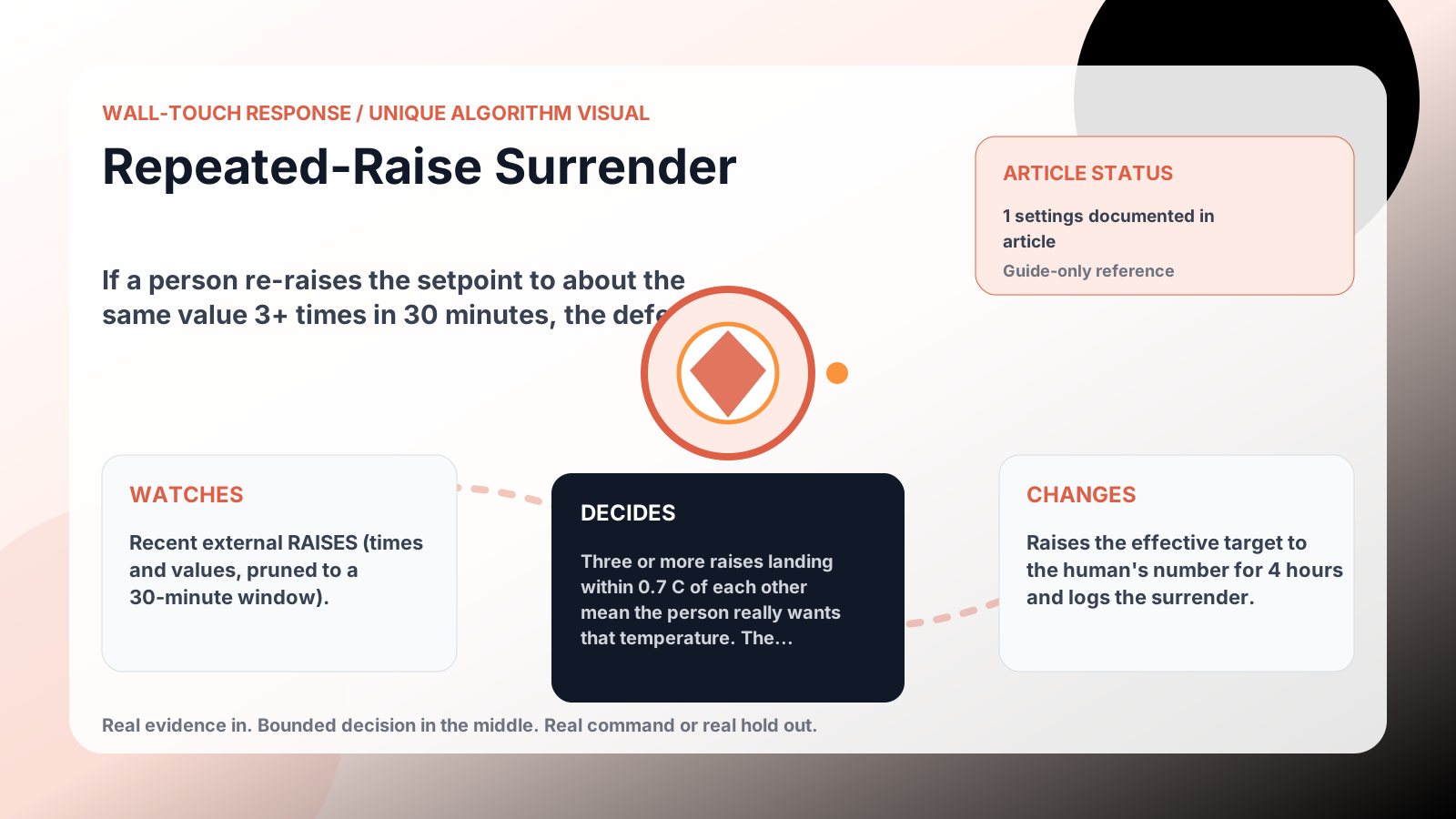
If a person re-raises the setpoint to about the same value 3+ times in 30 minutes, the defender adopts their number for 4 hours — the human wins the argument.
What it watches
Recent external RAISES (times and values, pruned to a 30-minute window).
How it decides
Three or more raises landing within 0.7 C of each other mean the person really wants that temperature. The defender adopts it (capped at 27 C) as the effective target for 4 hours — deliberately with NO 'unless the room is too warm' escape, because that escape hatch is what turned dawn disagreements into a detached thermostat. My temp stays the hard floor, emergencies still win, and a deliberate website target clears the surrender.
What it changes
Raises the effective target to the human's number for 4 hours and logs the surrender.
Safety boundaries
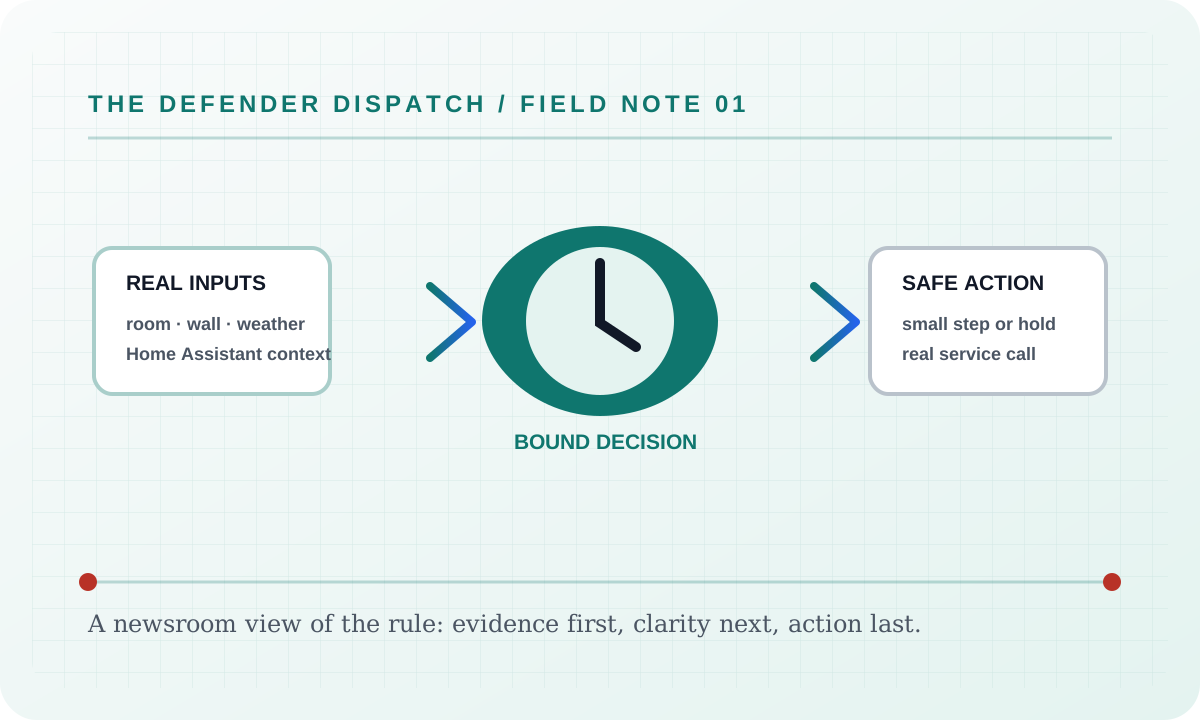
- Uses the real inputs listed above. It does not invent thermostat, weather, usage, or sensor state.
- Changes only the output listed above. Thermostat-affecting work goes through Home Assistant or returns a real error.
- The global AC Defender rules still apply: the website target remains the floor for cooling commands, the worker keeps refreshing real Home Assistant state 24/7, and comfort/safety rules are not bypassed by decorative timing.
Settings
(always on — fixed: 3 raises / 30 min window / 4 h hold / 27 C cap)
Where to see it
- Defense page: guide-only reference entry.
- Guide page: generated from the same guard catalog entry.
- Source:
Guards/GuardCatalog.csdescribes this page; the implementation is coordinated byServices/DefenderStateStore.csandServices/AcDefenderService.cs.
Failure modes
If Repeated-Raise Surrender cannot obtain one of its required real inputs, it reports a blocked, held, or unavailable result and leaves the background worker’s Home Assistant refresh running. It never fills a missing room reading, audit event, weather sample, usage value, or device state with a simulator value. If a real Home Assistant command is rejected, the user sees the service’s actual error and the article’s surface remains available for recovery.
Security considerations
This feature consumes only the configured Home Assistant entity data, local settings, and the audit context named above. Tokens and credentials stay in the server environment; the static documentation site does not collect analytics, transmit search text, or embed third-party assets. Logs and exports should be reviewed before sharing because real entity names and timestamps can identify a household.
Verification
Verify the shipped behavior at the feature’s live page or endpoint, then run the repository’s documented build and test commands. Confirm the real-input and real-error paths, keyboard access, reduced-motion behavior, and a 390 px viewport without horizontal overflow. Record the exact commit and workflow result when publishing a release; a static screenshot alone is not proof of a live Home Assistant command.
Suggested articles
- Feature briefs — find every documented surface and guard.
- Defender Logic — follow the complete decision cycle and its bypass rules.
- Settings — inspect persisted configuration, language modes, and safety limits.