Desktop Material — Active parity handoff
August 7 chrome, every feature back on top of it — 2026-08-15
Read this first; it supersedes the two entries below it. The requested end state is now live: the interface is the August 7 chrome, and every feature is back.
Those are not in tension, and the proof is two diffs rather than an assurance:
| Check | Result |
|---|---|
app/src/ui/repository.tsx vs
02d627e662 |
byte-identical — the workspace, rail, tabs and avatar are August 7 |
app/src/ui/app.tsx vs 02d627e662 |
81 insertions, 0 deletions — purely feature wiring |
Restored: Support Tickets, the authenticator (entries, TOTP, QR registration, secret vault), the regex builder, the destructive-action gate, the every-element appearance locks, the offline docs browser, agent sessions, the newer runner surface, and the personal-vocabulary, School-mode and dialog-emoji settings. Also back: diff line wrapping, hunk-expansion focus order, commit-drop insertion ordering, menu first-character navigation and the worktree list's merge-branch handling — the five post-August-7 fixes that were never MD3 and had been taken out indiscriminately.
Material mode stays retired. This is the earlier M3 design with the features on it, not the MD3 shell returning; see the entry further down for why the app is still Material Design 3 throughout.
How this was done, and why not by hand
app/ was restored wholesale from
9c9755d844, whose tree already was "August 7
chrome plus every feature" — the surgical route the revert jer had
produced before the literal revert removed it. Rebuilding 42,638 lines
by hand would have been slower and strictly worse: this way the result
is verifiable by git diff rather than by review.
Verified, against a real baseline
| Check | Result |
|---|---|
npx tsc --noEmit -p tsconfig.json |
exit 0, zero errors |
app/ vs 9c9755d844 |
identical (empty diff) |
| The 50-file contract suite | 64 failing of 465 |
| The 26 failures the literal revert introduced | 0 remain |
64 of 465 is exactly the pre-revert baseline, so the 21 reintroduced defects tracked on issue #196 are all resolved — the AI merge editor's security guards, the 158-glyph font contract, the accessibility and layout contracts, and the destructive-action honesty guards all pass again. The 5 obsolete guards in that issue are no longer obsolete, because the features they guard exist again.
[!NOTE] The remaining 64 were already red before any of this and are unrelated to the revert or the restore. They are the standing contract debt, not new.
Lint, captures, packaging and a built-artifact run were not performed.
The interface is now literally August 7, and the features went with it — 2026-08-15
Read this first. app/src/ui and
app/styles were hard-reverted to 02d627e662
(2026-08-07 21:10). This was requested explicitly and confirmed after
the cost below was put in writing, so it is a decision, not an accident.
146 files changed: 361 insertions, 42,638 deletions, 95 files
deleted.
What this deleted, deliberately
Support Tickets, the authenticator (entries, TOTP, QR registration,
secret vault), the regex builder, the destructive-action gate, the
every-element appearance locks, the offline docs browser, the
self-hosted runner manager's newer surface, and agent sessions. Their
app/src/lib modules (docs-browser/,
md3-locks/, authenticator/,
md3-view-preferences.ts,
stores/authenticator-store.ts,
rewrite-surface-registry.ts) and 22 test files went with
them.
[!WARNING] Several of these are contracts the shared agent instructions require of every user-facing app. This tree no longer satisfies them. That is a known, requested state — do not "fix" it by restoring them without asking.
It also took post-August-7 work that was never MD3
Reverting the whole of app/src/ui is indiscriminate, and
these went too: diff line wrapping, hunk-expansion focus order,
commit-drop insertion ordering, menu first-character navigation, and the
worktree list's merge-branch handling. Each was an accessibility or
behaviour fix, not chrome. They are recoverable from history if wanted;
they are named here so nobody has to rediscover the loss.
The 98-glyph icon font is back, and that has teeth
August 7 ships
material-symbols-rounded-prototype-98.woff2, not the
158-glyph official subset. MaterialSymbolNames in
app/src/ui/lib/material-symbol.tsx documents itself as "the
exact ligatures bundled" in that prototype, and a unit contract compares
it to font-assets-manifest.json.
A ligature name the font does not carry renders as its
literal English word. So do not widen that union to satisfy a
call site — 14 names (calendar_month,
construction, description,
edit_note, folder, help,
inbox, menu, merge_type,
more_vert, play_circle,
smart_toy, sort, wrap_text) were
referenced by the newer palette catalog and are not in the
98-glyph set. That catalog was reverted to August 7 rather than the
union widened, which is why the tree compiles. Subset the real font
first if a new icon is ever needed.
One deliberate non-revert, and why
ISelfHostedRunnerSetupRequest.accountKey and
ISelfHostedRunnerRemoveRequest.accountKey are now
optional. The August 7 runner UI has no account picker,
but multi-account infrastructure elsewhere in app/src/lib
survives and is used widely, so reverting the types was not an option.
validateSetupRequest resolves the key through
SelfHostedRunnerAccountCredentials.onlyAccountKeyForEndpoint
and returns ValidatedSelfHostedRunnerSetupRequest, so every
later step still has a concrete account. It refuses when two
signed-in accounts share an endpoint rather than guessing —
guessing would register a runner as a user who never chose it.
Known incoherence left in place
app/src/lib/settings-search/settings-search-catalog.ts
and app/src/lib/collection-surface-registry.ts still list
rows for surfaces the August 7 Settings does not render, and
lib/personal-vocabulary.ts,
lib/school-mode.ts, lib/dialog-emoji.ts and
lib/support-tickets.ts are still imported by
i18n.ts and that catalog. They were not
deleted, because deleting them breaks i18n. Auditing that
catalog against the August 7 Settings is real remaining work.
Verified for this revert — including what is red
| Check | Result |
|---|---|
npx tsc --noEmit -p tsconfig.json |
exit 0, zero errors |
| Prettier on all 44 changed source files | clean |
node script/test.mjs |
8,564 tests, 89 failing across 50 files |
| Lint, captures, packaging, built-artifact run | not performed, not claimed |
A baseline was taken, by running the same 50 files
at 9c9755d844 (the commit immediately before the revert) in
the same checkout:
| Failing leaf tests | |
|---|---|
Before the revert (9c9755d844) |
64 |
| After the revert | 89 |
| New, caused by the revert | 26 |
| Fixed by the revert | 1 |
So 64 of the 89 were already red and are not this revert's doing. The 26 new ones split two ways, and the split is the important part:
Five are obsolete guards — they guard deleted features and can never pass
feature-ledger-test.ts (3: "still declares every dialog
the app could open", "still has a live route to every dialog it
declares", "still ships every UI feature area"),
collection-surface-registry-test.ts (1),
support-ticket-recovery-test.ts (1).
Twenty-one are the revert reintroducing real defects
[!WARNING] These are not stale guards. Do not delete them to make the suite green — each is catching something the August 7 tree genuinely does wrong, which is why it was written in the first place.
| Area | Tests | What it means |
|---|---|---|
ai-merge-editor-test.tsx |
6 | Includes "renders hostile HTML-looking content only as plain text" — a security guard — plus "does not reintroduce CodeMirror hidden input buffers" and "refuses an over-limit result instead of emitting silently truncated code" |
bundled-fonts-test.ts,
material-symbol-test.tsx |
4 | The 98-glyph prototype font is back; see the icon-font section above |
button-token-test.ts |
2 | --button-height 25px vs 40px again — the trap that hid
a sub-minimum touch target once already |
responsive-repository-surfaces-style-test.ts |
3 | Narrow-width and short-height layout: missing-repository actions no longer stack, sheets escape their viewport insets |
popover-clipping-contract-test.ts,
post-shell-style-test.ts |
2 | Popovers unbounded; the floating-popover available-height token is gone |
command-palette-size-contract-test.ts |
1 | Palette results unusable at 200% zoom in a short viewport |
self-hosted-runner-removal-dialog-test.tsx |
1 | An irreversible removal hides itself while running |
shallow-clone-ui-test.ts |
1 | Post-clone runner provisioning no longer explicit, no longer blocks public repositories |
issue-134-workflow-paths-test.ts |
1 | The editable conflict result is off the native full-value control |
Accepting the August 7 interface means accepting these until each is fixed against August 7's chrome. They are tracked on the issue linked from the changelog entry for this revert.
One of the two MD3 designs was retired — the app is still Material Design 3 — 2026-08-15
[!IMPORTANT] The app did not stop being Material Design 3. It has had two M3 designs. The second one — the MD3 shell with its eight destination views — is the one that was retired. The first one is what renders now, and it is M3 throughout. Do not read the rest of this entry, or the phrase "Material mode", as saying Material Design left the product. It did not, and nothing here is a licence to "restore M3" against the design system that is already live.
Read this before the 2026-08-14 entry, which it supersedes on
one point. The revert was carried through:
finish/ui-revert-to-2026-08-07 merged into
main as 92b3ef9164, removing 60,309 lines —
the second design's shell, its eight destination views, its controllers,
adapters and its thirteen test files. The
Material mode setting no longer exists,
because the alternate shell it switched to no longer exists. The
2026-08-14 entry's heading "Nothing was deleted, and nothing needs
re-adding" described main on that date and is no longer
true of the tree; it is left in place as the record of what was decided
then, with a correction note attached.
The design system that is live right now
The chrome the revert restored is the earlier M3 design, and it consumes the same M3 foundations the second design did:
| Evidence | Where |
|---|---|
--md-sys-color-* system tokens declared on
:root |
app/styles/_material.scss — its own first line reads
"Material Design 3 foundations for Desktop Material" |
| M3 motion tokens | app/styles/material/_motion.scss |
| Material Symbols icon font, 158-glyph subset | app/styles/fonts/material-symbols-rounded-subset-158.woff2 |
| M3 components in the shared UI library | app/src/ui/lib/material-symbol.tsx,
material-switch.tsx,
material-context-menu.tsx |
| M3 surface partials | app/styles/_material-controls.scss,
_material-shell.scss,
app/styles/ui/_material-rail.scss,
_material-cards.scss, _material-switch.scss,
_material-symbol.scss |
MaterialSymbol call sites |
69 files under app/src |
The --button-height fix recorded below is itself proof
of this: the value that won came from
_material.scss, because the M3 layer is imported second and
is the live one.
What the retirement kept, deliberately: 46 md3 files remain, and they
are dialogs rather than chrome — the destructive-action gate, the regex
builder, the toasts, the menu overlay, the compose dialog, the
authenticator and Support Tickets. That is the line the revert itself
drew, and the four commits on the merged jer restore every setting the
shell's removal had stranded (lib/personal-vocabulary,
lib/school-mode, lib/dialog-emoji,
lib/md3-locks, lib/authenticator) into the
classic Settings surface.
Two user-visible defects were fixed on the way, and both are worth
knowing about because each had shipped: --button-height was
declared 25px in _variables.scss and 40px in
_material.scss, the Material layer is imported second and
wins, so the 25px was dead and under the minimum touch target;
and the revert had swapped the 158-glyph Material Symbols subset for a
98-glyph prototype while the code still asked for 158 names, so an
interface shipped with English words rendered where icons belong.
wip/stopped-fleets-2026-08-14 merged as
fe1db0dbb5, and only its GitLab design-conformance work
survived — five of its seven files built on the shell that is now gone.
That closes open item 3 below and leaves one open: the header
avatar's account switcher is still broken. The reverted rail
avatar works (onToggleAccountSwitcher,
railAvatarButtonRef); the header's does not, and the fix
that was in flight targeted files that no longer exist, so it must be
rewritten against the reverted chrome rather than ported.
Verified for this integration:
npx tsc --noEmit -p tsconfig.json exit 0, zero errors, on
the merged tree at fe1db0dbb5. The test suite, lint,
captures, packaging and CI were not run in this lane
and are not claimed.
UI reverted to the pre-rewrite interface — 2026-08-14
Read this first if you are picking up UI work. The default interface was changed back at the user's explicit and repeated request: "please revert the ui to how it was one week ago before this rewrite", "the new ui is causing more issues than good", "and keep all features".
What "the pre-rewrite UI" actually is
The pre-rewrite tip is f443f3cd10 (2026-08-11, "Report
the lint state of app.tsx honestly in the handoff"), named as such by
app/src/lib/interface-mode.ts itself. Reading
git show f443f3cd10:app/src/ui/app.tsx shows
renderApp() rendered
<Md3Shell views={md3NoViews} renderLegacyDestination={…}>
with the navigation drawer — every destination falling
through to the classic repository workspace.
That is identical to what renderClassicApp()
does today. The shell existed and rendered before the rewrite; what the
rewrite (0f5525ec89, "Render the app through the MD3
shell") added was the eight real MD3 destination
views.
So the revert did not require removing the rewrite. Three changes were enough:
| Change | File |
|---|---|
renderClassicApp() asks for the drawer again, not the
rail |
app/src/ui/app.tsx |
shellProvidesNavigation={false} — the workspace rail
draws its own tabs, Settings and avatar again |
app/src/ui/app.tsx |
InterfaceModeDefault is 'classic' |
app/src/lib/interface-mode.ts |
Nothing was deleted, and nothing needs re-adding
Superseded on 2026-08-15 — do not act on this subsection. It was accurate for
mainon 2026-08-14. The second MD3 design's destinations, controllers, adapters and navigation rail have since been deleted by92b3ef9164, and theMaterial modesetting went with the shell it switched to.navigation='rail'has no caller and no shell to serve. The app is still Material Design 3 — the restored chrome is the earlier M3 design, on the same--md-sys-color-*foundations; see the 2026-08-15 entry for the evidence. The claim that no features were lost still holds — every stranded setting was restored into classic Settings — but it now holds for a different reason. See the 2026-08-15 entry at the top of this file.
The user asked to "use the git commits to add features back once
reverted". No features were lost, so there is nothing to add
back. Every MD3 destination, controller, adapter,
command-palette entry, localized string and the navigation rail itself
are all still in the tree. Material mode is one setting away (Settings →
Appearance, or the command palette's "Use Classic mode" toggle). A
caller passing navigation='rail' still gets the rail.
If a specific feature does turn out to be unreachable from the pre-rewrite chrome, that is a real bug and should be fixed by making it reachable — not by switching the default back.
Work stopped mid-flight, preserved not discarded
Resolved on 2026-08-15. That jer merged as
fe1db0dbb5and was then deleted. Only the GitLab work below survived; the account-switcher work built on the deleted shell and did not. The header-avatar defect it describes is still real and is now the one open item from this entry.
Two multi-agent fleets were running when the revert was requested and
were stopped so they could not write into a tree being rewound. Their
unfinished work is preserved on the jer
wip/stopped-fleets-2026-08-14, commit
064fdab5fd. It is incomplete and unverified. It covers:
- The account-switcher wiring.
onMd3OpenAccountSwitcherinapp/src/ui/app.tsxdispatchesPopupType.Preferences, so a control whose accessible name promises "switch account" opens Settings, directly below a gear that opens the same popup. A workingAccountSwitcheralready exists (app/src/ui/account-switcher/, rendered byrepository.tsx'srenderAccountSwitcher()anchored torailAvatarButtonRef). The wrinkle: one handler serves two avatars (header and rail) and the popover must anchor to whichever was clicked.ObservableRefis structurally assignable toReact.RefObject, so the rail's existing observable ref can be theanchorRefwithout breaking its Tooltip. Still a live bug in the reverted UI — the header avatar has the same defect. - GitLab design conformance.
renderGitLabAccounts()inapp/src/ui/preferences/accounts.tsxdiverges fromdesign/Desktop Material v2.dc.htmllines 5174-5296 in five strings and one layout. See the "GitLab" section below.
Known open items in the reverted UI
- Actions is offered where it cannot work. The rail's
extra classic destinations are gated by
md3ClassicSectionAvailable(app.tsx), butactionsis one of the fixed eight inmd3Destinations()(md3-navigation-drawer.tsx), so it renders unconditionally. In Classic modeviewsismd3NoViews, so selecting it falls through to the workspace andRepositoryView.getSelectedSection()silently lands on Changes. The tab it replaced was gated onsupportsGitHubActions(). Do not just drop it frommd3Destinations()— those eight are the design contract asserted bymd3-contract-conformance-test.ts, and Material mode legitimately shows Actions because its real view handles the unavailable case. - Two red tests in the one-click Windows build
contract, pre-existing:
bounds only printenvz lock metadata and timestamp rounding for native freshnessandpasses the detected Visual Studio path only to the direct native rebuild. Confirmed at pristine HEAD. - GitLab does not match the design — fixed on
2026-08-15 by
fe1db0dbb5; all five strings and the endpoint default now match, with the design's maskedglpat-token placeholder. The structural note below (bordered three-column grid vs unbordered 460px flex column) is the part that remains open. The original entry, for the record: description says "Connect GitLab.com … instance" where the design says "Sign in to gitlab.com … server"; URL label "GitLab server" vs "GitLab server URL"; default endpointhttps://gitlab.comvshttps://gitlab.example.com; token placeholder "Token with api scope" vsglpat-••••••••••••••••; button "Add GitLab account" vs "Sign in to GitLab". Structurally the shipped.provider-sign-in-cardis a bordered three-column grid; the design is an unbordered flex column, 460px, 48px monospace fields, outlined pill button. The design is a single-state mock — keep the connected-accounts list, the provider error region, the loading state and the disabled-until-valid logic, and add the reduced-motion block and focus rings the mock lacks.
Traps this session paid for, worth not repeating
- A backgrounded command ending in
tailreports exit 0 for a failed build or push. WriteEXIT=$?into the log and grep for it; confirm effects independently (git merge-base --is-ancestor, grep the bundle for a symbol only new code contains). - The capture harness can photograph a stale build.
Fixed in
b9f1bb2c18; the freshness stamp isout/package.json, written bybuild.tsonly after webpack exits zero. Bundle mtimes are meaningless because webpack's[compared for emit]leaves unchanged outputs untouched. - Vendored
file:dependencies arrive with node-gyp run andtscnot.script/ensure-vendored-dependencies.mjsdetects and repairs this; the errors otherwise blame a missing module or a webpack loader. - Guards must be watched failing. Two written this session passed after the thing they guarded was deleted.
Repository snapshot as of 2026-08-14 (historical — see the 2026-08-15 entry above)
Checked at 2026-08-14T16:23:33Z against the fetched
default branch and GitHub state.
origin/mainis514ce07e1cf0c567007b6d762149f1f0b8400503— Render the interface the app had before the MD3 rewrite.- The GitHub issue tracker has zero open issues. #190 — Reconcile current roadmap and release receipts is closed.
- The latest published release is
v4.0.119701, published at2026-08-14T05:35:30Zforb7cfb51963157b431e37aa49a7183a6d135146fd, with six downloadable assets. No release for514ce07e1cf0c567007b6d762149f1f0b8400503was observed. - For
514ce07e1cf0c567007b6d762149f1f0b8400503, CI Linux run 31817029168 and Cheap LFS cloud compression run 31817029399 completed successfully. CI Windows run 31817029209 and Build Installers / Express Release run 31817209038 were still in progress when this snapshot was recorded.
This is a current-state reconciliation only. It does not turn a dated local check into CI, installer, test, or capture evidence, and it does not certify any earlier milestone beyond the evidence that milestone recorded. Every dated handoff below remains historical: open, pending, not claimed, and remaining work describe the boundary at that entry's time. Reconcile a historic item with later commits and the current tracker or release state before treating it as live work.
2026-08-13 — Bound DOM assertions in the agent-session panel test
app/test/unit/agent-sessions-panel-test.tsx no longer
passes nullable query results or DOM nodes to Node's object-formatting
assertions. The remaining absence checks use boolean identity and the
parent/focus checks use assertSameNode, so a failed
expectation reports the small mismatch instead of synchronously
serializing the jsdom document until it exhausts memory.
Implementation commit:
418e56a592722b72ee9f8ff4f6eb1dec2f8469bb.
Tests, lint, review, captures, and packaging were intentionally not run in this lane.
2026-08-11 — The MD3 shell is assembled, wired and documented
Scope. Assemble the Material Design 3 rewrite into the application chrome, keep the pre-rewrite chrome alongside it, and bring the documentation, the changelog and the site current in the same change.
Commit.
5aa2b582c23de7256dbed0b860b79934f618272e — "Assemble the
MD3 shell and keep the classic chrome that came before it". It follows
the nine rewrite commits listed in the August 11 ROADMAP entry.
What landed
app/src/ui/md3/md3-shell.tsx— the whole contract shell as one component, with an exported state shape (IMd3ShellState), an exported pure reducer (md3ShellReducer) and an exported per-field search binding (md3SearchBinding).App.renderApp()renders it.app/src/ui/md3/md3-shell-carryover.ts— the hand-written catalogue of the forty-four capabilities the design contract never drew, each with its menu kind, icon, localized label and destructive flag.buildMd3CarryOverExtensionsturns handlers into the shell'smenuExtensions;md3UnplacedCarryOverCommandsnames any without an action.app/src/lib/classic-toolbar.ts— the persisted Show the classic toolbar preference (default on) on the same local-storage boolean store every other UI preference uses, with a provenance reader and awindowchange event so the shell updates live.app/styles/ui/_md3-shell-layout.scss, imported fromapp/styles/_ui.scssimmediately afterui/md3-shell.- Documentation:
docs/features/design-system/md3-shell.md, indexed in that category's README in both languages; notes added to the five existing feature documents whose described route the rewrite changed; eighteen changelog entries added to4.0.0, each carrying a commit whose existence was verified withgit cat-file -tbefore the file was written.
Verification actually performed
| Check | Result |
|---|---|
npx tsc --noEmit -p tsconfig.json |
Clean at 5aa2b58, and clean again on the whole tree
after the concurrent destination-wiring work settled |
ESLint (--rulesdir ./eslint-rules) on touched
files |
Clean except app/src/ui/app.tsx, which reports three
errors that belong to the concurrent destination-wiring work, not to
this change — see below |
Prettier --check on touched files |
Clean |
feature-ledger-test.ts |
Pass — nothing went missing |
md3-contract-conformance-test.ts |
Pass |
docs-browser-bundle-test.ts |
Pass after regeneration |
i18n-test, command-palette-catalog-test,
settings-search-test,
palette-settings-coverage-test,
command-palette-appearance-test |
84 pass, 0 fail |
script/validate-changelog.ts |
Pass |
Not claimed: no installer was built, no remote CI run was observed, no release was published, and no capture of the new shell exists. The screenshot gallery still photographs the pre-rewrite chrome.
app/src/ui/app.tsx is red on lint, and not
because of this change. The three errors are
@typescript-eslint/member-ordering on
md3MenuPayload and md3SelectedAgentSessionPath
(both must be declared before the constructor) and one
react/jsx-no-bind on the workflow-dispatch
onSubmit arrow. All three belong to the destination-wiring
work that was rewriting this file at the same time — that pass added 779
lines to it — and none of them is on a line this change touched. They
were left rather than fixed because moving a member declaration in a
file somebody else is actively rewriting is how a conflict is
manufactured. Whoever lands that pass owns them.
Two defects found and repaired while documenting
- Unobserved promises in the shell's Git handlers.
onMd3Fetch,onMd3Push,onMd3CommitAndPush,onMd3Commit,onMd3SwitchBranchand the fetch/pull/commit-and-push arms ofonMd3MenuCommandeach started a dispatcher promise with a barevoid. React discards what a click handler returns, so a rejection was dropped — the exact defectdocs/features/quality-and-reliability/observed-user-initiated-operations.mdrecords against the old toolbar's handlers. All of them now go through the sharedobserveUserInitiatedOperation. - The new setting was not discoverable. "Show the
classic toolbar" had a
teleportAnchorbut no entry in the command-palette catalog, the settings search catalog orteleport-targets.ts, so it could not be found by name from either search surface. All three registrations were added, with real English and Cantonese copy.
Remaining work, named
- The carry-over handlers are not wired.
buildMd3CarryOverExtensionsis not called fromapp.tsx, so none of the forty-four renders in a menu today. This is not a capability loss:viewsismd3NoViews, so every destination renders the real repository workspace and build runner, and both legacy surfaces are on by default. Each becomes unreachable only when a destination's MD3 view replaces the legacy surface, so the change that wires a view must supply that view's handlers and checkmd3UnplacedCarryOverCommands. - Two carry-over entries need a decision. Log match
navigation and log group collapse: the contract filters the log rather
than dimming it, which may supersede match-stepping. Both survive in
runMenu. Neither has been retired, and retiring one requires aretiredrecord inapp/test/fixtures/feature-ledger.jsonwith a reason. - Captures. Every gallery frame still shows the
pre-rewrite chrome. The capture-coverage contract
(
ab2374968) enumerates what must be replaced. - The MD3 primitives do not ripple.
Md3IconButton,Md3TonalButtonandMd3GhostButtonrender their own<button>and never callattachRipple. Recorded in the ripple feature document as the same open follow-up the toolbar controls already carry. - Uncommitted at handoff. The source-side repairs in
item "Two defects" above touch
app/src/ui/app.tsxandapp/src/lib/i18n-resources.ts, which were being rewritten concurrently by the destination-wiring work. They are in the working tree and deliberately not committed here, so that in-flight work is not swept into a documentation commit.command-palette-catalog.ts,settings-search-catalog.tsandteleport-targets.tscarry the matching registrations and are in the same state, because their new rows reference i18n keys that live in the uncommitted catalog.
2026-08-10 — Land the audited history cache and request-guard repair
Issue #177 shipped the debugging bundle
desktop-material-debug-handoff-31d3fd4.zip, audited against
31d3fd4618fddb9d0941cc9ffdbcba02e5299a14. Its Phase 1
source-safe patch is now applied, tested, and merged; the bundle's own
patcher refused to run because its reconstructed anchors differ from
this tree in whitespace only, so the changes were applied by hand
against the real source and reviewed line by line rather than forced
through a fuzzy match.
What landed in GitStore:
commitLookupis capped at 2,000 entries (CommitBatchSize * 20, twenty full history pages) with least-recently-used eviction.storeCommitsrefreshes insertion order,lookupCommitrefreshes a cache hit, and a lazily loaded commit is routed throughstoreCommitsso it is bounded too. An evicted commit is transparently reloaded by the existing lazy lookup.reconcileHistory,loadCommitBatch, andloadHistoryBatchrelease their request keys throughfinally. Before this, a handled Git failure or an unexpected throw lefthistoryor a batch key permanently in flight, and the affected view never loaded again for that session.
Two repairs outside the bundle were required to leave the gates green:
BuildRunSettingsandGitIgnorenamed theircomponentDidUpdateparameterpreviousProps, which the repository'sreact-proper-lifecycle-methodsrule rejects.yarn lint:srcwas red on the default branch before this change.script/prepare-cheap-lfs-oras-test.tsasserted the Windows ORAS preparation ordering as raw file order. The trampoline-build change hoistedverifyInjectedSassVariablesintofinishBuildAfterPreparation, so the regex failed while the runtime ordering stayed correct. The test now asserts the real contract: the platform-guarded preparation promise gatesfinishBuildAfterPreparation, and that function verifies the Sass variables before packaging.site/index.htmladvertised 283 articles and 6 review-and-diff articles whiledocs/renders 284 and 7.node script/sync-site-doc-counts.mjscorrected the hub counts, which is the Pages half of issue #174.
Verification on this Linux container, with Node 22.22.2:
node script/test.mjs app/test/unit/git-store-test.ts: 21/21 passed, including the four new lifecycle regressions (handled reconciliation failure, thrown compare-batch failure, thrown all-refs failure, and the cache bound with recency preservation).node script/test.mjs app/test/unit/app-network-action-boundary-test.ts: 5/5 passed.- Full unit gate: 1,008/1,008 files, 8,495 tests, 8,443 passed, 22 failed, 13 skipped.
yarn test:script: 218 tests, 208 passed, 2 failed, 8 skipped (up from 206 passed and 4 failed before this change).yarn lint:src,yarn prettier --check,git diff --check, andnpx tsc --noEmit -p tsconfig.json: all pass.
The 22 unit failures and 2 script failures are not caused by
this change and are not claimed as fixed. They are Windows
contracts executed on a Linux host: WSL distribution discovery, UNC and
drive-root probing, packaged Dugite path selection, 7-Zip stash export,
\-separated ORAS staging paths, the self-hosted runner
manager, and update-coming-soon, whose renderer returns
null under __LINUX__. The exact same failing
set was recorded on a stashed, unmodified tree and after the patch — an
identical list, proving no regression. Windows CI remains the authority
for those files.
Not verified here: packaged Electron build, Windows E2E, the screenshot and accessibility matrix, heap soak evidence, and push/pull/commit stage timings. Phases 2 through 7 of the bundle's plan — push, pull, and commit latency instrumentation, the memory soak, the visual contract, and the release proof — remain open and need a packaged Windows runtime. Do not read this checkpoint as completing them.
2026-08-09 — Make self-hosted runner risk choice main-process owned
The Actions runner form still warns before setup and requires the two host-risk acknowledgements plus a third acknowledgement for a completed known unsafe finding. That third checkbox is intentionally not an IPC permission. Setup reruns the current workflow and queue audits in the main process, presents a Windows-owned confirmation containing the repository, complete labels, and finding detail, and keeps a receipt only in memory for matching evidence during that one setup operation. A safe recheck erases the receipt; a changed finding requires a new native decision; Start and scheduled trust monitoring remain strict and never reuse any earlier choice.
The manager now audits the complete runner label set—including
self-hosted— before creating the managed root or
registration, rejects more than 20 custom labels in the UI before a new
preflight or setup request, and strips legacy renderer-provided risk
fields from persisted runner state on load.
Focused verification passes 94/94 across the runner
contract, runner UI, removal-dialog, automatic commit proof, diff-theme,
style-token, and lifecycle suites. The root TypeScript check passes, and
the complete desktop test command reports 1,008/1,008
discovered files and 8,494 tests with no failures or
React unmounted-state-update warnings. A production build run with the
repository-pinned Node 24.15.0 produced
dist/GitHubDesktop-win32-x64/GitHubDesktop.exe; the build
script now owns a short-lived event-loop handle until asynchronous
packaging settles, so Node cannot exit while Electron Packager is still
copying the app.
Stop-and-handoff boundary: this local handoff
intentionally stops before yarn package, installer
verification, remote CI, tag, and Release publication. The unpackaged
application directory is real build evidence, not a verified Squirrel
installer or a remotely published result.
Preservation note: the detached audit worktree that
was present during the initial inventory disappeared from disk and from
Git worktree metadata during this handoff. Its base commit
d82f1fc1603ad3aa55cabdd016fd6b4adac4cce7 is an ancestor of
origin/main, but its staged index had uncommitted deletions
and is no longer available to inspect or recover. No cleanup command in
this handoff removed that worktree; do not describe its disappearance as
a verified safe deletion.
2026-08-09 — Complete School mode and settle command shortcuts
School mode is now a complete Windows Appearance surface. It supports a persisted custom name, local salted credential setup and unlock, immediate English-only presentation, hidden language/playfulness controls and related palette/settings-search rows, hidden scheduled language selection, and dim-sum suppression. The renamed value is used by the visible mode surface, command palette, and settings search; deleting the local profile remains the documented reset route rather than a claim of security.
The command palette is bound to Ctrl+Shift+P.
Ctrl+Shift+F remains bound to opening the current
repository in its folder, with a focused menu regression test covering
both accelerators.
Focused verification is 50/50 for the School mode,
command-palette, and settings-search changes, and
yarn lint:src passes. The required hidden-desktop capture
is not claimed: the Lowlevel MCP server executes basic commands but
hangs on its required Git preflight. Remote CI and installer-release
evidence must still be read from the actual main runs.
2026-08-08 — Keep standard CI Windows-only and remove the 60-minute cap
The standard CI and automatic installer release gates no longer
include the Linux TUI. ci-linux.yml retains only
platform-neutral lint and supply-chain checks,
ci-windows.yml retains the Windows desktop build and
packaged E2E jobs, and the installer publisher listens only to
CI Windows and uploads only the Windows installer payload.
The manual combined Super Express lane is now Windows-only as well; the
separate manual TUI workflow and all TUI source and historical
verification records remain intact.
All explicit timeout-minutes: 60 entries were removed
from the desktop CI, installer, and Windows emergency-release workflows.
This removes the workflow cap; it does not claim a remote run is
complete until GitHub reports its actual result.
Focused verification: the CI workflow safety and Super Express contract suite passes 31/31. Remote CI for the integrated commit and the resulting release are pending and must be reported from their actual run and asset records.
2026-08-08 — Repair OAuth, public runner preflight, Actions layout, and release details
The Windows desktop source now follows the upstream GitHub Desktop
OAuth request shape: the authorization and token exchange omit an
unregistered custom redirect_uri, so GitHub uses the
callback registered on the OAuth application. The Actions runner manager
now uses the rich searchable GitHub account picker, honours the
repository's persisted account binding, and permits public repositories
only after the immutable workflow audit proves that an untrusted event
cannot reach the managed labels. Unknown visibility and unsafe workflows
still fail closed.
The Actions run list fills the available row when no workflow detail is open and returns to the resizable split when a run is selected. Release notes now have a separate collapsible section from release metadata, preventing the notes from appearing inside the Release details dropdown. Focused verification passed 130/130 tests, including the OAuth, public-runner, searchable-account, full-width Actions, and release-details contracts. Lint passed; the exact production build and hidden-desktop capture were still in flight at handoff.
Changed source and tests are on main for the requested
integration pass. Remote CI, release publication, and the final cleanup
proof must not be described as green until their actual results are
observed.
2026-08-07 — Opt-in post-clone runner provisioning
Scope: Single interactive private GitHub/GitHub
Enterprise clones can opt in to a Windows or dedicated WSL/Linux
self-hosted runner. The clone dialog keeps the feature off by default,
requires a workflow-author trust acknowledgement, does not expose it for
public repositories, and excludes batch/background clones.
Dispatcher.clone triggers provisioning only after the new
repository is registered and its canonical GitHub remote matches the
original selection.
Changed: Clone options, clone dialog and dispatcher, the trusted runner manager, clone styles, focused tests, and repository-management documentation. The main process now independently verifies that the target repository remains private before allocating a local runner, WSL distribution, download, or registration token.
Verification: focused clone option/UI tests pass 8/8, the root TypeScript check passes, and the documentation catalog check passes 19/19. A real runner needs an authorized private repository plus a Windows/WSL host, so no local test claims live registration.
2026-08-07 — Harden the Windows self-hosted runner manager
The Windows Actions view now treats a managed GitHub Actions runner as one repository-scoped, exact-account operation. Public or unknown-visibility repositories are blocked. For a private repository, setup and every later start prove that private-fork pull-request workflows are disabled, resolve one default-branch commit, audit every workflow from that immutable commit, and scan complete stable pending-run and job inventories for any labels that could claim the runner. The setup-form result is bound to its current account and proposed labels; Start deliberately performs a fresh audit against the runner's live labels.
The main process keeps one-time registration and removal tokens in memory and keeps Windows registration tokens out of command-line arguments. It never uses runner replacement, rejects duplicate or inconsistent paginated inventories, verifies the official runner package digest, and waits for the exact new registration and complete label set to be online before reporting readiness. Process ownership, process-tree termination, stopped-state postconditions, exclusive operation leases, a lifecycle journal, restart reconciliation, and stable GitHub absence checks now cover setup, start, stop, cancellation, scheduled trust rechecks, removal, and shutdown. Ambiguous registration or local metadata retains recoverable state instead of guessing that cleanup succeeded.
The UI exposes contextual setup and start preflights, both security acknowledgements, runner-specific accessible controls, cancellable in-flight operations, and an irreversible removal dialog that keeps exact progress open after submission. Suggested labels stay within 64 characters without losing the platform suffix. Linux-in-WSL management is visibly disabled until the app can prove in-distribution process-group cancellation; WSL is not presented as isolation from the Windows host.
Focused local verification on the current source passes
48/48 tests:
app/test/unit/self-hosted-runner-contract-test.ts is
38/38, and
app/test/unit/ui/self-hosted-runner-manager-test.tsx is
10/10. The command was:
node script/test.mjs app/test/unit/self-hosted-runner-contract-test.ts app/test/unit/ui/self-hosted-runner-manager-test.tsxThe broader Windows app suite, exact production build, hidden-desktop
runtime exercise, live runner registration, and remote CI verdict remain
pending. The current source is not yet a published or remotely verified
result. Detailed behaviour and recovery guidance are in
docs/features/integrations/self-hosted-runner-manager.md.
2026-08-07 — Repair Windows CI, release contracts, and Pages validation
Repair commit fef8e7e5574d88dbd2f5720a2c0d5799a44032bb
restores the Windows CI setup and Super Express release contracts,
regenerates the documentation catalog and 279-article hub count, gives
reruns a unique package version, and replaces the AI merge editor's
inaccessible hidden input buffer with one controlled native text area
that exposes the complete document and submits one form value. Hardening
commit 4954a74529 adds fail-closed coverage for changed,
missing, and non-ENOENT unreadable dependency manifests.
Local evidence before publication: the full script gate passed 219 with 0 failures and 2 expected skips; the six originally failing unit files passed 85/85; the final AI editor pair passed 15/15; the release and manifest contract pair passed 11/11; and the lifecycle-accurate nested app install completed in 94.56 seconds without changing either app manifest. Adversarial mutations proved the exact runner labels, token chain, run-attempt version input, active shell programs, native editor, and every manifest failure mode can each turn their own contract red.
The GitHub Actions, Pages, and direct Windows manual-release results
remain pending until these commits reach main; this handoff
does not claim a remote verdict or a published Release in advance.
2026-08-06 — Repair the blank Windows startup renderer
The packaged Windows renderer failed before React mounted with
ReferenceError: __webpack_module__ is not defined. The
cause was the Node-oriented @github/copilot-sdk ESM graph
being concatenated into the renderer through CopilotStore;
the empty root and hidden-until-ready window then presented as a blank
white launch. app/webpack.common.ts now externalizes the
SDK, and script/build.ts fails before packaging if either
renderer bundle contains the undefined binding.
The focused contracts pass 14/14. A production
Windows build completed with the external SDK present. The exact
dist/GitHubDesktop-win32-x64/GitHubDesktop.exe launched on
the hidden desktop, reloaded through CDP with
readyState=complete, one populated
#desktop-app-container child, and no captured runtime
exceptions. The genuine Lowlevel MCP capture is tracked at
docs/assets/screenshots/material-blank-startup-fixed-20260806.png,
960x660, SHA-256
00D8BD6FCE0EFA10107523BF92BEA54E80DDA6ED66B8E3700B21297D6CBF2A82,
and shows the first-run Desktop Material surface. The detailed behavior,
failure modes, security notes, and verification record are in
docs/features/quality-and-reliability/renderer-startup-bundle-safety.md
and .codex/run-manifests/2026-08-06-blank-startup.md.
The source branch still needs its commit, dew, default-branch integration, and remote CI result before this handoff is complete.
2026-08-06 — Verify Super Express on the self-hosted pool
The pure self-hosted Super Express path now has remote runner
evidence. Run
31064587087 <https://github.com/Ding-Ding-Projects/desktop-material/actions/runs/31064587087>_
at 60f32baf76 completed preparation and Linux TUI packaging
on linux, then ran the Windows lane on CLAUDE.
The Windows lane passed the Git Bash preflight, AllSigned-compatible
PowerShell helpers, uv-managed Python 3.11, the pinned Yarn shim,
setup-node's Yarn cache probe, dependency installation, and reached
Build production app. GitHub's runner control channel
cancelled the job at 2026-08-06T02:26:44Z before
Package Windows.
Run
31065485291 <https://github.com/Ding-Ding-Projects/desktop-material/actions/runs/31065485291>_
at 3fe381f5f9 repeated the same self-hosted-only path on
COMPUTER; Linux TUI passed, the Windows setup and
dependency stages passed, and the Windows production build started. The
runner control channel cancelled it at
2026-08-06T02:46:25Z, again before
Package Windows. Both runs finished cancelled,
not success; both used publish=false, so no
Release was created. Self-hosted placement and prerequisite repair are
verified, while a completed Windows package/artifact and combined
Release remain unverified because the external cancellations occurred
before packaging.
2026-08-06 — Scope run cancellation to Super Express
Ordinary push-triggered CI, installer, and Pages workflows continue
to use unique run-and-attempt concurrency groups with
cancel-in-progress: false, so a new push cannot cancel an
earlier validation or publication run. The three Super Express workflow
files are the only exception: each uses a ref-scoped
cancel-in-progress: true group. A newer Super Express
dispatch can therefore free the scarce self-hosted runner from an
obsolete release, while normal push runs remain independent. The focused
workflow safety tests now enforce this allowlist and the group
scope.
2026-08-06 — Bootstrap every self-hosted Windows dependency shell
The self-hosted Windows dependency setup now selects the requested
Node.js version before the repository-pinned Yarn bootstrap runs. The
bootstrap copies vendor/yarn-1.21.1.js beside two small
launchers under RUNNER_TEMP: a Windows
yarn.cmd launcher and a POSIX yarn launcher
for Git Bash. The following Git Bash step converts the temporary
directory to an MSYS path, marks the POSIX launcher executable, and
fails if bare yarn resolves anywhere else. This covers both
PowerShell/cmd actions and the Bash cache/install steps, including
Unicode and space-containing temporary paths.
The focused CI contract test passes 2/2. A clean
local node vendor/yarn-1.21.1.js install --frozen-lockfile
completed in 84.58s, and an isolated probe selected Node
v24.15.0, returned Yarn 1.21.1 from both
launchers, and resolved Git Bash to the temporary POSIX launcher. The
remote Super Express run after this change is still the required final
verification; a queued, failed, or cancelled run must not be reported as
green.
2026-08-06 — Keep Super Express scheduling self-hosted-only
The latest self-hosted-only release dispatch reached the registered
Windows runner, but its first prerequisite failed because that machine
had no WSL distribution installed. The exact remote failure was
Windows Subsystem for Linux has no installed distributions,
so the Windows package never reached dependency setup or compilation
even though the Linux package passed.
The explicit release contract keeps every Super Express job on the
registered self-hosted pool: linux handles preparation,
Linux TUI packaging, and publication, while a registered Windows x64
runner handles the Windows package. The direct reusable Windows and
Linux TUI workflows use the same static
[self-hosted, Windows, X64] and
[self-hosted, Linux, X64] labels. A busy or unavailable
local runner queues or fails the release; it never moves to a
GitHub-hosted machine. uv python install 3.12 remains
responsible for the Linux TUI's pinned interpreter, and self-hosted
Windows setup uses uv for Python 3.11 after the Git Bash preflight.
The workflow contract test asserts the static self-hosted labels and
rejects hosted targets, runner-selection, and cloud-fallback shapes.
Focused workflow tests, YAML parsing, actionlint, Prettier, and
git diff --check are the local gates; the next remote Super
Express run is the required post-fix evidence.
2026-08-05 — Multi-remote fetch sync
The ordinary Fetch path now uses every configured remote when a
repository has more than one. A single-remote repository retains the
existing Fetch <remote> copy and focused selection.
Multi-remote repositories expose Fetch all remotes in the
toolbar and dropdown, with a status description that names the expanded
scope. The store keeps current/default/upstream remotes first and then
adds the remaining configured remotes once each.
Changed implementation and test files:
app/src/lib/stores/git-store.tsapp/src/lib/app-state.tsapp/src/lib/stores/app-store.tsapp/src/lib/stores/repository-state-cache.tsapp/src/ui/app.tsxapp/src/ui/toolbar/push-pull-button.tsxapp/src/ui/toolbar/push-pull-button-dropdown.tsxapp/test/unit/git-store-test.tsapp/test/unit/ui/push-pull-button-test.tsx
Focused verification is 19/19 tests passing. The
exact Windows production build completed with packaging skipped. The
real hidden-desktop renderer displayed Fetch all
remotes and Fetch the latest changes from every
configured remote for a two-remote fixture without clipping in
the inspected frame. The unmodified development renderer still logs its
existing __webpack_module__ is not defined startup error,
so the visual probe used a temporary CDP startup shim and does not claim
packaged-release proof. A later capture-only DOM-removal attempt
triggered the disposable app's crash boundary; that contaminated frame
was discarded. Documentation is in
docs/features/repository-management/multi-remote-fetch-sync.md
with index, README, roadmap, and feature-list references.
On the merged linked checkout, the first focused test invocation
found the declared windows-argv-parser native output
missing from app/node_modules. Running
yarn install --immutable rebuilt that vendor dependency;
the same focused command then passed 19/19 without
source or lockfile changes.
2026-08-05 — Harden the Windows dependency cache and preserve Team View styling
The CI dependency-cache hit path now validates the actual Electron
runtime, targeted Copilot package, and react-confetti ESM
entry for the current runner and architecture before reusing an
installed-dependency cache. The final dependency verification checks the
same react-confetti runtime file, so a cache containing
only package manifests cannot skip installation and then fail later in
the renderer build.
The Launchpad Team View selectors now live in the shared
.launchpad-view scope rather than only inside the
max-width: 520px media query. Team View therefore retains
its layout and state styling on desktop as well as narrow Windows
windows, while the Sass-safe parent-selector structure remains
intact.
Local verification is 32/32 focused CI, dependency,
workflow, and Launchpad tests, passing ESLint type-checking, and
git diff --check. A fresh production renderer compile after
this styling and cache follow-up is still pending; remote Windows/Linux
runs remain queued.
2026-08-05 — Settings account cards keep one active identity across providers
Settings → Accounts was using the first card in each provider section
as its active marker. A GitHub.com account and a GitHub Enterprise
account could therefore both appear active, while neither exposed
Make active. The surface now compares every account
with the single global accounts[0] identity and applies the
same predicate to GitHub.com, Enterprise, GitLab, and Bitbucket cards.
Clicking Make active updates the controlled account
order, so the target row becomes active and the previous row becomes
actionable. Explicit repository account bindings remain
authoritative.
Source commit 7a757f5b75d627e1b4b7ae5ed47b2181638fefa0
contains the fix and regression test. Focused account/store/routing/UI
verification passes 39/39; targeted ESLint, Prettier,
and git diff --check pass. The required Lowlevel production
build has not yet returned because its shared endpoint is servicing
another long-running build. No hidden-desktop capture or runtime success
is claimed until that route is healthy.
2026-08-05 — Account-aware repository transfer (verification in progress)
The Windows Electron app now has an account-aware Transfer
repository workflow. It can add another GitHub.com or GitHub
Enterprise identity through the existing sign-in dialog, choose a
personal or organization owner, keep or rename the destination
repository, and choose privacy. Full history uses a
temporary bare clone to publish every local branch and tag.
Clean state creates one root snapshot commit, retains
the previous tip under a local
refs/desktop-material/transfer-backups/ recovery ref, and
publishes only the current files. Both routes verify the destination tip
before retargeting origin and preserve the source as
upstream when needed.
The entry points are the Repository menu, repository-list context
menu, Command Palette, and Repository settings →
Remote. The transfer dialog requires two independent
confirmations plus a full-range authorization slider, and displays real
checking, creation, preparation, publication, retargeting, and
completion progress. Focused direct Node contract tests pass
7/7. Targeted ESLint passes, and the changed-path
TypeScript check reports no diagnostics in the transfer files although
the repository-wide command exits on existing TypeScript 6 findings. The
exact Windows production build reached the full renderer/main bundle
after the missing local file-package outputs were rebuilt, but remained
nonzero on four existing TypeScript 6 errors in
dds-converter.ts, two fixture typings, and
ui/index.tsx; it did not emit a runnable
out/main.js. The repository-wide test harness remains
blocked before test discovery by the malformed
whatwg-encoding dependency payload, so hidden-desktop
runtime evidence is not claimed.
Implementation commit
6c3a4ec8297e79226968a89e3232ba281c539357 contains the
feature, tests, and documentation update. Hardening commit
5e96aad79e82bc597b5c1233fccd17c0b37ce7fa preserves
known-private defaults and verifies the exact destination tip before
retargeting. Verification and changelog commit
8ac2bf5cfce2f4645fa4ead4e7cf05e23cd59478 records the run
manifest and current evidence.
2026-08-05 — Make Super Express release self-hosted-only
The Super Express Release path is now deliberately self-hosted-only.
The combined dispatcher runs preparation and publication on the
registered Linux x64 WSL runner, the Windows package runs on
[self-hosted, Windows, X64], and the Linux TUI package runs
on [self-hosted, Linux, X64]. The direct Windows and Linux
TUI recovery workflows use the same static labels. Hosted selectors,
ubuntu-latest, windows-2022, cloud fallback
jobs, and runner-inventory branching were removed from all three Super
Express workflow files. If a required local runner is offline or busy,
the release queues or fails rather than silently consuming a cloud
runner.
Because the Linux runner is Debian 13, the dispatcher publisher also
installs the pinned uv tool and Python 3.12 through
uv python install 3.12; TUI version discovery uses
uv run --python 3.12. This keeps the pure self-hosted path
independent of the actions/setup-python distribution
manifest that previously lacked a Debian 13 Python 3.12 entry.
The focused workflow contract now asserts that all three workflow
files contain only the expected static self-hosted labels and no hosted
target or fallback selector. Pure self-hosted run
31063281760 <https://github.com/Ding-Ding-Projects/desktop-material/actions/runs/31063281760>_
at eb5a769c51 proved
Prepare exact release target and the Linux TUI package on
runner linux; the Windows package reached runner
COMPUTER but stopped before its build because
shell: bash resolved to the Windows WSL launcher, which
reported that no WSL distribution was installed. The Windows action and
shared setup action now prepend the installed Git Bash directory to
GITHUB_PATH, and fail with a direct prerequisite message if
Git or Git Bash is absent. That repair is in the next pushed revision;
no Release was created because this run used
publish=false.
Follow-up pure self-hosted run
31063591401 <https://github.com/Ding-Ding-Projects/desktop-material/actions/runs/31063591401>_
at 4a9afbbbf7 proved preparation and the complete Linux TUI
package on linux, and reached the Windows build on
CLAUDE with Git Bash selected. It then failed in the shared
actions/setup-python@v6 step while installing Python 3.11
into the self-hosted toolcache
(Error happened during Python installation). The next
repair keeps hosted runners on setup-python, but uses
pinned uv, uv python install 3.11, and its
discovered interpreter path for npm_config_python on
self-hosted Windows. This run also used publish=false, so
it created no Release.
2026-08-05 — Fix Super Express workflow startup planning and repair build prerequisites
The Super Express dispatcher keeps preparation and publication on
ubuntu-latest, while its combined packaging jobs and its
two direct reusable packaging lanes each check the repository runner
inventory on a hosted selector. When an online, idle matching runner is
available, exactly one static conditional job uses
[self-hosted, Windows, X64] or
[self-hosted, Linux, X64]; otherwise the lane uses
windows-2022 or ubuntu-latest. The earlier
dynamic self-hosted fallback tried to build a multi-label
runs-on value from job outputs; GitHub marked those
dispatches startup_failure before creating a job, so no
runner log existed to diagnose. The combined dispatcher now inlines its
static selector/build jobs instead of calling the reusable workflows,
because the caller itself remained planner-invalid after the lane
repair. Static targets retain schedulability while allowing the
requested self-hosted-first behavior and keeping the zero-test emergency
lane and direct artifact-only lane behavior unchanged.
The workflow contract test now asserts the fixed labels and rejects
the dynamic runner-selection shape. The setup action now checks cached
React JSX runtime and react-confetti files before use; an
incomplete cache automatically returns to the bounded dependency install
path. The source Sass error at
app/styles/ui/_launchpad.scss:278 was corrected by nesting
the team selectors under .launchpad-view inside the media
query, so Sass can resolve every &__… selector against
its real parent.
Local verification is 9/9 focused
CI/dependency/workflow tests, YAML parsing, Prettier, and
git diff --check. The full production compile was attempted
with the repository-pinned TypeScript and a supported local Node 24
runtime, but the webpack process exceeded the four-minute local bound
without returning a client verdict; no production-build success is
claimed from that attempt. The earlier cloud Windows fallback run
31060316032 was red at the Sass error and also reported
react/jsx-runtime resolution from its incomplete dependency
cache. The cache repair and Sass correction address those reported
causes.
The matching Windows and Linux self-hosted runners were online and
idle during inventory checks. Follow-up combined dispatches
31060759025, 31061020998, and
31061157152 created the selector and static build jobs but
were cancelled by an external concurrent-run sweep before any selector
or build step ran. Self-hosted execution and a post-fix remote green
build therefore remain unverified; no Release was published by these
publish=false dispatches.
2026-08-05 — Close remaining Windows TypeScript build gaps
The merged default-branch tree exposed five additional TypeScript
diagnostics across three seams after the dependency and stylesheet
failures were corrected. The provider triage label switch now handles
the self-hosted account provider. The self-hosted OAuth
error path now captures and validates the active authentication state
before updating it, so a nullable store state cannot be spread into an
invalid sign-in state and a callback race cannot overwrite a replacement
flow. The SignInStore regression fixture now records callback accounts
in a typed list and asserts exactly one authenticated account before
checking its provider, endpoint, and login.
Local evidence for this follow-up is 41/41 focused tests across SignInStore, provider triage, and CI workflow safety; passing ESLint type-checking; and an isolated production renderer compile with 0 Webpack errors. The compile also emitted only the existing Sass deprecation warnings and no Koffi, JSX-runtime, Sass parent-selector, or TypeScript errors. Fresh remote Windows and Pages verification for the integrated fix is pending.
2026-08-05 — Restore Windows production build compatibility
The final Windows verification of the retired tooling correction
reached the production compiler but failed on three dependency and
stylesheet edges. The application now pins
@github/copilot-sdk back to 1.0.5, which
removes the Koffi native dependency introduced by 1.0.8;
the supplied dependency-install trace showed the retrying native failure
while Koffi's optional platform packages were being resolved. The
version-specific 1.0.8 declaration shim is removed with the
rollback.
react-confetti 6.4.0 keeps its React 16
JSX-runtime support, but its ESM entry asks Webpack for
react/jsx-runtime without an extension. The common Webpack
configuration now aliases that exact request to the installed
react/jsx-runtime.js file, preserving strict ESM resolution
for other dependencies. The Launchpad Team View styles are also nested
under their .launchpad-view parent so Dart Sass no longer
rejects a top-level & selector. The CI workflow guard
now matches the integrated removal of the retired agent-only submodule
instead of requiring a stale .gitmodules block.
Local evidence for this correction is 3/3 dependency compatibility tests, 13/13 Launchpad tests, 12/12 CI workflow-safety tests, passing ESLint type-checking, and an isolated production renderer compile with 0 Webpack errors. The earlier full production compile showed the other five compilers finishing successfully; the renderer's two reported errors are covered by the isolated rerun. Fresh remote Windows and Pages verification for this correction is pending.
2026-08-05 — Keep private tooling out of hosted CI checkout
The first remote Windows verification after the dependency repair
reached the runner but failed while recursively cloning
vendor/lowlevel-computer-use-mcp: that submodule is agent
tooling whose history is not available to the hosted workflow token. The
desktop build does not consume it; the three public product submodules
remain available. The first correction used update = none
to keep recursive checkout from attempting the unavailable agent-only
clone. The subsequent integration at
883c1b6c6b01ca1371d590d2971e756ff5ed9039 removed that
retired gitlink and its registry entry entirely, leaving only the three
public product submodules in .gitmodules. Fresh remote
verification of that integrated correction is pending.
2026-08-05 — Preserve dirty work while creating a destination worktree
The dirty branch-switch dialog now offers Leave my changes here. It closes the decision dialog without stashing or checking out the dirty source, opens the existing Add worktree flow with the destination branch and suggested name prefilled, and leaves creation and switching until the user confirms a path.
Verification
- Source commit:
c41ae8345a. - Focused UI test: 1 passed, 0 failed.
- Targeted Prettier and ESLint: passed.
- Isolated TypeScript check: passed.
- The exact production build was attempted through the required hidden
verification route but stopped before renderer emission on the
pre-existing
origin/mainSass error atapp/styles/ui/_launchpad.scss:278. A disposable renderer-only build with that unrelated selector wrapped emitted the fresh renderer used for capture. - Hidden-desktop runtime: verified. The source
fixture retained one modified
README.mdonfeature/worktree-switch; the created destination worktree was clean onmain; the application switched into it with zero stashes. - Captures:
docs/verification/dirty-worktree-worktree-option-20260805/dirty-worktree-switch-dialog.png(960×660, SHA-2560FF723C7361C6A9125B9C95AF9A9C40614C5B7B646BBC061A18C0B0D56DDDAB7).docs/verification/dirty-worktree-worktree-option-20260805/add-worktree-prefilled.png(960×660, SHA-25654B29ACF0B6A31CAA18E701BF413D720F161C65D3BA9DF5626A4747A3BD5588C).
GitHub integration and remote CI evidence are recorded after the source and documentation commits land on the default branch.
2026-08-05 — Direct Super Express lane dispatch actions
The Windows and Linux TUI Super Express packaging workflows now each
expose a manual workflow_dispatch action in addition to
their reusable workflow_call entry point. Direct dispatches
are restricted to main, default to the dispatched commit,
validate the same packaging payload, and upload an artifact-only
recovery result. They never publish independently, preserving the
combined dispatcher's one-Release update/bootstrap contract.
2026-08-05 — Restore CI-compatible dependency pins
The Dependabot upgrades to TypeScript 6.0.3 and
@types/request 2.48.13 made the Windows setup
action fail before the desktop tests could start: TypeScript 6 rejected
the repository's legacy project layout, and the newer request
declarations introduced an incompatible tough-cookie type
graph in the vendored compile. The dependency manifest and lockfile now
restore TypeScript 5.8.2 and @types/request
2.0.9, the versions compatible with the current setup
action and vendor sources. The same dependency group also carried
tsx 4.23.1, which transforms JSON imports
incorrectly under the test runner, and
@types/react-virtualized 9.22.3, which removed
the Grid.propTypes declaration used by the app; those are
restored to 4.19.3 and 9.7.14 as well.
The same correction refreshes the Pages Docs hub from
254 to 264 rendered articles using
node script/sync-site-doc-counts.mjs; the committed check
now agrees with the current docs/ tree. Remote CI
verification is pending for the resulting default-branch commit.
2026-08-05 — Cross-provider account switching correction
The rail account switcher was calling the real
promoteAccount path, but the account store immediately
re-sorted a selected GitHub Enterprise account behind GitHub.com.
Because the rail derives its active indicator from
accounts[0], the UI appeared to switch and then silently
returned to the previous account. The store now preserves the promoted
account at accounts[0] across providers, sorts only the
remaining accounts, and persists that order for the next launch.
Verification
node script/test.mjs app/test/unit/accounts-store-test.ts— 21/21.node script/test.mjs app/test/unit/get-account-for-repository-test.ts— 12/12.- Combined account-switcher contracts and interaction coverage — 55/55, including the new real click-handler test.
- The required production build was attempted through the hidden Lowlevel route. Its compiler worker stopped without a returned client exit status, so the rail surface has no runtime capture and no runtime success is claimed.
2026-08-05 — Super Express packaging lanes parallelized
The manual Super Express dispatcher now keeps one combined immutable
Release but runs Windows x64 and Linux TUI packaging in separate
reusable workflows. The Windows lane owns the desktop dependency cache,
build, Squirrel payload, portable ZIP, and installer assets on
windows-2022. The TUI lane builds on
ubuntu-latest with uv build and locked runtime
constraints, and carries the bootstrap and installer scripts as
executable assets. A single publisher downloads both lane artifacts so
the shared Squirrel latest feed and TUI bootstrap URL
cannot land on separate partial Releases.
Local proof for this change is 16/16 application
workflow-contract tests, 10/10 TUI installer-contract
tests, passing Prettier/YAML parsing, and sh -n success for
both checked-in TUI shell scripts. No remote Actions run or Release is
claimed by this handoff entry yet.
2026-08-05 — Partial Releases no longer steal the Windows update feed
Commit a4ce485037138f24d7534452a861a1fb7749beeb hardens
.github/scripts/promote-current-release.sh: a published
Release may own the Windows Latest alias only when it
includes both the Squirrel RELEASES manifest and a
*-full.nupkg package. This prevents a newer Linux/TUI-only
partial Release from making
releases/latest/download/RELEASES return 404 to the Windows
app.
Verification
- Focused version-order, CI-workflow-safety, and automated-release-notes suites: 29 passed, 0 failed.
- The previously broken live alias was repaired to the existing
Windows-capable Release
v3.6.3-beta3-zadwftypqg, whose assets includeRELEASESand both full Squirrel packages. The exactreleases/latest/download/RELEASESURL now returns HTTP 200. - The required Cheap headless production build was attempted, but terminated after about 800 seconds before emitting the renderer output; no About-dialog screenshot is claimed from that incomplete artifact. The direct release metadata and HTTP feed proof above are the available runtime evidence.
Remote state
The fix was merged into main as 6f5cf66c30,
with source commit a4ce485037138f24d7534452a861a1fb7749beeb
and documentation commit
96fcc0a2d14cd2f791fd51f6b470ae7f225695aa. The integrated
tree passes the focused suite with the repository's pinned Node
24.15.0 invocation: 29 passed, 0 failed.
The repository wrapper's additional --conditions=import
flag is not used for this proof because its current tsx
loader path changes the whatwg-encoding JSON import shape
before the test can start.
The dewed integrated tip was
bc63986119e2c71cc28d98e1465c9c8501c25f58. Its current-SHA
remote evidence is recorded precisely: Deploy Pages run 31056983826
passed; CI Windows run 31056982528
failed because the Windows jobs could not clone the configured
codingmachineedge/lowlevel-computer-use-mcp submodule
(repository not found), and the follow-on production step
could not find cross-env. The dependent
Build Installers / Express Release run 31057063196
was blocked because its trigger was workflow_dispatch, not
this repository's main push CI, so no Release was published. These are
external CI/submodule blockers; the updater guard's local tests and live
HTTP feed proof remain verified.
The enabled GitHub Wiki recovery note was committed as
34cb7157716cd846117ad9e86fe876dd70c389b2 and is now
published on its master branch. An initial publication
attempt used a stale Git credential and returned HTTP 403;
gh auth setup-git --hostname github.com refreshed the
credential path, after which the exact commit landed and the Wiki
checkout is clean.
2026-08-05 — Actions job-log transient 404 recovery
This Windows Electron fix was developed in the new linked worktree
branch codex/job-log-404-fix at commits
33f54a69825d97083dc8f0b1fb134b353e9686ca and
e85cf787e3aea81ac28679f00b3b0201507af133, and the
integration checkout carries those commits into the default branch.
GitHub can briefly return HTTP 404 while a valid
completed-job log archive is being prepared. The main-process transfer
now retries only that API response after 250/750/1,500 ms waits,
restarts from the original API endpoint for a fresh signed redirect, and
keeps the bearer header off cross-origin blob requests. A follow-up
audit separates the retry count from the redirect-hop budget, proves
cancellation during backoff prevents another fetch, and asserts the
blob-404 request has no bearer header. The log viewer explains the
provider state and exposes Retry and Open on
GitHub; its test checks the link destination and external
activation. The unrelated Launchpad Sass brace correction is included
because it was the build-blocking syntax error discovered while
producing the required renderer artifact.
Verification receipts
- Focused transfer/viewer tests: 20 passed, 0 failed (including the redirect-budget, abort-during-backoff, blob-header, and external-link audit regressions).
tsc --noEmit -p tsconfig.json: passed.- Changed-file ESLint and Prettier checks: passed.
git diff --check: passed before documentation and capture promotion.- Standalone renderer diagnostic:
hasErrors:false. The final exactyarn build:prodcommand completed with the fresh Node 24.15.0 runtime in 512.78s, passed the Sass/license checks, produced freshout/renderer.js,out/main.js, stylesheet, andout/index.htmloutputs, and packageddist\\GitHubDesktop-win32-x64. Signing was not run. - Genuine hidden-desktop capture at 1400×1000 from
the built artifact:
docs/assets/screenshots/material-actions-job-log-404-recovery.pngshows the final 404 explanation and both recovery controls (SHA-256444AA612720799BCB6107BFD7B3CEED66E56252E82E724B1C26559F347968972).docs/assets/screenshots/material-actions-job-log-404-recovered.pngshows the two expected log lines after Retry (SHA-25683D9704989173353467E8C5B079B8D3905A0C52AF6283AC7C09FAB92D2B15A78). - In the dedicated 404-to-Retry acceptance sequence, the fixture recorded four bounded 404 attempts followed by one successful transfer after the user activated Retry. The final recapture used the same built artifact after the fixture was reset and also rendered both states. No credential, token, or personal path appears in either promoted image.
- Teardown evidence: the exact Electron process, fixture server, isolated headless desktop, and isolated MCP server were stopped; the fixture listener is absent and three owned keytar entries were removed. The host shell policy blocked deletion of the explicitly named temporary capture roots and helper scripts, so those recoverable artifacts remain outside the repository.
The task-branch workflows were cancelled by workflow concurrency, so no remote green result is claimed here. Release publication remains an external follow-up after the default-branch workflow produces its verified installer.
2026-08-04 — Live Material renderer proof and startup cleanup
The design reference is now verified against the real production
Electron renderer rather than only the static design/ file.
Commit ab8c26d7535c9861f81b761e73798d1363bd78e1 also fixes
a startup race in
app/src/ui/repository-settings/repository-settings.tsx:
asynchronous initial settings reads now begin after mount and stop
updating state after unmount. That removes the React warning that
appeared when the settings surface closed while its reads were still
pending.
Verification
- Focused Material/UI contract suite: 47 passed, 0 failed; the unmounted state-update warning is absent.
- Targeted ESLint for
repository-settings.tsx: passed. - Cheap headless production build:
npx --no-install cross-env RELEASE_CHANNEL=development DESKTOP_SKIP_PACKAGE=1 yarn build:prod— exit 0 in 291.45s. The build emitted the renderer and main outputs and completed its shell-extension, license, and stylesheet checks; existing Sass/Node deprecation warnings are non-fatal. Packaging was intentionally skipped for this renderer proof. - Hidden-desktop runtime: verified. The built
out/main.jslaunched on a uniquely named hidden desktop, showed first-run setup, completed the no-sign-in path, added a disposable Git fixture, and reached the live repository workspace with Changes, History, Triage, Repository tools, and Branches surfaces visible. - Cleanup: verified. The exact launch PID was closed and the owned hidden desktop/temp root were removed.
Remote checks and boundaries
Run 30928494987
is still in progress. Its Lint job reports four pre-existing formatting
findings (.act-super-express-event.json,
.github/workflows/build-installers.yml,
app/test/unit/site-accessibility-test.ts, and
tui/src/desktop_material_tui/assets/changelog-catalog.json),
while TUI jobs have also failed; Windows x64/arm64 and CodeQL are still
running. The changed renderer file passes its targeted ESLint check. The
TUI scope is explicitly closed, so those unrelated TUI failures are
recorded rather than changed in this Windows Electron milestone.
The follow-up run for
0969cbbb76ed18fe4f6d79d33ad95b6ae96a38d9, 30929478484,
has the same Lint/TUI failures. Windows arm64 also built and uploaded
its artifact, then failed Run script tests because the
committed documentation hub catalog and index are stale relative to the
already-merged TUI articles. Running
yarn generate-docs-hub-catalog followed by
yarn test:script passes locally (214 tests, 213
passed, 1 optional skip), but the generated diff is entirely
for the closed TUI documentation surface and is intentionally not
carried into this Windows Electron task. Windows x64 and E2E remain
remote checks in progress at this handoff update.
The local package/signing step was not part of this proof and no signing policy was changed. No release is claimed by this handoff entry.
CI formatting follow-up
Commit a89900dd419e4dd78031516dea10c4edb1df9b38 formats
the two installer workflow TUI_CONSTRAINTS_NAME environment
assignments reported by the remote Lint job. It is a formatting-only
change: installer behavior and the intentional skip-signing contract are
unchanged. File-scoped Prettier and the Git whitespace check passed, and
the commit is on main.
- CI: 30931585531 — queued at this handoff update.
- Cheap LFS: 30931582576 — verified green.
- Code scanning: 30931582659 — queued or still running.
The remaining TUI catalog formatting and stale TUI documentation output are not changed because the Windows Electron task keeps the TUI scope closed.
Desktop lint correction
Commit a9c69adfde9bb97cd03e48a99783ff6e6a5a87f1 formats
only the desktop app/test/unit/site-accessibility-test.ts.
Its focused accessibility contract suite passes 11/11,
and file-scoped Prettier passes. The commit is on main and
is covered by CI
30932145369 and Cheap
LFS 30932145377, which were queued behind earlier Windows/TUI work
at this handoff update. The remaining formatter finding is the
closed-scope TUI catalog.
2026-08-04 — Search registry and changelog catalog correction
Commit 77c7b1ebc6cee54c9e0b1febf5a6b67496477891
registers the repository settings tab surface in the collection search
registry, updates its appearance contract test for the descriptor-based
UI, and aligns the Pages screenshot gallery contract test with the
tracked CSS. The focused suites pass 39/39; Prettier
and the Git whitespace check pass.
Commit 0b004744bb3f228651fdc8a2c693d57d9f933da1 restores
the 12 newest 3.6.3-material22 records already present in
changelog.json and updates the catalog count to
4151. The changelog suite passes
24/24, with one explicit release-tag date skip because
this checkout has no matching release-* tags; historical
dates were not rewritten from incomplete local metadata.
The full script suite currently reports 214 tests: 210 passed, 3 failed, 1 optional skip. All three failures are the already-closed TUI documentation scope: a stale committed docs-hub catalog and two missing Linux TUI pages. No desktop script contract failed. CI run 30935849771 is queued; no release or installer success is claimed here. The Squirrel Windows packaging job continues to skip signing as required by the current contract.
2026-08-03 — App fixes: repository list, Cheap LFS, local Actions, CI
A session of defect work across the app and the test harness.
Everything below is on main and dewed; the one item that is
not finished is named at the end rather than left for someone
to discover.
The Repositories list rendered nothing while holding
repositories. SectionList tested one value and
constructed another: the capability guard asked about the global
ResizeObserver while the constructor used
window.ResizeObserver. Whenever the two disagreed the guard
passed and new threw on undefined — and a throw in a
component constructor unmounts the subtree rather than degrading it, so
the panel came up empty instead of falling back to an unobserved list.
Fixed in bcd832d40e; the guard now asks whether the value
it is about to construct is callable. A separate change gives the
genuinely-empty case real copy and the three creation paths as operable
buttons, because the old empty state apologised for failing to find a
repository the user had never searched for.
Cheap LFS aborted a large commit on a momentary
lock. "Could not canonicalize the repository root" turned out
not to be about the root at all: probing that exact repository
afterwards canonicalizes cleanly. On Windows realpath must
open a handle to ask for the final path, so it queues behind virus
scanners, indexers, and Git's own working-tree writes; during an
18,750-file commit that contention is routine and lasts milliseconds.
0612c7c538 retries the transient codes (EACCES, EAGAIN,
EBUSY, EIO, EMFILE, ENFILE, EPERM, UNKNOWN) and excludes ENOENT on
purpose — a repository that is not there is not busy. It still fails
closed, and the reparse-point checks still run on whatever comes back;
only the waiting changed.
Local Actions runs work without a manual install.
act stops on an arrow-key menu asking for a default image
when it has no platform configuration; spawned from the app its stdin is
not a terminal, so the console read fails and Windows reports
Incorrect function — an error that never mentions images.
d023f5ef92 passes the platform mappings up front.
act itself is now installed automatically into the app's
own data directory (ccad989359), user-scoped, no elevation,
and a PATH-resolved copy always wins. Two things worth keeping: the
asset spellings are the release's own (x86_64, not
x64), and extraction must use the absolute System32 bsdtar
— where Git for Windows or MSYS is installed their GNU tar shadows it
and reads C:\... as host:path, failing a
purely local copy with
Cannot connect to C: resolve failed.
Settings tabs are no longer positional. The
RepositorySettingsTab enum was defined to equal
the TabBar's child indices, with a note asking integrators to keep them
contiguous. That holds only while the list is a fixed run of children —
the moment a filter removes earlier rows, clicking one opens whichever
page sits at that number. eb7fadc805 gives each row a
descriptor carrying the tab it selects and resolves clicks through the
filtered list, then adds the search field the shared rules require. The
open tab stays listed even when it does not match, so the strip can
never empty and strand a selection the panel is still rendering.
CI: memory exhaustion was real, and it was not the
tests. node --test runs one worker per file and V8
sizes each worker's old-space from the machine's memory, so four workers
on a 16 GB runner were entitled to the whole machine before git or
Windows asked for anything. Windows charges reserved commit, so it hit
the limit long before the tests wanted the memory, and the damage landed
as scattered, unrelated-looking failures: "paging file is too small",
"Not enough memory resources", spawn UNKNOWN, git "Out of
memory", V8 "Array buffer allocation failed". b02a3ff611
bounds per-worker heap and derives concurrency from memory as well as
cores. Verified: none of those strings appear in the CI unit log
afterwards.
Testing notes worth reusing. Module mocks in a
.tsx test must be followed by require, not a
static import — the file compiles to CommonJS, so require
resolves at call time and picks the mocks up while a static import
hoists above them, and top-level await import is a parse
error under that output format. Dialogs render inside a
<dialog> element that jsdom treats as closed, so role
queries against them need { hidden: true }. Stub git per
test file rather than in the shared globals: several suites run git
against real repositories on purpose and a global stub disarms them
silently.
Open:
agent-sessions-panel-test.tsx is pathologically slow
Two tests that complete in ~44 ms on an idle machine take 250–500 s, and the file fails. This is not caused by the worker heap cap or by the section-list repair — both were ruled out by substitution (restoring the pre-repair section-list still reproduces it; so does raising the heap back to 4 GB), and it was already taking 127 s in CI before either landed. Do not re-test those two.
DOM accumulation is ruled out too: rendering the panel repeatedly leaves 13 elements and one body child every time, so Testing Library cleanup is working and the queries are not scanning a growing document.
The per-test ceiling cannot help here, and the reason is worth
knowing before anyone retries it: node --test can only time
a test out between awaits, and these tests are synchronous. Whatever is
burning the time is blocking the event loop, which also means the cost
is inside a synchronous call — a render or a query — rather than in
anything being waited on.
a2c25bf537 added a 120-second per-test ceiling so a
wedged test names itself instead of the batch failing at file level with
nothing to act on. It has not had the effect hoped for here: the run
still ends at file level rather than naming the two tests, so the next
step is to establish why --test-timeout is not firing for
them before spending more time on the underlying slowness.
Desktop Material — Active parity handoff
2026-08-03 — Integrate-and-clean pass, and the Linux TUI is back on main
The TUI scope was reopened by the user during this session, so the
revival branch was integrated rather than kept aside. main
now carries it.
What was preserved before anything was touched
The linked worktree at
desktop-material-linux-tui-revival was holding 20
modified and 39 new files, all under tui/ —
uncommitted, which is the only kind of work a wiped directory takes with
it permanently. Committed first as dbbb3431c8, before any
merge: multi-account sign-in with keyring-backed secrets, a bounded
agent surface (CLI, client, access policy, local server) with its
Postman collection, GitLab and Bitbucket provider clients, Build &
Run with local AI repair and Ollama, automation, an audio system with
bundled melody cues, a gh push fallback, Help and Changelog
screens, settings palette search, and the Section 6 advanced Git and
workspace surfaces — 309 files, +17,694 lines including roughly 4,000
lines of tests.
That commit is a checkpoint, not a verified release. The TUI suite has not been run against it, so the parity contract is claimed rather than proven until it has. This is the first thing a successor should do.
The one merge conflict, and why it was not resolved by picking a side
tui/contracts/parity.yaml's status_summary
is a derived number. The branch claimed 89 rows
not_yet_available, main claimed 135, and the
merged row set actually holds 91 — so neither side was
right, and taking either would have published a total the file itself
contradicts. The contract was regenerated from its source of truth
(tui/tools/generate-parity-contract.mjs, which reads
docs/readme-tabs/complete-feature-list.md plus the
overrides). It produced the same counts a hand recount did, and fixed 26
further lines a hand resolution would have left stale. Merge commit
05528e87d1; main then fast-forwarded.
The site's count guard earned its keep
Merging the TUI branch added four docs/**/*.md articles,
and script/site-dc-pages-test.mjs immediately failed with
"the Docs hub advertises article counts that docs/ no longer
matches". One node script/sync-site-doc-counts.mjs and
the site went from advertising 249 articles to the real 253. That is
exactly the drift this guard exists to catch, on the first merge after
it shipped.
Deleted, kept, and left alone
| Item | Outcome |
|---|---|
codex/revive-linux-tui + its worktree |
Deleted after its tip was proved an ancestor of the
dewed origin/main |
origin/claude/pensive-visvesvaraya-e86ef2 |
Deleted — proved already an ancestor of
origin/main |
Nine dependabot/** branches |
Kept. Each backs an open pull request (#137–#145). Deleting them closes those PRs, and they are neither agent task branches nor merged |
| Stashes | None existed |
app/test/unit/agent-sessions-panel-test.tsx |
Left uncommitted. Another agent's
MARK … timing probes, added to diagnose a wedged test.
Debug instrumentation, not work — committing it would ship
console.log into the suite, and reverting it would destroy
their investigation |
.act-*, .codex/repo-list-* |
Left uncommitted, and now ignored. They kept reappearing as untracked noise in this shared checkout and being swept into unrelated commits; the patterns now cover the family |
Concurrency, again
Three separate agents committed into this working tree during the
session. One of them swept an earlier task's staged git rm
deletions into its own commits (ba452e4017,
dbea7be82f) and dewed them, briefly leaving
main publishing the old homepage with its stylesheet and
both Cheap LFS pages deleted. Stage explicit paths, never
git add -A, and re-read git log before
committing — the index may not still be yours.
2026-08-03 — The published site is one Material Design 3 component
Commit 80d05e73b881d6b2cd4da4f5a99465be5ad2df98 replaces
every hand-built page under site/ with a single Design
Component: site/index.html holds the template and its logic
class, site/Listbox.dc.html is the searchable select it
imports, and site/support.js is the byte-for-byte upstream
runtime.
Vendoring. site/support.js hard-codes
the unpkg URLs it loads React from. Rather than fork it,
script/vendor-site-assets.mjs downloads those builds,
re-hashes them against the SRI digests the runtime itself pins, and
points it at the local copies through the
window.__resources map it already consults —
site/vendor/dc-resources.js, which must load
before support.js. The same script subsets
Material Symbols Outlined by icon_names and Noto Sans HK by
text, both derived from the page source on every run. 420
KiB on disk; provenance, digests, and licences in
site/vendor/manifest.json.
Verified. A headless Chrome on an off-screen
desktop, against an assembled _site served locally: no
console errors, performance.getEntriesByType reporting zero
third-party hosts, all six pages rendering with content and correct
aria-labelledby, all eight overlay panels opening and
closing on Escape, the language switch reaching Cantonese with all three
Noto Sans HK weights loading, the playfulness slider changing the voice
line across levels 1 and 5, the regex builder naming its dialect and
reporting a syntax error, the four tab searches and both close modes
previewing with counts and protection, and the appearance editor
applying and persisting per element.
Five defects found and fixed during that pass.
- Every listbox selection was a silent no-op. The page is parsed from
the browser's own document, where HTML lowercases attribute names, so
the callback arrived as
onpickwhile the component readonPick. It now reads both. This is the failure mode to remember for any Design Component used as a page rather than previewed from source text. - The accent seed replaced
--md-sys-color-primarywithout--md-sys-color-on-primary, leaving the dark theme's#00344fon#006493— a 2.02:1 primary call to action.onColor()now derives black or white from WCAG relative luminance; all four accents measure 6.4:1 in both themes. - Both tab strips had
role="tab"with notabpanel, noaria-controls, and no rovingtabindex. - Three range inputs and the Bold/Italic/Underline toggles had no accessible name or pressed state.
- Seven drag-and-drop upload placeholders shipped as empty boxes; they now hold captures this repository already had.
Concurrency note. Two commits made by another agent
in this same checkout — ba452e4017 and
dbea7be82f — swept this task's staged git rm
deletions into themselves and were dewed, leaving main
briefly publishing the old homepage with its stylesheet and both Cheap
LFS pages deleted. Commit
80d05e73b881d6b2cd4da4f5a99465be5ad2df98 restores a
coherent tree. When several agents share one working tree, stage
explicit paths and re-check git log before assuming the
index is still yours.
Known, not caused here.
app/test/unit/wiki-function-gallery-test.ts fails two
assertions (88 raw-main images against 86 catalog rows). It fails
identically with this work stashed.
2026-08-03 — Stash manager portal runtime correction
The stash manager is now rendered through the shared dialog portal,
so its Manage, Export, History, and Appearance and voice tabs paint
above the Changes pane instead of being clipped inside it. The accepted
hidden-Windows capture
material-stash-manager-centered-20260803.png is 1443×992
and has SHA-256
B733BC06C0B3DB455BF634381409D64B898773D6D742A97097F2E9AF130F4A01.
Additional inspected captures proved the complete 7z option set, the
appearance/funny-level controls, and the History tab. A disposable
fixture also created a real Git stash with subject
Named headless stash; the manager surface itself did not
refresh its inventory before the final capture, so that Git result is
recorded as operation proof rather than as a UI-row claim.
Focused manager/export tests passed 17/17, targeted ESLint passed,
and the full TypeScript check passed. The exact fix checkout's webpack
compilation completed; the later packaging script stopped only because
the isolated checkout lacked ignored generated
choosealicense.com/_licenses data.
2026-08-05 — Dedicated History Graph repository page
The graph now has a first-class HistoryGraph repository section appended to the persisted RepositorySectionTab enum, so existing saved section values do not move. The repository rail labels the page Graph and routes it directly to the shared compare renderer in full-width page mode: the branch filter, history scope, commit search, filter chips, lane controls, selection, and commit actions are retained, while the narrow History sidebar is not mounted. The page has its own localized title and accessible panel relationship. The responsive surface catalog and repository section-order tests include the page and the previously drifted Launchpad, preference, AI-security, and repository- settings entries now match their source enums again.
Focused verification is 85/85 across graph behavior, repository navigation, section ordering, feature registration, and the responsive surface catalog. npx --no-install tsc --noEmit still stops on two unrelated dirty test fixtures (app/test/unit/ui/merge-choose-branch-dialog-test.tsx, lines 84 and 117), where the existing "Merge" fixture is not a MultiCommitOperationKind; that dirty work was preserved. The required Lowlevel preflight and checkout identity checks passed, but the MCP build receipt did not: the first exact build produced refreshed output and then wedged its client, while a retry returned an unhandled TaskGroup error while another checkout was building through the same service. No built-app capture is claimed from that unverified receipt.
2026-08-03 — History view tabs checkpoint
The History surface now exposes a real, keyboard-accessible
List / Graph tab strip rather than hiding the
graph mode behind an icon-only toggle. The selected view remains
persisted, the tabs use roving focus with arrow/Home/End navigation, and
both views share the existing commit actions and filter state. The
three-column graph continues to use the virtualized continuous lane
renderer. Focused source/style verification passed, and the exact
production build was exercised on a hidden Win32 desktop with a
disposable Git fixture. The inspected 1443×992 captures are
material-history-view-tabs-list.png (List selected) and
material-history-view-tabs-graph.png (Graph selected); the
CDP receipt also confirmed the
tablist/tab/tabpanel
relationship. R3 still retains its broader graph-scale and multi-branch
acceptance work, but the missing view-tab surface is now
runtime-proven.
2026-08-03 — Stash manager export slice
The new isolated checkout codex/stash-manager-20260803
contains a separate tabbed Stash Manager dialog with searchable
exact-identity export to directory, ZIP, and configurable 7z, plus
History and shared language/funny-level controls.
getStashes no longer truncates by entry count. Focused
verification currently passes 42/42 (40 existing Git/UI assertions plus
2 7z argument assertions). The production build emitted
out/main.js before the final appearance/options edits;
rerun the exact build and headless Windows capture after those edits. Do
not claim runtime verification until the dialog is opened in the real
built artifact and the export surface is exercised.
2026-08-03 — Bug-hunt and Ollama interface checkpoint
This checkpoint is the current source of truth for the active audit.
The main checkout started at
79d5d59662dd7639664a878b390706f0c3975f2c with unrelated
working-tree material already present. The audit kept that material
intact and added the following scoped fixes:
The Windows CI and Express Release unit-test steps now give the complete Node test coordinator a 4 GiB heap. The previous
a0d7b4a598CI run passed all 7,238 assertions but died at 318 MiB while the long Agents test batch was still emitting its accounting summary; the new workflow change is awaiting its own GitHui run for proof.The Agents creator now uses the shared modal dialog layer, exposes dialog semantics, avoids a nested form, and disables the Options disclosure while creation is running. The live Agents store and app mount are present; final built-app acceptance capture remains pending because the first-run/checklist overlay interrupted the CDP interaction path.
The Ollama model manager now has a localized, accessible Clear search action beside its inventory search. It clears only the query and preserves the selected plain-text/regex filter mode and case behavior.
The internal browser now has a toolbar and
Ctrl+Ffind bar. Plain-text searches retain Chromium highlighting; regex searches read bounded text from an isolated world and evaluate it with the safe RE2 adapter. The bar exposes case control, previous/next navigation, bounded regex match context, the shared regex builder, and localized accessible labels. Main-process and renderer request IDs prevent stale asynchronous tallies from repainting a newer query.The repository-list flex containment adjustment and its existing test remain in the task diff; they were preserved rather than discarded during this audit.
Verification so far: the required production webpack build emitted
the current out/main.js bundle; the hidden Win32 desktop
launched it with a disposable profile and fixture and produced a
nonblank 1443×992 first-paint capture;
ollama-model-manager-test.tsx passed 14/14; the focused
rejected-creation Agents test passed 1/1; the focused internal-browser
contract and UI files pass 32/32; Prettier, tsc --noEmit,
and the targeted repository ESLint rules are clean. The new browser
slice still needs a fresh exact build and runtime smoke; the prior
first-run/checklist overlay prevented a truthful Ollama capture.
The three roadmap audits confirm that R3/R4/R5/R8 have substantial local foundations but still need built-app captures or remaining live wiring, while R1/R2/R6/R7/R9–R18 retain the server, provider, adapter, or integration work listed below. No roadmap item is marked complete merely because source tests passed. Open issues were re-read at the checkpoint: desktop-material remains open on #23 and #118–#135; agent-global-memory has no open issues.
The hidden verification service was reached at the documented loopback MCP endpoint. Its scheduled task could not be enabled because Windows returned Access Denied, so the exact documented server command was run as a hidden, task-owned process for this capture. The disposable fixture, profile, desktop, and Electron process must be removed after final evidence is recorded.
2026-08-02 —
Session close: 51 commits, all on main
Start here. Everything below is dewed;
origin/main contains all of it and no worktree holds
uncommitted work.
What landed
- 23 defects fixed across the desktop app, each with a test that fails without the fix. The branch did not typecheck when the session started.
- All nine Dependabot branches merged, with
four bumps held back because they genuinely break the
build —
tsx4.23.1 (stops all 930 test files loading),@types/request2.48.13 (failspostinstall),@github/copilot-sdk1.0.8 (ships.d.tsnaming four types it never declares),@types/react-virtualized9.22.3 (removesGrid.propTypes). - Repository selection in Commit & push all, with a search bar on the regex builder whose bulk actions never reach past the filter.
- The history graph view — implemented with explicit List/Graph tabs, continuous lanes, and shared commit actions; built-app capture remains the final acceptance gate.
- The Agents panel — pure logic and components complete and tested, not mounted.
- 18 issues, #118–#135, one per roadmap item, linked
from
ROADMAP.md, with the build order and its reasoning inPLAN.md.
Full suite: 7,670 tests pass across 930 files.
tsc --noEmit clean.
The next concrete step: mount the Agents panel
It is built and green but reachable from nothing.
app/src/ui/agent-sessions/ exports
AgentSessionsPanel with
IAgentSessionsPanelProps:
sessions, availability, baseBranches, defaultBaseBranch, existingBranchNames,
selectedPath, onSelectSession, onCreateSession, isCreating,
onConfigureSetupCommands?
plus startAgentSessionRun /
cancelAgentSessionRun /
detectAgentRunnerAvailability from
agent-runner-bridge.
Mounting means adding a List / Agents tab
beside the repository list, in renderRepositoryList in
app/src/ui/app.tsx, and rendering:
<AgentSessionsPanel
  sessions={this.state.worktrees.map(w => toAgentSession(w))}
  availability={this.state.agentRunnerAvailability}
  baseBranches={allBranches.map(b => b.name)}
  defaultBaseBranch={defaultBranch?.name ?? 'main'}
  existingBranchNames={allBranches.map(b => b.name)}
  selectedPath={currentWorktree?.path ?? null}
  onSelectSession={this.onSelectAgentSession}
  onCreateSession={this.onCreateAgentSession}
  isCreating={this.state.isCreatingAgentSession}
/>
onCreateAgentSession calls the existing
dispatcher.addWorktree(repository, path, { createBranch: getAgentSessionBranchName(request.name), commitish: request.baseBranch }),
then
startAgentSessionRun({ agent, worktreePath, operationId, prompt, autoApprove }),
and reports the outcome through dispatcher.postNotification
— never a modal. availability comes from
detectAgentRunnerAvailability() once on mount, defaulting
to UnknownAgentRunnerAvailability.
The one piece nobody has built yet is the live status
feed. runState, diffStat and
editedFileCount are props; nothing polls git or subscribes
to codex-log / opencode-log, so the fleet
chips will render whatever the caller passes and no more. That belongs
in a store, and until it exists the panel shows a static fleet rather
than a live one.
Two design decisions worth knowing before reviewing it. The creator
has a Task for the agent field, required once a
runnable agent is chosen, because otherwise picking Codex spawns a
process with nothing to do. And Start sits below the
Options disclosure, not inside it — the screenshot
reads as putting it inside, but a primary action hidden behind a
collapsed section is a usability defect.
Two things found but deliberately not fixed
- The palette audit is done and unapplied. 108
concrete additions across both halves; 55 need only a
palette:*case. Two shipped rows are wrong:palette:tag-lifecyclelands on Status summary rather than Tag lifecycle, and three signing rows teleport to an anchor no element inapp/srcrenders. Structural finding: the catalog already holds all 68 non-test menu events, so there is no cheap addition left — the palette has exhausted the menu. - Right-clicking a graph row does nothing. The
per-commit menu lives in
commit-list.tsx; wiring it into the graph view is R8 (#125).
Still open from the bug hunt
Three tab surfaces and the Commit & push all dialog are
hard-coded English; the profile history page read is unbounded; the
version-history timeline is a listbox whose options are not
its children; the overflow button sits inside the tablist; the regex
block model is dead code emitting constructs RE2 rejects; compact
density starts the browser view 14 px low.
2026-08-02 — REQUESTED FEATURES, recorded before they are built
Read this first. These were asked for in one session, from screenshots of GitKraken. They are written down here before implementation because the machine they were requested from was about to lose power. Nothing below is finished unless it says so. Where a screenshot is the only specification, the description is what the screenshot showed, not a guess at what it meant.
The two rules that govern all of it
1. Every screenshotted feature MUST be added. Not should — must. The user's instructions, in their words: "if it doesn't exist, create the feature fully from scratch even if it means creating a web server" and "every single feature i screenshotted should be added, if not possible create them from scratch and host them in docker" — corrected immediately after to "not should be, must be added, and find a way to do so." So "we don't have that", "that needs a service we don't run" and "that is not possible here" are answers to nothing. A missing back end is a back end to write, and a way is found. Nothing on this list is cut for being hard.
2. Anything server-shaped is hosted in Docker, by the user. Every one of these features that needs somewhere for two machines to meet — collaboration, patches, insights, presence, deep links, single sign-on, SAML, the OAuth authorization server — runs in a container the user hosts, stood up by a fully automated, wizard-guided flow inside the app. There is no vendor backend anywhere in this design, and none is to be introduced.
Together those two rules say: write the server, ship it as a container, and make the wizard install it. That, not any individual feature, is the critical path.
1. History: a toggleable graph view — IN PROGRESS
A second view mode for history, alongside the existing list, laid out as three columns: Branch / Tag | Graph | Commit Message.
- Branch/tag chips down the left, coloured to match their lane, right-aligned against the graph, with the current branch marked.
- A continuous lane graph, not the per-row clipped SVG the current inline graph draws — lanes must join across rows.
- Commit summary per row, the row tinted by its lane colour so a branch reads as a horizontal band.
- Row pitch must equal the graph's row pitch or the lanes stop lining up.
Existing groundwork: showCommitGraph in
compare.tsx (persisted under
ShowCommitGraphKey), buildCommitGraphRows in
commit-graph-model.ts, and CommitGraph in
commit-graph.tsx.
2. Agents panel — IN PROGRESS
A second sidebar tab beside the repository List, called Agents. Three parts, from three screenshots:
- The fleet.
Worktrees+ a count, a+ New Agent Sessionbutton, then one card per worktree showing its name and a live status chip. Observed chips: a green diff stat (+97), a redError, and a working indicator (✏️ 91). The stated point is seeing every agent at once without opening any of them. - The session creator. Worktree name, an
Optionsdisclosure holding a Base branch picker, a Coding agent picker, aConfigure setup commandslink, andStart. - The coding agent picker:
<None>,Codex CLI,OpenCode— and nothing else. The first screenshot showed six entries including Claude Code, Gemini CLI and Copilot CLI, but the user then said "only use codex and opencode", which settles it: the picker contains only agents that genuinely run. Keep the catalog extensible so a third can be added when it has a real runner.
Both shipped agents are real:
app/src/lib/build-run/codex.ts and
opencode.ts, the *-runner.ts files in
app/src/main-process/build-run/, and the
codex-* / opencode-* IPC channels already
exist and work.
3. Command palette: far more commands — AUDITED, NOT YET ADDED
The user's screenshot showed 111 of 111 commands. The
catalog is now 246 unique entries, so that screenshot is an older build
— but the point stands: whole feature areas have no palette route.
An audit of the settings/app half returned 45 concrete
additions: tab management (close/others/left/right, the eight
sort orders, favourite, rename, move to group, group collapse/delete),
the notification centre inbox (which has no palette
route at all — the existing palette:notification-history
row is mistitled and actually opens the Git-backed version history),
settings undo/redo, sign-in actions, six element appearance editors, and
repository-scoped editor and default-branch overrides. 27 need only a
palette:* case in onPaletteCommand; 18 need a
teleport anchor first. The git/repository half of the audit was still
running.
Also found:
docs/features/design-system/command-palette-coverage-gaps.md
has a stale header claiming 112 catalog entries.
4. Proactive conflict detection — NOT STARTED
A banner: "Potential conflict detected" — «X has changes
that could conflict with your changes on branch. Review to
avoid future conflicts.» With Other options: send your
changes to that person as a Cloud Patch, push your changes so they can
fetch them, and ignore conflict warnings for your changes on that
branch. Plus a Show N overlapping files disclosure.
Cloud Patch is back in — the user first said "skip cloud patch", then said "even the cloud patch". It is built self-hosted, on the user's own Docker server, never as a vendor service. So the banner keeps all three options: send your changes as a patch, push so they can fetch, and ignore warnings for this branch. Tracked as R18.
5. AI-assisted merge conflict resolution — NOT STARTED
A three-pane conflict editor (ours | result | theirs) with
Auto-resolve with AI and
Open in external merge tool, plus an AI Merge
Summary panel giving, per conflict, a confidence percentage and
a plain-language reason for the choice it made.
Existing groundwork:
app/src/lib/copilot-conflict-context.ts and
copilot-conflict-resolution.ts already exist — start there
rather than from nothing.
6. Commit context menu in the graph — NOT STARTED
Right-clicking a commit in the graph view offers: Checkout this
commit, Create worktree from this commit, Create branch here, Cherry
pick N commits, Reset branch to this commit, Revert commit,
Recompose N commits with AI, and Recompose N
children of sha with AI.
7. Compose commits with AI — NOT STARTED
Restructure existing history into a cleaner story: take a pile of uncommitted WIP, or a mess of coding-agent commits, and reorganize it into logical, readable, reviewable commits. This is the feature the context menu's "Recompose" entries invoke.
8. Summarize past changes with AI — NOT STARTED
Select N commits and get a plain-language explanation. The screenshot
showed a header Explaining 3 commits, the commit rows with
author and date, then a prose summary followed by a
Changes bullet list naming each modified file and what
changed in it.
9. Launchpad — NOT STARTED
A prioritized inbox across issues, pull requests and work in
progress, grouped into collapsible status sections with counts:
Pinned, Ready to merge,
Unassigned, CI failing, Merge
conflicts. Each row shows age, status icons, the item title
with its #number, and its diff stat
(+102 / -0), and rows can be pinned. Stated purpose: start
the day here and act on the most important work without juggling
apps.
10. In-app pull request review — NOT STARTED
A GitHub Pull Request screen inside the app: the PR
number and title, an Open state badge, «author wants to
merge head into base», a Description section,
a Comments thread, and a right rail carrying
N files changed, a Review Code and Suggest
Changes button, a Submit a Review button,
Reviewers and Assignees.
The requested emphasis is suggesting code changes internally — writing review suggestions from inside the app and posting them as review comments, rather than opening the browser. The comment in the screenshot showed a posted suggestion block ("Code Suggestion for #212").
12. Feature parity checklist — a target list, not a claim
Three more screenshots supplied a competitor's feature checklist.
Below is that list with what a quick codebase check found. The
"here?" column is a grep-level answer, not a verified parity
claim — anything marked partial or ?
needs someone to open the app and look before it is called done.
| Feature | Here? | Evidence / what is missing |
|---|---|---|
| Git LFS | partial | Cheap LFS (release-backed) is extensive; ordinary Git LFS is a
separate thing — see
docs/features/repository-management/cheap-lfs-vs-git-lfs.md |
| Git Worktrees | yes | app/src/ui/worktrees/,
app/src/lib/git/worktree.ts |
| File history & blame | partial | 10 files mention blame; whether there is a blame view needs checking |
| View & create pull requests | partial | Creating exists; the in-app PR review screen is item 10 above |
| Hiding & soloing | no | zero hits — graph lane hide/solo does not exist |
| Auto-Gen SSH key | no | 3 incidental hits only |
| Git hooks support | yes | extensive, including a hooks proxy |
| Submodules | yes | app/src/ui/repository-settings/submodules.tsx and
more |
| Visual Interactive Rebase | no | zero hits for interactive rebase |
| Visual Interactive Cherry Pick | partial | cherry-pick is everywhere (42 files); the visual interactive form is the gap |
| One-click undo & redo Git operations | partial | undo exists; a general redo of Git operations needs checking |
| Command Palette | yes | 246 entries — and item 3 above is about growing it |
| GPG commit signing | partial | 10 files mention gpg |
| Keyboard shortcuts | yes | throughout |
| Dark, Light & Custom Themes | yes | full appearance customization system |
| Local Workspaces | partial | repository groups exist; "workspace" appears in 45 files, needs checking |
| Cloud Workspaces | no | hosted service, and out of step with this app's local-first design |
| Merge Conflict Tool | partial | conflict handling exists; the three-pane tool is item 5 above |
| Merge Conflict Output Editor | no | the editable result pane of item 5 |
| Code Editor | no | external editors are supported; there is no in-app editor |
| Pull or fetch multiple repos | yes | Pull all, and Commit & push all |
| Multiple Profiles | partial | a profile store exists (22 files); a user-facing profile switcher needs checking |
| Gitflow support | no | zero hits |
And the agent-specific checklist:
| Feature | Here? | Note |
|---|---|---|
| Agent Sessions View | in progress | item 2 above |
| Launch Agent Sessions | in progress | item 2 above |
| Independent Terminal Sessions | partial | create-terminal-stream.ts and a CLI workbench exist;
per-session terminals do not |
| Worktree Status | in progress | the fleet status chips in item 2 |
| Claude Code | no runner | picker entry only |
| Codex CLI | yes | real runner and IPC |
| OpenCode | yes | real runner and IPC |
| Copilot CLI | no runner | picker entry only |
| Gemini CLI | no runner | picker entry only |
13. Team collaboration — self-hosted, wizard-guided, NOT STARTED
A team-collaboration feature set, from a screenshot: Code Suggest, shared workspaces, Insights, Launchpad with pinning and snoozing, a Team View both in the Launchpad and as live activity status in the left panel, Conflict Prevention, predictive merge-conflict alerts, filtering the commit graph by team, and sharing with deep links.
The user's explicit design decision: there is no vendor cloud. The user hosts their own Docker server, and setting it up must be a fully wizard-guided, automated flow inside the app. That is what makes this set buildable here at all — everything above needs a place for two machines to meet, and the answer is a container the user owns rather than a service they rent.
So the first deliverable is not a feature from that list; it is the wizard: detect or install Docker, generate the server's configuration and credentials, start the container, verify it is reachable, and hand back a join URL — with every step recoverable and nothing asking the user to type a command. The collaboration features are then built against that server.
Constraints that already apply here: secrets never go through chat or
a log, the server's credentials are generated rather than typed, and the
app must degrade honestly to single-player when no server is configured.
Cloud Patches from that screenshot stays out, per the
earlier decision. Share Cloud Workspaces becomes "share a
workspace through your own server", or it is cut.
13b. Every "cloud" function runs on that Docker server
Said plainly by the user: use the Docker server for the cloud functions. There is no vendor backend anywhere in this design. Anything a competitor calls "cloud" — shared workspaces, patches, insights, team presence, deep links — is served by the container the user owns, or it is not built.
Resolved: the "skip cloud patch" said earlier meant no vendor patch service. The user has since said "even the cloud patch", so patches are in, self-hosted on that server. Private storage and self-hosted storage collapse into the one thing. Tracked as R18.
13c. Admin and security controls — NOT STARTED
From a screenshot: AI security controls, and patch storage that is private and/or self-hosted. With the self-hosted decision above, "private storage" and "self-hosted storage" collapse into one thing: storage on the user's own server.
AI security controls means the administrator deciding what may be sent to a model at all — which repositories, which files, whether diffs leave the machine, and which provider is permitted. Every AI feature in this list (items 5, 7, 8 and Code Suggest) has to be gated by it, so it is a prerequisite for them rather than a companion to them.
13d. Access management — the Docker server is also the identity provider
From a screenshot: Single Sign-On, Multi-Domain SSO, SAML. The user's direction: a custom Docker OAuth server. So the same container the user hosts issues the identities — it is the OAuth authorization server, and SSO and SAML are things it federates, not things a vendor sells.
This makes the wizard in item 13 bigger and more important, not smaller: it now has to provision an OAuth server, which means real key material, correct redirect handling, and token lifetimes — generated by the wizard, never typed by the user and never shown in a log.
Two things this app already knows that apply directly: it has
no OAuth loopback HTTP listener — sign-in uses the
x-github-desktop-auth protocol deep link (recorded in the
peer-closed-stream entry further down this file) — so a self-hosted
OAuth flow must decide deliberately between that deep link and a
loopback listener rather than assuming one exists. And the internal
browser already has a hardened private-session OAuth path with partition
rotation and callback correlation, which is the right place to run this
flow.
15. Integrated terminal — NOT STARTED
From a screenshot: a Git-enhanced terminal, a commit graph that stays live and synchronized with what the terminal is doing, CLI diff/blame/history views, and auto-suggest plus auto-complete for Git commands.
Existing groundwork:
app/src/lib/create-terminal-stream.ts, the CLI workbench
(app/src/lib/cli-workbench.ts,
cli-workbench-catalog.ts), and the
start-cli-command / cli-command-output /
cli-command-state IPC channels. The live-synchronized graph
is the interesting half: it means the graph view of item 1 has to be
able to refresh from an external mutation, not only from the app's
own.
14. Issue tracker integrations — NOT STARTED
From a screenshot: Jira Cloud, Jira Data Center, the Git Integration for Jira app, GitHub, GitHub Enterprise, GitLab, GitLab Self-Managed, and Trello.
GitHub and GitHub Enterprise are already first-class in this app, and there is existing GitLab and Bitbucket account plumbing (see the submodule provider sign-in strings). Jira and Trello are entirely absent. Each integration needs its own credential path, and every one of them must obey the rule that a token is never rendered, logged, or pasted into a conversation.
11. Screenshots belong in a gitignored directory
Requested during this session: reference screenshots go to a
gitignored folder. design/reference-screenshots/ is created
and ignored for exactly this. Note honestly: the agent that recorded
these features could not write the image files — the
screenshots were pasted into a conversation, not handed over as files on
disk, so only the descriptions above exist. Drop the images into that
folder and the descriptions become checkable against them.
2026-08-02 — Fleet bug hunt: six readers, ten fixes so far, more in flight
Six read-only agents were pointed at disjoint areas of the desktop app — the internal browser, appearance and tabs, the regex builder and every search surface, localization/changelog/dim-sum, main-process and IPC, and the local version history plus notifications. Between them they reported around thirty candidate defects. Each one below was re-read against the code before it was touched, and each fix carries a test that fails against the old code.
The branch did not typecheck when this started.
tsc --noEmit failed on two ipcWebContents.send
calls in internal-browser-window.ts, so the previous
handoff's claim of a clean typecheck was wrong. That was the first thing
fixed.
Landed
| Commit | What was wrong |
|---|---|
2714c53345 |
internal-browser-find /
internal-browser-page-text were sent but never declared in
RequestChannels — the branch failed tsc. Both
now carry named payload types and appear in the IPC contract test. |
1dbeca53ff |
Pinned tabs went into the overflow dropdown whenever the active tab
sat past the leading run. The layout now takes pinnedCount
and lays the pinned run out first. |
cb29c34dbc |
Notification dedupe matched on kind/title/body only, so repository
A's failure and repository B's collapsed into one row pointing at B.
accountKey and repositoryId now take part, and
the coalesced entry no longer inherits fields the new notification
omitted. |
dff4f9c9fb |
24 keys existed only in English, so Cantonese mode rendered the submodule Create-remote tab in English and bilingual mode rendered it twice. Both catalogs are now asserted key-for-key and placeholder-for-placeholder. Two mojibake ellipses repaired. |
ae4ba15421 |
safeSimplexListener caught rejections and not
synchronous throws, so one malformed update-accounts
payload reached uncaughtException and destroyed every
window. |
19940edffb |
Filter surfaces trimmed the query and then searched with the trimmed
string: the regex + became the uncompilable
+, and a substring with a deliberate trailing space matched
text without it. |
4d9e6216e3 |
FilterList and AugmentedSectionFilterList
computed regexError and rendered only a red border, so an
invalid pattern listed every item with nothing announced. They now
render the same role="alert" message
SectionFilterList already had. |
3df847fcfa |
A profile restore that deletes a state file unlinked only the
primary, leaving the git-ignored crash-safe backup; the next read
recovered from it and resurrected the file. Now uses
clearCrashSafeFile. |
abb255cbd8 |
Silent install judged the release asset's name and spawned whatever was at the supplied path, with nothing requiring them to match. The review now compares the path's base name too. |
e4595bc179 |
normalizeInternalBrowserCommand never learned the three
page-search commands, so every find request was dropped at the IPC
boundary before reaching its handler. The feature could not have
worked. |
Landed in the second pass
| Commit | What was wrong |
|---|---|
d324e86952 |
The quick-action window disabled its summary box at "done" while leaving Commit & push enabled, over a snapshot it never re-read — a second click re-committed the files it had just committed. |
470c78ce2c |
The dim-sum card cancelled its dismissal timer on
focusin and never restarted it, so tabbing past it once
left it up for the session. Changelog copy had no
catch. |
7eecf4c227 |
QuickActionWindow treated any
did-fail-load as fatal and reported it twice;
notificationWindowOwners grew without bound; the exception
reporter logged the crash instead of the submission failure. |
e8a16d8ab5 |
The tab colour picker showed the default over any stored
#rgb or #rrggbbaa and silently flattened alpha
on the next touch. |
953600d6e0 |
Roving tabIndex with no arrow-key roving: only the
active tab was keyboard reachable. role="tablist" also sat
on a container holding seven non-tab controls. |
754abc062e |
The date-range picker rewrote the field under the caret and could swap a half-typed value into the other end; the calendar lost its only tab stop once a range was set. |
84c3ea0e72 |
Feature: Commit & push all now selects repositories, with a search bar wired to the regex builder. Bulk select/clear never reach past the filter. |
1a8ea1a964 |
The two bulk tab closes disagreed on mode, casing and match-key scope, so they were not each other's negation. Whitespace-only queries enabled a dead button; the surface defaulted to fuzzy subsequence over the absolute path. |
97040068ec |
Settings search marked no characters in regex mode; version history advertised a file search it could only run against one loaded commit. |
318616e127 |
Notification and log history mutations ran with no profile repository lease, so a debounced commit could land on a half-restored tree and the restore would roll back onto it. |
ca3cf95a49 |
Six internal-browser defects: renderer leak on window close, address bar reverting on Enter, auth tabs never showing an error, a blank external-open button below 840 px, a 21 px dead band above every page, and clipped focus rings. |
9c70e73849 |
The regex builder seeded the user's plain-text query unescaped and
then switched the surface to regex — (WIP) silently became
a capture group. The palette also had no way to insert a literal at
all. |
fc8eafbf12 |
The automation store had the same missing lease as its two siblings. |
Still open, verified but not fixed
- Three tab surfaces are hard-coded English — the
close-tabs popovers, the tab style editor and the arrange popover —
while their siblings translate. The Commit & push all dialog is
likewise English throughout, including the controls added in
84c3ea0e72. Both are localization work, not defects in the behaviour, and neither was attempted here. getProfileHistoryInternalreads the whole repository twice per page, with no limit on thegetCommits(repository, 'HEAD')it uses only for a count. With the log store committing roughly once a second of renderer activity, this is the thing that will make Log history unusable first.git rev-list --countis the fix.- The version-history timeline is a
listboxwhose options are not its children, with noaria-activedescendantand no rovingtabIndex, so arrow keys do not move between commits. - The overflow button renders inside the tablist, so
that row still owns one non-tab control. Moving it out requires changing
how
recomputeOverflowreserves its width, or the reservation double-counts. - The regex block model is dead code that would emit
(?=and(?<=— constructs RE2 rejects outright — if anyone ever wired it up. - Compact density still starts the browser view 14 px low until the first real measurement arrives, because the safety floor is the default-density chrome height.
2026-08-02 — Internal browser: page search renderer completed, three features remain
Read this before touching
app/src/internal-browser/. The main-process and
renderer halves of page search are now present. Four commits established
the browser defects/plumbing, and the current slice makes the feature
reachable.
Landed
| Commit | What |
|---|---|
af9b60b787 |
Four real defects fixed (below) |
abee1ad199 |
Page-search plumbing: commands, main-process handlers, IPC back-channels |
The four defects, each found by reading rather than from a report:
- An IPC message per keystroke.
componentDidUpdatere-measured the content viewport on every state change, and typing in the address bar is one state change per character — each cancelling a frame, rescheduling a 120 ms timer, and sending the native view an identical rectangle. Now gated onchromeLayoutKey, which changes only when the chrome's height can. - A
tablistwith no panel and non-tabs inside it. Wrapperdivs sat between the tablist and its tabs, the new-tab button was a non-tab child, and nothing declared itself the panel. Wrappers arerole="presentation", the button moved out, the viewport is the panel, and asr-onlyline explains the panel is empty because a separate native view draws the page. - The window was called "Browser" forever — several browser windows were indistinguishable in the taskbar. It now names the active tab.
- A null check that missed.
tab?.url === nullis false when there is no tab (undefined is not null), so it validated an empty string every render.
The security decision, stated plainly
Page search in regular-expression mode runs a script inside the page. This is the first time this browser has ever done so, it was an explicit user decision after the constraint was raised, and it happens on every regex search on every site. It is built as tightly as the platform allows:
- an isolated world
(
PageTextReadWorldId = 1010), so page scripts can neither observe the read nor replace the globals it uses; - it reads
innerTextonly, truncates toMaximumPageTextLength(2 MB), and returns — defining nothing, storing nothing, mutating nothing; - the pattern never enters the page. It is evaluated in the trusted renderer under the existing RE2 bounds, so a hostile page never learns what is being searched for and a pathological pattern cannot hang it.
A successor changing any of this should treat it as a security boundary, not an implementation detail.
Known limitation, by design
Regex mode cannot highlight or scroll to matches in the
page. Doing that means mutating the page's DOM, which is a far
larger boundary than reading text. Plain mode gets real in-page
highlighting from Chromium's findInPage; regex mode gets a
match count and a results list with surrounding context
(findMatchContext builds the window). This must be
documented in the UI, not left to look like a bug.
Not started
| Feature | Notes for whoever picks it up |
|---|---|
| Find bar UI | Implemented in
app/src/internal-browser/internal-browser-app.tsx. The
renderer listens to internal-browser-find and
internal-browser-page-text, sends bounded request-token
commands, keeps plain text as the default, and offers regex mode plus
the shared anchored builder. Focused contract/UI tests pass 32/32; exact
Windows build and runtime smoke are still pending for this
checkpoint. |
| Funny-level sliders | It reads languageMode and uses t() for 37
strings but never consults readFunnyLevels(), so its copy
ignores a setting the rest of the app honours. Pattern to copy:
app/src/lib/dim-sum-copy.ts. |
| Non-blocking notifications | It has no toast surface; the error notice is
role="alert" aria-live="assertive" in the
header, which interrupts and shifts layout. |
| Dim sum surprise | The browser is a separate renderer entry point and takes no part in
the 10% draw. Model, copy and card all exist — see
app/src/models/dim-sum.ts and
app/src/ui/dim-sum/. Needs its own suppression rules (an
authentication tab is mid-task and must not be interrupted). |
Verification state
tsc --noEmit clean, Prettier and targeted ESLint clean,
SCSS compiles. The focused internal-browser contract and chrome suites
pass 32/32, including plain and regex query dispatch,
request-token matching, regex result navigation, and close behavior. The
exact Windows build and runtime smoke are the remaining verification
boundary for this checkpoint.
2026-08-01 — The dim sum surprise reaches the app
The website has served a dim sum dish on one visit in ten since
309ad27736; the Windows app served none. It does now.
What shipped
app/src/models/dim-sum.ts— the pure part: the 10% band, dish selection, the seven suppression reasons in priority order, bilingual naming with per-runlangtags, alt text, and the opt-out migration. No DOM, no randomness of its own — every draw is passed in, so every outcome is pinnable in a test.app/src/lib/dim-sum-assets.ts— build-time import ofapp/static/dim-sum/manifest.json, coerced defensively so one corrupt entry costs one dish rather than startup. A filename that is not^[A-Za-z0-9._-]+\.png$is dropped rather than resolved.app/src/lib/dim-sum-copy.ts— composes the card for a language mode and a pair of funny levels. Bilingual renders two framing blocks, each at its own language's level, and one name.app/src/lib/dim-sum-random.ts—drawUnitRandom(), a full 32-bit CSPRNG draw over its range.Math.randomis banned repository-wide by theinsecure-randomrule, and a biased source would not give the stated rate anyway.app/src/ui/dim-sum/dim-sum-surprise.tsx+_dim-sum-surprise.scss— the card. Bottom-left, because the error notice stack owns bottom-right.app/src/ui/app.tsx—drawDimSumSurprise()at the end ofperformDeferredLaunchActions, wrapped so a failure costs a dumpling and not a startup.
The pictures
Twelve dishes, ~27 MiB, copied byte for byte from the shared catalog
by script/generate-dim-sum-assets.ts. Twelve rather than
the whole catalog because each is a multi-megabyte lossless PNG the
installer pays for; the twelve span steamed, baked, fried, rolled,
bakery, dessert and drink. script/build.ts copies
app/static/dim-sum to out/static/dim-sum,
matching how the narration assets already travel.
Verification
47 unit tests across five files, all passing:
dim-sum-surprise-test.ts,
dim-sum-copy-test.ts, dim-sum-assets-test.ts,
dim-sum-wiring-test.ts,
ui/dim-sum-surprise-test.tsx. The asset test hashes every
committed PNG against the manifest on every run, so a picture that stops
decoding fails CI rather than reaching a user as a broken image. The
wiring test walks every settings surface and fails if a dim sum toggle
ever appears.
Not done here
No screenshot of the card in the running app: it appears on a 1-in-10 draw at launch, and the capture harness has no hook to force the draw. Adding one would mean a test-only override of the probability, which is a change to the feature rather than to the harness. The rendered markup is asserted instead.
2026-08-01 — Gallery recapture after the palette rework
Issue #23 asked for every published screenshot to be replaced.
81 of 92 are refreshed against a build containing the
full-app command palette; the 11 that are not are listed with concrete
blockers in
.codex/run-manifests/2026-08-01-gallery-recapture.md (5 are
the Linux TUI, which is out of scope by directive).
The run exposed three real app defects, all fixed here:
window.location.reload()was dead app-wide — the main process denied everywill-navigate, including a document reloading itself, so both renderer Reload buttons did nothing. Fixed inapp/src/lib/same-document-reload.ts.- The repository logo editor grew a second scrollbar because its
override released
overflow-ybut notoverflow-x(CSS computes(hidden, visible)as(hidden, auto)). - The capture fixture seeded its token under the dev-flavoured credential service name only, so a production build could never hydrate an account — the blocker that killed the 2026-07-31 run.
Four harness drifts were also corrected (Shift+right-click appearance
editors, two controls that moved into the More menu, the
· N visible artifacts clause, and rail buttons whose text
now embeds their Material Symbol ligature).
Published: 66d446266e, ancestry proven against the
remote main.
2026-07-31 — Full-app command palette: rich controls and teleport
The Ctrl+F command palette was rebuilt as Material 3's full-screen search view. Three behaviours landed together:
- Full-app coverage — the palette dialog opts out of
the floating-card geometry and covers the window below the title bar
(
#dialog-layer dialog#command-palette.command-palette-full), with a 1180px content column, a detail pane, and a hint footer. - Rich controls — a catalog command may declare
control(toggle|entry|number|choice); the palette renders the matching live control inline.Appsupplies values viagetPaletteControlValues()and writes viaonPaletteControlChange, reusing the exact dispatcher setters the Settings panes call. Unknown values render disabled controls; changes never dismiss the palette. - Teleport — every command resolves a home
(
resolvePaletteHome); click/Enter opens the owning surface and spotlights the exact control (teleportToinapp/src/ui/lib/teleport.ts, selector registry inapp/src/lib/teleport-targets.ts, anchors spread withteleportAnchor(...)in the preferences panes). Ctrl+Enter/Run executes. Push/force-push/pull/fetch/discard/remove homes carry no self-opener, so teleporting can never fire them. A missing surface posts a non-blocking notification instead of failing silently.
New i18n keys live under commandPalette.* /
palette.* in both languages. Docs:
docs/features/design-system/command-palette-full-coverage.md.
MD3 audit of the whole UI:
docs/verification/md3-ui-audit-2026-07-31.md (84/100;
missing
--md-sys-shape-corner-extra-small/-full tokens
were added).
Verified locally: tsc clean; changed-file eslint/prettier clean;
palette suites green (catalog 27, rich 6, filter-mode 4, appearance,
i18n 23); _command-palette.scss +
_teleport.scss compile standalone under dart-sass.
2026-07-31 — In-app changelog viewer and two context-menu defects
Handoff written mid-stream at the user's request. Three of five requested items are complete and pushed; two were never started. Nothing is left in a broken or half-applied state, and no work is stashed or branch-only.
Done and pushed
4942f2025c — context menu regex builder and
keyboard shortcuts.
The regex builder opened from a context menu was unusable, from three separate causes that had to be fixed together:
- The builder's overlay sat at
z-index: 70while the menu's own full-viewport backdrop sits at1000. Both are body-level layers in the same stacking context, so the builder was painted under a transparent sheet: the first click landed on the backdrop, dismissed the menu, and unmounted the builder. Fixed with a named--regex-builder-z-index: 1100token inapp/styles/_variables.scss. - The builder portals to
#regex-builder-layerondocument.body, so it is not a DOM descendant of.filter-mode-control— only a React-tree one. The menu'sonKeyDownguard tested that class alone, so every keystroke typed into the pattern field drove the menu instead: Escape tore the menu down, Enter fired a menu action, arrows moved a highlight nobody could see. Every other host of the builder already tested.regex-builder-overlay; the context menu now does too. - A click landing in the builder overlay's transparent margin still reached the backdrop. The backdrop now stands down while a builder carrying its own search-surface id is open.
Also in that commit: IMenuItem gained an
accelerator, rendered as a trailing
<kbd> hint and announced through
aria-keyshortcuts (never both, so the shortcut is not read
twice). Electron's composite editMenu role is now expanded
into Cut / Copy / Paste / Select all — it previously rendered as
one blank unclickable row, which means every text field
in the app (text-box, text-area, the
autocompleting input) had an empty context menu. The menu's three
hardcoded English strings are now localized.
f89f162d3d — the changelog viewer.
The app had no changelog: only a release-notes dialog for a pending update, plus a link that opened a website. The new Release history dialog covers all 683 recorded releases and 3,694 entries, reachable from Help → Release history, the command palette, and About.
- Entry text is imported directly from
changelog.json. Only the dates are generated (app/src/lib/changelog/release-dates.ts, fromrelease-*Git tags viascript/generate-changelog-catalog.mjs, which now writes both the site catalog and the app dates from one tag read). The app and the documentation site therefore cannot drift about what a release said. - The 39 releases with no tag render "date unrecorded" rather than a guessed date, and a date range reports how many it excluded for that reason instead of letting them disappear.
- Every time is 24-hour; a test asserts no AM/PM form survives anywhere.
- Search runs through the shared
FilterModeControlwith the full regex builder; plain text stays the default. Category and date filters compose with it rather than overriding it. - Export and copy render exactly the filtered view, with the active filters and the omitted-undated count stated in the file itself.
- New shared
DateRangePicker(app/src/ui/lib/date-range-picker.tsx): presets, month/year jumps, range selection, and typed entry accepting ISO in any locale plus the locale's own order and the2026年7月31日form. An incomplete or impossible date is reported under its field without discarding what was typed, and the last good range keeps filtering.
That commit also repairs yarn lint:src, which was
already red on main from two test files
added earlier in this session's work
(docs-site-color-test.ts,
docs-site-tabs-test.ts).
CI had been red on main for the previous three
pushes, blocking every release, from three independent causes — all of
them mine, all now fixed. The lint job above was only one of
them. The other two:
ci.ymlconcurrency. Commitf35fcb76daearlier in this session rewrote the concurrency group so superseded pull-request and feature-branch runs would cancel, to save runner minutes. That silently broke the safety contractapp/test/unit/ci-workflow-safety-test.tsexists to defend: the installer workflow publishes a Release only when CI concludessuccess, so a cancelled or queued main run makes a release quietly never ship. Now reverted to the uniqueci-${{ github.run_id }}-${{ github.run_attempt }}group withcancel-in-progress: false, and the comment says why so the next person does not re-optimise it.script/render-mermaid-test.mjsasserted the docs template contained no<script>at all, as a proxy for "nothing loads from a CDN". That proxy held until the dim sum surprise shipped a locally bundled script intosite/docs-template.html. The assertion now checks what it actually means — everysrcmust be relative, and no inline script may import a remote module — and was verified to still fail against an injected CDN tag rather than being loosened into something that passes everything.
Build Installers / Express Release run
30652270161 shows the shape of the damage: it built,
packaged, signed and collected the installers successfully, then failed
on "Preserve the upstream CI failure result" and skipped publishing. The
release machinery is fine; it was being fed a red CI.
Evidence
| Check | Result |
|---|---|
changelog-viewer-test.ts |
37/37 |
changelog-viewer-wiring-test.ts |
10/10 |
ui/context-menu-shortcuts-test.tsx |
11/11 |
docs-site-color-test.ts +
docs-site-tabs-test.ts |
68/68 |
material-context-menu-style-test.ts |
4/4 |
i18n-test.ts, filter-mode and diff-search suites |
35/35 |
npx tsc --noEmit |
clean |
yarn lint:src |
clean (was red before) |
The backdrop and keyboard cases in the context-menu test genuinely fail without their fixes — verified by watching them fail first.
Decision: stop supporting arm64
The user has directed that arm64 support ends. The only development machine is amd64 (x64), so nothing arm64 can be built, run, or verified here — an arm64 job can only ever report a result nobody on this project can reproduce or debug.
This is recorded, not yet implemented. Nothing has been removed. Whoever picks it up should drop the arm64 matrix legs and any arm64-only packaging, release assets, and verification steps, then confirm the release still publishes a complete x64 installer set.
Worth knowing before starting: the arm64 leg has already cost real
time this session. One of the three CI failures above — the
render-mermaid-test.mjs CDN assertion — was reported
only by the arm64 runner, because the matrix splits
which test batch runs where, not because the failure was
architecture-specific. It reproduced on x64 the moment it was run there.
So removing arm64 must not be treated as removing coverage: check which
test batches the arm64 legs were carrying and make sure the x64 legs
still run all of them, or the suite will get quieter without getting
greener.
Search starting points: .github/workflows/ci-linux.yml,
.github/workflows/ci-windows.yml,
.github/workflows/build-installers.yml, and any
arch/matrix entries naming
arm64.
Not done — pick these up
- Drag a tab onto a tab to create a group; drag into a group to add. Requested this session, not started. Nothing was written for it.
- Per-repository tabs above the history editor, so history can be read tab by tab. Requested this session, not started.
- No webpack build has been run since the changelog
landed.
tscand the unit tests pass, but the renderer now statically imports the 552 KBchangelog.json(viaapp/src/lib/changelog/changelog-catalog.ts, path../../../../changelog.json). There is precedent for importing JSON from outsideapp/src(github-api-operation-catalog.ts), so this is expected to resolve — but expected is not verified. Runyarn build:prodbefore trusting it, and consider a dynamicimport()so the catalog lands in its own chunk rather than the main bundle. - Documentation is not updated for either commit: no
feature article under
docs/, noREADME.mdorROADMAP.mdentry, no landing-page or docs-site section, and no screenshots of the new dialog. Anything added underdocs/must be followed byyarn generate-docs-hub-catalog— a missed regeneration is what broke CI earlier in this work. - Issue #23 is unchanged from the previous handoff:
8/86 frames promoted, 38 uninspected frames outside the repository, the
per-feature
verify_*batch untouched, and the live Cheap LFS batch still needing real multi-gigabyte uploads. - The
settings-historycapture has still not been re-run under demo mode.out/was rebuilt at the start of this session (exit 0) and now contains the redaction, so the run is unblocked — it just has not happened.
Notes for whoever picks this up
expandRoleMenusandariaKeyShortcutsare exported frommaterial-context-menu.tsxspecifically so they can be tested without a DOM.- A context menu whose builder is open cannot be
dismissed by clicking the backdrop. That is deliberate. A test that
awaits
showMaterialContextMenu's promise after opening a builder will hang forever; tear the menu down by removing.material-context-menu-hostinstead. filterChangelogkeeps a release whole when the version matched, and shows only matching entries otherwise. Searching3.6.2is a request for that release, not for a line inside it.
2026-07-31 — Recurring Git errors auto-repair (local verification)
The Windows app now contains the four failures reported from the
repository surface. Its app-owned, hook-free
rev-parse --verify HEAD probe retries only the localized
Windows launcher denial, twice, with bounded cancellation-aware backoff.
Repository-indicator refresh contains each provider failure, clears
visible progress in finally, continues with the other
repositories, and reschedules without producing the generic
background-action toast.
Add Submodule repairs a missing working .gitmodules only
from one immutable, Git-validated stage-0 blob OID. The byte buffer is
restored exactly (including valid non-UTF-8 comment bytes) through an
exclusive create; failure rollback removes only a matching device/inode
and preserves any path whose ownership cannot be proven. Cheap LFS
pointer inventory omits protected metadata and gitlinks, while oversized
protected dot paths remain in commit enforcement and fail before
provider discovery, credentials, release anchoring, upload, commit, or
push. Normal, mixed automatic/manual, scheduled, and one-click commit
paths therefore cannot silently commit those raw bytes.
Local evidence includes 6/6 launcher/updater
regressions, 62/62 exact pointer/submodule checks,
101/101 broader focused checks, the exact non-UTF-8
blob and terminal-branch checks, 19/19 generated
documentation checks, changed-file ESLint, and TypeScript no-emit. The
reproducible production build passed through Lowlevel MCP before rebase,
and the exact merged 7b6bed9768 tree passed again in
559.1 seconds (returncode: 0, no timeout).
A real off-screen Win32 session opened a deterministic repository with a
modified .gitmodules and deleted gitlink; after twelve
stable seconds the 960×660 Changes surface showed both entries,
notification history was empty, and isolated logs contained none of the
four reported errors. The accepted 80,546-byte frame had SHA-256
32f2849dd973c899f4596618f73a498929c137f00402c196a667a1003374cb21.
The app, desktop, profile, fixture, screenshots, and incomplete
dependency backup were removed. Push, hosted CI, installer Release, and
dim-sum asset proof remain pending. Rolling progress is recorded in Discussion
#113.
香港粵語:Git 啟動跣腳會有節制咁再試,背景 fetch
自己仆低唔再拉埋全場; .gitmodules 只會由同一粒 index blob
原封不動補返,連奇怪 comment byte 都唔會俾 UTF-8 攪成炒蛋。Cheap LFS
亦識得分清 metadata 同大檔,唔會再 亂報 unsafe
path,更加唔會未判死刑就走去開 Release、commit 或 push。
The first hosted CI run (30677422935) found one
inherited Windows regression from the changelog commit rebased
immediately before this fix: Release history and
Show logs in Explorer both claimed H in
Help. The release-history mnemonic now uses R; the exhaustive
menu combination test passes. The same run's three Linux parity jobs
reported 202 desktop feature rows against a frozen 201-row TUI contract.
Rather than edit the prohibited TUI surface, this follow-up removes the
duplicate summary row while retaining the dedicated feature article,
category index, Pages card, and app documentation. The second hosted run
(30678663185) cleared those failures and passed 7,472 of
7,473 Windows unit checks; its sole failure found the same incoming
context menu's new search input used a constant expression where the
registry auditor requires a literal one-to-one surface ID. The input and
its regex control now carry the literal
material-context-menu ID, and the focused registry contract
passes without changing runtime behavior.
2026-07-30 — Publish organization listbox sizing (pushed acceptance)
Publish repository's Organization control is no longer a native select whose options could disappear inside a compact dialog. It is now a searchable, explicit-None listbox with persisted fuzzy, substring, and bounded-regex matching plus direct access to the full Regex Builder. Keyboard operation covers Home, End, Enter, Space, and Escape. The parent ignores a previous account's late organization response. The shared Regex Builder portal now owns Escape and closes itself without closing the Publish dialog.
The list viewport is bounded to 128–176 CSS px, scrolls vertically inside the dialog, and ellipsizes long organization names. Shared select wrappers also gain shrink containment so they cannot force dialog-level horizontal overflow. The owned provider fixture returns exactly three stable organizations, including one deliberately long name and local deterministic avatars.
Local evidence is green:
- focused Publish UI and style coverage: 26/26;
- TypeScript no-emit: passed;
- capture, gallery-state, and responsive verifier contracts before gallery promotion: 83/83;
- provider fixture coverage: 19/19;
- documentation catalog and page checks: 61/61; and
- exact hidden Windows production build: return code 0 after 1042.19 seconds, no timeout, with only npm's upgrade notice on stderr.
The accepted final capture,
docs/assets/screenshots/material-publish-organization-picker.png,
is 1440×960, 133,919 bytes, with SHA-256
7db03d5db789d19e1ad49de66bd79abb62e46c7909eda9de08878aac367033d8.
Its narrow acceptance used a 390×844 physical window, 780×1688 logical
viewport, and combined DPR/zoom 0.5. The list measured 176 CSS px / 88
physical px with clientHeight=172,
scrollHeight=184, and maxScrollTop=12; the
harness reached the bottom, kept the final option visible, found no
horizontal overflow, proved the long label ellipsis, and restored None
as the selection. The owned provider, app processes, headless desktop,
fixture, profile, and temporary evidence were cleaned up.
Gallery promotion brings the current Windows plan to 85
scenes: 67 canonical plus 18 specialist. Older dated 84-scene
entries below remain point-in-time provenance. Implementation commit
63c1ec08c4f24f85d87f21d98851dcd5784c7800 is proven on
origin/main. Its first hosted matrix exposed two
provenance-generation omissions rather than an application regression:
this retained receipt was not committed even though the generated
catalog linked it, and the TUI parity contract had not been regenerated.
This follow-up publishes both inputs; final exact-SHA CI, Pages/wiki,
and installer Release proof remain open.
2026-07-30 — Conflict/CI agent repair and hideable progress (local state)
- Conflict dialogs and failed Actions details open the existing Codex/OpenCode composer with bounded, non-destructive local repair prompts.
- Build/agent work shows elapsed time and a conservative ETA. Closing the panel hides it without stopping work or letting streamed output reopen it.
- Cheap LFS restore details collapse while the live header remains visible.
- Five command-palette results dispatch these exact features on Enter or click; the palette's mode, case, regex-builder, and appearance toggles remain inline.
- Local evidence: TypeScript no-emit, targeted lint, repository-wide
Prettier, and 42/42 focused tests passed. The real production renderer
was exercised on Lowlevel MCP's off-screen Win32 desktop; direct palette
activation, the CI composer, active elapsed/ETA progress,
hide-without-Stop, and palette reopen are captured in
docs/verification/agent-repair-progress-2026-07-30.md. Remote SHA, hosted CI, and installer release remain pending until push.
2026-07-29 — CURRENT HANDOFF (read this first)
Collapsible filters, searchable publish owners, relative age, and per-repository appearance
The repository side sheet now keeps its account, service, status, search, and regex controls behind one state-preserving Filters disclosure that starts collapsed. Active filters remain applied and are counted on the disclosure. The existing compact Add, Select, and More action strip remains reachable outside the panel. Its three equal-width buttons stay inside the 390 px sheet; bilingual labels stack inside each button instead of overflowing or recreating the old multi-row clutter.
History commit hover/focus cards now pair the exact authored timestamp with an auto-updating relative age. The relative phrase follows the active English, Hong Kong Cantonese, or bilingual mode. The command-palette appearance editor is compact and left-aligned and adds a persisted Random per repository mode. It derives one of six balanced row layouts from the stable local repository ID, so the same repository keeps its look across opens and restarts without storing a path or redrawing randomly.
Publish repository now replaces the organization select with an anchored Material listbox. Its native search field uses the shared fuzzy, substring, and safe-RE2 modes plus the full Regex Builder. Typing never changes ownership, invalid regex remains visibly fail-open, and switching accounts clears a stale organization before the newest request can populate the list.
Focused implementation verification passes 133/133 tests
across 11 files, including the ordinary
.gitmodules Cheap LFS false-positive regression,
state-preserving filter collapse, bilingual relative time, nested
listbox/builder focus, fail-closed publishing, and a renderer-level
proof that two repository keys resolve to different row structures. The
two gallery capture-contract suites pass 73/73. The
exact Windows production build and the four final current-build captures
remain in progress; no stale renderer or missing organization screenshot
is being presented as final evidence.
The earlier candidate files awaiting current-build replacement are:
material-repositories-sheet.png— 1440×960, SHA-2560e7b37cc5b3e369c5ffb6a389c2b9cd7af02a4e51d76728d5ad96384ea97e02e;material-history-hover-time.png— 1440×960, SHA-256e3cc4132c79031ca7b7b8c559bdc1df9b862d60f887d34da2fe57f47cb14d933;material-command-palette-appearance.png— 1000×687, SHA-25623b2274af93b126ef3fa6103863c53a3abe0f3750f4bafd6f24758143fc65a7c.
香港粵語:repo 篩選而家識摺埋又記得狀態,三粒主要掣喺窄版雙語都唔會
衝出門口;Publish owner 由舊式下拉變咗可搜尋 listbox,仲有完整 Regex
Builder,打錯 regex 都唔會將選項變魔術消失;History hover 同時講實際日期
同「幾耐之前」;命令面板仲可以每個 repo 穩定抽一款外觀,唔會每次打開都
洗牌洗到暈。133/133 個 focused test 同 73/73 capture contract 已過,
.gitmodules 唔再無啦啦畀 Cheap LFS 捉去問話;exact build
同四張最終圖 仲做緊,未綠燈就唔會偷步報喜。
Earlier July 29 reliability close-out
This close-out is limited to two existing reliability changes. The
Cheap LFS cloud-compression workflow commit now uses a temporary empty
core.hooksPath, closing the post-commit gap left by
--no-verify without changing hooks for ordinary user
commits. The second change adds the authenticated diagnostic-log
service, the best-effort client transport, its deployment runbook,
feature documentation, and category/master Postman collections.
The focused desktop gate passes 38/38 tests across 2
files, including a real-Git fixture whose deliberately failing
Git LFS-style post-commit hook is not invoked while the
exact workflow commit still reaches its bare remote. The service gate
passes 4/4 tests for authorization, dashboard
isolation, ingest/redaction/persistence/search, and bounded storage
metadata. TypeScript, focused Prettier and ESLint, JSON parsing, Docker
Compose validation, and git diff --check pass. The deployed
ARM64 service at 192.168.50.242:4318 returns HTTP 200 from
/health; its earlier authenticated ingest/search/storage
acceptance remains recorded below without re-reading or exposing its
bearer token.
The exact hidden Lowlevel MCP production build passed before
integration in 402.68 seconds. While closing out,
origin/main advanced independently to
d99c09886001f778f11cbf51db67021e76b4f4ad with the compact
repository actions work. Local main was fast-forwarded to
that commit and this scope reapplied without conflict. The exact
integrated production build then passed in 520.65
seconds with client_ok: true, return code 0, no
stderr, and no timeout. The client reported a session-termination
transport cleanup failure only after returning the complete successful
result; this non-visual run created no headless desktop or app window.
The integrated tree again passes 38/38 desktop tests across 2
files, 4/4 service tests, and 19/19
documentation-catalog tests, plus TypeScript, focused
Prettier/ESLint, new-file Markdown lint, JSON parsing, Compose
validation, catalog parity, and git diff --check. Remote
publication evidence is the remaining gate.
Final review caught and corrected the dashboard's default
level= request: an empty level now means all levels, while
a malformed non-empty client filter returns HTTP 400 instead of falling
through to an all-client query. The 4/4 service suite covers both cases,
and the service image builds locally. After a fresh host
capacity/workload/port preflight, only the existing
desktop-material-diagnostic-log-server Compose service was
rebuilt and recreated. It is running/healthy; live public
health and authenticated default search return HTTP 200,
malformed-client search returns HTTP 400, and the deployed
server.mjs SHA-256 is
087a3e7b47d71c857dd9ee4b5111249dbf7e382dd3b0e3f44fde5beee37c9270.
The host again reported that its kernel does not enforce the configured
memory limit; CPU, PID, retention, storage, and application-level bounds
remain active.
Immediately before commit, origin/main advanced from
d99c098860 to 5a2fb5c228 with one test-only
correction in
app/test/unit/ui/repository-group-management-test.tsx. The
staged close-out was preserved, local main was
fast-forwarded, and the index reapplied without conflict. No production
source changed after the accepted build; the upstream focused test was
rerun as the integration gate.
香港粵語:今次淨係收好兩件已經開咗工嘅可靠性修正——Cheap LFS 背景
commit 唔再畀壞咗嘅 post-commit hook
扮失敗,同埋中央診斷記錄服務/客戶端正式 執齊。38/38 個桌面測試、4/4
個服務測試同靜態檢查都過晒;遠端中途有新 main commit
亦已經穩陣接返,冇用推土機式 push。依家只欠合併後最終
驗證同遠端出貨證明,唔會臨收舖先加新餸。
2026-07-29 — Compact repository actions
The repository side sheet no longer presents five equal-weight pills across three rows. Its top-level action strip is now one 44 px row with Add, Select, and More. The More menu preserves repository-group creation, workspace sync, and commit/push-all; the two menu buttons expose localized accessible names and popup state. New visible and accessibility copy ships in English and playful Hong Kong Cantonese.
Focused repository-action and layout tests pass 6/6.
Targeted ESLint and Prettier pass. The exact Lowlevel MCP production
build completed successfully, and the built Electron UI was exercised on
the isolated WinSta0\DMCompactActions20260729T200345
desktop with a disposable one-repo fixture. The accepted dark
1440×960 capture is
docs/assets/screenshots/material-repositories-sheet.png,
SHA-256
a4337af0544827860e8c0e9cf540359926f2b79b51c4ae9d1fe4b9571841dd1a.
It contains no user repository names, credentials, or private account
data.
The first production build correctly failed because an unbundled
more_horiz ligature violated the typed Material Symbols
allowlist. The action now uses the already bundled category
glyph; the repeated build passed. The headless run restored the matching
Electron 42.0.1 runtime from its checksum-verified local cache, with no
download. Remote and CI publication evidence follows in the rolling
progress record, Discussion #98.
2026-07-29 — Diagnostic logging and Cheap LFS hook containment
The current task adds two isolated reliability surfaces. The Cheap
LFS cloud-compression workflow commit now uses a temporary empty
core.hooksPath, closing the post-commit gap that
--no-verify leaves. Its real-Git regression passes with a
deliberately failing Git LFS-style hook and proves the exact one-file
commit reaches the remote.
The repository now also contains the authenticated diagnostic log
service, client remote transport, deployment runbook, feature
documentation, and category/master Postman routes. The ARM64 service is
running healthy at 192.168.50.242:4318 from
/home/docker/services/desktop-material-diagnostic-log-server,
with data at
/home/docker/data/desktop-material-diagnostic-logs. Its
bearer token exists only in the host-side mode-0600 secret file. Live
ingest, redaction, search, and storage-status acceptance passed. Docker
warned that this host does not enforce memory cgroup limits; CPU, PID,
storage, retention, and application-level bounds remain active.
The issue-closeout, Cheap LFS helper, GitLab, and Windows bug-hunt
lineages are now reconciled in the local main merge, and
all six textual conflicts are resolved. The shutdown/profile persistence
checkpoint is present at ac0e50fc2d; its focused tests and
task-branch push passed before reconciliation. The merged tree then
received four additional P1 repairs:
- single-clone Cheap LFS selections now reach the first real-repository refresh before ordinary all-pointer hydration can start, including an explicit empty selection;
- clone-helper inventories now begin with the exact
HEADpointer set and overlay only commit-selected paths, preserving hydrated and locally deleted unselected pointers while covering new pointers, rewrites, renames, and selected deletions; - a retried quit requests pause before awaiting an already resumed clone batch, so a long clone cannot consume the bounded shutdown window before its journal is flushed; and
- profile leases and native close preparation are renderer-document scoped. Active profile mutations block unload until release, acquisitions crossing a navigation are rejected, and a replacement document must answer a fresh close request before normal exit or update installation may continue.
The post-reconciliation focused gate passes 194/194 tests across 17 files. TypeScript, targeted ESLint with the repository rules, targeted Prettier, the 231-entry documentation catalog, the generated hub parity gate, and the line-ending contract also pass. This is a source checkpoint, not the final acceptance claim. Completion still requires the full-tree gates, an exact Windows production build through the off-screen Lowlevel MCP workflow, runtime and updater-exit acceptance, a pushed default-branch proof, cleanup of every merged task worktree/branch, and the applicable issue receipts.
香港粵語:四條工作線已經喺本機 main
完整對齊,六個文字衝突亦已解決。 今輪再修正單一 clone 揀檔時序、clone
helper 清單遺漏、重試關閉等候長時間 clone,同埋 reload
跨文件設定檔鎖/關閉確認競態;相關 194/194 個重點測試 已通過。未完成完整
Windows build、離屏實機驗證、推送同清理之前,唔會當成 最終完成。
Desktop Material is Windows-only. The five
linux-tui-*.png files, the TUI source/package notes, and
the July 27 Debian/Xvfb manifests are preserved historical records, not
supported product/release targets and not blockers for this Windows
close-out. Any later heading that says “read this first” is an archived
point-in-time handoff and is explicitly superseded by this section.
Current-source updater capture accepted and published
The packaged development x64 application at runtime source
b069384ad7d8a65d1192ee06859a705fe484c9c8 passed the real
updater-ready gate. Screenshot promotion commit
e3967f1b81ec039624500797dca40a1ab6d98598 publishes
docs/assets/screenshots/auto-updater-current-source-ready.png:
960×660, 47,086 bytes, SHA-256
0fc9caf5b13eb5b914121090f403c394545e02ea4303b11dd4598afcb3a2dfca.
The 12,299-byte receipt has SHA-256
50fe3ed0bcb5287786933a6ae1523021bd1417b1462a3fe5bb48d644d7527f3c.
The accepted package contains 6,210 files and 385 directories
totalling 904,084,592 bytes, with SHA-256
1b728afc5c53c9a37b63b57af528a71356a726a1115458a458b6284fb05a7cdc.
Its 226,677,760-byte GitHubDesktop.exe has SHA-256
7930378e3675b12f337784dd29018c5110b4b789ec5bb79be2cec6c83a8a0c40.
The verifier exercised real Electron/Squirrel events over loopback
using a disclosed inert, no-executable 9000.0.1 full nupkg.
It proved the exact current development x64 source, frontmost About,
onboarding absent, and the ready state. Protected install and external
state stayed unchanged. File Exit was requested before the graceful
direct-quit fallback; Quit and Install was never
clicked. Owned processes, registry state, install tree, profile,
temporary state, and ready tree were removed, then the desktop listed
zero windows and closed.
Original-resolution inspection rejected an earlier formally
successful frame because Welcome covered About. The verifier was fixed
to require the first-run checklist to be absent and to use
elementFromPoint for a frontmost About attestation. That
rejected candidate and the dated pending notes below remain historical
facts; they are superseded as the current updater acceptance state. The
immutable July 22 legacy migration frame remains a separate historical
artifact.
香港粵語:今次用真 build 同真 Electron/Squirrel event,Welcome 遮住
About 嗰張舊候選圖已經打回頭;修正 gate 要 onboarding checklist
消失兼驗明 About 喺最前,先收貨 960×660 圖、receipt
同完整清理證明。Quit and Install 冇撳過,保護中嘅
install/外部狀態亦冇郁過。
Main consolidation and task-worktree cleanup
Every task tip was rechecked as clean and as an ancestor of both
main and origin/main before cleanup:
codex/bug-hunt-20260728atbd0041d33989ded70ba1b6424b538312d502b455;codex/report-gitlab-coreat10c2e3142d165fc971ba06bac52191a41f0b5b91;codex/report-gitlab-fixtureatada118d1bafe52e96f2517452747cbd94102da53;codex/report-gitlab-integrationatb574c256061c1aebf524da4df86f5e384bfcacd2;codex/report-gitlab-live-fixtureata5ae2f6f535309113d10b3e119be580a0747cd92; andcodex/report-gitlab-uiatbf566b4c5bee3487d2b3409443c91fc427d3a1d6.
Their six linked worktrees and local branches were removed. The
merged remote origin/codex/bug-hunt-20260728 tip
ac0e50fc2d4571ffe0ec8c6d72f929988daf35cb was also deleted.
The one initialized submodule set was at its recorded commits with no
modified or untracked content; the other five sets were uninitialized.
Git left four dependency junction shells after unregistering the
worktrees, so each exact junction was resolved and removed without
traversal; the main checkout's root and app node_modules
targets remained intact. The now-empty worktree parent was removed.
Final cleanup proof must continue to show one registered
main worktree, no local or origin task branches, and no
stashes. The unrelated desktop-plus and
upstream remotes were deliberately preserved.
香港粵語:六個 task tip 全部先驗明已經入咗本地同遠端
main、worktree 乾淨、submodule 冇改動,先刪
worktree、分支同已合併嘅遠端 task 分支; 共用 dependency junction
只刪連結本身,主 checkout 嘅 dependencies
冇郁。desktop-plus 同 upstream 係無關
remote,所以保留。
Final regression and security sweep
The complete post-merge test run used application source
d0be4827e0bb636132006d2c361ce845dc579f15 plus the
documentation-only publication edits in this handoff. It accounted for
all 873 discovered files across four batches: 7,112 tests reported,
7,111 passed, one intentional skip, zero failures, and exit code 0 in
457.47 seconds. The script suite separately reported 190 passes, two
intentional skips, and zero failures.
yarn lint, yarn tsc,
yarn test:eslint, the 27 updater/Pages verifier contracts,
and the 17 screenshot/wiki contracts all passed. The documentation
catalog regenerated 231 entries without a tracked generated-file
change.
The full run exposed and then verified two late high-zoom regressions. The GitHub Releases controls now retain their normal 40 CSS-pixel target while the dedicated 125%–200% zoom layout uses 32 CSS pixels so a complete release row stays above the fold. The formerly contradictory tests now assert both scopes, and the verifier sources that had failed CI formatting are formatted.
The dependency sweep now resolves every brace-expansion
consumer through the callable compatibility adapter backed by patched
5.0.8. The adapter is covered across minimatch 3/10, glob 7/13, bounded
expansion, and Electron ASAR unpack globs. markdownlint-cli
0.49.1 now brings markdown-it 14.3.0 and
linkify-it 5.0.2. The dev-dependency audit reports zero
vulnerabilities, and GitHub reports zero open Dependabot alerts.
Nine CodeQL false positives were removed without exclusions or
suppressions: fixed error strings are asserted exactly, the GHES host is
checked as the exact --hostname argument, Git config uses
JSON string serialization, and credential tests use length-checked
constant-time equality without printing secrets. The subsequent CodeQL
run closed all nine. One high alert remains: the production OAuth client
secret is intentionally compiled into the native public client. Moving
it to another shipped bundle would not secure it. GitHub's device flow
is disabled for the bundled app registration, and changing to device
flow or a confidential exchange broker requires external app-owner
authority, a credential rotation/migration plan, and a product decision.
Alert 45 therefore remains open rather than being dismissed
inaccurately.
香港粵語:最終 full suite 873/873 個檔案都有結果,7,112 個 test 係 7,111 pass、1 個有意 skip、0 fail;lint、TypeScript、驗證器同文件合約 亦全綠。三個 Dependabot 漏洞已清零,九個 CodeQL 誤報用更精準斷言收妥。 OAuth secret 嗰個真實架構警報冇扮作解決:要 app owner 開 device flow 或者提供 confidential broker,同時要做憑證輪換先可以真正移除。
Security, packaging, and toolchain hardening checkpoint
The merged tree at d273ae95d7 received a second bug-hunt
pass before packaged runtime acceptance:
- the static-resource packager now materializes only contained regular-file links, rejects escaping, directory, broken, and destination links before a copy can write outside the output tree, and leaves the packaged static tree free of reparse points;
- the shell-extension build captures Visual Studio's environment
through one bounded static
cmd.exebootstrap, parses only rows after an explicit marker, and passes every compiler path and option directly tocl.exeas argv; - bounded linear OCI component validation replaces three backtracking regular expressions, including million-character pre-network regressions;
- payload bounds use checked
BigIntarithmetic, guided-proof authorization is length-bounded and linear, TLS tests trust their fixture CA, certificate paths reject controls, and documentation HTML extraction uses JSDOM rather than regex stripping or manual entity decoding; - real OAuth values are injected only into the full renderer. Main,
crash, CLI, highlighter, and quick-action bundles receive JavaScript
undefined; the quick-action renderer now has its own process kind so it cannot emit a false authentication warning; - TypeScript-ESLint 8 support retains the repository's explicit legacy policy while fixing the custom React lifecycle rule for the renamed AST field and for context leakage across sibling or nested classes; and
- the dependency refresh pins compatibility-sensitive TypeScript, React, formatter, test-runner, and request-typing versions, removes an unused Azure dependency, raises the honest Node floor to 22, and keeps both Yarn lockfiles plus the TUI UV lock synchronized.
Current local gates pass: a frozen root install (including the
app/native post-install), repo-wide lint, TypeScript, 93/93 focused app
tests, 186/188 script tests with only the absent ARM64 toolchain and
optional Mermaid browser skipped, 4/4 custom ESLint-rule tests, and the
TUI's 250 tests with its one platform-only skip plus Ruff and Mypy. The
dependency audit is reduced to one unique brace-expansion
advisory through four repository build/lint paths; no compatible 1.x
patch exists, those paths do not ship in the app, and forcing the
incompatible 5.x API into Minimatch 3 was rejected.
This is still a source checkpoint. The exact committed tip needs its own production build, packaged-tree proof, off-screen updater receipt and inspected 960×660 screenshot, full 7,100-test gate after screenshot promotion, final documentation push, remote CI/Pages proof, and merged branch/worktree cleanup.
香港粵語:第二輪已加固封裝 symlink/reparse point、原生編譯器參數、OCI 驗證、加密長度、文件 HTML 解析、OAuth bundle 邊界、ESLint AST 相容性同 依賴鎖檔;fresh install、lint、TypeScript、重點 app/script/TUI 測試已 通過。未完成同一個 commit 嘅 Windows 封裝、離屏 updater receipt、完整 7,100 個測試、遠端 CI/Pages 同分支/worktree 清理之前,仍然唔會當成 最終完成。
Superseded stop-now checkpoint
The last exact source-and-verifier checkpoint is
ddfbec8302cd4ac4f5f4fb4313f36505dd34750c, and the stop-now
handoff recording its final boundary is pushed at
d107b0aeb8be2db6f3bd1baf152548249bcd562b. Local and remote
main matched that latter commit before this final cleanup
note. The completed Cheap LFS and close-out source tips are ancestors of
pushed main; their two remote task branches were deleted
after that proof.
The exact-tip updater run built ddfbec8302 successfully
and reached the real Electron/Squirrel Update ready UI.
Chromium wrote a 960×660, 46,232-byte candidate PNG, but the verifier
deliberately rejected the run because its normal File → Exit request
left the owned app process alive beyond the 45-second cleanup bound. The
candidate was therefore not promoted to the gallery and
no complete verifier receipt exists. Cleanup was then performed through
the real app dispatcher with quitApp(true) on the same
off-screen desktop. The app process count and headless window count both
reached zero, and
DesktopMaterialMainUpdater-20260728-441a0f01ca54 was
released. A successor should repair the verifier's normal-exit boundary,
rerun it from a clean owned root, require the complete receipt, inspect
the image at original pixels, and only then promote the screenshot.
The focused updater source gates completed before this stop: updater behavior 31/31, release-note behavior 6/6, and verifier contract 18/18, with TypeScript and targeted formatting/lint clean. Full final-tree tests and the exact pushed CI/release verdict remain remote or outstanding and must be reported as such.
Eight sibling directories that were no longer registered Git worktrees were revalidated as empty shells containing only two junctions back to this checkout's dependency directories. The junctions were unlinked first and all eight empty shells were removed. The failed updater run root contained no live owned process or reparse point; its read-only Git objects were normalized and the exact temporary root was then removed. No stash or additional registered worktree remains.
origin/codex/bug-hunt-20260728 is intentionally
preserved at bd0041d33989ded70ba1b6424b538312d502b455. It
is an unfinished lineage, not cleanup debris: 25 commits diverge from
main, a trial merge has six content conflicts, and
exact-tip CI run 30420344514
failed current docs/gallery gates. Its own handoff still requires a
build, full tests, visual acceptance, and issue receipts. Do not delete
or wholesale-merge it until those changes are reconciled and
verified.
For d107b0aeb8, Cheap LFS cloud compression run 30423623373
passed, while CI 30423623412
and Code scanning 30423623414
were still running at handoff. No release targeted that SHA yet. The
continuous issue scan remained #23, #80, #81, #82, #85, #87, #94, #95,
and #96.
Cheap LFS long Windows filenames and materialized-pull boundary
The integrated tree now keeps every Cheap LFS
recovery/materialization component independent of the tracked basename.
A valid 200-unit Windows filename previously grew to 256–267 units when
the tracked store, GHCR/OCI restore, or generated clone hydrator
appended its suffix; a 255-unit filename grew to 311–322. Those
per-component overflows are not repaired by core.longpaths,
\\?\, a short checkout root, or 8.3 aliases. The new
bounded process/UUID names cover tracked recovery, consumed sources,
GHCR staging, OCI materialization, and generated hydration. Current and
historical crash-orphan shapes are also recognized by the owned-artifact
scanner and private info/exclude block.
The focused Windows regression gate passes 82/82 tests across
seven files: 255-unit tracked publish/replace, 200-unit Release
helper hydration, 200-unit GHCR and OCI materialization, all bounded
sidecar kinds, and current/legacy owned-artifact shapes. That is a
source-level checkpoint only. The earlier successful
exact-67d475fd5e production compile/package is now
superseded by this later source change; the bounded-sidecar final tip
still needs its own full build, headless acceptance, commit, push, CI,
and installer release.
The reported Pull dialog is a separate boundary. Desktop projects an
exact-hash Materialized payload as clean, while Git
still sees raw bytes where its index carries a pointer and correctly
refuses an incoming overwrite. Do not use Stash changes and
continue for multi-gigabyte materialized payloads. On the
current build, first copy those verified payloads outside the
repository, restore only paths explicitly marked
Materialized from HEAD, pull, run
Materialize all, and retain the backup until hydration
verifies. An edited or Modified path must never be
restored this way.
Standalone Cheap LFS versus Git LFS comparison atlas
The Pages lineage based on remote 823f7fa0e5 added
site/cheap-lfs-vs-git-lfs.html as a genuinely separate
route rather than stretching the existing product guide again. The route
controller defines exactly 72 bilingual, row-level sourced criteria in
12 categories and renders desktop table plus narrow card views. Its fit
signals are contextual: cheap, git,
tie, or depends; there is no aggregated
product winner.
Six browser-style tabs separate the verdict, matrix, exact
git push handoff, workflow diagrams, fit finder, and source
library. Tab order, pins, active hash, and per-tab
font/size/color/radius appearance persist. Comparison category and
outcome persist under route-specific keys, while the page shares the
established EN/粵/EN+粵, independent funny-level, and theme keys. Text
search remains plain by default. Explicit regex mode delegates both
search and builder work to the documentation site's shared same-origin
worker, which the page terminates at 750 ms; patterns never compile on
the page thread and are not persisted.
The dedicated push tab preserves the product boundary: provider bytes
and provider proof precede a Cheap pointer commit on an established
branch; a first Release-backed publication may need the app's
create-only anchor; OCI does not. Plain git push publishes
the already-created pointer commit. The proof inspects
git show HEAD:path/to/large-file.bin, pushes, fetches, and
requires git rev-parse HEAD to equal
git rev-parse '@{upstream}'. It warns that materialized raw
bytes may appear modified and must not be added over the pointer, and
that ordinary git push --set-upstream origin HEAD is not
the app's hook-skipping anchor. The parallel Git LFS lane documents
tracking, .gitattributes, the clean filter, and the
pre-push hook.
The two marketing graphics are code-native
site/assets/cheap-lfs/comparison-orbit.svg and
site/assets/cheap-lfs/pointer-paths.svg; they are
conceptual diagrams with accessible titles/descriptions, not fabricated
app evidence. The full feature contract is docs/features/repository-management/cheap-lfs-vs-git-lfs.md.
Verification state: local Pages acceptance completed
before integration. The new 72-row contract and original 30-row guide
pass; documentation catalog/hub/regex/search suites pass 59/59; and the
exact Lowlevel MCP run passed 35/35 installed-Chrome checks in six
phases with 33/33 HTTP 200 responses, zero runtime errors, zero document
overflow at 1440×960 and 390×844, and verified browser/server cleanup.
The accepted captures and hashes live in
docs/verification/cheap-lfs-vs-git-lfs-pages-2026-07-28/.
That branch base predates renderer multi-compiler correction
6903c9ae1e. Its skill-required production-build attempt
entered that known pre-fix webpack path, so only the validated
task-owned ten-process tree was stopped. The captured boundary is
returncode=4294967295, empty stderr, and
timed_out=false; no app-build success is claimed. The route
is now present on remote main at
80e0209a12f41df8a6a80ef52925b52ab9ecb1b0, and Pages run
30391300142 deployed that source successfully. Final exact
application build proof still belongs to the integrated tree.
Cheap LFS Pages comparison and push guide
site/cheap-lfs.html now presents a filterable
30-decision Cheap LFS versus Git LFS comparison and a six-stage push
handoff. The copy is deliberately marketing-forward without hiding the
boundaries: an established branch uploads and verifies provider bytes
before the compact pointer commit is pushed; a first Release-backed
publication may require the app's create-only, hook-skipping branch
anchor first. The CLI proof uses git show for the committed
pointer, warns against adding the materialized raw file, fetches the
remote, and requires HEAD to equal
@{upstream}.
The dedicated verifier served the assembled site on loopback and
drove installed Chrome headlessly through Lowlevel MCP. Its
46/46 checks across eight phases covered all three
language modes, both themes, independent funny-level persistence, every
comparison filter and reload persistence, desktop and 390 px overflow,
compact-nav keyboard reachability, image/network health, and
browser/server cleanup. Accepted captures are
docs/verification/cheap-lfs-pages-revamp-2026-07-28/cheap-lfs-comparison-wide.png
(1440×960) and cheap-lfs-push-narrow.png (390×844); exact
hashes and the Pages-only evidence boundary are in the dated
receipt.
The skill-required full Electron production build was started through the exact Lowlevel MCP endpoint but remained silent for more than 34 minutes. It was interrupted when the user prioritized publishing the site update, so this milestone makes no full-app build claim and changes no app screenshot.
Close-all-open-issues verification provenance
Integrated close-out gate
The close-all-open-issues wave is merged locally but remains unpushed. Source and contract work is present, but completion still requires the exact Windows production build, the declared focused and full test gates, fresh acceptance for all 86 Windows gallery targets, default-branch integration and push proof, and separate finished/closing receipts for each issue. None of those remaining gates is inferred from an older screenshot or test run.
Desktop Material is Windows-only. The five
linux-tui-*.png files, the TUI source/package notes, and
the July 27 Debian/Xvfb manifests are preserved historical records, not
supported product/release targets and not blockers for this Windows
close-out. Any later heading that says “read this first” is an archived
point-in-time handoff and is explicitly superseded by this section.
Immutable provenance for historical screenshot hashes
Every dated screenshot byte count/SHA table below refers to the exact
commit-addressed blob in this table. The pathname is a display label,
not a claim that mutable main still contains the same bytes
after a gallery refresh.
| Historical frame | Immutable source blob |
|---|---|
| Tab groups | material-tab-groups.png
at 58be6fe5953477b015a134c414a8cf82363ecc75 |
| Command palette | material-command-palette-appearance.png
at 58be6fe5953477b015a134c414a8cf82363ecc75 |
| Cheap LFS UI | cheap-lfs-ui-acceptance.png
at 342a1548009a3e1591c27f7a4af82cf6cf02c96e |
| Cheap LFS cloud | cheap-lfs-cloud-compression.png
at f7b4760a13894f0320f7b361f055f6fba40d913f |
| Cheap LFS commit progress | cheap-lfs-commit-progress.png
at c3db37ea5524b91f9603151ae5d1107205f16a59 |
| Compact Releases | material-github-releases-compact.png
at 513c5cc96aee045a218837530a11951e8466b618 |
| Legacy updater migration | auto-updater-update-ready.png
at 923dbb51acad8f01f01f1c100c6945c7a2e08e23 |
| Safe regex builder | regex-builder.png
at f8eca3ac844e8eaec2dc2dce635f57874b4e92bc |
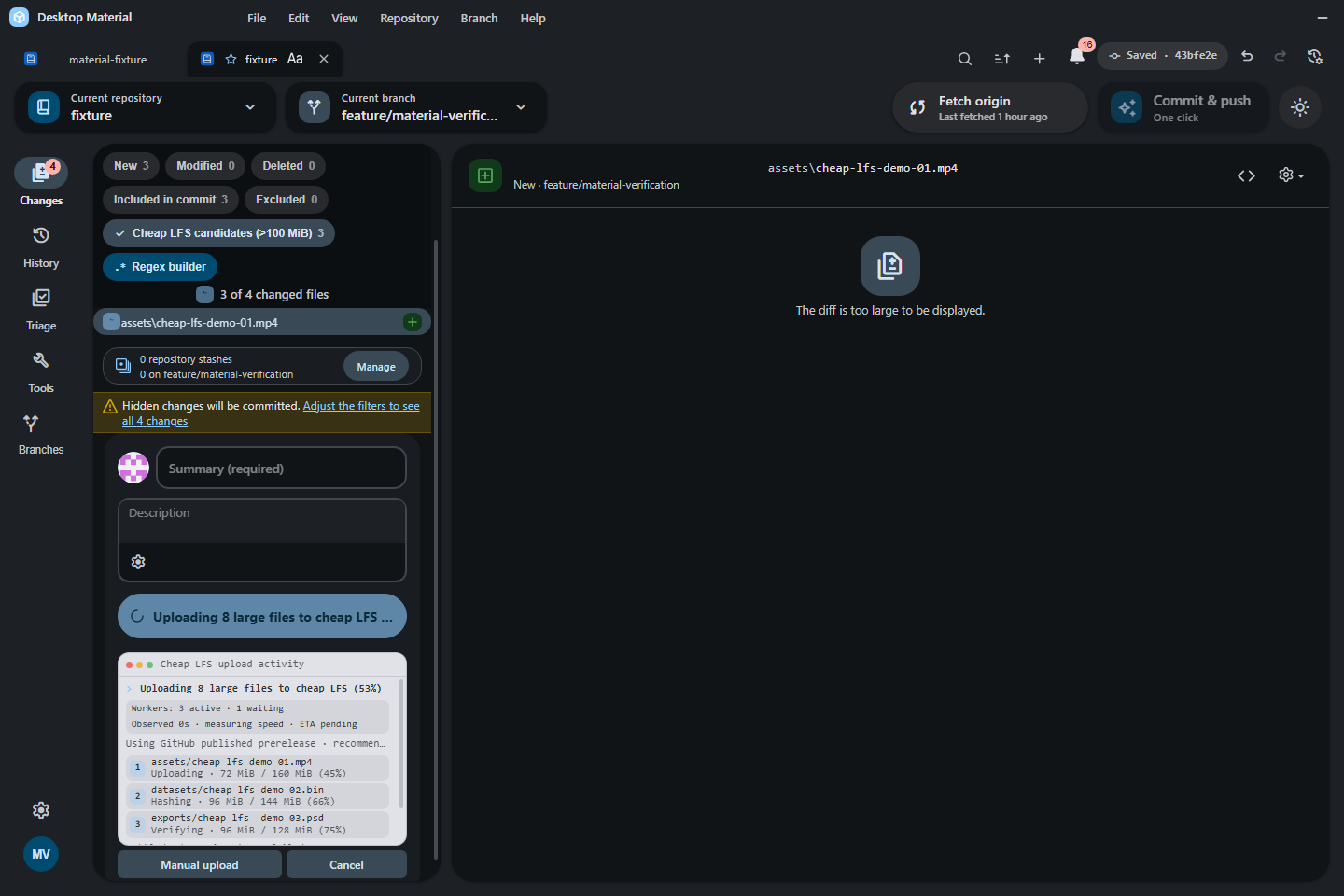
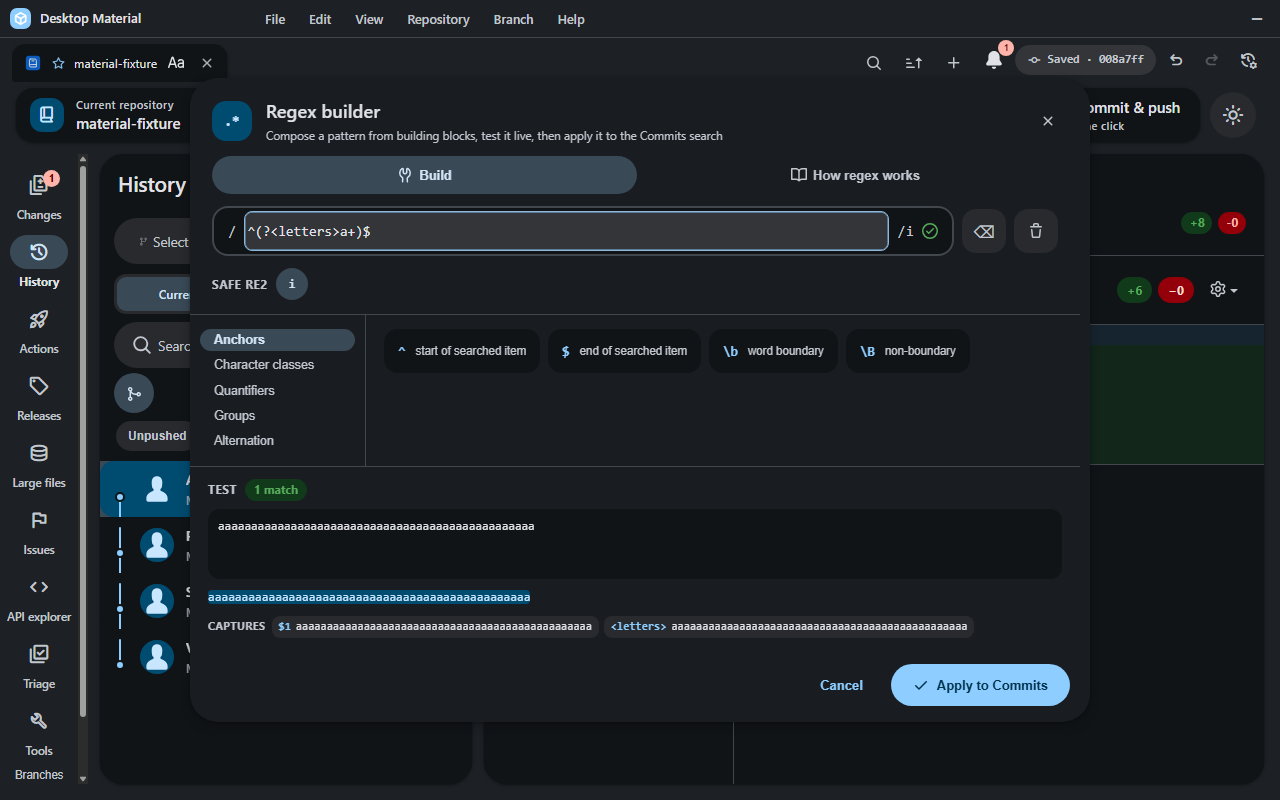
Superseded pre-final-review TypeScript gate
The logged root npx tsc --noEmit run completed with exit
0 after its foreground wait had timed out. The
authoritative files are
%TEMP%\DesktopMaterial-close-all-open-issues-20260728-1581a0ec8c65\logs\tsc-noemit-source-freeze.log
and
%TEMP%\DesktopMaterial-close-all-open-issues-20260728-1581a0ec8c65\logs\tsc-noemit-source-freeze.exit;
an empty log is expected for this clean compiler pass. Wrapper PID
14588 and compiler PID 19300 were both
rechecked and proved absent, so the gate left no owned compiler process
running. Later adversarial review changed progressive error
normalization and its tests, so this earlier pass is retained only as a
scoped historical checkpoint and is not the final-tree
TypeScript proof. A second run begun before that review finished was
deliberately marked superseded; its exact
wrapper/command/compiler/console-host process tree (3148,
6168, 16148, 16340) was stopped
and proved absent. Final closure requires a fresh post-review compiler
run. Neither checkpoint stands in for the production build, full test
suite, visual acceptance, publication, or issue closure.
Reviewed-source
checkpoint before main reconciliation
After the adversarial code and documentation reviews completed, a
fresh npx tsc --noEmit run passed with exit 0,
and yarn lint passed the repository-wide Prettier check,
the ESLint/Prettier compatibility check, and source ESLint with exit
0 in 319.30 seconds. The authoritative files are
%TEMP%\DesktopMaterial-close-all-open-issues-20260728-1581a0ec8c65\logs\tsc-noemit-reviewed-source-freeze.{log,exit}
and
%TEMP%\DesktopMaterial-close-all-open-issues-20260728-1581a0ec8c65\logs\yarn-lint-reviewed-source.{log,exit}.
Their wrapper/compiler process trees were rechecked and proved
absent.
All 16 verifier contract files then ran. 206/207
assertions passed; the only failure was the intended fail-closed Pages
import because the distinct current-source updater frame,
auto-updater-current-source-ready.png, does not exist yet.
The complete log is
%TEMP%\DesktopMaterial-close-all-open-issues-20260728-1581a0ec8c65\logs\verifier-contracts-reviewed-source.log.
This checkpoint predates reconciliation with the newer remote
main fixes, including #96, so the same gates must run again
on the merged source before the exact build.
Post-checkpoint acceptance and CI reconciliation
The pushed close-out checkpoint is
2fedf140e394fa2fea3e380203e716b6f7aa8628. Remote CI run 30370044526
completed with successful lint, Windows TUI core, and packaged Windows
x64 E2E smoke. Its 845-file/6,957-test Windows x64 unit run had exactly
seven leaf failures: the two deliberate missing-updater gallery gates
plus five stale source/copy assertions described below. Three Linux TUI
jobs stopped only at the generated parity-contract hash, and Windows
arm64 script tests stopped only at the generated documentation catalog.
The parity contract has therefore been regenerated from the current
201-row source. The documentation catalog repair already exists on newer
main and will be regenerated again only after the final
documentation tree is reconciled.
The preceding branch run also exposed three stale source-shape tests. Their assertions now follow the current lazy repository-tools JSX wiring, the shared context-menu appearance helper, and the localized “Subtrees could not be loaded” copy. These are test-contract repairs, not product-behavior changes. The updater/wiki failures remain deliberately unresolved until the distinct current-source updater frame is produced by the packaged-build verifier.
A separate read-only acceptance audit proved that every required
verifier implementation exists, but found two printed command templates
that their own containment checks would reject. The internal-browser
receipt is now a direct child of its owned run root, and the Ollama
receipt now shares the owned P0 captures directory with its
PNG. A cross-contract assertion pins both rules. After the shared
renderer profiler became quiescent, the three repaired app test files
passed 46/46 across 3/3 files, the regenerated 201-row
parity contract passed its checked-generation gate, and the gallery plus
live Cheap LFS contracts passed 75/75. Prettier,
application-test ESLint, the repository-ignored verifier lint with its
intentional CommonJS/synchronous rules disabled, syntax checks, and
git diff --check are green. The authoritative logs are
%TEMP%\DesktopMaterial-close-all-open-issues-20260728-1581a0ec8c65\logs\post-ci-repair-{targeted-tests,contracts,format-lint}.log.
Those reviewed repairs and provenance fences are pushed at
107bd91a003f490fa3d91cc642a7beaa350d2c35; branch CI run 30376865471
is queued. The matching rolling checkpoint is Discussion
#54 comment 17815363, and the private-gallery authority boundary is
recorded on #23
comment 5106684118. Those two earlier receipts printed a nonexistent
source-gate SHA; the correction is explicit in Discussion
comment 17815648 and #23
comment 5107001088. Only
107bd91a003f490fa3d91cc642a7beaa350d2c35 is
authoritative.
The open-issue scan after that audit remains exactly #23, #80, #81,
#82, #85, #87, #94, #95, and #96. Two #23 specialist frames still
require read access to
DingDingChae/desktop-material-cheap-lfs-private-20260722-153308.
Both GitHub API and non-prompting HTTPS checks under the active
codingmachineedge identity return not-found. No substitute
repository, historical frame, or mocked provenance will be represented
as that private live acceptance.
The read-only audit also found that the cloud specialist's current
pin is internally inconsistent with the retained history. Its verifier
requires e56519d4742c63bb2c9f5f1e917de3fca7379fdd, the
pre-compression UI-acceptance commit, while simultaneously requiring the
compressed pointer first documented at
6259b0fa0dc6c65cdb5a90af8e1da9358b45b0ac and today's
no-private-workflow encrypted-builder routing. Read access is required
first to inspect authentic later history. If no retained commit contains
the compressed pointer with the legacy private workflow removed,
producing that current-state evidence will require separate owner
authorization for one narrowly scoped fixture commit; it will not be
inferred from the request to capture screenshots.
The live Cheap LFS specialist now fails closed around that boundary.
Before attaching to Chromium, after the settled production surface
proves the current builder-routing state, and immediately after
original-pixel capture, it bookends read-only Git snapshots and requires
a clean main checkout at the exact origin/main
SHA. Every fence revalidates the repository root and .git
directory as the same real directories, checks Git's reported top-level
and absolute Git directory, and rebinds the reviewed GitHub origin. The
cloud scene additionally requires
.github/workflows/cheap-lfs-cloud-compression.yml to be
absent from HEAD, the index, and the real working tree;
link/junction parents, ignored occupants, and any other non-absence
fail. A version-2 receipt binds the exact reviewed commit, hashed
origin, and stable filesystem identity to its canonical SHA-256
fingerprints. Capture creation uses an exclusive descriptor, full write,
fsync, and identity-aware cleanup; the fully written
receipt is published atomically without overwriting through a
same-directory hard link. The focused contract passes
20/20, including real dangling-link and
atomic-publication probes plus injected write failures. This closes the
verifier's mount-time rewrite and orphan-output gaps without pretending
that the inaccessible, internally inconsistent fixture pin is resolved.
A mutation that begins and fully reverts between samples remains the
unavoidable read-only TOCTOU limit; the owned fresh clone and three
double-fenced samples are the strongest non-mutating mitigation.
2026-07-28 — Bounded Cheap LFS inventory joins the close-out (Refs #96)
Issue #96 was filed while this campaign was active. The initial fix
landed on remote main and is now present through this
merge. Adversarial review showed that its size preflight still sent a
pointer-looking oversized file to git grep -I --untracked,
so a hostile 50+ GiB sparse file could exhaust Git before Desktop
Material's bounded format validator ran.
The close-out branch now removes working-tree content from Git grep entirely. Unscoped inventory asks Git only for NUL-delimited changed/untracked names; explicit path selections are validated before any asynchronous Git work. Each candidate is then proven as an in-repository regular single-link file and only its first 512 bytes are read through the tracked-path store. The prefix read requires a settled identity, rechecks the opened handle and visible path after the read, revalidates every parent, refuses symlinks/reparse points, gitlinks, linked files, and identity drift, and rejects unsafe or non-safe-integer bounds. Clean committed pointers remain classified from their bounded working-tree text. Pointer-looking oversized files are carried to the existing bounded format rejection; raw oversized files never enter content grep.
The regression uses real NTFS sparse files with the issue's exact
logical size, 55,581,030,080 bytes, for both raw and
pointer-looking cases. Git Trace2 proves the vulnerable
grep --untracked command is absent while the bounded name
inventory still runs. It also covers scoped and unscoped calls,
traversal prevalidation, clean committed pointers, modified gitlinks,
selected symlinks, the exact pointer-format boundary,
future-mtime/unsettled identity proofs, and invalid prefix bounds. The
final focused pair passes 82/82; the complete Cheap LFS
directory passes 673/673 across 48 files and 89 suites
in 187.55 seconds. Two independent adversarial reviewers found no
remaining actionable blocker in #96's reported working-tree scope.
Index/HEAD Git-object inventory still uses bounded-result Git plumbing
and is recorded as a separate hardening opportunity, not part of #96's
explicit --untracked reproduction.
The source fix is closure-ready locally, but the issue remains open.
Final closure still requires a fresh final-tree typecheck/lint pass
after all reconciliation, the exact MCP production build, pushed
main ancestry, applicable remote checks, and a timestamped
finished receipt.
2026-07-28 — Guided gallery scoped to 84 Windows scenes (Refs #23)
The current guided-gallery contract, capture plan, and Pages manifest
declare exactly 84 Windows targets: 67 canonical
outputs and 17 specialist outputs. That declaration does not become a
published 84-image acceptance until every target exists and passes the
current-build capture, privacy, and promotion gates. The five original
linux-tui-*.png files and their dated Debian/Xvfb manifests
remain byte-for-byte historical evidence, but are explicitly outside the
current gallery rows, raw-main image set, Pages figures, and promotion
plan. README/wiki/site screenshot surfaces describe that boundary
without relabeling the old pixels as Windows evidence.
Issue #23's older public body and comments contain superseded 77- and 89-image counts. Its final evidence comment must explicitly correct that history to the current contract: 84 blocking Windows scenes, plus five preserved historical Linux/Xvfb frames outside the current set.
The July 22 legacy updater-migration frame is also retained outside
the current set at immutable commit
923dbb51acad8f01f01f1c100c6945c7a2e08e23. Current-source
updater acceptance owns a distinct filename, so its promotion cannot
overwrite or relabel those 49,195 historical bytes.
Static documentation generation and the non-image-dependent
documentation, tab-count, tooltip-lifetime, and localization checks
pass. The fail-closed gallery validity checks correctly remain red
because the distinct auto-updater-current-source-ready.png
target has not yet been captured; the legacy updater blob is historical
evidence and cannot satisfy that current slot. No UI was launched and no
screenshot was recaptured or deleted in this documentation checkpoint.
Issue closure still requires current-build acceptance for all 84 Windows
targets.
2026-07-28
— Measured Changes/History renderer update suppression
(main checkpoint)
The exact baseline v3.6.3-beta3-zadughkqcv Windows x64
portable build at 9bdfdb8b25e458e4834bdaa26473d44a5602621d
was driven on an isolated Lowlevel MCP Win32 desktop. Idle rendering was
already smooth (122/122 frames at 16.51 ms average, 16.80 ms max, zero
over 25 ms), but twelve warmed Changes/History switches measured 56–104
ms and six 59–67 ms long tasks. A single Changes click measured 104 ms,
one 62 ms long task, and 166 mutation records.
RepositoryView.onTabClicked always dispatched
updateCompareForm({ showBranchList: false }) after the real
section mutation. AppStore._updateCompareForm then merged
and emitted even when the value was already false, producing a second
root render for one user click. Navigation now dispatches only when the
list is open, and a store-level equality gate protects every caller.
Focused responsiveness, lifecycle, progressive-loading, and navigation
coverage passed 42/42. In that source checkout,
changed-file ESLint could not load five repository-specific rules; it
reported only missing rule definitions, not source findings.
That source checkout's mandated production build and direct compile diagnostic both reached bounded webpack timeouts, and its reused incomplete dependency tree left repository-wide TypeScript red without naming the new helper or test. No post-fix binary or timing was claimed by that checkpoint. The merged close-out tree still owes the final gates listed in the current handoff above.
2026-07-28 — Tab-group dialogs move onto the dialog layer (Refs #92)
CreateTabGroupDialog/EditTabGroupDialog
rendered inline in repository-tab-strip.tsx.
Dialog carries tooltip-host, whose
position: relative overrides the UA
position: absolute on <dialog>, so they
laid out as in-flow flex items of the strip at
z-index: auto and the app bar's positioned pills painted
over the Group color swatches. Both now portal into
#dialog-layer via the new
app/src/ui/dialog/dialog-layer.tsx. Second defect in the
same frame: Tooltip anchors mouse-placed tips to
mouseRect, which stays (0,0,0,0) when a tip is
shown by focus, and getDirection falls back to an unclamped
SOUTH — so the tip landed half outside the window.
getTargetRect now falls back to the target's box and
clampTooltipRectToWindow bounds every tooltip. Verified:
17/17 across the three touched test files (5 new, each confirmed failing
before the fix), tsc exits 0, eslint and repo-wide prettier
clean. Not visually verified — no build or capture was
run on this worktree.
2026-07-28 — Disconnected tooltip owners clean up immediately (Refs #94)
A tooltip could outlive a transient button or row when React removed
its owner without dispatching mouseout or
blur. Tooltip now observes target connectivity
only while a tip is pending or visible. If the target disconnects, it
cancels pending show/hide timers, stops its observer and viewport
listeners, removes the portal, and clears the old target's tooltip
marker and aria-describedby; unmount performs the same
cleanup. Focused regressions cover both removal before the delay expires
and removal after the tooltip is visible. Final built-app acceptance
remains part of the current Windows gate and is not claimed here.
2026-07-28 — Tab counts use truthful singular and many copy (Refs #95)
Count selection now lives in tab-count-copy.ts instead
of being scattered through individual controls. English uses singular
copy for exactly one and the many form for zero or two-plus across the
group chip, edit-dialog intro, member-menu button/status, and
overflow-button accessible name. Cantonese keeps its natural count
wording while using the same one/many selection contract. Unit coverage
exercises 0, 1, and 2 in English and Cantonese and checks the real
collapsed-group and overflow-button accessible names. The fresh
source-freeze #95/i18n run covered 4/4 declared files and passed 64/64
tests with exit 0; its authoritative files are
%TEMP%\DesktopMaterial-close-all-open-issues-20260728-1581a0ec8c65\logs\focused-tab-copy-source-freeze.log
and the matching .exit file. Wrapper PID 3252
was rechecked and proved absent. This is exact focused proof, not
built-app acceptance, which remains pending with the current Windows
gate.
2026-07-28 — Encrypted restore names the decrypting phase (Refs #85)
Encrypted-and-compressed Release restores now report the real transform order: Downloading → Decrypting → Decompressing → Verifying → Materializing. The plain bilingual label is Decrypting · 解密緊; funny-level voice may vary without changing the phase, path, byte counts, or order. The focused operation, progress, localization, and real-operation verifier contracts cover the distinct phase. Exact current-build UI acceptance remains pending and is not borrowed from the July 22 Cheap LFS screenshots.
2026-07-28 — Unattended encrypted Cheap LFS pin skips instead of prompting (Refs #87)
isBackgroundTask now reaches
autoPinLargeFilesBeforeCommit. A scheduled commit whose
repository has Release payload encryption on and no saved password skips
the pin via app/src/lib/cheap-lfs/unattended-encryption.ts
— nothing encrypted, nothing uploaded, no anchor published, the large
files left in the working tree and out of that commit, and one
non-blocking notice per repository. The interactive modal is unchanged.
Verified: 638/638 Cheap LFS tests green (22 new),
npx tsc --noEmit exits 0, yarn lint clean. Not
visually verified — no build was run.
2026-07-28 — Shift+Right-click opens appearance editors (Refs #89)
The appearance editor no longer claims a plain right-click anywhere.
The gesture is now Shift+Right-click, decided once by
isAppearanceEditorPointerGesture in
app/src/ui/appearance/; the shell-wide
document listener in app.tsx uses
isAppearanceEditorFallbackContextMenu, which also accepts a
keyboard-originated context menu so those owners never become
mouse-only. Surfaces with a real menu (tab strip, tab overflow rows,
repository list) keep it and their Customize entries. Settings →
Appearance advertises the gesture in both languages at every playfulness
level. Verified: 100 unit tests across 15 files green, eslint and
prettier clean. Not visually verified — no build was run.
The two pre-existing tsc errors that branch recorded
against its base (operations.ts and app.tsx)
were the merge-collision damage fixed in ff53cd2155; after
merging, npx tsc --noEmit exits 0 on this tree.
2026-07-28 — Root renderer resource lifetime audit (historical predecessor checkout snapshot)
The root App created telemetry and update-check
intervals without retaining their handles, while
componentWillUnmount cleared only an unrelated interval. A
queued idle callback could therefore start permanent polling after
unmount. The same root instance was retained by undisposed
app/build/updater/drag subscriptions, three IPC listeners, document
drag/drop/focus handlers, and application-menu key listeners.
The fix collects subscriptions in one
CompositeDisposable, makes typed IPC on()
registrations disposable, retains and clears both deferred timer
handles, releases every global handler, and guards queued
idle/animation-frame work with the mounted state. Focused lifecycle
tests pass 4/4 and ESLint is clean on all three changed
files.
In that predecessor checkout, the exact Lowlevel MCP headless build
preflight passed against server checkout
f2edfe442555cfe35a519dd0b058986cb09d6ee3, but the mandated
production build stopped before compilation because that predecessor
checkout had no dependency tree and npx --no-install
correctly refused to download missing cross-env.
Repository-wide TypeScript was also red from missing baseline
dependencies (dugite, registry-js, Copilot
SDK, Dexie, and others); no reported diagnostic targeted the changed
files. That checkout-specific environment is superseded by the current
handoff and is not a current blocker or current test verdict.
2026-07-27 — Progressive asynchronous lazy loading (locally verified, Refs #82)
App.render() returns null until
AppStore.loadInitialState() resolves, so every await in
that method was a blank window. Two of them were slow and optional:
enumerating installed external editors (a filesystem walk plus, on
Windows, a registry read) and recovering the interrupted clone-queue
journal. Both now run in loadDeferredInitialState(), which
loadInitialState() starts without awaiting. The selected
editor is adopted from localStorage so the shell paints
with the user's real choice; the availability scan corrects it
afterwards and drops its own answer when
externalEditorSelectionGeneration shows the user picked an
editor while it was running. Each deferred step is isolated and reports
failures through sendNonFatalException('deferredStartup')
rather than swallowing them. No timers were introduced anywhere in that
path.
repository.tsx previously imported seven substantial
section modules statically (Actions, Releases, Cheap LFS, Issues, GitHub
API explorer, provider triage, repository tools), so all seven were
evaluated at launch even in a session that only looked at Changes. They
are now type-only imports plus direct named asynchronous imports,
rendered through a new LazyView. The production renderer
emits the exact seven repository-*.js chunks; no
webpackMode: "eager" or barrel import remains. Changes and
History stay static. A failing section shows a local
role="alert" surface naming the real error with a working
retry, plus a persistent corner notification — never a modal, never a
focus move. Webpack chunk failures retain the actionable chunk name
while redacting only a private file:///C:/…/out/
installation prefix before the message reaches either surface.
app/src/lib/progressive-load.ts holds the ordering rules
once: LatestLoadGate refuses a token that is not strictly
newer than the last accepted one, and ProgressiveLoad.run()
never rejects, turning a rejection into a failed state
carrying the real Error. It is used by
LazyView and by the submodule/subtree count loaders in
repository.tsx, which also stop discarding their failure
reason in a bare catch {}.
Current focused evidence is 37/37 across
progressive-load-test.ts,
ui/lazy-view-test.tsx, and
progressive-startup-test.ts; the new packaged verifier
contract is 8/8. That verifier inventories the exact
seven chunks, withholds only repository-tools.js, observes
the real accessible loading→local-failure transition without focus or
modal theft, restores the identical SHA-256, uses the physical
Try again control, and requires a spinner-free cached
revisit. The final exact MCP build and off-screen original-pixel
execution remain the publication gate and are not claimed by this source
checkpoint.
2026-07-27 — Funny-level sliders: superseded by the owner's own integration (Refs #83)
A parallel implementation of #83 was written on this branch and then
discarded during the merge with
origin/main, because the repository owner had
independently implemented and pushed the same feature in
a550dc1ea8 ("Integrate safer pushes, encrypted payloads,
and funny controls"). Their version is the one that ships;
FunnyLevelControls
(app/src/ui/preferences/funny-level-controls.tsx) and its
14-test suite were deleted rather than merged, because two
implementations of one settings control is strictly worse than either
alone.
The same happened to the #78 encryption work merged earlier from this
branch: a550dc1ea8 deleted
app/src/lib/cheap-lfs/encrypted-payload.ts,
app/src/ui/repository-settings/cheap-lfs-encryption-gate.tsx
and their three test files, replacing them with
payload-encryption-credentials.ts and
cheap-lfs-payload-password.tsx. That deletion is the
owner's call and stands.
What survived from this branch, because the owner's commits did not
cover it: the decrypting restore phase (#85), progressive
lazy loading (#82), the repository/tab group management merged in
a2ad99e218 (#81), the capture fixture's menu:
step, and the two CI test repairs below.
2026-07-27 — Observed user-initiated push/pull/fetch promises (locally verified, Refs #80)
Pressing Push origin could surface the generic "A
background action stopped unexpectedly" notice instead of the real
failure. The toolbar handler started dispatcher.push(...)
and dropped the returned promise, so when the push preflight's
hosted-repository lookup 404s and
repositoryWithCanonicalRemoteForNetwork rejects, the
renderer's global unhandledrejection containment in
app/src/ui/index.tsx — which is deliberately generic so an
arbitrary rejection cannot copy a credential onto the screen — was the
only thing left to report it.
The rejection was never double-reported by the store:
performFailableOperation catches a Git-level push failure,
calls emitError, and resolves, so a
rejection escaping _push is by construction a failure
nothing has presented. The fix is therefore
observe-and-report at the call site, not
observe-and-swallow. New helpers live in
app/src/ui/lib/observed-operations.ts; the toolbar
push/force-push/pull/fetch, the menu push and force push, the force-push
confirmation dialog, and the workflow-push-rejection retry now route
their promise through observeUserInitiatedOperation, while
the previously void-ed provider triage refresh is contained
as a background diagnostic via containBackgroundOperation.
A failed canonical-remote preflight still runs no Git command at all —
withCanonicalRemoteForNetwork never invokes
performPush when the destination cannot be proven.
Local evidence:
app/test/unit/push-rejection-observation-test.tsx passes
17/17, including a rendered PushPullButton
click on a rejecting push (asserted to post the real error once and
leave nothing for Node's unhandledRejection), and the same
suite fails 2/17 when the observation is reverted. Adjacent suites pass
— provider triage and canonical-remote preflight 52/52,
source-regex/style neighbours 100/100, docs-hub catalog
33/33. npx tsc --noEmit, ESLint, and
Prettier are all clean. Remote CI, installer, and built-app screenshot
evidence for #80 remain outstanding.
2026-07-27 — Historical encryption/network/tone checkpoint (superseded status)
The current local implementation covers three open issues. #78 provides optional AES-256-GCM encryption for GitHub Release-backed Cheap LFS payloads: the app asks once per operation unless the user explicitly opts into the Windows credential vault, reads legacy pointer formats, restores plaintext legacy payloads without prompting, and fails closed when authentication and cleanup both fail. #80 observes asynchronous push, fetch, and pull actions and shows an invalid canonical remote as a persistent yellow notification whose Change remote URL action opens the repair surface. #83 restores separate, persisted 1–5 funny-level sliders for English and Cantonese. #81 and #82 are deliberately deferred to a later continuation.
Current local evidence is 194/194 focused tests and
6768/6768 full tests across 831 files, with
tsc and yarn lint clean. This checkpoint does
not claim packaged visual evidence or remote CI. #78, #80, and #83
remain open pending screenshots captured from the real built
application.
2026-07-27 — Historical TUI path browser and Cheap LFS Git wrapper (archived, non-blocking)
The Linux-first Textual edition now has a folder-only browser in its Open and Create repository dialogs. Browse/Hide, Home, and Up remain reachable by mouse and keyboard while the repository path stays a real editable field. Matching outer single or double quotes are removed from pasted paths immediately where the terminal exposes bracketed paste, with the same normalization at submission. The input is treated only as a path: it is never evaluated by a shell.
The literal github launcher now also provides bounded
native-Git routing:
github pushandgithub git pushforce a native parseable dry-run, inspect the publication delta for Cheap LFS safety, and invoke the real native push only after that preflight passes.github pullandgithub git pullinvoke native Git first, then materialize canonical Cheap LFS pointers only after exact size and SHA-256 verification.- Other
github git <argv>operations pass an argument vector directly to Git, without shell parsing. The wrapper does not stage, commit, rewrite history, upload payloads, or shadow the systemgitexecutable.
The README and installation guide include one-line Linux shell and
Windows PowerShell installs. Both install the github,
dmt, and desktop-material-tui launchers
through uv and run uv tool update-shell so uv's tool
directory is added to future shell PATH values.
Current automated evidence is green:
| Gate | Result |
|---|---|
| full Windows-hosted TUI suite | 250 passed, 1 Linux-only skip in 182.76 s |
| focused path normalization/browser/Pilot suite | 29 passed |
| focused Cheap LFS Git-wrapper suite | 47 passed |
| Ruff lint and format | clean |
| strict mypy, normal and explicit Linux platform | clean |
| package build | wheel and source distribution built successfully |
The final handoff accepted the source and package with one bounded
visual gap. A disposable Debian/Xvfb/xterm run launched the packaged TUI
and captured the real Open repository dialog. Its deterministic
bare-remote fixture advanced through safe-push and
pointer; the consumer restored 23 bytes whose SHA-256
exactly matched both the pointer and cache object. The Windows uv tool
install puts all three 0.1.0 launchers in
C:\Users\cntow\.local\bin, which was already on
PATH, and the Linux wheel smoke reported the same aliases.
The owned distro, displays, fixtures, and virtual environments were
destroyed and proved absent. Immediate bracketed-paste normalization,
the expanded-tree click path, narrow live resize, and Ctrl+Q exit remain
automated rather than accepted visual evidence, as recorded without
inference in the run
manifest and cleanup
ledger.
The preceding TUI compatibility correction commit
f555d374a6 is contained in origin/main. In CI
run 30317262582, the Linux TUI Python matrix and
Windows TUI core job passed, but the workflow overall failed in the
unrelated Windows x64 unit job. Installer run
30318769692 failed and published no Release. Feature
commit 62420efaf6 is integrated and pushed through merge
f5f6f04c7e, which remains an ancestor of current remote
main. For that exact merge, Pages run
30323259671 and Cheap LFS cloud run
30323259650 passed; CI run 30323259648 and
code-scanning run 30323259706 were still running at handoff
and are not claimed green.
2026-07-27 — Historical TUI compatibility correction (archived, non-blocking)
The first CI run for merged source 2abccae8fd exposed
two real portability defects after the earlier local matrix:
- Git 2.54 on Ubuntu emits strict ISO UTC timestamps ending in
Z. CPython 3.10 rejects that suffix indatetime.fromisoformat, which caused nine direct Git/profile-history failures and two downstream TUI failures. - Linux typeshed deliberately does not expose the Windows-only
msvcrt.lockingandLK_*members, so strict mypy rejected the statically imported Windows branch even though its runtime guard was correct.
The Git porcelain, reflog, and profile-history parsers now normalize
only a terminal uppercase Z to +00:00; numeric
offsets and malformed-date failure behavior remain unchanged. The
Windows lock branch now imports msvcrt dynamically as
Any, matching the existing fcntl runtime
boundary. The installer workflow also skips TUI package work when
prepare has already marked an upstream failed-CI target as
non-publishable. That prevents a newly loaded workflow from assuming a
historical pre-TUI target contains tui/, while successful
current-source release runs still require the wheel and source
distribution.
Local correction evidence is green: the isolated CPython 3.10.20 full
suite passed 193 tests with one Windows-host Linux-PTY
skip, the affected post-format set passed 35/35, Ruff
lint/format passed, strict mypy passed all 47 source files for both
Linux and Windows platforms, 32 focused persistence/CLI tests passed,
and the release workflow safety suite passed 8/8.
Packaged Windows E2E passed in job
90140843987. Correction commit f555d374a6
is contained in origin/main. CI
run 30317262582 passed the Linux TUI Python matrix and
Windows TUI core job, but the overall workflow failed in the unrelated
Windows x64 unit job. Installer run
30318769692 failed and produced no Release. The earlier
failed jobs that motivated the correction were Python
3.10, Python
3.12 mypy, and the historical-target
TUI package job.
2026-07-27 — Historical Linux-first interactive TUI preview (archived, non-blocking)
A new tui/ Python project is a terminal-native sibling
to the Windows-only Electron application. Its Textual shell is designed
for both mouse and keyboard operation: repository/workspace tabs,
buttons, lists, tables, checkboxes, and selectors are clickable, while
repository paths, URLs, commit messages, provider bodies, API payloads,
regex patterns, and sample text use real
Input/TextArea controls.
- Local Git covers repository open/create/clone, status/diff, file staging, commit/amend/sign-off, fetch/pull/push, history, branches, stashes, plus read-only tag/remote tools through argv-only bounded subprocess adapters.
- The GitHub pane uses an installed, non-prompting
ghCLI for issues, pull requests, Actions, releases, packages, read-only Projects inventory, and a bounded REST/GraphQL explorer. It does not store a GitHub token. - Shared literal/fuzzy/explicit-RE2 search enforces pattern, input, memory, match, capture, and zero-width iteration bounds. Settings and notification state use XDG paths, atomic TOML, SQLite WAL, and an isolated app-owned Git history.
- Linux packaging is a wheel plus source distribution. The additive Ubuntu CI job tests Python 3.10/3.12/3.13; Python 3.12 also checks Ruff, mypy, package contents, a fresh-wheel install, and the generated parity ledger.
- An additive Windows Server 2022/Python 3.12 lane checks the non-PTY unit, application, infrastructure, Cheap LFS, lint, and typed core. Linux PTY and mouse acceptance remain Linux-only and are not inferred from that lane.
- Cheap LFS reads and writes the canonical Windows Release-v1 pointer format across Linux and Windows, uses a 500 MiB limit for new writes while retaining 2 GiB legacy reads, and verifies size/hash before restore with a local recovery cache. The TUI preview does not yet implement OCI/GHCR or cloud-provider writes, encryption, or automatic multi-file batching.
tui/contracts/parity.yamlis generated from the existing 201-row desktop source of truth. Current mapping is 14 adapted, 53 partial, 132 not yet available, and 2 terminal-owned; unmapped work can never default to complete.- Categorized docs under
docs/features/linux-tui/cover installation, interaction, accessibility, XDG persistence, Git/GitHub, RE2, language, appearance, notifications, editor/history, security, failure modes, and verification.
Status: implementation commit eee005c7f4, integration
merge ba45dcfbaf, and verification commit
fcb86eca4d are integrated and pushed through merge
2abccae8fd. Local evidence is complete: 193 Windows-hosted
TUI/core tests passed with one Linux-only PTY skip, that PTY test passed
on real Debian, all 164 focused Windows Cheap LFS tests passed, the
wheel/sdist and fresh install were inspected, and a non-root remote
Docker build ran successfully. Five original Lowlevel/Xvfb screenshots
prove mouse clicks, editable Inputs/TextAreas, regex matches, bilingual
narrow layout, and Cheap LFS preview; every disposable process, display,
filesystem root, Docker image, and WSL distribution was removed and
proven absent. Pages/wiki publication is live; the first CI defects and
locally verified correction are recorded immediately above. Packaged
Windows E2E is verified. The correction is contained in
origin/main, and its Linux TUI matrix and Windows TUI core
jobs passed in run 30317262582; that workflow still failed
in the unrelated Windows x64 unit job, while installer run
30318769692 failed and published no Release. The run
manifest records the exact local evidence and hashes.
2026-07-27 — HISTORICAL SESSION HANDOFF (superseded; do not read as current)
main is at 949dc81e6d,
pushed, with zero divergence from the remote. The
working tree is clean; no stashes; every agent branch is merged and
deleted except the one still running (below).
Verification state on this tree
| Gate | Result |
|---|---|
node script/test.mjs |
6,508 tests / 808 files / 0 failures |
node script/test.mjs script |
163 pass / 0 fail / 2 skipped |
npx tsc --noEmit (root) |
clean |
npx eslint --rulesdir ./eslint-rules |
clean |
npx prettier --check (repo-wide) |
clean |
| CI | runs were still in flight at handoff time — not green, not claimed green |
Nothing in this session was closed on a CI badge. Every closing
comment says so explicitly and commits to reopening rather than burying
a later CI failure. If CI on 96eeb54c17 or its ancestors
reports a failure, that is real and the affected issues should be
reopened.
Issues: 23 open → 6 open
Closed with a real capture from a built app: #22, #73 (tab overflow with its search field, Regex builder and per-row customize control), #74 (repository groups expanded and collapsed, count pill and accessible name visible), #70 (sync summary line).
Closed as fixed, merged, pushed, locally verified: #55, #56, #58, #59, #65, #67, #69, #72. Each carries its own regression tests, and each was proven to fail without its fix.
Closed as shipped: #63, #64, #71, #75.
Still open, with the honest reason:
| Issue | State |
|---|---|
Closed. Stream-hash shipped in
949dc81e6d: OCI drops from 7 full payload reads to 3, with
the registry authoritative for layer digests. The Release path was
already single-pass from tranche 1 — 2 → 2, no saving, and that is
stated rather than dressed up as a win. |
|
| #66 | Fixed and pushed (registration now targets the update-stable Squirrel root, stale registrations detected and repaired). Not closed because no real re-registration was exercised — verifying the post-update repair needs an installed build carrying the change to be updated over. |
| #68 | Fixed and pushed. Not closed because the private
route deliberately ends at a builder-unavailable blocker:
creating the public builder repo and writing its Actions secrets needs a
token this feature never holds. Until that external setup exists,
private-repo compression does not run at all — which is the safe
outcome, not a silent fallback. |
| #34 | Feature shipped and merged. Wants a framed capture of the branch picker. |
| #23 | 79-capture campaign. Now unblocked —
script/capture-app.js exists and works. |
| #62 | Blocked on the user. All 21 desktop-plus features
referenced anywhere in this tree are already implemented; no unadapted
one could be found. Needs a name or screenshot of the feature believed
missing. Upstream delta measured: 78 commits since fork point
d9080117b1, versus 1,345 here (2,438 files, +902k lines).
Do not bulk-merge upstream. |
| #78 | Blocked on the user. Needs the scope decision: encrypt Cheap LFS payloads before upload (fits this app), or encrypt working-tree files in place (fights Git's diffing). |
Things a successor should know
- The Electron runtime was broken and is now fixed.
node_modules/electron/dist/held only alocalesfolder because the postinstall had downloadedelectron-v42.0.1-win32-x64.zip(144 MB) into the cache on July 12 and never extracted it. Every "blocked on a build host" note in earlier handoffs traced to this. Extracting the cached zip fixed it;path.txtnow nameselectron.exe. - Captures have two paths and they are not
interchangeable.
script/capture-app.js(CDP) drives interaction — it seeds repositories straight into the renderer's IndexedDB and opens tabs through the app's own IPC, so no app behaviour was changed to make capture possible. The Lowlevel MCP headless desktop launches and captures the real build off-screen, but cannot drive Chromium: posted input toChrome_RenderWidgetHostHWNDis ignored. Use the former for interaction scenes, the latter for launch-and-capture. - Screenshot counts are pinned in two places —
app/test/unit/wiki-function-gallery-test.tsandapp/test/unit/site-accessibility-test.ts, the second cross-referencing the wiki manifest againstsite/index.htmlfigures. Adding a PNG without updating the wiki row, the rendered image, the Pages figure and both counts turns one red test into a different red test. This broke CI twice. - New docs must be followed by
node script/generate-docs-hub-catalog.mjs. The staleness test caught this three times in one session. - A junctioned submodule breaks
git statusoutright in a worktree (fatal: not a git repository). Remove such junctions before any git command. ghresolves the default repo from remotes. After anupstreamremote was added to measure the fork delta, a comment landed ondesktop/desktopinstead of this fork. It was deleted within the minute andgh repo set-defaultnow pinsDing-Ding-Projects/desktop-material. Keep that pin.
Open risk worth carrying forward
The racily-clean fix (#72) makes publishing pay one filesystem
timestamp tick. Measured: ordinary revalidation is unchanged (3.95 ms →
3.68 ms, still skipping the re-hash, so #35's win survives), but
publishTextBatch pays roughly 17 ms × N in
its staging loop. Settling members in parallel is the obvious follow-up
if that shows up on a large batch.
2026-07-27 — Ignored files to a local submodule (local phase, on a branch)
Built on the isolated worktree branch
worktree-agent-a1c6b6311afbc2837; not merged and not
pushed. It implements only the local half of the
roadmap entry: candidates come from
git status --porcelain=1 -z --untracked-files=all --ignored=traditional
and each is proven by git check-ignore -v -z --stdin run
without --no-index, so a tracked path — including
one force-added against an ignore pattern — can never be proven ignored
and can never be selected. Eleven per-file rejection reasons and nine
destination reasons are all fail-closed. Every staged copy is verified
by size and SHA-256 while the parent repository is still strictly
read-only; the first index mutation anywhere is the new repository's own
commit, and the single git submodule add follows it.
Originals are only ever read and are re-hashed at their exact original
paths afterwards. Independent recovery copies under
<git-dir>/desktop-material/ignored-submodule-recovery/<run>/
are deleted only after that final verification and are named in every
failure.
Local evidence: 36/36 focused tests (9 pure
planning, 22 against real temporary Git repositories, 5 dialog), and
732/732 across the cheap-lfs, submodule,
repository-settings, collection-surface-registry,
search-surface-filters, and i18n suites (61 files). Root
npx tsc --noEmit is clean and
npx eslint --rulesdir ./eslint-rules is clean on every
touched file. Two mutation checks confirm the safety tests are
load-bearing: adding --no-index to
check-ignore fails exactly the two tracked-file tests, and
disabling the staged-copy hash comparison fails exactly the copy-proof
abort test.
Still open: merge to main, push, CI, and headless
screenshot acceptance. The publish phase — Release/OCI storage
selection, Cheap LFS upload, pointer conversion, provider repository
creation, remote creation, and push — is deliberately
not built; the module imports none of that code and a
source test asserts it. Detail in docs/features/repository-management/ignored-files-to-local-submodule.md.
2026-07-27 — Session summary: fifteen pushes, and what is still open
Pushed to main through 821ab93d57. Full
local gate on that tree: node script/test.mjs reports
6,508 tests across 808 files with 0 failures, root
npx tsc --noEmit is clean, eslint is clean,
and repository-wide prettier --check passes.
Shipped and pushed this session, each verified before its own push:
- Latest-release reconcile (
2e62c5a2a6) — installed apps had stopped receiving updates. Promotion only crowned a release whose commit still equalled the tip ofmain, so any push landing mid-build stranded Latest permanently while Squirrel polledreleases/latest/download/. Promotion is now a monotonic reconcile alongmain. - Racily-clean identity revalidation (#72,
01d2ba31fd) — a genuine fail-open found by CI, not by review. Same-size writes inside one filesystem timestamp tick produced identicalmtimeNsand size, sosameEntryreported "unchanged" for different bytes and the deferred-hash path could accept stale content. Reproduced locally in 11 of 40 trials. Observed tick steps here were 0.79–3.1 ms, not the 15.6 ms Windows default, so a hardcoded constant would have been wrong in the unsafe direction; the fix probes granularity per device behind a 2 s conservative bound. - Cheap LFS owned-artifact rule (#65,
f7cb50b874) — the app was pinning and uploading its own in-tree scratch files during a clone. The cause was commit-time selection, not a background scanner. - Post-commit payload restore (#55), UTF-8 byte budget for asset names (#67 — long CJK files could not be pinned at all), scratch-ODB worktree fingerprint (#59), append-guarded release uploads (#56), documentation-search worker (#69), tab-overflow search and customization route (#73), collapsible repository groups (#74), repository-list sync summary (#70), the complete feature list (#64), the tabbed documentation hub (#63), and README feature diagrams.
Open, with the honest blocker recorded on each issue:
- #66 Windows 11 context menu — root-caused on this
machine. The sparse package registers with
Path.dirname(process.execPath)as its external location, which resolves toapp-<version>\and therefore changes on every Squirrel update; the package keeps reportingStatus: Okwhile its location rots. Architecture mismatch and COM activation are ruled out. Fix in flight. - #22, #34, #73, #74 captures — the Electron runtime was repaired this session (the postinstall had downloaded the 144 MB zip on July 12 and never extracted it), so single-repository captures now work and produced #70's evidence. Multi-tab scenes still need the reusable fixture filed as #75; three UI-driven routes were tried and all proved fragile. No substitute screenshot has been posted for any of them.
- #35 — the deferred profiler findings are all fixed; stream-hash-on-upload ("cloud hash") remains.
- #62 — a read-only survey is under way rather than a blind upstream merge.
- #68, #71, #75 — in flight.
Two self-inflicted CI breaks were fixed in the same session: a screenshot added without its wiki-manifest row, and then the same screenshot missing from the Pages gallery, which is a second pinned count cross-referencing the first.
2026-07-27 — GitHub Pages renders Mermaid diagrams instead of their source (#71)
Ten ```mermaid fences — three in
docs/learn-more/unreachable-commits.md, five in
docs/readme-tabs/features.md, two in
docs/readme-tabs/complete-feature-list.md — rendered as
diagrams on github.com and as raw fence source on the published site,
because pandoc --from gfm turns a Mermaid fence into
<pre class="mermaid"> and
site/docs-template.html loads no JavaScript at all.
- Pre-rendered at build time, not in the reader's
browser. The new
site/render-mermaid.mjsruns after pandoc and before the search index, finds each<pre class="mermaid">, renders it with@mermaid-js/mermaid-cliin a headless Chromium, and splices the SVG inline inside<figure class="mermaid-figure">. No CDN tag, no vendored runtime bundle, no second request; the site still loads zero external resources, asserted by the test against both the template and generated output. - Theme safety by construction. Mermaid is handed a
sentinel palette — one unique impossible colour per theme variable — and
every sentinel in the returned SVG is replaced with a CSS custom
property, defined inside the SVG for light with a
@media (prefers-color-scheme: dark)override. All ten real diagrams now render with zero literal colours surviving the build's audit. Contrast is asserted numerically in both schemes (4.5:1 text, 3:1 graphics). - Accessibility. Each SVG gets
role="img",aria-labelledby, and a<title>taken from the bold caption the author already wrote below the fence. The bilingual English / 廣東話 prose under every diagram is untouched and remains the real fallback. - Failure is loud; local builds still work. A fence
that will not render fails the build with the page, position, name,
Mermaid error and source; the page is left unwritten and nothing is
published. Without
--require-toolchaina missing toolchain is only a warning and every fence is left exactly as pandoc emitted it, so a contributor needs no browser. - Legibility floor. A diagram may scale down to 80% of its drawn size and then scrolls inside its own container, so the 1,557px-wide feature map no longer shrinks to 7px type in the 52rem column.
Local evidence: node script/test.mjs script passed
148/150 with 0 failures and 2 environment-gated skips (pre-existing
ARM64 cross-tools; the new browser-gated end-to-end render, which passed
when run with DESKTOP_MERMAID_TOOLCHAIN set). The full
Pages build was reproduced locally with real pandoc 3.10 and a real
headless Chromium 151: all ten diagrams rendered, zero colour-audit
warnings, and Chromium reported 0
non-file: requests for the published pages in both colour
schemes. npx prettier --check passes on every touched
non-Markdown file. Not yet verified against the deployed Pages site.
2026-07-27 — Exact-90% restore, app-hosted browser, and private badge (pre-publication local receipt)
At this pre-publication checkpoint, three user-facing continuations
were locally accepted and integrated into local main. The
source and captures were later pushed through 2abccae8fd,
and Pages/wiki publication is now verified live. Packaged Windows E2E is
verified. At that checkpoint, a TUI compatibility rerun and
installer/Release evidence were still pending; the TUI item is now
historical and non-blocking under the Windows-only product boundary. Do
not attach an older installer badge to these changes.
Cheap LFS restore scheduling and progress
app/src/lib/cheap-lfs/operations.tsgives one Release restore batch a FIFO coordinator capped at two active HTTP downloads. File-level and multipart look-ahead both use the same fixed threshold: 899/1000 stays single-lane and 900/1000 may start the next file or part. A provider with no usable progress total opens the next lane only when the current transfer settles.- The look-ahead changes download scheduling only. Ordered part decompression/verification, part and whole-file size/SHA-256 proofs, unchanged-pointer compare-and-replace, input-ordered results, cancellation draining, and owned-temp cleanup remain in the materialization path. The shared coordinator prevents nested file/part prefetch from exceeding two downloads.
app/src/lib/cheap-lfs/restore-progress.tsdefines the canonical UI model: repository/provider/phase, file totals, logical and actual downloaded bytes, rate/ETA/elapsed time, queued work, fixed threshold, bounded failures, cancel state, and separate current/look-ahead lane detail including file and multipart ordinals.app/src/ui/lib/cheap-lfs-restore-progress.tsxis reused by the Large files manager and batch-clone restore progress. It keeps exact visible counters, buckets screen-reader announcements to meaningful 10% transitions, removes active shimmer under reduced motion, and wraps narrow/bilingual content rather than clipping. Legacy sequential progress is adapted into the same contract.- The combined local gate described below supersedes the earlier 42/42 and 15/15 focused checkpoints.
App-hosted browser
app/src/lib/internal-browser.tsowns strict HTTP(S) normalization, credential/query/fragment redaction, bounded bookmark persistence, the persisted internal/external setting, explicit default/authentication intent, serializable state, and runtime command/bounds validation.app/src/main-process/internal-browser-window.tsseparates trusted local browser chrome from remoteWebContentsViewtabs. Remote content has Node and preload disabled, context isolation/sandbox/web security enabled, permissions and downloads denied, certificate errors refused, and no trusted Desktop Material IPC registration. Valid HTTP(S) redirects stay in place,window.opentargets are captured into new tabs, app callbacks return to the app, and only the allowlistedmailto:,tel:, andms-settings:schemes escape to Windows.app/src/internal-browser/supplies New tab, close/activate tabs, URL bar, Back/Forward, Refresh/Stop, Go, ordinary bookmarks, and Open externally. Authentication tabs show a SIGN IN chip, cannot be bookmarked, use one in-memory partition, clear its storage/cache after use, and expose Continue in system browser.app/src/ui/preferences/advanced.tsxpersists the global choice. Main/menu routing uses that choice for browser-bound links while authentication intent remains explicit rather than inferred from URL text. Webpack produces a separate trusted browser-chrome bundle.- The built browser passed the local redirect, popup, New tab, query-stripped bookmark, authentication-session, and external-escape receipt described below.
Private-repository lock badge
app/src/ui/repositories-list/repository-list-item.tsxrenders a separate filled Material lock only when provider metadata is exactlyisPrivate === true.false,null, and missing GitHub metadata render no privacy claim.- The lock remains visible beside a fork glyph or custom logo, is keyboard-focusable, exposes a localized tooltip, and contributes Private repository to the canonical row accessible name. Its fixed 22 px shape (20 px in compact density) does not widen or clip bilingual rows.
- The UI does not infer privacy from a URL, account, remote name, access failure, or local filesystem state.
Local acceptance
- The combined browser, Cheap LFS restore, IPC, localization, and private-badge test run passed 652/652 across 53 files.
- The two deterministic verifier contract suites passed 14/14.
- Full
tsc --noEmitcompleted cleanly. - The exact Windows production command completed with
returncode 0,timed_out false,client_ok true, and no stderr. The resultingoutdirectory includes the normal renderer/main assets and theinternal-browserHTML, JavaScript, and CSS assets. - The real built app ran on an isolated hidden Win32 desktop. Wide English and narrow bilingual restore receipts both proved the current lane at exactly 90% and the already-running next lane at 10%, with no clipping, overlap, or private data. The browser receipt proved same-tab redirect, popup capture into a new tab, New tab, query-stripped bookmark storage, and the explicit authentication escape without using a real account or credential. The private-repository badge receipt proved the separate lock in the real repository picker.
| Accepted local capture | Dimensions | Bytes | SHA-256 |
|---|---|---|---|
docs/assets/screenshots/cheap-lfs-restore-lookahead.png |
1440×960 | 106,724 | 001e9d09e95cf81c981f4b97a33c2aab958a93fce8eca064a8d0cea9df1e3a96 |
docs/assets/screenshots/app-hosted-browser-authentication.png |
1144×741 | 65,346 | 257960b35797e2f7e5f2a8e442c353e656d98af5ef4a088fe30113b641293f69 |
docs/assets/screenshots/private-repository-lock-badge.png |
960×660 | 87,517 | 7cf7e27565bceb3d584c24752c2e066b29abdbcafe066b25250fa65d3284de9a |
Publication update
The source and accepted captures are pushed through
2abccae8fd, and Pages/wiki publication and packaged Windows
E2E are verified. At that historical checkpoint, installer/Release
evidence remained pending; the separate TUI correction no longer defines
or blocks the supported Windows product. This pre-publication local
receipt does not claim the missing installer evidence.
Feature contracts: Release-backed Cheap LFS, App-hosted browser, and Private-repository lock badge.
2026-07-27 — Documentation search no longer compiles reader regex on the UI thread (#69)
site/docs-search.html, published as
/docs/search.html, built and compiled reader-supplied
patterns with a bare new RegExp(...) on the page thread. A
catastrophically backtracking pattern such as ^(a+)+$
against a long non-matching page hung the tab with no recovery. This was
pre-existing debt, not a regression from #63.
- One evaluator, one deadline owner. The hub's job
runner moved out of
docs-hub.jsintodocs/assets/site/docs-regex-job.js, and both published surfaces now use it: a fresh same-origin worker per request, a page-owned hard 750 ms timeout that callsterminate()before reporting failure, and a fail-closed path whenWorkeris unavailable. Neither page keeps a private copy of that logic any more. - Same worker, new bounded operation.
docs-hub-regex-worker.jsgained apagesoperation for the full-text corpus: at most 2,000 pages, 200,000 characters per page, 12,000,000 characters in total, 500 counted matches per page and the requested excerpt cap per page. Only match offsets cross the structured-clone boundary; the page slices excerpts from text it already holds, so a pattern matching everywhere cannot amplify one reply. - Plain text is still the default and no longer uses regex at
all. Plain search is a bounded substring scan; match-case and
whole-word are honoured with an explicit ASCII word-boundary check
rather than a compiled
\b. Regex stays an explicit opt-in, and query/pattern/options still round-trip through the address bar. The regex builder, its six snippets, excerpt highlighting, and the result and status copy are unchanged. - Regression guard extended.
docs-hub-regex-worker-test.mjsnow assertsdoesNotMatch(/new RegExp\s*\(/)against bothdocs-hub.jsanddocs-search.html, and requires each to reference the shared runner and the shared worker. The newscript/docs-search-page-test.mjsdrives the real page in jsdom against the real worker on a real thread. - Publication.
/docs/search.htmland/docs/index.htmlsit at the same depth, soassets/site/docs-hub-regex-worker.jsresolves identically from both;pages.ymlnow asserts the runner and worker ship next tosearch.htmland that the page references them. The site still loads zero external resources.
Local evidence: node script/test.mjs script passed
121/122 with 1 pre-existing skip and 0 failures, including 12 new
worker/controller assertions and the new 12-test
docs-search-page-test.mjs, whose adversarial case measured
^(a+)+$ against a 20,000-character non-matching page
terminating at ~815 ms wall clock (deadline 750 ms) with the page still
answering a plain-text search afterwards.
npx prettier --check passes on every touched non-Markdown
file. No TypeScript was touched. Not yet verified in a real browser
against the deployed Pages site.
2026-07-27 — Tabbed GitHub Pages hub with a site-wide search dock (#63)
The published documentation hub (docs/index.html) is no
longer one long scroll. Six top-level tabs — Overview, Install,
Features, Reference, Search and Project links — each open a panel of
their own, and Features and Reference carry generated sub-tabs so a
category or a documentation folder is a page rather than a section to
scroll past.
- Routing. Every tab is a route and every route is
the id of the panel it opens, so
#features/design-systemand#reference/technicalare shareable addresses and Back returns to the previous tab. Unknown sub-routes fall back to their parent tab; anything else falls back to Overview. - No-JavaScript behaviour is a first-class case. The
committed markup hides nothing and claims no ARIA tab state;
docs-hub.jsadds the tablist roles, the roving tab stop,aria-controls, arrow/Home/End movement and thehiddenattributes at runtime. Without scripting the same file is one complete, readable document whose tabs are ordinary in-page anchors. - Search on every page. The search box, the
plain-text/regex switch, the regex builder and the results moved into a
dock above the panels, so they are present on every tab. Plain text
stays the default; regex remains an explicit opt-in and still runs only
in the existing fresh same-origin worker under the page-owned 750 ms
termination deadline. No new
RegExpevaluation path was added. - Every documented feature is on the site.
yarn generate-docs-hub-catalognow also refreshes four managed blocks indocs/index.htmlfrom the same records the search catalog uses: 8 feature categories (78 feature pages) and 10 reference sections (84 pages), 162 generated document links in total. Nothing is hand-maintained, and a drifted page failsyarn test:script. - Appearance. Density (comfortable/compact) and
accent seed (violet/teal/amber/rose) join theme, language mode and the
two playfulness sliders; all six persist in
localStorageand apply before first paint. Compact removes whitespace only — no control loses its hit target. - Issue #64's comparison list is linked at
readme-tabs/features.htmlrather than copied, so that page stays the single source for it.
Local evidence: node script/test.mjs script passed
104/105 with 1 pre-existing skip and 0 failures, including the new
script/docs-hub-page-test.mjs (14/14 — tab state, deep
links, arrow-key movement, no-JS readability, plain-text default versus
regex opt-in, builder⇄search synchronisation, the empty state, a real
^(a+)+$ termination measured at ~750 ms through the real
worker on a real thread, and appearance persistence) and the extended
script/generate-docs-hub-catalog-test.mjs (22/22, including
a coverage assertion that every feature page is linked from the hub and
a staleness assertion for the committed page).
npx prettier --check passes on every touched file. Rendered
checks in a real browser at 375×812, dark, bilingual, compact: no
horizontal page overflow on any tab, no overflowing element outside the
pre-existing overflow-x: auto code blocks, tab targets 48
px tall, and text contrast between 7.2:1 and 13.2:1 for tab, sub-tab,
body, note and link roles. The Pages workflow is unchanged and its
docs-hub-catalog.js assertion still holds.
2026-07-26 — Dedicated Cheap LFS tab in Repository Settings
The Cheap LFS preferences moved out of the combined "Build, run & large files" tab into their own Cheap LFS tab in the Repository Settings dialog, inserted immediately after Build & run (enum value = TabBar position invariant preserved; the conditional ForkSettings tab stays last).
- New
app/src/ui/repository-settings/cheap-lfs-settings.tsxrenders the storage-provider selector, auto-materialize / auto-pin / parallel-upload toggles, and the cloud-compression consent, moved verbatim frombuild-run-settings.tsx. The preference plumbing is unchanged: both tabs edit the sameIBuildRunPreferencesworking copy through the sameonBuildRunPreferencesChangedcallback and the existing Save flow. - Deep links rerouted to the new tab: the
palette:cheap-lfs-settingscommand (app.tsx) and Open Cheap LFS settings in the Large files manager (repository-tools/cheap-lfs.tsx). All otherRepositorySettingsTabcallers keep their original intent. - Localization:
repositorySettings.cheapLfsTabadded ("Cheap LFS" / "Cheap LFS 大檔案"),repositorySettings.buildRunTabrenamed back to "Build & run" / "建置同執行", andcheapLfs.settings.locationnow points at the new tab. Settings search indexes only Preferences tabs, so no search-catalog change was needed. - The responsive surface catalog gained the
repository-settings.CheapLfssurface (metadata count 91 → 92 pinned inresponsive-surface-catalog-test.ts).
Verification: build-run-cheap-lfs-settings-test.tsx now
exercises the new component plus new tab-wiring/i18n/negative cases;
with cheap-lfs-test.tsx and
responsive-surface-catalog-test.ts the three files pass
43/43, and the nine adjacent suites (repository-settings
management/appearance, settings search/surfaces, build-run
opencode/auto-pull, i18n, tab-session style, command-palette catalog)
pass 80/80. npx tsc --noEmit is clean. Feature docs, the
User Guide, and this handoff were updated to the new path
Repository settings → Cheap LFS.
2026-07-26 — Add Submodule dialog searchable branch picker (issue #34)
The Add Submodule dialog's URL route now lists the remote's branches
instead of relying on free-text alone. A "Load branches" action beside
the URL field (also fired automatically on first blur with a valid URL)
runs
git ls-remote --symref -- <url> HEAD refs/heads/* —
--heads alone was verified to suppress the HEAD symref
line, so the ref patterns are explicit — through the new pure parser in
app/src/lib/git/ls-remote-heads.ts and the spawning helper
listSubmoduleSourceBranches in
app/src/lib/git/submodule.ts (source revalidated before
spawn, remote-operation env, credential trampoline, AbortSignal process
kill, 5,000-branch cap with truncation reported, malformed lines
skipped, empty repo yields an empty listing).
The loaded list renders as the registered standalone search surface
add-submodule-branches (literal IDs in JSX for the static
audit): a type="search" input plus
FilterModeControl on the shared fuzzy/substring/RE2
matchGroup stack with the invalid-regex
role="alert" contract, then a select whose pre-selected
first option is the visibly marked remote default. Picking writes the
free-text branch field, typing free text deselects the list, and the
remote-default option maps to an empty branch argument (no
-b), preserving the existing addSubmodule call
contract and Create remote behavior. All new copy is keyed in English
and Cantonese
(submodule.addLoadBranches*/addBranch* keys);
loading is announced through a polite live region and failures are
inline and non-blocking.
Verification (local, this worktree):
collection-surface-registry-test.ts 4/4,
search-surface-filters-test.ts 15/15, new
ls-remote-heads-test.ts 6/6,
ui/add-submodule-dialog-test.tsx 16/16 (5 new picker
tests), the eight existing submodule suites 55/55,
i18n-test.ts 20/20, and root npx tsc --noEmit
clean. Feature doc updated in
docs/features/repository-management/submodule-subtree-and-remote-creation.md.
Refs #34; remote CI has not run on this branch yet.
2026-07-26 — Unit-test repair after the remote-automation hardening
The f8eca3ac84 hardening moved scheduled commit/push,
pull preview, and commit-batch flows onto
repositoryWithCanonicalRemoteForNetwork before network I/O
but did not update the test suite, so the Windows x64 unit job failed in
CI (and in the dependent Express/Super Express release runs). Commit
6d6bda8a79 repairs the suite without touching the hardened
runtime behavior:
- Structural-store tests
(
Object.create(AppStore.prototype)) that mockedrepositoryWithRefreshedGitHubRepositoryorwithRefreshedGitHubRepositorynow stub the canonical-remote seam instead: the scheduled-automation repository-switch tests mockrepositoryWithCanonicalRemoteForNetwork, the pull-preview suite'ssetRefreshedRepositoryWrapperalso stubswithCanonicalRemoteForNetwork, and the Cheap LFS unborn-root checkpoint test passes the repository straight through the new seam. - Source-guard regexes were re-pinned to the hardened call shapes:
isBackgroundTaskthreading in the split-push/legacy-flush and scheduled_commitIncludedChangescalls,maybeAutoMaterializeCheapLfs( refreshedRepository, …)on repository open, the multilineperformScheduledPush(repository, null, isBackgroundTask)probe, and the regex-mode branch that moved into the extracteddiff-search-matcher.ts. The organization-account wiring test now also asserts the canonical resolver delegates torepositoryWithRefreshedGitHubRepository( latestRepository, true, false, true), keeping the account-routing chain guarded end to end. - The GitHub Packages explorer search inputs and
FilterModeControls now carry the literal surface IDs (github-packages-search,github-package-versions-search) the collection-surface audit requires; JSX const references are invisible to that static audit.
Verification: the seven previously failing files pass 54/54 locally,
and the full unit suite reports 793/793 files with 6306 tests — the only
local failure is get-shell-env-test.ts (pwsh), which fails
identically on clean f8eca3ac84 and is a pre-existing
local-shell environment issue, not a regression. Remote CI on the push
is tracked from the run list; no remote success is inferred before it
lands.
2026-07-26 — Remote repair, unattended Git, and distribution surfaces
- Before Git network work, Desktop Material now resolves the exact
matched GitHub default remote and repairs its URL after a repository
rename or transfer. The repair preserves SSH versus HTTP(S), requires
the same exact web origin, refuses stale/unsafe candidates, and does not
assume
origin. An explicitpushurlmoves only when it exactly equals the old fetch URL; deliberately divergent write/deployment targets and unrelated remotes remain untouched. Background checks are bounded and retry failed config mutations; explicit network actions revalidate immediately. - Scheduled commit/push and pull are non-interactive. They use only already available account/vault credentials, skip repository hooks, disable commit/merge signing, suppress GitHub/generic/GCM/SSH prompts, and run post-push SSH deployment with batch mode and AskPass disabled. Failure is reported through non-blocking notification state. Manual operations remain interactive and retain the user's normal hook and signing behavior.
- App-managed Cheap LFS Release buckets now carry an exact body sentinel and are hidden from the ordinary Releases catalog by default. A user can reveal them without mutating or deleting their releases/assets; legacy prerelease buckets remain recognizable from valid Cheap LFS asset provenance.
- The repository Distribution surface now includes a GitHub Packages explorer for bounded, exact-repository-associated package/version metadata across the supported GitHub ecosystems. Its narrow native file-transfer path publishes app-owned GHCR OCI artifacts with unique tags and reports immutable digests; download accepts only an exact digest, verifies app artifact type, repository provenance, safe filename, size, and SHA-256, and never overwrites a file.
- Actions artifacts now support the same bounded search modes and safe regex feedback as the other catalog surfaces. Actions cache download is explicitly unavailable because GitHub exposes supported cache list/delete APIs but no supported cache-archive download API; downloadable output remains a workflow artifact operation.
- The ignored-files-to-local-Cheap-LFS-submodule workflow remains planned, not implemented. Any future implementation must leave the ignored originals byte-for-byte at their exact original parent-repository paths, retain recovery copies until final verification, and must not replace originals with links or silently upload/create a remote/push.
Final-tree local evidence: canonical yarn lint and root
TypeScript --noEmit passed; the final cross-feature
regression matrix passed 104/104 across seven files;
and yarn test:script passed 84/84 across
twelve files, including x64/ARM64 shell-extension and
documentation-catalog checks. The exact Lowlevel-MCP-routed unpackaged
production build passed in 287.9 seconds. The fresh
off-screen Win32 build then completed the dark-English regex-builder
scene at 1280 x 800; its adversarial safe-RE2 near miss
completed in 16 ms. The accepted capture is
docs/assets/screenshots/regex-builder.png (SHA-256
BEFBFA90491120195884F7424AAB551B81CB3174068077E466A8020C335A28B1).
A separate issue-#39 capture proves the one-ahead fixture renders
Push origin rather than Publish branch
(SHA-256
568C2B927F555586CDBFA62BD1AC79B6E4A7C8B7CC17D4F98178CCF6441D4AC6).
Remote CI and publication are pending until this commit is pushed; no
remote success is inferred from the local receipts.
Remaining audit risks: automatic Cheap LFS OCI materialization still invokes the external Docker credential helper without a direct unattended/no-window proof. Also, direct Cheap LFS remote operations in publication-state reads, first-publish anchor pushes, and workflow-commit pushes still need either the canonical-remote preflight or explicit stale-URL coverage. Treat both as open until verified or repaired.
Product follow-up requested by the user: every cancellation action must use a slide-to-confirm interaction. This is a handoff requirement only in the current push; the existing cancellation controls have not yet been migrated or claimed as verified. The eventual control must remain keyboard- and screen-reader-operable, expose clear pending/confirmed/canceled states, respect reduced motion, and avoid turning ordinary non-cancellation navigation into a confirmation gate.
2026-07-26 — Pull-and-bug-hunt reliability pass
Fast-forwarded clean main from a6d5841b05
to 78dc8d0bc5, scanned every open issue and three touched
repositories, then split the bug hunt across Git, renderer/security,
static Pages, and native Windows packaging. The resulting repair set is
deliberately broader than issue #39 because adversarial review found
additional release-blocking defects in the first implementations:
- A branch with an exact
origin/<branch>publication ref but nobranch.*config now reconstructs ahead/behind after either remote or status refresh; the follow-up status read can no longer erase the fallback. The branch stays untracked so the next real push still writes--set-upstream. This resolves the restart and same-session form of #39 without trusting a same-name ref on another remote. - Quick Commit & Push follows the configured tracking remote and
refuses a slash-containing tracking label when more than one remote can
parse it. A missing or ambiguous upstream never redirects a completed
commit to
origin. - The Explorer DLL resolves
GitHubDesktop.exefrom the sparse package's real parent layout, validates the owned directory and file, builds with the target x64/ARM64 MSVC lane, validates the PE machine before manifest generation, and removes stale generated output even when that target toolchain is absent. - Every app-owned user regex now goes through RE2JS. Pattern, input,
aggregate, match, capture-preview, and capture-group/match-work budgets
compose instead of multiplying. Diff search keeps large literal lines
searchable, caps one operation at 5,000 navigable highlights, and
announces truncation. Size-limit list filters fail closed; Actions
exposes the evaluation error. Capture previews retain only 24 bounded
first-match entries. Tester rows retain per-candidate anchor semantics,
status errors no longer overflow or announce three times, and both
builder tablists use roving keyboard focus with live
aria-controlstargets. - Notification rules preserve meaningful boundary spaces and old JavaScript-only patterns remain visibly disarmed until edited into safe RE2; invalid list-search patterns are announced, and duplicate imported rule IDs are repaired before toggle/remove actions can alias two rules. The Pages hub retains ECMAScript compatibility in a fresh same-origin worker, enforces a hard 750 ms termination deadline, and bounds match/capture data before the structured-clone boundary.
Local evidence so far: root TypeScript no-emit passed; canonical
yarn lint passed; the changed renderer/real-Git matrix
passed 179/179; the tightened RE2 stress rerun passed 14/14 and reduced
the 500-group case from roughly 875 ms to roughly 100 ms; the Pages
worker/controller passed 9/9 including real hard termination and capture
amplification; and the script gate passed all 83 non-catalog tests,
including real x64 DLL activation and ARM64 cross-compilation. Its one
catalog assertion correctly reported the two new verification pages as
unindexed before regeneration. The final production build, off-screen
Win32 UI capture, regenerated catalog/full gates, and remote receipts
are recorded below in this section before publication; do not infer
remote success from this local implementation paragraph alone.
2026-07-26 — Multi-account token-invalidation fix re-verified; worktree sweep
A reported bug — AppStore.onTokenInvalidated resolving
the affected account by endpoint position, so a second same-host
account's invalidated token signed nobody out — was investigated and
found already fixed and on main. Commit
3e692befb2 ("Sign out the account whose token actually
failed") is an ancestor of origin/main:
getAccountForEndpointAndToken (api.ts:5975) matches endpoint
plus the exact token the failing request used, and
onTokenInvalidated (app-store.ts:2013)
uses it, so exactly the affected account is signed out and other
accounts on the host stay signed in. A token no signed-in account holds
signs nobody out and logs a warning. Coverage already exists at accounts-store-test.ts:186
— five tests including the two-dotcom-accounts / second-token case, the
first-account case, the unheld-token case, and
same-token-different-endpoint. Re-verified this session:
node script/test.mjs app/test/unit/accounts-store-test.ts
with TEMP=C:\dm-temp → 21/21 pass, 0 fail.
No source change was needed, so nothing new was written to
app/.
Worktree/branch sweep completed in the same pass.
git worktree list now shows only the main checkout; branch
claude/determined-heyrovsky-eca6d2 was merged (identical
tip 12d3ed4600) and deleted; no stashes exist. 43 stale
directories under .claude/worktrees/ were left behind by
earlier sessions. Before deleting anything, every file in the two
non-empty ones was hashed and checked against git's object store:
agent-a55be6fd4ca9e9180 — 103/103 blobs already known;
material-design-ui-audit-763c44 — 3572/3576 known, and the
four outliers were two test files byte-identical to main
(CRLF-vs-LF hashing artifact) and the two
icon-logo.icon/icon.json assets, which are
semantically equal to main and differ only
by a stray reformatting. Conclusion: no unique, uncommitted, or unpushed
work in either. All 74 node_modules junctions were deleted
as links (never followed) and the real node_modules trees
were verified intact afterwards, then all 42 removable directories were
deleted — including agent-a55be6fd4ca9e9180 (206M) and
material-design-ui-audit-763c44 (629M, whose
WORKTREE-IN-USE.md marker was a stale 2026-07-20 note whose
branch no longer exists). Roughly 835M reclaimed.
NEXT AGENT: nothing is pending here. One empty directory,
.claude/worktrees/determined-heyrovsky-eca6d2, could not be
unlinked only because it is the running session's shell cwd; it holds no
files, is not a registered worktree, and disappears when that session
exits.
2026-07-26 — Windows 11 context menu LIVE; packaging gap fixed
The packaged handler is registered and verified on this host
(DesktopMaterial.ShellExtension_1.0.0.0_x64__6yspk5eyn48ge,
from the CI-built v3.6.3-beta3-zadttgmugx payload). No
security setting was changed — Developer Mode was already enabled.
Verified: manifest wires Directory +
Directory\Background to the compiled class;
DllGetClassObject S_OK; root command
ECS_ENABLED (app-beside-DLL check passes); right-clicking a
folder in Explorer opens the Win11 modern menu (PopupHost windows on
demand) — exercised on an off-screen desktop via Lowlevel MCP, where DWM
does not compose XAML popups, so the one outstanding capture is an
interactive-session screenshot of the open menu (registration +
activation + menu-opens are proven; the entry rendering inside it is not
pixel-proven yet).
Found and fixed in the same pass: packaged builds ship
shell-extension/ under resources\app, but
registration needs it beside GitHubDesktop.exe — no shipped
build could register at all. Registration now self-heals by copying the
shipped folder into place
(decideShellExtensionPackageSource, three new tests), and
the settings pane counts either location as package-present. Gates: both
tsc projects, 110/110 extension tests, yarn test:script
68/68, prettier clean. NEXT AGENT: an interactive-session screenshot of
the top-level menu entry (right-click any folder on the real desktop)
completes the evidence; the registered package on this host already
serves it.
2026-07-26 — Integration cycle complete: CI verified green, two releases shipped
Remote main = 6d3b2f0834; CI run 30192722432
on b7146213fd is fully green (Lint,
Windows x64/arm64, E2E smoke, script tests). Everything below in this
file dated 2026-07-26 is now merged, pushed, and CI-verified; issues #40
#41 #42 #43 #45 closed on that run. Releases
v3.6.3-beta3-zadtsszkum (target 7608c04200)
and v3.6.3-beta3-zadttgmugx (target
b7146213fd, the green tip) were published manually from the
lanes' own verified artifacts because the Actions token currently cannot
create ANY release (fallback run proved prerelease creation 403s too —
#44, needs an org admin: the change window is
2026-07-25T20:55Z → 2026-07-26T02:50Z; tag pushes still work, repo
rulesets empty, workflow grants unchanged).
Local push gate, now mandatory and memory-recorded: app tsc
and yarn tsc -P script/tsconfig.json,
node script/test.mjs (all-batch fail-0 + accounting),
TEMP=C:/dm-temp yarn test:script, yarn lint,
and yarn generate-docs-hub-catalog whenever docs pages
change (the staleness guard fails CI otherwise — it caught three
un-catalogued docs on its first CI pass). The compression-workflow
caller is pinned to a Prettier fixed point (byte-equality test vs the
rendered template) after an automation reflow broke main's lint; CodeQL
is pinned to javascript-typescript after the COM stub woke
the cpp autobuilder.
Open user-action items: promote v3.6.3-beta3-zadttgmugx
to Latest
(gh release edit v3.6.3-beta3-zadttgmugx --repo Ding-Ding-Projects/desktop-material --latest);
investigate #44 in org settings; restore
read:project/project token scopes for board
updates. Open work: #22 closing capture, #23 screenshot tranche, #25
decision, #34 submodule branch picker, #35 perf tranche 2, #39
publish-label remote read.
2026-07-26 — Windows Explorer context menu + quick-action window
Branch feat/windows-context-menu (worktree), three
commits, not yet merged or pushed:
48e1f02b45 (classic verbs), 807a6f5267
(quick-action window + packaged Windows 11 handler), plus an unrelated
pre-existing prettier fix to
.github/workflows/cheap-lfs-cloud-compression.yml that was
blocking yarn lint.
Shipped: per-user (HKCU-only, never elevated) Explorer
verbs on folders and folder backgrounds — "Open with OpenCode here" and
"Open in Desktop Material"; a small always-on-top MD3 quick-action
window (own webpack entry quick-action) doing status →
commit → push for one folder; and a real IExplorerCommand
COM server in a sparse MSIX for top-level Windows 11 placement. Settings
→ Integrations reports which implementation is actually serving the
menu. Full detail:
docs/features/integrations/windows-explorer-context-menu.md.
Verified: tsc clean; yarn lint green;
targeted suites green (151 tests across the three new files plus the
ipc/i18n/settings-search/settings-surfaces contract tests). The COM DLL
compiles with MSVC and exports
DllGetClassObject/DllCanUnloadNow undecorated;
the generated manifest passes real MSIX schema validation via
makeappx pack — which is what caught the X.500
quoted-publisher and bare-GUID requirements, and that
Directory item types come from the
desktop5 schema, not desktop4.
Bug found and fixed by actually launching the app,
not by tests: handleCommandLineArguments runs at module
scope before app.on('ready'), so the quick-action
branch tried to create a BrowserWindow too early and died
as an unhandled rejection. Now guarded on app.isReady();
the initial command line is handled from the ready handler
and that branch serves second-instance only.
NOT verified, needs a human or a differently-configured
host: live Add-AppxPackage -Register and the
resulting top-level menu entry — it needs sideloading enabled in Windows
Settings, which is a system security setting the agent will not change.
No certificate is ever installed by design (trusting a self-signed cert
is a machine-wide change); the classic verbs are the documented
automatic fallback. A cold-open millisecond figure from a packaged build
is also still outstanding — the instrumentation is in and logs
Quick action window interactive in <n>ms; the dev
bundle is 11.4 MB vs the main renderer's 25.8 MB, which is a size proxy,
not a timing.
2026-07-25 HISTORICAL SESSION HANDOFF — superseded / 舊交接紀錄
Seven cycles pushed today (tips: f9e07c9c42 →
72876526d4 → 7c588cb224 →
a49757e881 →
51fcf503f4/645657f470/be5784f7da
→ ee591a3278 →
896497dba0/4698458a84 →
a71cbd4a74 → 7921cceb97), each gated on tsc +
lint + the accounted full suite and receipted in Discussions (#37 and
the rolling thread #3). Test-releases-only mode is ON:
both lanes publish prereleases (--prerelease), the promote
step skips prereleases cleanly, and releases/latest stays
frozen at zadtorqoxa so installed apps do not auto-roll;
revert the two --prerelease flags to resume production
releases. Latest green prerelease: v3.6.3-beta3-zadtqgahmd
(all fixes below).
Cheap LFS 200k end-to-end (issues #24/#38), state after round
3 on the test repo bambustudio-deps-cheaplfs-test
(local f3a768470 "pin 10 large deps", 3 pointer files
committed, 7 files pending; remote has main @ 611b665e9 and
three one-asset prereleases — verified read-only): verified WORKING live
— first-publish bootstrap (branch published to an empty remote through a
stock LFS pre-push hook), hook stdin spool + --no-verify
anchor, per-file failure reasons, 600k path ceiling (212k paths; scoped
scan 3.5s vs 161s), loud aborts; EBUSY never recurred. ONE OPEN
DEFECT (the only #38 remainder): GitHub's releases API returns
[] for a commit-less repository, so the pre-commit release
review cannot see pre-existing releases; the anchor push then un-hides
them mid-flight and the review-fingerprint guard correctly aborts the
in-flight uploads ("The reviewed release, asset, repository, or account
changed."). FIX IMPLEMENTED, NOT YET PUSHED OR RE-VERIFIED
LIVE — see "Anchor before the release review" below; it is
committed only on branch fix/bootstrap-before-review in a
linked worktree and still needs a merge, a push, and a fourth headless
E2E pass. Then re-run the E2E pass 2 (app is parked headless at "Commit
7 files to main", desktop CheapLfsRun3, CDP 9223) and close
#38/#24 on captures.
Environment lessons that cost real time (also in
agent memory): MSIX Temp virtualization on this host diverges the
container %TEMP% from real Temp — junction fixtures then
fail realpath with ENOENT; run gates with
TEMP/TMP=C:\dm-temp. The Lowlevel MCP server sees REAL
paths (container %LOCALAPPDATA% =
...\Packages\Claude_pzs8sxrjxfjjc\LocalCache\Local).
Headless app driving that works: extract the portable release zip,
launch via Lowlevel MCP launch_on_headless_desktop with
--remote-debugging-port, and drive by CDP DOM clicks
(scripts under the session scratchpad
run2/run3; omit the Origin header
against Chrome 148). A gate is green ONLY if every batch's
ℹ fail line is 0 AND the exit code is 0 — never trust the
tail. Worktree junctions must use full Windows paths; worktree
build:prod needs the gemoji/choosealicense/gitignore
submodule content.
Open issues: #22 (tab overflow — fixed + released,
needs a live capture to close), #23 (screenshots: 36/77 regenerated,
tranche 2 pending), #24/#38 (above), #25 (needs the user's A/B/C
decision on six external-UI screenshots), #34 (submodule branch picker
feature), #35 (Cheap LFS perf tranche 2 / stream-hash uploads). The
stale July-1 GitHubDesktopSetup-x64.exe should be deleted
by the user (Squirrel --install performs no version
comparison; guard shipped but cannot stop a re-run installer).
2026-07-25 Repository list bulk actions
Branch feat/repo-list-bulk-actions (worktree only;
not merged, not pushed — push was explicitly out of
scope for this task).
- Selection state machine —
app/src/ui/repositories-list/repository-bulk-selection.tsis pure and React-free: enter/exit, per-row toggle, filter-aware select-all, prune, and the all/some-visible predicates. Select-all only ever adds or removes the ids the caller says are visible, so a selection made under one filter survives the next filter. Escape and Clear both callexitBulkSelection, which leaves the mode and empties the set;clearBulkSelection(used after a bulk removal) empties it but stays in the mode. - Visible rows —
SectionFilterListnever exposed its filtered rows, and they cannot be recomputed by a consumer because the match mode, case sensitivity, and chip filters are private state. A new optionalonVisibleItemsChangedprop publishes the exact visible items on mount and whenever the visible id list changes; the id-equality guard is what stops the parent'ssetStatefrom looping. Pinned and Recent repeat a repository, so the picker dedupes by id. Cloning and submodule rows are never selectable (temporary ids; a submodule cannot be removed from the list at all). - Bulk runner —
app/src/lib/automation/bulk-repository-runner.tsis a sequential, determinate runner.isCancelledis consulted only between items, so the in-flight repository always finishes and the rest are reportedcancelled/"Not started" rather than dropped. Every detail and thrown error passes throughsanitizeBulkFailureReason: Windows/UNC/POSIX absolute paths →<path>, URL credentials andgh*_/github_pat_tokens →<redacted>, whitespace collapsed, elided at 200 chars. The Windows drive-letter pattern carries a leading non-alphanumeric guard so it cannot eat a URL scheme. - Reviewed pull/fetch is not bypassed — each selected
repository is submitted as its own single-repository
dispatcher.syncRepositoriescall, so_syncRepositoriesrevalidates the id against the live persisted inventory andperformPullAllRepositoryapplies its unchanged per-repository review (missing repo, no remote, detached/unborn tip, no upstream, network op in flight). A row that fails or is skipped does not stop the batch. - Removal safety — bulk removal is confirmation gated
in a
role="alertdialog"that names every affected repository and states nothing on disk is deleted. The path always callsremoveRepository(repository, false)and has no access toforceRemoveRepositoryor the trash route; the collection-surface contract test asserts both the presence of thefalsecall and the absence of the destructive ones. - Registry — new
repositories-listentry inBulkActionSurfaceRegistry(the existingrepositoriesentry still points at the Sync dialog). The pinned contract test gained a source match for the new surface plus a check that every registered operation id exists as a real value in the implementing source, so the registry cannot drift into fiction. - i18n / a11y — 51 new
repositoryBulk.*keys across the union, English, and Cantonese catalogs; destructive copy is plain and placeholder-free in both. Selection bar isrole="group", the count isrole="status", the progress track is arole="progressbar"witharia-valuenow/aria-valuetext, each row checkbox has a per-repository accessible name, and every control is a native focusable element. Clicking a row toggles it while multi-select is on, so the list's own keyboard navigation reaches every checkbox. Clear and the Select-multiple toggle are disabled while a batch runs so a running batch's progress and cancel control can never be hidden. - Local verification:
yarn lintgreen end to end (Prettier repo-wide check clean,eslint-config-prettier-checkclean, repo-wide eslint clean) andnpx tsc --noEmitclean, all withTEMP=C:\dm-temp.- Dependency-scoped sweep — every test file importing any changed
module (
section-filter-list,repositories-list,collection-surface-registry,automation/pull-all,i18n-resources, the new bulk modules): 247/247,ℹ fail 0,Test file accounting: 31/31 discovered file(s) produced results across 1 batch(es); 247 test(s) reported., exit 0. Includes the two suites that renderRepositoriesListdirectly. - Targeted sweep of the three new suites plus repositories-list,
pull-all, i18n, and filter-mode: 117/117,
ℹ fail 0,Test file accounting: 12/12 … 117 test(s) reported., exit 0. - Broad UI/contract sweep (
app/test/unit/uiplus every registration, responsive, settings-search, palette, design/style, and surface suite): 212 files, 1308 tests,ℹ fail 1—OllamaModelManager chat panel. That suite imports none of the changed modules; re-running it in isolation failed a different pair of its own tests, i.e. the same non-deterministic timing behavior already recorded for it in this file. Everything else passed. - A full
node script/test.mjswas started as well; batches 1 and 2 finished clean (1388/1388ℹ fail 0; 1338 tests, 1337 pass, 1 pre-existing skip,ℹ fail 0) and batch 3 was still inside the slow Cheap LFS/git integration files when the run was stopped, so the full-suite accounting line was never emitted. Those remaining batches are Git/Cheap-LFS integration work that the dependency-scoped sweep above shows is untouched by this change. - SCSS: the new partial compiles standalone with
sass(6,164 bytes), so the bundle import cannot break the build.
- Dependency-scoped sweep — every test file importing any changed
module (
2026-07-25 Cloud compression installs its own workflow (background)
Branch feat/auto-install-compression-workflow (worktree
only; not merged, not pushed — this session was
explicitly forbidden from pushing).
Defect. A repository could use Cheap LFS cloud
compression and compress nothing.
ensureCheapLfsCloudCompressionWorkflow wrote
.github/workflows/cheap-lfs-cloud-compression.yml into the
working tree and deliberately stopped there ("never stages, commits, or
pushes"), leaving a Changes entry the user had to notice, review,
commit, and push. GitHub Actions never sees an uncommitted file, so
until they did, compression was off in fact while the UI said it was
on.
Fix. New pure module
app/src/lib/cheap-lfs/workflow-auto-install.ts holds the
decisions;
AppStore.maybeAutoInstallCheapLfsCloudCompressionWorkflow
(fire-and-forget, in-flight-guarded per repository) runs them.
- Detection reads the committed blob
(
git cat-file blob HEAD:<path>), not the working tree, so a fileensurejust wrote does not read as "installed". Decisions:install/installed/offer-update/blocked-unowned/disabled. - Install writes through the existing hardened writer, re-verifies the
bytes are canonical, stages the one path by name, and commits with
git commit --no-verify -m "Add Cheap LFS cloud compression workflow / 加入雲端壓縮工作流" -- <path>so the user's staged selection survives untouched. - Publish decision:
pushwhen the remote tip equals the commit's parent (goes throughILocalCommitBatchingOperations.pushwithexpectedRemoteSha, thenreadRemoteTipproves the new tip);anchorwhen the branch was never published (reusesensureCheapLfsReleaseAnchorunchanged);defer-unpushed-commitswhen the branch diverged — committed, deliberately not pushed, so no unreviewed local commit is ever published for the user. - Never overwrites. A divergent managed caller gets a confirm-class
one-click update on the notice stack (new
IErrorNoticeActionkindupdate-cheap-lfs-workflow, two-step confirm mirroringremove-repository-lock); an unowned file is left alone and reported once. workflow-scope refusals are classified and named with the fix; every relayed Git string goes throughsanitizeCheapLfsFailureReasonfirst.- Hooks are skipped on both the commit and the push: app-generated,
single-file, unattended, and a hook prompt would hang it forever.
Documented on
ILocalCommitBatchingExactPushRequest.skipHooks.
Entry points.
_ensureCheapLfsCloudCompressionWorkflow (covers the
settings toggle and the Cheap LFS panel sync) and
maybeAutoMaterializeCheapLfs (a checkout demonstrably
carrying Release pointers).
Gates (all green, TEMP=C:\dm-temp).
npx tsc --noEmit exit 0; yarn lint green
(prettier check + eslint);
node script/test.mjs app/test/unit/cheap-lfs → 417/417,
accounting
32/32 discovered file(s) produced results across 1 batch(es); 417 test(s) reported,
ℹ fail 0; workflow-auto-install-test.ts alone
→ 30/30, ℹ fail 0, accounting 1/1; i18n +
error-notice + notice-stack + auto-fix + notification-centre → 68/68,
accounting 6/6, ℹ fail 0;
local-commit-batching-git-test.ts +
pending-commit-push-safety-test.ts exit 0.
Not done here. No push (forbidden this session), no
merge to main, no live headless verification of the
background install against a real GitHub remote, and no screenshot of
the new notices. Account selection uses the repository's current
association only — the fallback resolver work lives on another
branch.
2026-07-25 Anchor before the release review (#38 last defect)
Branch fix/bootstrap-before-review (worktree only;
not merged, not pushed). Addresses the round-3 defect
above plus the toolbar state it left behind.
Root cause, exact pre-fix lines.
app/src/lib/stores/app-store.ts:14771 called
ensureCheapLfsReleaseAnchor and then went straight to
autoPinLargeFilesForCommit (:14799) — the
release inventory was only ever read inside the per-file pin
(allocateCheapLfsReleaseBucket,
app/src/lib/cheap-lfs/operations.ts:2075), so nothing in
the flow re-read or re-fingerprinted it once the anchor had changed what
GitHub was willing to show. Compounding it,
decideCheapLfsFirstPublish
(app/src/lib/cheap-lfs/first-publish.ts:84) returned
blocked-unborn-branch for an empty local repository, which
is the one case that can never escape the hidden-inventory state on its
own.
Implemented sequence (release provider, anchored
path only): ensureCheapLfsReleaseAnchor → bootstrap commit
if the branch is unborn → create-only push → prove from
ls-remote → record tracking ref + upstream and reload
remotes/branches/status → GitHubReleasesStore.listAll →
takeCheapLfsReleaseReview → pin/upload. An
already-published repository returns anchored: false, takes
no review, and behaves exactly as before.
- Empty repository: one
--allow-emptycommit throughcreateCommit, messageInitialize repository for Cheap LFS / 開荒留名, app's ordinary author identity, no invented file content. A refusing hook aborts withcheapLfs.firstPublish.unbornBranchplus the underlying detail. - Fail-closed after the review: a bucket the review proved exists which the live lookup can no longer see aborts instead of being created twice. Every mutation still revalidates its own release fingerprint.
- A capped or unreadable inventory yields no review rather than a false one, so the guard can never conclude that unseen buckets are absent.
- Toolbar: the create-only anchor push sets no tracking, which is why
"Publish branch" survived it;
trackAndRefreshAfterCheapLfsAnchornow writesrefs/remotes/<remote>/<branch>to the proven tip, sets the upstream, and reloads remotes → branches → status (ahead/behind comes from the status branch header, so it is read last). Both Git writes are best effort.
Docs:
docs/features/repository-management/release-backed-cheap-lfs.md.
Gates: prettier clean, tsc --noEmit clean,
yarn lint green, targeted
node script/test.mjs app/test/unit/cheap-lfs app/test/unit/github-releases-store-test.ts
= 415/415, 32/32 files, fail 0, exit 0 (run with
TEMP=C:\dm-temp). Still unverified: no
live E2E re-run against a build containing this fix.
2026-07-25 Bundled-Git hook stdin, swallowed abort, 100k path cap
Branch fix/push-hooks-and-caps. Closes the three defects
the live #38 re-verification found against
v3.6.3-beta3-zadtpwiotl after the first-publish bootstrap
started working.
1. Bundled-Git /dev/stdin hook failure.
Root cause proved locally against the bundled Git 2.53.0.windows.3:
app/src/lib/hooks/hooks-proxy.ts:188 ran
git hook run <hook> --to-stdin=/dev/stdin. Git for
Windows is a native Win32 program whose
open() special-cases only /dev/null, so
/dev/stdin was resolved as an ordinary filesystem path and
xopen() in Git's pick_next_hook died before
the hook was spawned —
fatal: could not open '/dev/stdin' for reading: No such file or directory,
exit 128, on every intercepted hook run in a repository with stock Git
LFS hooks. The companion MSYS symptom
(sh: /dev/stdin: No such file or directory) has the same
shape: /dev/stdin is a symlink to
/proc/self/fd/0, and the MSYS runtime cannot re-open an
anonymous Windows pipe inherited from a non-MSYS parent (measured: it
can re-open a disk-file handle).
Fixed at the layer that fixes all hook users:
app/src/lib/hooks/ hook-stdin-spool.ts streams the proxied
payload into a real file (bounded at 64 MiB,
mkdtemp-private, removed in a finally) and
--to-stdin=<that path> is passed instead.
Additionally, the Cheap LFS first-publish anchor push now carries
--no-verify
(ILocalCommitBatchingGitOptions.skipPushHooks →
buildLocalCommitBatchingExactPushArgv(..., skipHooks)),
with hook interception dropped in lockstep. That is scoped strictly to
the app-generated create-only publication; the user's reviewed push and
every batch push still run hooks.
2. Silently swallowed abort.
AppStore.ensureCheapLfsReleaseAnchor returned only a
TranslationKey and logged the real Git failure to
log.warn, and the notification it produced went to the
notification-centre history — the app's on-screen surface is
the ErrorNoticeStack, fed only by _pushError.
Net effect: the commit aborted with no toast and no reason anywhere. It
now returns
ICheapLfsFirstPublishFailure { reasonKey, detail }, and
buildCheapLfsFirstPublishAbort derives all three surfaces
from that one failure — per-file rows (reasonKey +
reasonDetail), a terminal progress snapshot stating
failed = n / succeeded = 0 with the reason on every row,
and a persistent notice enqueued straight onto the notice stack (not
emitError, which can become a modal).
reasonDetail is scrubbed by
sanitizeCheapLfsFailureReason on every surface. New EN +
粵語 keys cheapLfs.firstPublish.reasonWithDetail and
.abortTitle.
3. 100k path cap.
MaximumLocalCommitBatchingPaths was 100,000, refusing a
real 212,569-path first publish outright. The bound is a memory
bound only — paths reach Git through NUL-delimited stdin, and the
per-batch 10,000-path / 1.4 GB ceilings are what bound a commit and a
push. Raised to 600,000 from measured cost (400k paths
= 58 MiB raw-diff stdout + 159 MiB parsed entries + 106 MiB tree map;
600k = 87/239/158 MiB), which keeps the worst-case transient parse
footprint near 400 MiB and clears the required 400,000 by 50%; 1,000,000
was rejected at ~700 MiB. The 64 MiB raw-diff and path-inventory stdout
budgets were raised to 160 MiB in lockstep — at 400k paths a raw diff
already measures 58 MiB, so the byte budget would otherwise have become
the real, less legible cap. The proof capture's whole-tree
git add -A ceiling matches.
Gates: npx tsc --noEmit clean; Prettier written;
targeted node script/test.mjs green with intact accounting
lines (hooks/ hook-stdin-spool-test.ts new,
cheap-lfs/first-publish-test.ts and
git/local-commit-batching-git-test.ts extended).
cheap-lfs/ oci-registry-runtime-test.ts "accepts a pinned
winget link…" fails both with and without this change (Windows
symlink/realpath privilege in the fixture) — pre-existing, verified by
re-running it on a stashed clean tree. Not yet re-verified against a
live installed build.
2026-07-25 Cheap LFS first publish, EBUSY push race, silent failures
Branch fix/cheap-lfs-first-publish. Closes the three
defects proved by the headless 200k end-to-end in issue #38, plus the
launch-time Actions metadata error observed in the same session.
1. Release-route first publish (422 × 10).
pinFileToRelease →
allocateCheapLfsReleaseBucket →
releases.create passes
targetCommitish: await releaseTargetCommitish(...)
(cheap-lfs/operations.ts:1493), which resolves to the
local branch name via
resolveReleaseTargetCommitish (:927). On an
unpublished repository that branch does not exist on the remote, so
GitHub answers 422 Validation Failed for every file,
unrecoverably.
Design chosen: publish the branch tip before uploading, then
prove it from the remote, consistent with the existing "each
batch pushed and proven" contract.
app/src/lib/cheap-lfs/first-publish.ts holds the pure
decision; AppStore.ensureCheapLfsReleaseAnchor runs it once
per commit before any hashing or upload and, for
publish-branch, pushes with
expectedRemoteSha: null (create-only, can never overwrite)
and re-reads the remote ref via
isCheapLfsFirstPublishProven. Blocking decisions refuse
with a localized per-file reason instead of retrying into another 422.
Deferring uploads to the push phase was rejected: it would commit
pointers whose bytes exist nowhere remote, so a clone taken between
commit and push would resolve to a dangling pointer. No silent provider
fallback was added.
2. EBUSY push race.
readWorkingTreeFingerprint
(git/local-commit-batching-git.ts) built a scratch index
under desktop-material-commit-batch-* and cleaned it with
an unconditional rm(dir, { recursive: true, force: true })
in a finally. At 200k files the git add -A
holds index.lock ~14 s, so the unlink hit
EBUSY — and because it threw from a finally it
replaced the real error and aborted the push before any network I/O.
Replaced with git/temporary-index-cleanup.ts, which
consults decideTemporaryIndexLockCleanup (fail-closed:
never touches a symlink or non-regular lock; awaits a live or
indeterminate owner on a bounded 60 s / 250 ms budget; treats
EBUSY/EPERM/EACCES from the
unlink as proof of a live owner) and never throws. The same pattern in
git/commit-push-batch-proof.ts
(desktop-material-commit-intent-*) was fixed identically.
The trigger was also removed: the whole-tree git add -A ran
with a 256 KiB (8 KiB in the proof capture) stdout ceiling, so Node
killed Git part-way through a large tree's line-ending warnings — which
is what stranded the lock. Both now use the 64 MiB path-inventory
ceiling.
3. Silent failures.
ICheapLfsAutoPinFailure now carries statusCode
(read from responseStatus on
GitHubReleasesError/APIError) and an optional
self-diagnosed reasonKey;
ICheapLfsAutoPinProgress.failedFileDetails republishes
every settled failure with its sanitized reason on each progress
snapshot. The Cheap LFS mini terminal renders per-file failure rows and
folds the reasons into the summary's aria-valuetext; the
failure notification appends Reason: HTTP 422 — ….
sanitizeCheapLfsFailureReason bounds the text to 240
characters, collapses control characters, and strips URLs,
gh*_ tokens, and Authorization: Bearer values
before display. New EN + Cantonese keys; error copy stays plain and
factual.
4. ActionsMetadataJSONError on launch.
The only producer of that message outside api.ts is the
update-build probe (desktop-material-update-build.ts),
whose 256 KiB bound is far below a real compare or
workflow_runs page. One oversized response aborted the
whole probe, and onUpdateNotAvailable is registered
directly as an IPC listener, so its floating promise turned any
rejection into the generic "background action stopped unexpectedly"
toast. The bound now matches the shared 2 MiB Actions limit; each leg
degrades independently through updateBuildProbeDegradation
(unproven is never reported as "ahead"); UpdateStore logs
every skipped response and emits onActionsMetadataSkipped
at most once per session, which app.tsx turns into one
informative non-blocking notification; and
onUpdateNotAvailable can no longer reject.
Gates: npx tsc --noEmit clean, yarn lint
green, yarn prettier --check green, targeted
node script/test.mjs green (new suites
cheap-lfs/ first-publish-test.ts,
cheap-lfs/failure-reason-test.ts,
git/temporary-index-cleanup-test.ts, plus honest contract
extensions to cheap-lfs/automation-test.ts and
update-coming-soon-test.tsx). Not yet verified against a
live installed build — the 200k end-to-end that produced the evidence
has not been re-run.
2026-07-24 trampoline token lifecycle fix
Production build zadtjbevjx logged repeated
Unhandled renderer promise rejection — Error: Tried to use invalid trampoline token
from trampoline-server.ts processCommand,
immediately after a 5 s updateRemoteHEAD timeout
overlapping a git fetch --recurse-submodules. User-visible
symptoms were "A background action stopped unexpectedly" toasts and
Cheap LFS randomly failing a 10 GB commit.
Root cause: a trampoline token was revoked when the promise
that requested it settled, not when the Git process it was
issued for exited. Timed-out, aborted, and max-buffer operations — and
spawnGit, which resolves the moment the process starts —
all leave Git running past that point, so a live process asked for
credentials with an already-deleted token. processCommand
then threw from a socket data handler: an unhandled
renderer rejection and a reply that never arrived, wedging that
Git process on an unclosed socket while it still held its lock
files.
Fix (fix/trampoline-token-lifecycle): tokens are now
lease-counted and disposed only once revoked and every child
process holding them has exited
(keepTrampolineTokenAliveUntilExit, wired into
git(), spawnGit, and the bounded SSH
working-copy runner). Per-operation trampoline context moved from the
promise's finally to token disposal so a late request keeps
the right repository and forced account. The invalid-token path now
replies on the socket and logs one warn naming the command
identifier, credential-helper verb, and parameter count — never the
token, stdin, or askpass prompt — and distinguishes an expired token
from one this session never issued. No new user-facing copy, so no new
translation keys.
Verification: trampoline-token-lifecycle-test.ts (11 new
tests, including a real server driven over a loopback socket);
trampoline suites 39/39 and the related Git/SSH suites 49/49 green with
the accounting line intact; tsc --noEmit clean;
yarn lint (Prettier + ESLint) green.
2026-07-25 updater downgrade investigation and guard
fix/updater-downgrade, branch-only. The reported
"auto-update downgraded the install to 3.6.2" did not
come from the update feed, and no comparer ranked 3.6.2
above 3.6.3-beta3-*:
- The live feed
(
https://github.com/Ding-Ding-Projects/desktop-material/releases/latest/download/RELEASES) served exactly one line,6C3349F0B42AD9F3466E80687B7DF6D30AFA984A GitHubDesktop-3.6.3-beta3-zadtorqoxa-full.nupkg 326312175. None of the repository's 124 published releases carries a3.6.2tag or any3.6.2asset. Squirrel-CheckForUpdate.logshows every network check sendinglocalVersion=3.6.3-beta3-zadtjbevjx, with no check at all in the 09:39 → 00:11 window that brackets the 17:40 event;Squirrel-Update.logshows the only applied update aszadtjbevjx→zadtorqoxa.%LOCALAPPDATA%\SquirrelTemp\Squirrel-Install.logrecords the real cause at[24-07-26 17:40:06]:Starting Squirrel Updater: --install . --checkInstall --silent,Reading RELEASES file from ...\SquirrelTemp,First run, starting from scratch, thenWriting files to app directory: ...\app-3.6.2. A stale local bootstrapper carrying the 2026-07-01GitHubDesktop-3.6.2-full.nupkgwas re-run; Squirrel's--installpath does no version comparison whatsoever.
Fixes landed as defence-in-depth for the same failure class, since Squirrel installs the highest feed entry without comparing it to the running version:
app/src/lib/update-version-order.ts— legacy-NuGet-compatible ordering,RELEASESparsing, andprobeUpdateFeed, wired intoAppWindow.checkForUpdatesso a feed whose best offer is older thanapp.getVersion()reports no-update instead of reaching Squirrel. Fails open on network/HTTP/non-manifest responses.script/release-version.js filterplus both release workflows — the publishedRELEASESis filtered to theGitHubDesktoppackage at exactlyRELEASE_VERSIONbefore the payload copy, and the package-copy loop now reads the filtered manifest so a stale entry cannot conjure a mislabelled asset.
Verification: prettier --check clean,
tsc -P tsconfig.json and
tsc -P script/tsconfig.json clean, yarn lint
green,
node script/test.mjs script/release-version-test.ts app/test/unit/update-version-order-test.ts app/test/unit/super-express-release-workflow-test.ts app/test/unit/ci-workflow-safety-test.ts
→ 34/34 pass, accounting 4/4. Not pushed; no CI run exists
yet.
2026-07-24 feature discoverability pass
Two Opus audits (entry-point matrix + user-journey burial hunt, 11
raw reports) drove feat/feature-discoverability, integrated
with one review blocker fixed. All changes are additive or relabel-only;
no entry point was moved or removed:
- New command-palette commands: Preferences → Sound, GitHub API explorer (which now un-hides a user-hidden API rail item before navigating — the review blocker), tag lifecycle (Repository Tools), Cheap LFS repository settings, per-repository automation settings, and Ollama chat.
- Cheap LFS findability: the Repository Settings tab is relabelled "Build, run & large files" with an explicit "Large files & storage (Cheap LFS)" section heading around its toggles.
- Settings-search additions: Ollama manager/chat under Copilot (findable by "ollama"), global ignore and Git-hook environment under Git.
- Honest skips recorded in the workflow result: no standalone Ollama Preferences tab (the pane is Copilot-access-gated and would frequently render sign-in content; churns the pinned responsive catalog), no auto-fix preference toggle (nothing reads it yet — a dead toggle would repeat the repack-toggle defect), no Repository-Settings entries in settings search (its schema is typed to PreferencesTab).
Verification: lint fully green after removing a stale workflow
worktree Prettier was sweeping; tsc clean; complete suite
run exit 0, 0 failures, coverage of the palette/search/tab suites
confirmed in the log.
2026-07-24 mega wave: audio wiring, auto-fix, large repos, search
Seven more branches were merged into main after the
morning feature wave, each built by an isolated Opus agent and
adversarially reviewed before integration:
feat/wire-narration-assets(#9b) — the 243 bundled narration/melody assets now play at runtime: per-language recorded MP3 narration (English / Cantonese / bilingual strictly serialized) through one non-overlapping queue with live-TTS fallback, melody WAVs as per-event cues, packagedstatic/audiocopying, a persisted "use recorded narration" toggle, and a filesystem manifest-completeness contract test.feat/sfx-event-mapping(#10) — push/fetch/pull and every Build & Run phase get audibly distinct motifs (four families) via a pure, exhaustively tested event → category → motif mapping, plus a per-cue audition grid in Settings → Sound.feat/repo-theme-music(#11) — a deterministic synthesized theme per repository (seeded from its identity) with per-repo override/clear; persistence moved from localStorage to a Git-backed dedicated-setting store with one-time migration.feat/auto-fix-errors(#15) — pure classifier for recognized Git failures (staleindex.lock, auto-gc/maintenance hang, non-fast-forward push, forbidden org-remote push, detached-HEAD commit) with safety classes (auto / confirm / manual; destructive fixes are never automatic) and a localized one-click "Fix it" notification action.feat/native-large-repo(#16) — per-repository large mode extends gc/maintenance suppression to status/add/checkout/fetch, fail-closed stale index.lock removal, an explicit "checking for changes" state (no more transient "No local changes"), suspended polling with one persistent notification for missing-on-disk repositories, and a confirm-class nested.gitcompression offer. The review's one confirmed blocker — a dead "Repack large repositories when idle" toggle — was fixed at integration: large classification now schedules one controlled deferred repack per repository per process (setting re-checked at fire time) with notification-centre progress/outcome toasts.feat/more-search-bars— the stash manager inventory gains the shared fuzzy/substring/regex filter with the full inline regex builder, registered in the search-surface audit registry (audit rated the other unsearchable surfaces low-value; they remain listed in the workflow result).fix/regex-builder-clipping— the regex builder gets a responsive contract (min-width floor with single-column collapse, internal max-height scroll region) so small host dialogs no longer clip it, pinned by new style-contract tests.
Integration notes: audio-cue-store.ts needed a real
three-way resolution (narration queue × SFX routing × theme player —
operation cues route through the merged playForEvent gate
with null event ids so recorded narration stays attached to
notifications); i18n-resources.ts resolved keep-both three
times. One regression was found by the first complete full-suite run and
fixed at the root: a hidden or unrealized tab strip measures every tab
width as zero and the overflow split collapsed all but one tab — the
strip now never splits on unmeasurable widths. Earlier "full" runs had
silently skipped the tab UI suite; the final gate below is a complete
run.
2026-07-24
feature-wave integration into main
The five July 24 feature branches and the narration-asset branch were
merged into main sequentially:
feat/settings-search,
feat/tab-overflow-dropdown, feat/audio-system,
feat/audio-narration-assets (243 MP3/WAV files +
manifest.json under app/static/audio/),
feat/local-actions-runner, and
feat/batching-filecount-progress-wip (#14). Per the handoff
plan, the batching WIP branch's stray concurrent-agent copies of the
settings-search and preferences files were resolved in favor of the
already-merged feature branches; its batching-only changes (dual caps,
commit progress, gc isolation) merged cleanly. Three integration commits
follow the merges: the Sound pane (which merged in parallel with
settings search) is indexed by the settings-search catalog — tab name
key in English and Cantonese plus five entries reusing the pane's own
labels; four pinned source-contract tests were updated to the post-merge
source shapes (command allowlist gains run-actions-locally,
renderRailTab feature-marker gating, tab-control
registration, and gc suppression followed through
AutomaticCommitPushBatchGitMaintenanceArgs); and the
responsive surface smoke catalog registers the Sound settings tab,
moving its pinned gate count from 87 to 88.
Known follow-up: the bundled narration/melody assets are not yet played by the audio runtime — the narrator currently uses live TTS and SFX are synthesized; wiring the pre-generated files (and per-event melodies) remains task #9's second half. Remaining backlog after this integration: #10 sound effects mapping, #11 repo-themed music tracks, #15 auto-fix errors, #16 native large-repo handling, and the Cheap LFS end-to-end app test (push as codingmachineedge, big-file auto-pin, fresh-clone verify).
2026-07-24 settings search (feat/settings-search)
Added a search box to the Settings (Preferences) dialog rail so a setting can be found by title, description, or keyword across every tab and jumped to directly. Because the rail renders on every tab, the box is present on every settings page.
- New pure catalog + matching module
app/src/lib/settings-search/settings-search-catalog.ts(SettingsSearchCatalog,filterSettingsEntries,groupSettingsResultsByTab,settingsTabsWithMatches,settingsSearchKeys,settingsTabNameKey). All searchable text is packed into the first two match keys so keyword aliases (e.g. "telemetry" → Usage stats) match in fuzzy mode, not only substring/regex. - New UI
app/src/ui/preferences/settings-search.tsx(SettingsSearch): labelled combobox → listbox results grouped by tab, highlighted title matches, full keyboard nav (arrows/Home/End/Enter/Escape),role="status"live count, clear button. Reuses the sharedFilterModeControl+ regex builder; registered as thepreferencesstandalone surface incollection-surface-registry.ts. app/src/ui/preferences/preferences.tsxmounts the box in the rail, tracks query/mode/case/languageMode state, subscribes toLanguageModeChangedEvent, shows per-tab match-count badges, and dims non-matching tabs during a search.- Fully localized (English / Cantonese / bilingual) via new
settingsSearch.*keys inapp/src/lib/i18n-resources.ts; navigational so tone is funny-level neutral. Styles inapp/styles/ui/_preferences.scss. Docs:docs/features/identity-and-workspace/settings-search.md. - Verification:
npx tsc --noEmitclean;app/test/unit/settings-search-test.ts15/15 pass;collection-surface-registry-test.ts3/3 andi18n-test.ts16/16 still pass. The catalog is a representative index of high-value settings, not an exhaustive mirror of every control — new settings should add an entry.
2026-07-24
tab-strip overflow dropdown (branch
feat/tab-overflow-dropdown)
When the repository tab strip overflows its width, the tabs that no longer fit move into a keyboard-accessible "more tabs" dropdown instead of clipping or scrolling horizontally. The split keeps a contiguous, in-order run of tabs visible, guarantees the active tab stays on screen by sliding the run, pins collapsed-group chips, and preserves every per-tab appearance customization for both visible tabs and dropdown rows.
- New pure geometry module
app/src/ui/repository-tabs/tab-overflow.ts(computeTabOverflowLayout,hasTabOverflow) — DOM-free and unit-tested. - New dropdown
app/src/ui/repository-tabs/tab-overflow-popover.tsx(labelled listbox, arrow/Home/End/Enter/Escape, per-tab styling). repository-tab-strip.tsxmeasures widths via aResizeObserver, caches them, and renders the more-tabs button plus popover;.repository-tab-listnow clips (overflow: hidden) instead of scrolling.- i18n:
tabs.overflow*keys added in English and Cantonese (bilingual derived). - Tests:
app/test/unit/tab-overflow-test.ts, 11 cases, all green vianode script/test.mjs.npx tsc --noEmitclean; Prettier applied. - Docs:
docs/features/identity-and-workspace/tab-overflow-dropdown.md(+ category README index).
MVP-vs-complete: the split, active-tab guarantee, chip pinning, appearance preservation, a11y, i18n, and tests are complete. Overflow rows do not carry the live repository logo/icon (they show label + path + status chips); adding the async logo loader to dropdown rows is a possible follow-up.
2026-07-24
optional audio system (branch feat/audio-system)
Added an optional, off-by-default audio layer with three parts: a
spoken TTS narrator (English + zh-HK Cantonese,
rate-limited), Web Audio synthesized sound effects (no bundled assets),
and per-repository looped music. New pure modules under
app/src/lib/audio/ (audio-settings,
audio-throttle, narrator-lines,
tone-synth) plus the renderer audio-cue-store;
a new Settings → Sound pane
(app/src/ui/preferences/sound.tsx) wired through the
PreferencesTab.Sound tab; and event routing added to
App via the in-app notification centre
(syncAudioSystem). Anti-annoyance is enforced by the pure
decideAudioActions (master gate, global SFX debounce +
per-category cooldown, narrator cooldown, quiet hours, reduced-sound,
screen-reader coexistence); errors always bypass suppression and stay
clear at every funny-level. All copy localized (English / Cantonese /
bilingual) via settings.sound*. Funny-level (1–5, per
language) scales only narrator tone.
Verification: npx tsc --noEmit clean;
app/test/unit/audio-throttle-test.ts (16) and
app/test/unit/audio-settings-test.ts (15) pass — 31 total.
Feature doc: docs/features/design-system/audio-system.md.
MVP scope: throttling, settings serialization, TTS/SFX/music, and the
Settings UI are complete and working; build-run phase SFX and a distinct
push/fetch cue mapping are noted follow-ups (push currently narrates via
the auto-commit notification). Per-repo music persists in
localStorage rather than the git-backed dedicated-setting store — a
possible future upgrade.
2026-07-24
Local GitHub Actions runner (branch
feat/local-actions-runner)
Added a local GitHub Actions runner: Repository ▸ Run actions
locally… (and the "Run Actions locally" command-palette entry)
opens a dialog that discovers and parses .github/workflows,
feature-detects act+Docker (clear localized install
guidance when either is missing), and streams a chosen workflow/event/
job run — with workflow_dispatch inputs, secrets (written
to a 0600 temp --secret-file, deleted after
the run, never logged, never on the argv), and a dry-run
(-n) mode. Cancel tears down the container tree via Build
& Run's kill-tree. Renderer↔︎main is wired over new IPC
channels (detect-actions-local-tools,
list-actions-workflows,
start-/cancel-actions-local-run, and the
actions-local-run-log/-state pushes).
- New code:
app/src/lib/actions-local-run/{types,parse-workflows,command}.ts(pure, tested),app/src/main-process/actions-local-run/{tool-resolver, discovery,runner,index}.ts,app/src/ui/actions-local-run/ actions-local-run-dialog.tsx,app/styles/ui/_actions-local-run.scss. - Wiring: ipc-shared, main-process-proxy, main.ts, menu-ids/menu-event/ build-default-menu, command-palette-catalog, desktop-material-features, popup model + app.tsx, i18n-resources (EN + Cantonese; bilingual derived).
- Tests:
command-test.ts(15) andparse-workflows-test.ts(16) green;ipc-contract-test.tsupdated (5) and green.npx tsc --noEmitclean. - MVP boundary:
running/streaming/secrets/inputs/dry-run and the release-upload
detection + guarded notice ship now. The one-click
"upload this run's artifact to the real release" button (reusing the
account-bound
upload-release-assetboundary) is a documented follow-up. A live container run is not covered by unit tests.
2026-07-24 batching dual caps, detailed commit progress, and gc isolation
Extended the automatic local commit batching and commit progress.
- Dual per-batch caps. Batching is now bounded by
both a configurable file-count ceiling (default 10,000
files,
AutomaticLocalCommitBatchFileCountLimit, kept in lockstep with the existing per-batch path bound) and the existing 1.4 GB changed-blob byte ceiling, whichever is reached first.createLocalCommitBatchPlanthreads the file-count limit into the shared splitter, anddecideLocalCommitPushBatchingnow considers file count as well as bytes: a single local-only commit whose file count exceeds the cap is rewritten into bounded batches even when its bytes fit, and a combined range that only crosses a ceiling in aggregate (every commit within both caps) is pushed one existing tip at a time. The design note incommit-push-batching.tsrecords why the byte default stays at the conservative 1.4 GB changed-blob figure (which keeps each push below the hard 1.5 GBAutomaticCommitPushMaximumBytespush ceiling after pack/tree/commit overhead) rather than a nominal 1.5 GiB. - Auto-push per batch preserved. Each committed batch
is pushed and proven at the remote branch tip before the next commit is
created; a push failure aborts before the next batch and restores the
original tip where safe. No
gh auth switchis used; the existing gh-credential push path is unchanged. - Detailed commit progress. Added
ICommitBatchProgressand the purecomputeCommitBatchProgresshelper; extended thegit-commitcommitOperationPhasevariant with an optionalbatchProgressfield (stage, batch index/total, cumulative files/bytes committed)._commitIncludedChangesemits it from the batch sequencer'sonProgress, and the commit-message UI renders "Committing/Pushing batch N of M (X/Y files)" for multi-batch commits. Single-batch commits keep their existing text. - Auto-gc / auto-maintenance isolation. Large batched
commits, their explicit staging, and their pushes now carry
-c gc.auto=0 -c maintenance.auto=false(AutomaticCommitPushBatchGitMaintenanceArgs) so agc --auto/maintenance --autorepack cannot fire mid-batch (observed live to burn 1000+ CPU-seconds and hang the operation). The working-tree commit opts into this via a newdisableAutoMaintenancecreateCommit flag gated to multi-batch runs, and a single best-effortgit repack -druns once after the whole sequence (repackAfterBatchedCommit). Ordinary single-batch commits are unchanged.
Files changed: app/src/lib/commit-push-batching.ts,
app/src/lib/git/local-commit-batching.ts,
app/src/lib/git/local-commit-batching-git.ts,
app/src/lib/git/commit.ts,
app/src/lib/app-state.ts,
app/src/lib/stores/app-store.ts,
app/src/ui/changes/commit-message.tsx, plus the
commit-push-batching,
git/local-commit-batching,
git/local-commit-batching-git, and
legacy local commit batching entry points unit suites, and
docs/features/repository-management/automatic-commit-push-batching.md.
Local verification: npx tsc --noEmit is clean for the
changed files (the only tree-wide tsc errors belong to an unrelated
in-progress settings-search/actions-local-run
feature being edited concurrently in the same checkout, not to this
change). Prettier is clean on every changed file. node:test suites
green: commit-push-batching 19/19, mock
git/local-commit-batching 24/24,
legacy local commit batching entry points 8/8, and the
real-Git git/local-commit-batching-git integration
suite.
2026-07-24 final integration and clean Git topology receipt
The requested merge-and-cleanup pass found no separate work left to
integrate. After git fetch origin --prune --tags, both
local main and live origin/main were exactly
727496025775c1015492beb936b79e0b4f019b04 with
0/0 divergence. The live remote exposed only
refs/heads/main, GitHub had no open pull requests, the
checkout had no local non-default branch, .git/worktrees
did not exist, the sole registered worktree was the clean primary
checkout, and the stash list was empty. Accordingly, branch merges,
branch deletion, linked-worktree removal, stale-metadata pruning, and
stash deletion were all deliberate no-ops: every available repository
tip was already contained in main.
Exact-source local acceptance ran before this documentation-only
receipt. The fixed Lowlevel MCP service reported healthy at
127.0.0.1:8765; its scheduled task pointed to the required
checkout and Python, whose source tip was
547a102a49169d41da876de217856229ab7c03a1. The prescribed
unpackaged production build returned 0, did not time out,
and completed in 527.53 seconds. Its binding hashes
were out/main.js
c0573314a9e3fcda894e41cf545e5c2e876c1324317a3b7b5da7bbfcc3a1c625,
out/index.html
d44d3b8f637b17fc75c9f3ea14bc08166a7fa931de46b6ea41971ccd6131f553,
out/keytar.node
391976ea3af33d6697a9df2e007a8a00d5c7e0aa6f08c7eceeb21fb483591c09,
and Electron
082d352efc6a9f5882354ee4096ae0b40b78bc6c8e52fc5084f3df9254c613ff.
That bundle launched only on the uniquely named off-screen Win32
desktop DM-Merge-20260724-a82f, using isolated profile and
disposable Git fixture paths. The runtime-resolved
Desktop Material window (PID 18216, HWND
1056160) produced a stable, nonblank, unclipped,
private-data-free 960×660 client capture: 90,059 bytes, SHA-256
f6d8bcf136f3a993eafbfeaba5a18ef1b55298ec9923173641984357b5a0c80f.
The generic background close helper could not resolve that
alternate-desktop HWND, so the already revalidated saved PID was
terminated as the declared fallback. The desktop then reported zero
windows and closed successfully. The exact owned Temp root and the two
ignored trampoline bootstrap directories were moved to the Recycle Bin
after path validation; all remain recoverable until the bin is
emptied.
Local validation passed Electron-version and changelog checks,
TypeScript, full source lint/Prettier, and all 39/39
script tests. The optional local desktop-trampoline bootstrap could not
compile because this host lacks the ClangCL Visual Studio toolset (and
uses Node 26/Python 3.9 rather than CI's pinned Node 24.15/Python 3.11);
it changed no tracked source, and its generated directories were removed
as described above. The authoritative fresh Windows x64/arm64, packaged
x64 E2E, CodeQL, Cheap LFS, and downstream installer/release results for
this receipt are therefore verified after its single main
push and recorded in the GitHub Discussion plus the final external
handoff, avoiding an endless documentation-release loop.
This receipt changes no product behavior or UI. /
今次純粹係合併同清場驗收:啲分支 一早已經乖乖地入晒
main,冇偷走、冇亂刪,亦冇整花個介面。
2026-07-23 materialize cancel/summary correction from verified bug audit
A multi-agent bug audit of the last fifteen commits (nine finder lenses, every finding adversarially verified by three independent reviewers) confirmed seven defects. The three user-facing materialize-flow defects are fixed in this change:
- Cancel now reaches queued batches. Materialization
owners register in
cheapLfsMaterializeOwnersfrom enqueue time, so canceling Materialize all aborts every pending batch for the repository — including an automatic restore enqueued by a concurrent fetch/pull, which previously took over the queue slot and restarted the downloads the user had just canceled. A single-file cancel stays scoped to its own request signal, anddisposeTemporaryRepositoryStateaborts queued owners too. - Honest completion reporting.
runCheapLfsMaterializeresolves with anICheapLfsBatchMaterializeResult(per-file failures now carry messages and the batch total bytes), and the Large files panel reports "Materialized N files; M files failed and were left as pointers." instead of unconditionally claiming every object is verified locally. - No stale list after cancel. A canceled Materialize
all reloads the pinned-file list again, so files completed before the
cancel no longer keep
workingTreeState: 'pointer'— which also restored the local-deletion warning on Remove for those files.
Verification: tsc --noEmit clean; ESLint and Prettier
clean on every touched file; focused suites pass —
app/test/unit/cheap-lfs 298/298,
ui/cheap-lfs-test.tsx 20/20 (three new
behavioral tests plus the rewritten repo-wide-cancel test),
submodule-mutation-guard-test.ts 7/7 and
submodule-repository-navigation-test.ts
21/21. The latter two were already failing at the
previous HEAD (the dispose assertions matched an outdated map shape and
a line-wrapped source pattern) and were repaired with the field
rename.
Remaining verified findings, not yet fixed: committing a selected
non-deleted .git*-prefixed path whose
parent directory is a symlink/junction, or whose leaf is a symlink or
multi-link file, still throws an unhandled
CheapLfsTrackedPathError that fails the whole commit
(app/src/lib/cheap-lfs/commit-key.ts, a regression of
"Allow ordinary .github commit files"; the merged legacy-deletion guard
from 9a0be385a1 already bypasses the more common
deleted-path case); maybeAutoMaterializeCheapLfs awaiting
the whole per-checkout queue can stall awaited
_selectRepository chains behind long downloads
(app-store.ts, medium); the cloud-compression action
rejects documented-valid exactly-2-GiB legacy parts and lacks a stdin
error listener in readPointerBlobs
(.github/actions/cheap-lfs-cloud-compression/cloud-compress.mjs,
medium/low).
2026-07-23 Cheap LFS settings, scrolling, and legacy-deletion key guard
The Large files manager now makes its configuration route explicit: Open Cheap LFS settings opens Repository settings → Build & run, where storage, automatic pinning, transfer concurrency, clone/open materialization, and cloud compression are configured. The manager is also the repository page's vertical scroll owner, so long pinned-file inventories remain reachable instead of being clipped by the repository shell.
Private-registry commit-key validation keeps its pointer/key proof fail-closed. Its only compatibility exception is an otherwise Windows-hostile selected path whose exact repository-relative identity is proven deleted by a fresh live Git status. A current nondeleted unsafe path, a missing or mismatched status proof, or a real OCI pointer stored under a control-plane path is still rejected. This allows a legacy deletion to commit without turning path validation into a key bypass.
UI note / 介面提示:Open Cheap LFS settings / 開啟 Cheap LFS 設定 會直接帶你去 Repository settings → Build & run;長檔案清單都可以一路碌到底,唔使周圍搵 設定。
Exact-source verification passed 58/58 focused key,
commit-entry, UI, localization, navigation, and temporary-workspace
regressions; TypeScript and the full source lint passed. The fixed
Lowlevel MCP production build returned 0. An isolated
960×660 app then rendered 60 canonical pointers with computed
overflow-y: auto (518 px client height,
9,942 px scroll height), reached
assets/large-file-60.bin, and opened
#repository-settings with Build & run
as the sole selected tab. The complete bundle/capture hashes and
recoverable cleanup receipt are in
.codex/run-manifests/2026-07-23-cheap-lfs-settings-scroll-key.md.
The first concurrent publication at 9a0be385a1 passed
lint, ARM64 packaging, packaged x64 E2E, Pages, CodeQL, and Cheap LFS
cloud automation. Its x64 unit job found two pre-existing
source-contract regexes that still expected the old three-item
scroll-owner exception list. The follow-up makes both contracts expect
the new Cheap LFS exception and also preserves the earlier
Prettier-tolerant controller assertion. / 首次 push 功能本身過關,但 CI
捉到兩條舊 regex 仲認住舊 scroll-owner
清單;今次一齊更新,唔畀測試字蝨再扮大佬。
2026-07-23 responsive Releases publication and live Bambu checkpoint
The integrated Cheap LFS, ordinary-Git batching, responsive
Repository Releases, and richer commit-progress source is now published
through corrective source c22e29a03ac14b01e35ab7b1434fa288bc794307.
Exact-source Cheap LFS cloud-compression run 30055965804,
CI 30055965807, CodeQL 30055965809, and Pages
30055965817 passed. Installer run 30057456712
then published immutable, non-draft, non-prerelease, six-asset
exact-target Release v3.6.3-beta3-zadthusbjk.
The corrected unpackaged production build returned 0
after 390 seconds wall (Yarn 387.64
seconds) through the fixed Lowlevel MCP endpoint. Its
1,179,200-byte out/renderer.css has SHA-256
6fba1434112ea5c02256a12e6ce8af42f5c870f0db5835155acb8075708d9d28.
The current public-safe UI receipts are:
| Surface | Dimensions | Bytes | SHA-256 | Acceptance |
|---|---|---|---|---|
| Cheap LFS progress, English | 1440×960 | 113,869 | 3d6358567126e3ce0504b04c4489abbfd473b77546bd82dac834553d50fe9333 |
All 36 named assertions passed, including
noBlockingDialog; one real pointer selection settled the
diff and all three worker rows are contained. |
| Cheap LFS progress, bilingual | 640×960 | 85,175 | 1b99c827d1b5b2cf05298fb1255873acdf0502f72a40437c378c0be7bb989e50 |
All 36 named assertions passed after one real pointer attempt; progress bottom y=942 remains inside panel bottom y=944, with no injected diagnostic style. |
| Repository Releases, 200% zoom | 960×660 | 89,856 | 8e29ac666a0832d353126d8dd759200ba7e853016a940501e5c7cbdbb1cf992a |
The 480×330 CSS viewport contains one complete 53.5 px release row,
HH:mm timestamps, a wrapping bilingual disclosure, and zero
horizontal overflow. |
| Bambu Cheap LFS, live ten-object inventory | 960×660 | 98,404 | 55a6519a81edef49cb7b6f6f02606a75485b34a1fed21beafa21b67fd758d142 |
The inspected public-safe frame shows the real Bambu repository with ten tracked raw pointers, their immutable public Release tag, local pointer state, sizes, and Materialize actions. The separate fresh-clone hash receipt below proves the later 10/10 restore. |
The historical initial-integration changed suite passed 151/151. For the corrected source, the focused Releases style/localization/UI plus Pages contracts pass 55/55. A final 152-test integrated rerun was still progressing after 693 seconds with no observed failure when the user explicitly requested the immediate push; it was stopped cleanly during the disposable-Git batching suite and therefore has no aggregate pass claim. A complete rerun is handed off instead of being misreported.
For the compact Releases scene, native Enter expanded and collapsed the tools disclosure. Search, status, selection, and release-row actions remained keyboard-focusable; the no-next-page pagination action remained present with its correct disabled state. Constant-physical-size probes passed at 100%, 125%, 150%, and 200%, with one complete row and zero horizontal overflow at every scale. The gallery source now contains 77 inspected images.
The public codingmachineedge/bambu-build
exercise copied exactly 8,305 payload files and
14,809,588,162 bytes. Desktop Material created four
ordered UI batches (639d566b, 8efaa6f9,
93d72d61, and f58fd4c0) and proved each remote
tip. The first normally packed push received HTTP 408 while leaving its
exact pending commit durable; the real UI retry pushed that same
immutable SHA with process-local fast-pack options, then completed the
remaining three batches.
Managed public cloud run 30048474438
processed the 13 Release objects one by one and reported 13
compressed, 0 kept raw, and 0 failed. The Release still retains
all 13 raw originals beside the 13 verified compressed assets, for
26 assets and historical raw fallback. The real Changes
UI then pushed manifest/workflow commit 712ad85f92f9002474f0f13b6bb6991153d586af.
Verifier run 30054805137
passed all 8,305 files, ten pointers, and 26 assets and published
immutable Release bambu-build-verify-30054805137
with its 5,489-byte manifest asset (SHA-256
234e88a446073d59c293e40966b6cbcfa080e21467fe14df840452d0c04694b3).
A fresh real-UI clone at exact 712ad85 restored all ten
working files to the manifest SHA-256 values (10/10)
while their committed Git objects remained 370–514-byte pointer blobs.
The first explicit Materialize all overlapped
clone/open automatic materialization and reached two hash-identical
compare-and-swap recovery copies. Integrity remained correct, but that
overlap was not accepted; it prompted repository-scoped serialization of
automatic and manual materialization.
The repository-scoped correction passed 29/29 focused queue and UI tests; the wider four-suite Cheap LFS pass immediately before the final progress plumbing was 108/108. Coverage includes a real disposable-Git concurrency regression in which automatic, individual, and Materialize-all requests target the same checkout. The test proves one download, FIFO queue release, exact-request cancellation ownership, fresh pointer re-listing under the lock, and no rejected-tail poisoning. The initial real-UI clone remains the GUI receipt; a second multi-gigabyte overlap rerun was not claimed because the user requested immediate publication and worktree cleanup.
Cleanup followed remote proof of exact handoff commit
a64c1cb54c. All six completed Desktop Material task tips
were ancestors of origin/main; their clean linked worktrees
and merged local branches were removed, the default checkout was
fast-forwarded, and the repository finished with only clean
main, no stash, and zero divergence. The older unstaged
run-manifest draft contained no exact receipt token absent from the
pushed final manifest and was therefore dropped as superseded. In
codingmachineedge/bambu-build, both sets of locally
materialized payloads were size- and SHA-256-proven against all ten
committed pointers before restoration; its default checkout now equals
712ad85, and its merged manifest worktree/branch were
removed. The empty headless desktop was closed, and the two owned
temporary evidence directories were moved to the Windows Recycle Bin, so
they remain recoverable. The unrelated
BambuStudio/.claude/worktrees/recursing-kepler-58a6c3
checkout was preserved.
Historical initial integration commit c3db37ea5524b91f9603151ae5d1107205f16a59
and responsive source 513c5cc96a are both ancestors of
corrective c22e29a03a. That correction replaces the 7–8
px/22 px compact overrides with readable 9–16 px text, 30–34 px
controls, a 52 px row, a wrapping localized disclosure, and three-column
metrics. Its widened 800×560 combined gate covers the exact 125% case
(768×528 CSS) that the earlier 760×520 gate missed. Exact-source build,
four-scale geometry/keyboard proof, original-pixel review, capture
promotion, cloud compression, CI, CodeQL, Pages, and installer Release
publication are complete. The newer repository-scoped Cheap LFS
serialization fix is covered by the deterministic concurrency regression
above. The promoted live inventory frame documents the real ten-pointer
UI, while the separate fresh-clone manifest proof documents the 10/10
restored bytes.
2026-07-23 cross-lane automatic updater recovery
Commits 241cc90ce90f240bad075edac7ebe43eea515df8
and 04246fdf12c09446b88d2f40130581d603131c8e
moved automatic and Super Express packages into one Squirrel-monotonic
z<9-letter-base-26-run-ID> namespace. The alphabetic
payload retains GitHub run ordering without triggering the installed
NuGet comparer's 32-bit overflow on modern decimal run IDs.
Exact-source CI
29977738533 and downstream Build
Installers 29978844761 succeeded for
04246fdf12c09446b88d2f40130581d603131c8e. The latter
published six-asset Release v3.6.3-beta3-zadtberjmv.
A live installed 3.6.3-beta3-s000000000201 build
automatically selected, downloaded, and applied its 311,110,425-byte
full package; the installed packages/RELEASES and the
following check both reported zadtberjmv.
For a visible UI receipt, successful Super
Express run 29980281736 published and promoted the
greater same-SHA Release v3.6.3-beta3-zadtbhvdfc.
On the isolated off-screen legacy process, Check for
Updates changed from the reproduced stale latest
version state to Downloading update…, then to
An update has been downloaded and is ready to be
installed with Quit and Install Update.
Squirrel independently recorded
localVersion=3.6.3-beta3-zadtberjmv, downloaded the
zadtbhvdfc full package, wrote its app directory, repointed
the execution stub, and finished. The accepted 960×660 capture is 49,195
bytes with SHA-256
a02cffa612114be3af5e0fffcd5b602a4ba4dfd3226298e48d143a6bed76bd4d.
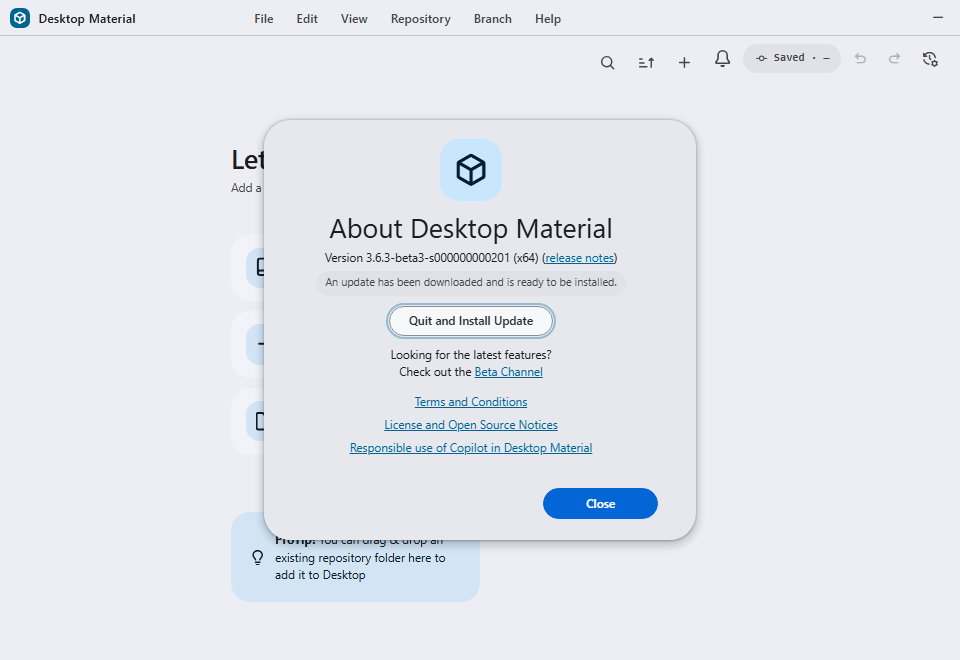
The detailed fail-closed, remote, package, log, headless-desktop, and
cleanup receipt is in docs/verification/auto-updater-version-order-2026-07-22.md.
2026-07-23 Cheap LFS registry storage and automatic push batching
This continuation is integrated, locally build/UI accepted, and
remotely published through corrective source c22e29a03a.
Its exact-source cloud, CI, CodeQL, Pages, and six-asset installer
Release receipts are recorded above. The subsequent repository-scoped
materialization serialization correction remains inside this overall
task but does not borrow those earlier remote receipts.
Cheap LFS commit preparation now keeps a compact terminal-style panel directly below Commit. It reports sanitized active paths, hashing/preparation/upload/ verification phases, per-file and aggregate bytes, and completed/failed counts. The persisted Upload up to three large files at once toggle defaults on and limits Release or OCI transfers to three; disabling it restores sequential work. The Changes filter can isolate files strictly over 100 MiB. A per-file upload failure removes that raw path from the current commit but leaves it selected for retry; successful pointers and unrelated safe changes may commit, and an all-failed selection creates no empty commit.
Repository settings → Build & Run → Large-file storage now selects a published GitHub prerelease, GHCR, or Docker Hub. New Release buckets are real published prereleases, not drafts, and exact older Desktop Material drafts are published in place after revalidation. The progress panel also computes a byte/capability recommendation without changing the saved provider: ordinary Git at or below 100 MiB, Releases for one transfer totaling at most 1.5 GiB, private-source GHCR for a larger eligible GitHub.com batch, Docker Hub when it is locally configured, and Releases when no registry setup is detected. These signals do not prove live quota, billing, organization policy, or service health.
The concrete user report in codingmachineedge/lowlevel-computer-use-mcp
was repaired without rewriting Git. Remote main
f2edfe442555cfe35a519dd0b058986cb09d6ee3 contains the
166-byte pointer for software/docker.exe. After
revalidating tag assets, release ID 357437469,
its one uploaded asset ID 486745803, exact size
638124464, and provider digest
sha256:a5b5837542f2f57fadbb09db90a60c84f8efc0a65f8d6dcd2e5b9fca3a2b87e6,
that exact legacy draft was published in place as a non-draft
prerelease. The four unrelated empty same-tag drafts were left
untouched. The stable public asset is now available from the assets
prerelease. The source repository currently contains only
.github/workflows/pages.yml and has no Cheap LFS
compression run, which proves why cloud compression never started. The
updated app will create the managed
.github/workflows/cheap-lfs-cloud-compression.yml caller in
Changes when that public repository is opened; by design it is not
silently committed or pushed, so the user must review and commit that
one workflow before compression can run.
GHCR and Docker Hub each use one logical
<source-name>-cheap-lfs OCI package with stable tag
desktop-material-cheap-lfs-v1. A complete current snapshot
is bounded to 4,096 objects, 8,192 layers, and 8 MiB each for canonical
config and manifest JSON. Add or remove inside those proof bounds
uploads only new content- addressed chunks, verifies a new immutable
manifest, creates and verifies its deterministic retention tag, moves
the stable tag, and rewrites current pointer- form files to that digest
while preserving verified materialized raws and their valid older
pointer metadata. Historical retention tags are not deleted. It cannot
mutate or append to an existing manifest or timed-out layer; unchanged
and already accepted blobs are reused, while a timed-out object is
reprepared at half the prior layer bound down to an 8 MiB floor. New
chunks start at 1.5 GiB, safely below GHCR's documented 10 GB layer
limit, and each GHCR ORAS process times out below the provider's
ten-minute boundary. Docker Hub has no hard layer-size or upload- time
limit encoded; current plan, pull, storage, abuse, and fair-use rules
remain external provider policy.
Same-provider updates retain the exact package coordinate already named by the committed/index-aware pointer inventory, including Docker Hub organization or collaborator namespaces. Only a first Docker publish defaults to the current credential username. GHCR-to-Docker or Docker-to-GHCR migration refuses unless every old pointer is an exact unedited materialized raw; it re-hashes those bytes, performs no old-provider pull or delete, publishes a fresh full snapshot, then rewrites the pointer-form paths. Mixed logical targets, same-provider relocation, pointer-form migration inputs, and edited raws fail before publish.
Verified-private repositories encrypt every OCI chunk with
AES-256-GCM. The shared key is intentionally committed at
.desktop-material/cheap-lfs-registry-key-v1 so authorized
private-repository collaborators can restore it. This protects payloads
from a registry-only leak; it does not protect them from anyone who can
read the private repository, an old clone, fork, backup, or Git history.
Key removal or rotation must retain old bytes for historical immutable
pointers. New private pointers bind the exact key with
key-id sha256:...; both canonical and legacy key paths are
reserved from pin/remove operations. Required-key staging overrides
ignore and selection state, proves the final commit-tree bytes, and
safely rolls back a hook-damaged commit. Credentials remain
operation-scoped: GHCR uses the selected GitHub.com account and Docker
Hub uses the trusted Docker Desktop credential helper, passing a token
to ORAS through standard input and clearing it afterward. A first public
GHCR package is refused before upload because GitHub creates it private
and exposes no supported visibility-change API; use Releases, Docker
Hub, or an existing exact-linked public package. GitHub browser sign-in
now requests write:packages; the account-scope audit offers
reauthorization for older tokens, while destructive
delete:packages remains excluded. GitHub's OAuth scope page
describes write:packages as granting package
upload/download, but its Container registry page separately says
Packages supports PAT classic only. The selected OAuth token passed a
non- mutating GHCR challenge; no live package mutation was performed, so
PAT-classic compliance is not claimed and any provider rejection fails
closed before the stable tag or Git pointers move.
Windows builds download and verify the official ORAS 1.3.2 AMD64
archive, executable, and license before packaging. The installer ships
the Apache-2.0 text as
static/cheap-lfs/oras/LICENSE.ORAS.txt. Both package
architectures use that audited x64 executable, so the ARM64 package
depends on Windows 11 x64 emulation and fails closed if it cannot
start.
The default-on clone/open detector now scans Release and OCI pointers
before it requires a selected Releases account. Explicitly public
GitHub.com Release and public OCI pointers can materialize while signed
out. Anonymous Release reads omit Authorization; Release
mutations and private/unknown reads stay account- gated. Private OCI
pointers fail closed without matching credentials and the tracked key.
Updated Desktop Material repairs an old pointer-only clone by reopening
it or by choosing Large files → Materialize all.
Original bytes remain in Release assets or immutable OCI layers, and
verified temporary bytes replace the working-tree pointer atomically
only after size, digest, source identity, visibility, and (when
applicable) GCM checks pass.
Ordinary Git commits now stay below a decimal 1.5 GB
(1,500,000,000-byte) push ceiling by using a 1.4 GB
changed-blob budget and bounded path/proof overhead. The app forms
stable path batches, creates one commit, records a durable
branch/remote/path intent and pending-commit ref, pushes it with
ordinary fast-forward rules, proves that exact commit as the same remote
tip, and only then creates the next commit. Intent-to-pending and final
cleanup are atomic two- ref transactions. No later commit exists after a
failed or ambiguous push; retry reconciles the exact intent and resumes
the pending push before new commit work. A required tracked
private-registry key is promoted into batch 1 and included in the
byte/path/proof budget exactly once. Push also inspects local- only
commits made by older app versions. Existing individually safe commits
are pushed and proven one at a time without changing their SHA, author,
timestamps, message, or signature before any new working-tree batch is
created; a currently pending batch bypasses that legacy rewriter. An
individually oversized commit can be rebuilt only on a clean, linear
local-only branch with an exact configured or resolved destination and
no Git operation. A compare-and-swap ref below
refs/desktop-material/commit-batch-backup/ protects the
original tip. Before the first proven push, a safe failure restores it;
after a proven push, the app never rolls the branch backward and retains
the recovery ref when needed. Every replacement batch must reproduce the
expected path modes and object IDs, and a candidate already reachable
from any configured remote is never rewritten. Rebuilding preserves the
reviewed message and final tree but creates new commit IDs, does not
preserve cryptographic commit signatures, and does not promise the
original author timestamp on each replacement batch. Final tree equality
and every replacement path's exact mode/object ID are proven before
success.
Every app-owned commit entry point supplies process-local
-c gc.auto=0; no repository/global setting is changed. The
commit flow records HEAD and verifies the new commit's object, tree,
parent transition, and message. If Git exits nonzero only after creating
that exact commit (for example an unrelated post-commit maintenance
failure), Desktop Material accepts it once and shows a maintenance
warning. An unchanged, unreachable, or unexpected HEAD remains a real
failure and is never retried into a duplicate commit.
Local acceptance is recorded in the dated
Cheap LFS commit-progress receipt. The initial
c3db37ea55 worktree's unpackaged production build returned
0 after 400.46 seconds (404.3
seconds wall) through Lowlevel MCP and produced
out/renderer.css SHA-256
6381556b36c295ba47ad90e8080f4079cbc61951bd7811ab9cb9fc3520638cb1.
That is retained as historical first-publication evidence; the
responsive correction's current build receipt is the 390-second
6fba1434… build above. The current promoted accepted frame
is:
| Frame | Dimensions | Bytes | SHA-256 |
|---|---|---|---|
docs/assets/screenshots/cheap-lfs-commit-progress.png |
1440×960 | 113,869 | 3d6358567126e3ce0504b04c4489abbfd473b77546bd82dac834553d50fe9333 |
The wide English receipt passed all 36/36 named
assertions, including noBlockingDialog, plus its
deterministic one-pointer selection receipt and contains all three
worker rows. The final 640×960 bilingual receipt also passed all
36/36 named assertions after one real pointer attempt.
Its 85,175-byte capture has SHA-256
1b99c827d1b5b2cf05298fb1255873acdf0502f72a40437c378c0be7bb989e50,
keeps the progress surface at y=942 inside the y=944 panel, and contains
no injected diagnostic style. The earlier 1,466.27-second build,
107,411-byte wide frame, and visibility-hidden narrow failure remain in
the dated receipt only as superseded interim evidence.
The corrected companion
material-github-releases-compact.png proof passed at 100%,
125%, 150%, and 200% in one 960×660 physical viewport. The promoted 200%
frame is 89,856 bytes with SHA-256
8e29ac666a0832d353126d8dd759200ba7e853016a940501e5c7cbdbb1cf992a.
Its 480×330 CSS viewport shows one complete 53.5 px row, 24-hour
timestamps, a wrapping bilingual disclosure, and zero horizontal
overflow. All compact scales measured the 176 px panel, 30 px target
floors, 9 px text floor, and the three-column metrics layout. Native
Enter expands/collapses the tools; available actions retain focus
semantics and the no-next-page pagination control remains correctly
disabled. The gallery source now contains 77 images,
including the dedicated live Bambu Cheap LFS frame.
Release/OCI operations pass 80/80, registry transport/runtime policy 77/77, disposable-Git batching 117/117, UI/settings/localization 157/157, ORAS scripts 8/8, the headless verifier contract 19/19, and the compact commit-shell style contract 7/7. The full Cheap LFS folder aggregate is deliberately reported as 261/262 because one wall-clock policy case exceeded its 2.5-second harness budget during concurrent heavy Git work; the isolated policy rerun passed 8/8, including that same behavior.
These UI/build receipts are local evidence for the initial
integration and its isolated responsive correction. The final acceptance
app PID 20836, HWND 1905774, provider PID
16700, hidden desktop, provider credential, ports
52613/53748, and exact owned temporary root
were stopped, deleted, or proved absent. The separately retained
installed-app Bambu environment remained untouched during that earlier
checkpoint. Corrective source c22e29a03a later completed
exact-source cloud, CI, CodeQL, Pages, and immutable six-asset installer
publication. Bambu commit 712ad85, cloud run
30048474438, verifier run 30054805137, its
immutable manifest Release, and the initial 10/10 fresh- clone hash
proof are now complete. Only the newer serialized materialization rerun
and its final promoted image remain explicitly pending above.
2026-07-22 Cheap LFS cloud compression implementation
Cheap LFS now has repository-local cloud compression without cloud
decompression. A generated caller pins actions/checkout and
Desktop Material's composite compressor to immutable SHAs, grants only
contents: write, and runs on pushes to the repository's
default branch or by manual dispatch. Public repositories receive
automatic setup in the Large files UI. Private repositories remain off
until the user explicitly enables a persisted setting; unknown
visibility fails closed, and the workflow repeats a live
event-visibility guard.
The Action downloads Release objects directly, raw-DEFLATEs one
object at a time at level 9, and uploads a verified side asset without
Actions artifacts or caches. A strictly smaller success changes only
that pointer object to the existing v1 part-deflate form
and pushes a [skip ci] commit. Mixed raw and compressed
multipart pointers are valid. Original raw assets are never deleted
because historical commits can still name them. Failed or non-beneficial
objects retain their exact raw pointer and remain cloneable; independent
later objects still run.
Desktop Material alone downloads and decompresses. Its existing bounded local inflate path checks the recorded output cap, original per-object size/SHA-256, and assembled whole-file size/SHA-256 before replacing a pointer. The UI labels raw, compressed, and mixed pointers, explains the local-only boundary, and offers English, playful Hong Kong-style Cantonese, and bilingual copy.
Focused tests exercise the real composite Action against a temporary
Git remote and fake Release API, workflow/policy ownership,
public/private UI controls, settings persistence, pointer state, failure
and non-beneficial fallback, ambiguous-push recovery, build-output-style
pointer paths, bounded draft lookup, atomic workflow replacement and
link rejection, repository-switch races, and local compressed-object
materialization failures. The final combined gate passed 134/134 tests
across 25 suites; all 27 script tests, repository-wide Prettier and
ESLint, the ESLint/Prettier compatibility check, TypeScript, and
git diff --check also passed.
Live cloud-compression acceptance is complete in the retained repositories:
- The public production UI wrote and pushed caller commit
72b2db3e0b6554364e07e5e34945c8be5c125216. Actions run29969707165succeeded and pushed bot commitf10d8d2acedbba0e3b5ce978dff09c25217cad9c. - The private production UI showed cloud compression off, then
recorded the explicit opt-in and pushed commit
3d398786dd4c599730e0dbb77b0c83a5fa14a57a. Private Actions run29969957449succeeded and pushed bot commit6259b0fa0dc6c65cdb5a90af8e1da9358b45b0ac. - Each bot commit changed only its payload pointer to
part-deflate. The public and private compressed assets are each 1,033 bytes, have stored digestsha256:8d22b086820b0896bdcb33cf965ebc275cb0b5f0b4c44a364aa4144c015f9f7b, and expand to the original 1,048,576 bytes with digestsha256:30e14955ebf1352266dc2ff8067e68104607e750abb9d3b36582b8af909fcb58. The corresponding raw 1 MiB assets remain uploaded for earlier commits.
The first public run, 29967844734,
also provides the live safe-failure proof. GitHub's tag endpoint
returned 404 for the draft release; the Action reported
0 compressed, 0 kept raw, 1 failed safely, did not rewrite
the pointer or remove the raw asset, and exited failed. The production
UI then materialized that still-raw pointer successfully with the exact
1 MiB digest above. After the bounded draft lookup correction, the
public and private compressed pointers were each materialized manually
through the UI and again produced that exact size and digest on the
local PC.
Draft lookup is deliberately bounded to 100 API pages of 100 releases, or 10,000 releases. If the exact draft tag is outside that window, the object fails safely and remains raw. A GitHub Release also holds at most 1,000 assets; because the historical raw asset is retained, a full Release cannot accept the compressed side asset and likewise stays safely raw until capacity is available.
The production bundle and all interaction ran through the fixed
Lowlevel MCP HTTP endpoint on the isolated
DesktopMaterialCheapLfsCloud-20260722-190000 headless
desktop. The accepted bilingual private-opt-in/compressed-row frame
is:
| Accepted local capture | Dimensions | Bytes | SHA-256 |
|---|---|---|---|
docs/assets/screenshots/cheap-lfs-cloud-compression.png |
960×660 | 105,577 | 9449e50f60cd298e9cc261e9044fc0cd93706a8e9f243dcceb88d63b6df9ab8d |
The canonical yarn build:prod wrapper could not start
because this fixed environment has no yarn executable. No
dependency was downloaded; the equivalent existing-dependency production
Webpack command compiled all five targets through MCP in 420.6 seconds
with ok: true, client_ok: true, and
returncode: 0. The one-time development alias and GitHub
credentials were deleted and verified absent, the production credential
was restored with no backup left behind, the exact Electron process and
zero-window headless desktop were closed, and the owned synchronized
test-clone run root was removed.
Publication is complete for source checkpoint
f7b4760a13894f0320f7b361f055f6fba40d913f, which is pushed
on main with a clean zero-divergence checkout. Exact-source
CI
29972351158, CodeQL
29972351173, and Pages
29972351147 all succeeded. Wiki commit
407cbf260c229e9f8e7fd86062afad83e5080f63 publishes the
synchronized seven-page source, and the live Pages gallery serves all 73
figures including the byte-identical 105,577-byte cloud-compression
capture. Downstream installer
run 29973527338 published non-draft, non-prerelease
latest Release v3.6.3-beta3-b0000040887
from that exact tag and commit with all six required Windows x64 assets.
The final source audit found only local/remote main, one
root worktree, and no stashes.
2026-07-22 live Cheap LFS public/private GitHub and UI acceptance
Live Cheap LFS protocol, history, and Desktop Material UI acceptance
completed through the configured DingDingChae account. Both
purpose-built repositories are retained on pushed main
commits:
- Public:
DingDingChae/desktop-material-cheap-lfs-public-20260722-153308, commita7c90eff6a4d7963577125e3204a1b9af28da756, release358270369, UI asset486477022(payload-public-30e1495.bin). - Private:
DingDingChae/desktop-material-cheap-lfs-private-20260722-153308, commite56519d4742c63bb2c9f5f1e917de3fca7379fdd, release358270368, UI asset486479377(payload-private-30e1495.bin).
Both releases remain draft prereleases tagged
assets-test-20260722-153308. The original backend assets
and the two UI-created assets are all uploaded at 1,048,576 bytes with
digest
sha256:30e14955ebf1352266dc2ff8067e68104607e750abb9d3b36582b8af909fcb58.
The public UI explicitly materialized and re-pinned its payload; the
private UI materialized on open in a fresh profile and passed the same
native-picker, review, upload, and pointer-replacement sequence.
The first live UI attempt exposed two defects: GitHub's exact
draft-tag route can return 404, and an absent asset label can arrive as
either null or "". The store now performs a
bounded release-inventory fallback, while the provider model normalizes
both no-label spellings. The focused Release-store and transfer/model
gates pass 17/17 and 41/41, TypeScript passes, and all five production
Webpack targets plus staging completed in 296.8 seconds.
Fresh public/private clones resolved to the exact UI commits above,
retained their earlier deterministic-pointer commits as parents, and
were clean. Their canonical five-line Git blobs are 201 and 202 bytes;
Windows CRLF copies are 206 and 207 bytes. git lfs ls-files
returned no entries, proving the test is real Cheap LFS history rather
than Git LFS metadata.
The user explicitly authorized a temporary bridge from the logged-in GitHub CLI account to Desktop Material's development secure store. The token was not printed, logged, placed in an argument/URL, written to source, captured, or committed. After both isolated UI runs, the exact credential entry was deleted and re-read as absent; the app PIDs, CDP ports, and off-screen desktops were also closed.
Both repositories include the generated Cheap LFS logo. The canonical
documentation copy at docs/assets/cheap-lfs-logo.png is
1254×1254, 1,091,778 bytes, SHA-256
34b2e68ad1e95f45cac08e3c2ee5d9981a35611d30b0deb7282a5c7fe0682a2f.
The accepted UI capture at
docs/assets/screenshots/cheap-lfs-ui-acceptance.png is
1200×752, 79,404 bytes, SHA-256
8f53ed803dc7415ca86e4399040201afbbd627718a48e4a453e637099fa03684.
Full evidence is in the dated
verification record.
2026-07-22 command palette rows, tab groups, Alt reliability, and release gates
The published baseline at 7edca120c5 introduced rich
command-palette rows, appearance controls, the first tab-group
data/actions, and its accessibility follow-up. That exact SHA is on
origin/main; CI
29895625564 and code
scanning 29895625583 passed. Build
Installers 29896993449 published the non-draft,
exact-target Windows release v3.6.3-beta3-b0000040881
with all six required non-empty installer/feed/portable assets. Those
receipts prove only that baseline; they do not verify the continuation
below.
The current continuation makes tab groups real, visible strip controls. One named/color-coded chip appears before each group's first member with a count, chevron, accessible expanded state, and active-group marker. Clicking the chip or pressing Enter/Space hides or restores the member tabs; focus and a localized status announcement return to the chip when a mutation removes the focused tab from view. Group creation, context actions, color names, chip descriptions, success/failure announcements, and accessible names now follow English, playful Hong Kong-style Cantonese, or bilingual mode.
Persistence now retains groups through open,
single-close, bulk-close, session-import, per-window serialization,
legacy-primary mirroring, reload, and unknown-field round trips.
Malformed/duplicate group records are repaired at the profile boundary.
A group can contain pinned tabs or unpinned tabs, never both: a
cross-boundary move is a no-op, preserving the invariant that every
pinned tab precedes every unpinned tab. Portable version-1 tab-session
exports deliberately strip groupId and do not export
profile-local group definitions; import preserves the destination
profile's groups rather than creating dangling memberships.
Group ordering is normalized as one contiguous block at load and after every structural mutation. Manual movement within the block keeps membership; moving a member outside the block ungroups only that tab. Label, opened-time, repository-status, and favorite arrangements sort whole blocks by their first member, and malformed cross-pin input degrades incompatible later members to ungrouped tabs rather than splitting one group across the boundary.
The command palette keeps its 760px shell, 520px result area, leading icon, title, optional keyword line, and group chip. The title/search/empty state, stable group labels, row search-term prefix, anchored appearance editor, and the Ollama/Copilot/background-queue discoverability entries now follow all three language modes. Search retains English and localized keys. Escape closes only the appearance editor and restores its toggle focus; density and row-part choices remain persisted and safely repaired.
Windows bare-Alt handling is now an isolated state machine: one uninterrupted bare press toggles once, held repeats remain part of that press, and Alt plus another key, Shift/Ctrl/Meta, prevented events, modal transitions, orphaned repeats, or out-of-order key-up events cannot leave stale state for a later toggle. Every Alt release consumes its pending sequence and clears the menu highlight path. This is covered as a deterministic keyboard-state contract; current end-to-end headless interaction evidence has not yet been recorded.
At this July checkpoint, the manual Super Express
Release lane ran the complete unit and script suites before its
production build/package. That test-before-build contract was explicitly
superseded on August 2 by the owner-directed zero-test emergency lane
recorded later in this handoff. Release pull requests continue to target
the Windows product's main default branch.
Local continuation acceptance is complete; publication is
pending. The exact unpackaged production build passed through
the fixed Lowlevel MCP endpoint in 394.1 seconds with
client_ok: true. An isolated off-screen run restored the
named group after relaunch, collapsed it to a selected
role="tab" chip, expanded it again, and confirmed the
member was visible. The same run opened the fully contained
command-palette appearance editor, kept Reset visible, and returned five
Ollama matches.
| Accepted local capture | Dimensions | Bytes | SHA-256 |
|---|---|---|---|
docs/assets/screenshots/material-tab-groups.png |
1000×687 | 94,467 | fd857137f71b79fbef65225e4469f2d2e3d95ecb6701e4847b84da11ad2875b8 |
docs/assets/screenshots/material-command-palette-appearance.png |
1000×687 | 99,234 | ac4db2aa3696d2e1987c0c93573ccf48f86c61111e42fcabf0cec54db3b87a7d |
README, Pages, the User Guide, and the 73-scene Guided Feature
Gallery now reference the two inspected synthetic-only captures plus the
separately accepted raw and cloud-compression Cheap LFS UI frames.
Implementation checkpoint
58be6fe5953477b015a134c414a8cf82363ecc75 is pushed on
main; exact final CI/code scanning, Pages/wiki publication,
and installer Release receipts remain required.
2026-07-22 mobile Pages, documentation search, and regenerated gallery
The published Pages site is now usable on a phone. The top app bar previously hid every navigation link below 760px, leaving Install/Features/Screenshots/ Docs unreachable; a hamburger control now discloses the same links as a stacked sheet with 48px targets, and a 480px breakpoint collapses the feature, footer, and principle grids to one column without page-level sideways scrolling. The rendered documentation template gained a sticky, wrapping header, a search field, and a compact type scale.
site/docs-search.html publishes as
docs/search.html and searches every rendered page from a
search-index.json built by
site/build-search-index.js during the Pages workflow (137
pages locally). Search accepts plain text or a regular expression with
match-case and whole-word options, highlights up to three excerpts per
page, guards zero-length matches, reports invalid patterns instead of
throwing, and mirrors state into the URL. A regex builder composes
contains/starts/ends/exact/any-of/all-of patterns with an optional
quantifier plus six ready-made snippets, previews the pattern, and
applies it to the query. The builder was exercised in a browser:
(?:cheap lfs|pull request) and
\b(?:timeout)+\b both compile.
Screenshot regeneration ran against a fresh production build on an
isolated profile with the deterministic loopback GitHub provider and
Ollama fixtures. 52 distinct canonical captures were promoted (50
replacements plus the new
material-repository-folder-detection and
material-repository-submodule-management, both added to the
Feature-Gallery catalog, the Pages gallery, and their two count
assertions, now 69). Two captures were withheld because they were
byte-identical to another surface
(material-api-app-functions matched the API explorer;
material-notification-bulk-actions matched the notification
centre), so the previously published images for those two remain in
place rather than publishing a duplicate as a distinct feature. Thirteen
further canonical scenes could not be made deterministic in this run and
their existing images are unchanged: error-notice, app-identity,
history-power-tools, remote-manager, logo-studio, submodule-context,
rebase-review, pull-request-compose, pull-request-open, pull-all,
history-deepen, history-deepening, merge-all, and cheap-lfs-preparing.
They need the additional submodule/shallow-clone/remote fixtures rather
than the base P0 fixture, and material-pull-preview and
material-ollama-model-manager are outside the canonical
set. No scene is reported as renewed unless its file actually
changed.
2026-07-22 Cheap LFS 1.5 GiB parts, no upload timeouts, Pages-hosted docs
Cheap LFS release uploads kept failing near the 2 GiB asset ceiling,
so CHEAP_LFS_PART_SIZE_BYTES now plans new parts at 1.5 GiB
while the pointer parser still accepts legacy parts up to exactly 2 GiB.
Release-asset uploads no longer apply any stall or total-runtime timeout
by default on either the GitHub CLI or Electron compatibility transport:
a transfer ends only on completion, transport failure, or user
cancellation. Tests keep injecting explicit
stallTimeoutMs/maximumRuntimeMs values to
exercise the watchdog paths, and the pointer contract test now pins the
legacy 2 GiB parse bound independently of the upload cap. Feature and
User Guide documentation were updated to match.
The GitHub Pages site now hosts the complete rendered documentation
set. The Pages workflow installs pandoc, renders every
docs/**/*.md (README files as folder indexes) plus the root
project documents through site/docs-template.html with
site/md-links.lua rewriting .md and wiki-style
links, and the site's Docs/Read-the-docs/Documentation links point at
the hosted docs/ index instead of redirecting to the GitHub
wiki. The render loop was executed locally with pandoc 3.10 (137 docs
pages plus root documents) and one page was visually verified. Local
verification: 142 passing tests across site accessibility, CI workflow
safety, release transfer, cheap-lfs, and pull-preview contract suites,
plus repository-wide TypeScript no-emit and Prettier on changed files.
Remote CI, the Pages deploy, and the express release are post-push
verification items.
2026-07-21 pull preview moved to right click on the toolbar Pull button
A plain left click on the toolbar Pull remote button now performs the pull directly via the dispatcher; the reviewed pull-preview dialog opens only from a right click on that button (wired solely to the pull-state button) or from the application-menu Pull action, which is unchanged. The pull-preview contract test was updated to pin the new routing, and the feature doc, docs index, wiki User Guide, and Feature Gallery now describe the click/right-click split. Verified locally with the pull-preview contract suite (5 passing tests), repository-wide TypeScript no-emit, and Prettier on changed files. Remote CI and release publication occur after push.
2026-07-21 reviewed pull previews
Ordinary pulls now open a reviewed Material dialog before mutating
the current repository. The implementation freezes the local/upstream
refs and full OIDs, ahead/behind counts, effective
pull.rebase/branch rebase/pull.ff plan, and
bounded incoming commit/file summaries. Confirmation revalidates that
identity, strategy, and a freshly read clean worktree, then integrates
the exact reviewed OID. Unsafe, stale, detached, conflicted, dirty,
failed-fetch, busy, and fast-forward-only-blocked states fail closed.
The dialog is globally modal and non-dismissible while Git runs, with
persisted English, playful Hong Kong-style Cantonese, and bilingual
copy.
Local verification on implementation source b86b4618d3
passed 92 focused tests across 24 suites, TypeScript no-emit,
changed-source ESLint/Prettier, git diff --check, and the
exact production command
npx --no-install cross-env RELEASE_CHANNEL=development DESKTOP_SKIP_PACKAGE=1 yarn build:prod
through Lowlevel MCP (exit 0; 625.37 seconds). The fixed MCP checkout
was ed1427f69b20dcd66df1de2ae3c6ba6591e2e640.
The app was exercised on the uniquely named off-screen Win32 desktop
DesktopMaterialPullPreview-b86b4618 against a synthetic
clean repository. The review showed local
6692f0306cb38b794ed44d910f32f554134aeff0, upstream
c5543728717b5029acc9b80c901dd22f6fcdc343,
0 ahead, 2 behind, a fast-forward plan, two
incoming commits, and three changed paths. Confirming the dialog
advanced HEAD to the exact upstream OID with +0/-0 and no
worktree changes. The inspected client-only screenshot is 960×660,
62,882 bytes, SHA-256
cbbfc9876ded7366aca8532a7d685fed4a959453c1ccfd1845f4dc7fc408895,
at docs/assets/screenshots/material-pull-preview.png; it is
nonblank, unclipped, and contains synthetic data only. The validated
Electron PID, hidden desktop, and containment-checked fixture root were
removed and confirmed absent.
The feature was replayed onto the latest remote baseline in an isolated publish worktree because another active task had unrelated edits in the shared checkout. Those edits were left untouched. Remote CI, Pages, installer/release, and live wiki synchronization are post-push verification items.
2026-07-21 CI lint newline repair
GitHub CI run 29879526652,
Lint job 88797062810, failed only during the
repository-wide Prettier check: opencode.json had no final
newline. The configuration values and permissions were already valid, so
the repair adds only the missing newline and does not change OpenCode
behavior. On the exact failing source plus this repair, the full
CI-equivalent yarn lint command passes Prettier, the
ESLint/Prettier-compatibility check, and repository-wide ESLint. Remote
CI and installer publication remain pending until this commit reaches
main.
2026-07-21 final pull-preview, Cheap LFS, and stale-overlap CI checkpoint
Reviewed pull previews now gate execution on fresh repository status, retain an atomic raw strategy/configuration snapshot, and parse changed-file output as a bounded stream. A busy sentinel and phase-locked modal prevent refresh, close, or footer actions from racing an active pull; accessible state and the footer remain synchronized with the exact phase. The privacy-safe reviewed pull-preview screenshot was accepted at 960×660.
Cheap LFS cancellation now opens an explicit confirmation instead of stopping the operation immediately. The GitHub CLI fallback streams the exact source, uses 1 MiB chunks to reduce renderer progress traffic, verifies the streamed digest, bounds retry, and reconciles the Release inventory before retrying so an ambiguous prior upload is never duplicated or deleted. Authentication, proxy authentication, cookies, and Basic credentials are redacted from bounded CLI diagnostics.
The manual browser handoff now stages only regular, nonempty files.
It uses a verified same-volume hardlink when possible and otherwise a
bounded copy; it never exposes a symlink that Explorer or GitHub can
interpret as an empty .symlink file. Multipart files remain
actual regular parts. Existing uploads with the exact expected size and
digest count toward progress and capacity, so a partial manual upload
can resume with only missing objects. Digestless legacy assets receive
bounded download/hash verification before reuse. Every reuse is
revalidated against a fresh complete Release inventory, followed by a
final inventory fence before any pointer is published.
The pre-integration Cheap LFS gate passed 189/189,
with the manual staging and partial-resume subset passing
23/23. After rebasing onto the final remote baseline,
the expanded Cheap LFS/Release selection passed 207/207
and the pull-preview selection passed 81/81. Root
TypeScript, configured targeted ESLint, targeted Prettier,
feature-document markdownlint, and git diff --check are
green on the merged tree.
Express Installer hotfixes 98bd712f2f and
484ebc0210 separate stale overlap from genuine CI failure
without dropping a successful Release. Every successful exact target
publishes its own immutable Release even after newer commits overtake
it. Creation is always non-latest; only a freshly revalidated current
main target is promoted, and a mid-promotion branch advance
triggers verified demotion. The flow deliberately avoids GitHub's lossy
shared concurrency queue. A real failed upstream CI still preserves the
artifact while the workflow remains failed. The focused workflow
contract passes 8/8.
Release v3.6.3-beta3-s000000000201
was already published from fa4806971c with all six required
assets. That is the verified installer-release baseline, not a claim
that the later hardening batch has published. The user explicitly
requested that completion not wait on future CI, and explicitly skipped
the GitHub Projects board; neither is a remaining acceptance gate for
this batch.
2026-07-21 final Git topology cleanup
Feature tip 5c0fec2381 was verified byte-for-byte as the
remote main tip before cleanup. Every remaining local and
remote topic-branch tip was proven an ancestor of that pushed default
branch. Eight merged local topic branches and four merged remote topic
branches were then deleted without force; the two temporary CI worktrees
had already been removed after their own remote proofs.
git worktree prune leaves only the clean main
checkout, the stash list is empty, all initialized submodules are at
their recorded commits, and local main has zero divergence
from origin/main at this checkpoint.
2026-07-21 printenvz Windows install-stage repair
The install stage failed building vendor/printenvz with
LINK : fatal error LNK1117: syntax error in option 'opt:lldltojobs=2'.
Node >= 24 Windows headers ship enable_thin_lto=true and
lto_jobs=2 in config.gypi, so the bundled
common.gypi Release config injects clang/lld-only flags
(-flto=thin, /opt:lldltojobs=N) into every gyp
target; MSVC link.exe rejects them.
vendor/printenvz/binding.gyp now forces
enable_lto=false, enable_thin_lto=false, and
lto_jobs="" on Windows through gyp's
conditions-inside-variables pattern, the only scope that survives
config.gypi include merging and still applies to
target_defaults Release conditions (target-level variables
are evaluated too late, and plain top-level variables are overwritten by
includes). Verified with the exact failing step
(node-gyp rebuild in vendor/printenvz):
build/Release/printenvz.exe links and runs, and the
generated printenvz.vcxproj no longer contains any
-flto/lldltojobs options. No cleanup of
branches, worktrees, or stashes was needed; the untracked
opencode.json predates this task and is intentionally left
uncommitted.
2026-07-21 Settings clone queue and mobile connection checkpoint
The durable automatic-clone policy now has a first-class Settings → Clone queue destination. One card per signed-in hosted account hydrates the saved base directory, parallel/sequential mode, and enabled state. A folder is required before enabling; changing the directory or mode while enabled updates the same policy immediately. Discovery still establishes a baseline and checks every five minutes, queues only newly discovered repositories, uses the existing three-wide/one-at-a-time modes and durable batch journal, and never opens an unsolicited progress dialog. The page does not expose the Agent API's fixed eight-running/64-waiting request bounds as user settings.
Settings → Agent access now keeps a localized
Mobile connection card visible in every mode. Local or
stopped states explain the required recovery; when Paired LAN mode is
running, Open mobile connection page first replaces any
existing pairing code, then hands the fresh five-minute one-use
/connect URL to the default browser. Its secret stays in
the fragment, is not logged or sent to the site server, and a
browser-open failure reports only a generic localized error.
Focused Queue, Agent access, and Settings registration coverage exercises policy hydration, directory choice/validation, enable/disable and clone-mode dispatch, fresh-link generation, unavailable states, browser failure, and all three language modes. The responsive inventory includes the new Settings page. Exact-source TypeScript/lint/format gates, production build, Lowlevel MCP off-screen interaction and screenshot acceptance, remote CI, Pages/wiki sync, Release verification, and final topology cleanup remain separate acceptance steps and are not claimed by this checkpoint.
2026-07-21 manual multipart Cheap LFS and express release checkpoint
The browser-assisted Cheap LFS fallback no longer rejects a file
merely because it exceeds GitHub's per-asset size limit. Planning first
stats the complete batch, fails before expensive hashing when projected
parts exceed one Release's 1,000-asset cap, streams whole/part SHA-256
values, allocates one bucket with room for the complete batch, and
reserves collision-safe names. A large source becomes ordered
.partNNN files in the private handoff folder using 1 MiB
bounded range copies. Small sources retain symlink, hardlink, then
bounded-copy fallbacks. Hash and copy callbacks are time-throttled
before they reach the renderer, the preflight reserves the worst-case
copy fallback plus verification space, and Unicode/Win32 case variants
cannot collide in the flat folder.
The existing single action opens the exact Release editor and the prepared Explorer folder. Polling remains cancelable for roughly six hours, backs off to 30 seconds, scans the bounded paginated inventory once per attempt, accepts only new uploaded IDs with exact names and sizes, downloads and hashes every part sequentially, then rehashes every source before writing any pointer. A version-2 handoff manifest records original nested paths and all flat asset ranges. Materialization uses the bounded preview when sufficient and otherwise caches the complete paginated Release inventory before resolving pointer parts, so assets beyond the preview page are not reported missing. Subfolders remain encoded in each tracked pointer; they do not need matching Release folders.
Build Installers / Express Release keeps the automatic
successful-main-CI path and adds a manual main-only fast path whose
Linux lint, Windows x64 trampoline/unit/script tests, and Windows x64
build/package jobs run in parallel. A failed or cancelled main CI still
runs the package lane for a recoverable Actions artifact but cannot
publish. The package job uploads the exact ZIP/EXE/MSI/Squirrel payload
as a three-day uncompressed artifact before release-note generation and
publication. The publisher revalidates current main and tag absence,
then uses one create-only gh release create --notes-file
call. A deterministic package-version-plus-commit-count tag prevents
reruns from inventing a second release for the same source commit.
The shared CI setup action restores only an exact installed-dependency cache keyed by platform, target architecture, toolchain, manifests, lockfiles, install configuration, post-install logic, and local vendor inputs. It includes Playwright's external FFmpeg payload; Python setup remains unconditional. Cache hits and cold installs validate package sentinels before use or cache save; misses retain bounded install retries. Build output, installers, Release payloads, credentials, and runtime configuration are not cached. Focused Cheap LFS, UI, workflow-safety, setup-action, and release-note tests currently pass 72/72. Remote CI, cache-hit timing, live multi-gigabyte browser upload, and Release publication remain external verification rather than claims in this checkpoint.
2026-07-21 responsiveness, resource lifecycle, and CI handoff
The lag, hang, and retained-resource implementation is integrated
through 2a2742796bdf65fc8562b317dcb73423bff9aa30. The final
task branch is rebased onto the concurrent clone-queue/mobile-settings
work at fa4806971c; its two task commits update the
temporary-submodule build-fix guard contract and make wide anchored
appearance editors use their intended 780 px shell without changing the
compact 390 px fallback.
The focused Git/process gate passes 30/30, the changed-test/Pages/wiki gate passes 84/84, the complete UI directory passes 815/815, and the full all-files run passes 1,491/1,492 with one intentional skip and zero failures. After the later release, CI, and settings integrations, the combined Cheap LFS/release/workflow/guard/responsive-editor gate passes 83/83.
The fixed Lowlevel MCP checkout remained clean at
ed1427f69b20dcd66df1de2ae3c6ba6591e2e640. App-source
candidate aabb111d2c01f38e7535ab077048816a5ad16893
completed the required no-download production build; all five Webpack
configurations compiled successfully and the build finished with
Done in 1178.13s. The later fa4806971c app
feature arrived while that build was running, so the pushed-SHA Windows
CI result is the required final integrated build proof.
The first off-screen screenshot candidate was rejected during final visual audit because the 780 px repository-toolbar editor was clipped by its 390 px anchored shell. The shell-width defect is now fixed and covered by a responsive style contract. The rejected PNG is not published; the tracked gallery image remains unchanged, and a fresh final-source recapture is follow-up evidence. All owned Electron processes, loopback listeners, and headless desktops from the rejected run were closed.
Remote CI proved the Playwright cache validator fix on Windows x64,
packaged E2E, and arm64. The remaining x64 failure was exactly the stale
runOpencodeFix source assertion corrected by this branch. A
concurrent opencode.json merge then added a
missing-final-newline lint failure; this handoff formats that file as
well. Exact pushed-SHA CI, installer, and Release verification remain
pending.
2026-07-21 remote discovery hard-total-bound follow-up
The responsiveness correction is rebased additively onto
910f7de5be3b577e4492d65c1162fcea962d7652. Remote
default-branch discovery still receives five seconds, including proxy
environment preparation. If that deadline aborts an owned Git process,
process-tree termination receives one final five-second grace window.
The advisory post-fetch lookup therefore has a ten-second hard
settlement bound even when taskkill/SIGKILL completes without an
observable child close. Its termination promise receives a
rejection observer as soon as abort starts, including after the caller's
bounded wait has ended. Clone cancellation continues to use the
unbounded strict-close barrier.
Repeated environment preparations for the same exact URL and resolver now share one in-flight system proxy promise. A timed-out caller can stop awaiting without starting duplicate unresolved operating-system work; success or failure evicts the entry and authentication environment assembly remains per operation. Electron exposes no abort signal for proxy resolution, so one permanently stalled entry can remain for each distinct URL until resolution or restart.
The Windows helper audit found only the existing environment-derived
SystemRoot pattern (and equivalent WINDIR
guesses) in this Node/Electron codebase, not an authoritative
GetSystemDirectoryW binding. The correction therefore
preserves the existing realpath/type/basename/containment validation and
C:\Windows fallback instead of substituting a different
guess. Independent Windows-installation-directory authentication remains
a defense-in-depth item.
Deterministic focused coverage passes 30/30: injected never-settling and late-rejecting terminators, the normal cleanup barrier, same-URL proxy coalescing and eviction, and clone's unchanged strict termination barrier join the existing remote-HEAD/account/clone tests. The exact rebased changed-test, Pages, and wiki set passes 84/84. Root and script TypeScript, changed-source ESLint and Prettier, categorized feature Markdown, and diff integrity pass on the same tree. This local checkpoint claims no push, CI, package, wiki deployment, or Release.
2026-07-21 temporary submodule viewer and dialog-wheel checkpoint
The changed/new submodule commit card no longer calls the permanent
openOrAddRepository path. It resolves the clicked absolute
checkout back to a currently declared submodule, rejects relative or
unrelated paths, and enters the existing validated
SubmoduleRepository path. That model remains absent from
the repository database, Recent, tabs, and last-selection persistence
and keeps the established read-only mutation/process boundary.
The manager and diff card now say Open temporary viewer instead of promising normal repository management or commits. English, playful Hong Kong Cantonese, and compact bilingual resources explain the read-only/no-import boundary. The temporary context bar adds a visible, accessible, responsive Close viewer action beside the customizable Back control. Both use the same guarded return path, which disposes temporary caches and restores the persisted parent.
The shared dialog shell now routes wheel and trackpad gestures from
any descendant to the nearest vertical owner with remaining range.
Nested lists and editors consume their own range, an owner at its edge
lets the outer body take the next gesture, preventing controls and
Ctrl+wheel retain ownership, and a background floating
dialog still requests front through the existing stack.
Local verification passed 103/103 checks: 67
temporary-viewer, localization, and Pages contracts plus 36 existing
dialog/responsive/style regressions. Root TypeScript no-emit, targeted
ESLint, targeted Prettier, and git diff --check passed. The
fixed Lowlevel MCP endpoint at http://127.0.0.1:8765/mcp
timed out during startup_status; the visible desktop was
not used as a fallback. Therefore this checkpoint claims no exact
production build, off-screen screenshot, remote CI, or release. After
rebasing onto d6dd74b9d761f3b384788af8b2a8889213017d4b, all
six changed test files pass 46/46; root TypeScript and
exact changed-file ESLint, Prettier, Markdown, and diff gates also
pass.
2026-07-21 Cheap-LFS CLI-first crash containment and direct manager
Production Release-asset uploads now try the trusted, exact-length
GitHub CLI transport before Electron. This prevents the reported fatal
mojo result not ok: 9 path when a validated
gh.exe is available: Electron's native chunked upload data
pipe is never opened for that attempt. GitHub CLI credentials remain
isolated, progress stays bounded, and cancellation/quit still tears down
the owned child process. The memory-bounded Electron uploader remains
only as the compatibility path when the trusted CLI cannot be
resolved.
The repository rail now has a direct, localized Large files destination. Its Cheap LFS manager lists committed pointers from nested folders, searches by path, pins reviewed files, materializes one or all objects, and owns a stable vertical scroll region. Users no longer need to locate or decode assets in the GitHub Releases catalog. The existing Release editor plus flat temporary-folder handoff remains available for explicit browser recovery; its manifest still maps every asset back to the original repository-relative path.
The manager, repository-section mapping, scroll contract, and all three language modes pass 48/48 focused tests across six suites. This checkpoint does not claim a live multi-gigabyte upload or final packaged-app visual receipt.
2026-07-21 CI update-coming-soon and exact-SHA Release notes checkpoint
The updater now distinguishes “no release yet” from “GitHub Actions
is actively building or packaging a newer commit.” After Squirrel
reports no update, a bounded unauthenticated provider probe derives only
the configured HTTPS GitHub release feed and reads exact
ci.yml plus build-installers.yml run data. It
accepts only an in-progress main push CI run or
workflow-run/manual-dispatch installer run under the expected workflow
path. Bounded job data must also prove that run's exact
Windows x64 build/packaging job is in progress for the same
run ID and SHA. GitHub's compare endpoint must then prove that exact SHA
is ahead of the installed exact __SHA__; equality,
behind/diverged state, malformed data, a non-GitHub feed, network
failure, and rate limiting all retain the ordinary no-update state.
The accepted state is the new in-memory UpdateComingSoon
enum and is never stored. About renders New update coming
soon, 新版本就快焗好出爐, or the compact
bilingual composition from the existing persisted language preference.
The ordinary last-check timestamp remains compatible. An
update-transition generation prevents a delayed Actions/compare result
from overwriting a real Squirrel available/downloaded event, and the
check button plus existing four-hour schedule continue to use the normal
release feed after publication.
Build Installers now checks out full history at the same
exact RELEASE_TARGET_SHA already protected by the initial
and pre-publication main checks. A new TypeScript generator reads the
latest published Release through a 256 KiB authenticated response,
resolves its tag, requires ancestry and exact HEAD,
collects at most 50 newest exact commit IDs/subjects in the range, and
caps the final body at 24,000 characters. Subjects are
whitespace/control normalized, limited to 180 characters, and
neutralized for Markdown, HTML, and mentions. The notes expose the exact
range and commit links, report omitted history, preserve the update-feed
explanation, and reach the single release action through
body_path; mismatches fail before publication.
CI, installer, and Pages now make the overlap contract explicit: each
invocation has a unique run_id/run_attempt
concurrency group and cancel-in-progress: false. A newer
run therefore cannot cancel active work or replace GitHub's single older
pending slot. The workflow source contract scans every YAML workflow to
reject cancel-in-progress: true and any declared group that
omits either uniqueness component. Release notes are generated before
the final main/tag revalidation, keeping that fail-closed check
immediately adjacent to the single publish action.
Focused updater, persisted-state, race, English/Cantonese/bilingual,
non-cancelling workflow concurrency, exact Git range, sanitization,
bound, and first-release checks pass 35/35. Root app
TypeScript and script TypeScript pass. The implementation has not been
pushed or exercised by remote Actions, so no CI run or sample published
Release is claimed. The fixed low-level MCP preflight passed after its
stalled scheduled task was restarted, but the mandated no-download
production-build command could not start because this host has no
yarn executable; no headless GUI capture is claimed.
Integration must preserve the exact workflow filename and include the
generator, workflow, runtime, tests, feature docs, wiki, Pages, roadmap,
and this handoff together.
2026-07-21 Codex CLI support for Build & Run repair
Build & Run's existing OpenCode repair path now also supports the Codex CLI. The failed-build and free-form send dialogs expose the same provider selector, persist it per repository, and retain a separately gated per-run auto-approve choice. Settings exposes both preferences. New labels and guidance use English, playful Hong Kong Cantonese, and compact bilingual resources.
The installed codex-cli 0.144.0 help was inspected
directly before the runner was written. Detection uses shell-free
codex --version and codex login status.
Execution uses the supported stdin form:
codex --ask-for-approval <on-request|never> exec --sandbox workspace-write \
  --disable hooks --ephemeral --ignore-user-config --ignore-rules \
  --color never -
A local parser dry run of that complete option prefix with
--help exited 0; putting --ask-for-approval
after exec exited 2. A second installed-CLI probe confirmed
that --disable hooks disables the stable hooks feature and
--ignore-rules is accepted. The exact root-option order and
flags are locked into the pure and runner tests.
The child cwd is the repository root. Neither the
repository path nor prompt enters argv. A selected nested profile
directory is lexically validated to stay inside the repository, capped
at 1,024 characters, and included in stdin only. Failed-build output is
capped at 4,000 characters, free-form input at 8,000 characters,
captured detection output at 8,000 characters, and each streamed line at
16,000 characters. Both providers retain the existing bounded
dialog/panel buffers and application-owned shutdown barrier. Operations
are owned by the exact renderer WebContents; duplicate IDs
are rejected, foreign cancellation is ignored, owner
navigation/destruction aborts and awaits the process tree, and panel
Stop fences the verification rerun. Codex never
receives the dangerous sandbox-bypass flag.
--ignore-user-config skips the user's base config,
--disable hooks disables lifecycle hooks, and
--ignore-rules skips user/project execution-policy rules.
An inert installed-CLI probe also established that
mcp_servers={} does not clear MCP servers contributed by
trusted project .codex/config.toml, and Codex CLI 0.144
exposes no verified blanket MCP-disable switch. Project Codex
configuration therefore remains an explicit repository trust boundary;
the integration does not claim MCP isolation.
Missing Codex installs show
npm install --global @openai/codex behind explicit consent.
Missing authentication points to codex login in a terminal
and states that Desktop Material does not request or store secrets.
Agent completion never establishes success: the dispatcher still runs
the selected Build & Run profile again unless the operation was
cancelled.
Verification from the isolated codex/codex-build-fix
worktree based on
2a2742796bdf65fc8562b317dcb73423bff9aa30:
- focused Codex/OpenCode, ownership, cancellation, repository-identity, localization, IPC, shutdown, settings, panel, and dialog tests passed 115/115;
- root TypeScript
--noEmitand script TypeScript compilation passed; - changed-source ESLint and Prettier passed; and
- the categorized feature guide/index and
git diff --checkpassed.
The README, categorized feature documentation, roadmap, local wiki sources, Developer Guide, User Guide, and Pages source now describe the feature and its safety/failure contract. A packaged production UI run, screenshot acceptance, default-branch integration, remote CI, wiki/Pages publication, and release proof remain pending. This branch is intentionally committed without push or merge so the coordinating agent can integrate it with the other July 21 worktrees.
2026-07-21 Cheap-LFS recovery, output controls, and portable-ZIP checkpoint
This earlier checkpoint removed two misleading Cheap-LFS progress states from the compatibility Electron path. A two-minute no-forward-progress watchdog aborts its owned request, and the transfer reserves 100% until an exact provider response or reconciled asset proves GitHub accepted the object. The later CLI-first checkpoint above prevents that native data pipe from opening whenever the trusted GitHub CLI is available.
A stalled request now retries automatically through a fixed
gh api transport. HTTP 411 also selects that exact-length
path because GitHub requires Content-Length while Electron
needs chunked mode for memory-bounded multi-gigabyte requests; HTTP 502
selects it because the failed native request may have left an asset in
starter. Each reconciliation scans at most the ten
100-object Release pages once, then polls only the discovered asset ID.
An exact uploaded name, label, size, and digest is reused, while a
persistent incomplete object fails closed without clobbering or deleting
it. A failed CLI process gets one post-failure reconciliation in case
GitHub committed the upload before the transport error.
The fallback resolves only the real
Program Files\GitHub CLI\gh.exe, uses no shell, and
supplies the selected account token only through a scrubbed child
environment and one temporary empty GH_CONFIG_DIR.
Inherited GitHub credentials/debug state, prompts, update checks,
telemetry, spinner, and color are disabled. The exact validated source
range streams through stdin while its SHA-256 and progress are
calculated; stdout/stderr, no-activity time, and total runtime are
bounded. Cancellation terminates and awaits the owned process, and the
temporary configuration root is removed. Application quit now stops
accepting Release transfers, aborts all active native/CLI work, and
waits for their completion through the existing owned-process shutdown
barrier. Missing CLI, failed CLI, and incomplete-asset results have
localized English and playful Hong Kong Cantonese recovery text;
bilingual mode composes both. The explicit browser/Explorer
drag-and-drop handoff remains available when the user chooses manual
recovery.
The Build & Run panel now exposes a one-shot Scroll to bottom action, persisted Auto-scroll output, and persisted Truncate long lines. Reading older output automatically pauses auto-scroll; enabling it again jumps to the tail. Truncation is display-only: the full line remains in the DOM and Copy all output retains the original text. Both toggles expose pressed state and all three names use the English, Cantonese, or shared bilingual translation path.
Windows packaging now creates
dist/GitHub Desktop-x64.zip from the complete packaged
application tree before building the Squirrel outputs. Native Windows
tar.exe streams a ZIP64-capable archive to
.partial.zip, lists it to reject a truncated/corrupt
result, requires non-zero size, then promotes it atomically. The release
workflow collects that ZIP beside the EXE, MSI, update manifest, and
NuGet packages and treats a missing or empty ZIP as a publication
failure. This also makes the same portable output available from a local
Windows production build and yarn package if remote CI is
unavailable.
Verification is deliberately recorded by subset rather than as one unrun total:
- transfer plus localization passed 34/34 (21 transfer and 13 i18n) after the watchdog, CLI, reconciliation, error-copy, and shutdown changes;
- Build & Run UI, style, and localization passed 42/42;
- portable-ZIP and CI workflow contracts passed 11/11; and
- root TypeScript no-emit, script TypeScript, and the applicable focused ESLint, Prettier, and diff checks passed at those checkpoints.
The combined Cheap-LFS, transfer, output-control, style, localization, workflow, and portable-ZIP gate passed 165/165 across 18 suites. A complete local production package has not yet run. Therefore this checkpoint does not yet claim a full-size local ZIP/installer, an exact production-build receipt, remote CI, or a published release containing the ZIP. Those receipts must be appended after they exist.
2026-07-21 Cheap-LFS 0% transport repair and manual Release handoff
The automatic Release-asset upload's 0% deadlock was traced to
Electron's ClientRequest.write() contract: it returns
void, while the old pump treated that value as Node
backpressure, paused the source, and waited for a drain
event Electron never emits. Commit
c4403f2a0faf6e96fb53be3c5a9f4587f4a219c7 now advances the
stream from Electron's write callback and reports accepted-byte
progress. It was fast-forwarded to origin/main; CI
29853767664, CodeQL
29853768026, and Build
Installers 29855717704 all passed. The exact commit is published as
non-draft release v3.6.3-beta3-b0000000266
with the canonical/full x64 NuGet packages, x64 EXE, x64 MSI, and
RELEASES.
The follow-up manual fallback is implementation-complete.
Manual upload is available beside
Cancel only during an automatic upload. It stops that
attempt, plans every remaining file as one collision-safe batch, splits
sources above the Release limit into ordered .partNNN
assets, and creates a random upload-these-files handoff.
Whole files use symlink, hardlink, then a bounded streamed-copy
fallback; multipart ranges use bounded 1 MiB streamed copies. It opens
the validated exact GitHub Release editor before bringing Explorer to
the front, and polls for the user's drag/drop upload. GitHub Release
assets are flat, but the manifest and pointers preserve every original
repository-relative subfolder; duplicate basenames receive hash-suffixed
asset names. Only newly created exact-name/exact-size asset IDs are
accepted. Every asset is downloaded and SHA-256 verified, every source
is rehashed before any pointer is written, and the original commit
resumes automatically. Explicit cancel is distinct from
account/repository aborts. Every multipart part counts toward the
1,000-asset bucket cap and remains in one release with its logical
file.
A later live multi-gigabyte attempt exposed a separate
1%/out-of-memory failure: Electron buffers a ClientRequest
body internally when chunked encoding is not enabled. The upload adapter
now removes the conflicting Content-Length only at the
Electron boundary and enables chunkedEncoding before the
first write. The validated byte range still bounds every read and
progress value, while Electron can release streamed chunks instead of
retaining the complete asset in process memory. The focused transfer
suite proves the flag is already active on the first write, the length
header is absent, authentication/type headers survive, only one source
chunk is in flight, and the exact range reaches the request. Commit
e90f1765017892a857cc6d4ecad791b122c03412 is on
origin/main; its CI
run 29858326644 passed lint, Windows x64 tests/package, Windows
arm64 package, and packaged x64 E2E.
The same repair now enforces GitHub's 1,000-asset Release capacity as
a complete repository-local bucket family: assets,
assets-2, assets-3, and later exact tags. All
ten 100-item pages are inventoried. An automatic multipart file or
complete manual batch is allocated as one group, so a group that would
cross the remaining slots moves intact to the next Release and every
pointer, refresh, rollback, handoff, and verification uses that selected
tag. A group above 1,000 is rejected before hashing or per-file I/O.
Provider objects still in the starter state count toward
capacity and name collision checks but are shown as processing and
cannot satisfy manual detection, upload success, download, or
materialization. Exact single-release JSON remains bounded at 8 MiB so a
legitimate 1,000-record response fits; list responses keep their smaller
2 MiB boundary.
Rollover acceptance covers 998 existing objects plus a two-part file
staying in the base bucket, 999 plus two parts moving together to
assets-2, the matching two-file manual case, exactly 1,000
objects across ten capped pages, pre-I/O 1,001 rejection, and
starter-to-uploaded polling. The expanded
related suite passed 165/165; after the final audit
added rejected-asset cleanup and wrong-tag refresh guards, its focused
transfer/operations rerun passed 34/34. TypeScript
no-emit, scoped formatting, and diff validation also pass.
Local acceptance passed 104/104 focused tests across
the transfer pump, cheap-LFS operations/automation/manual flow, GitHub
Release parsing/API/store, asset download, and commit UI. TypeScript
no-emit, scoped ESLint, scoped Prettier, and
git diff --check passed. The exact low-level-MCP production
build (RELEASE_CHANNEL=development,
DESKTOP_SKIP_PACKAGE=1) returned
client_ok: true after 840.62 seconds. The resulting app
launched on the uniquely owned
DesktopMaterialCheapLfsManual20260721 off-screen desktop
with only a synthetic Git fixture and isolated user data. Its 960×660
client capture was nonblank, unclipped, light-themed, private-data-free,
and SHA-256
4267b4e51261c170ee994b70696080207f4df1f47f13488d55f025f525e537b3.
The server's generic resize/close helpers could not resolve their own
headless HWND; the exact saved Electron PID was therefore terminated as
the documented fallback. The window list reached zero, the desktop
closed, and the validated Temp run root was removed. No public
screenshot was promoted.
No live browser drag/drop was performed; direct draft/GHES editor
routes, pagination, pre-existing-ID exclusion, basename collision
handling, remote and source corruption, cancel cleanup, and link/copy
fallbacks are deterministic unit coverage. During final verification the
user's still-running visible app was read-only inspected and found to be
build b0000000256, started before the repair was published.
It therefore cannot contain either the b0000000266
transport correction or this follow-up manual fallback; the visible
process was not closed or replaced by the verifier.
2026-07-21 — lag, hang, and resource lifecycle hardening
This milestone is implemented in the isolated
codex/fix-lag-hangs-20260721 worktree. It started from
c4403f2a0faf6e96fb53be3c5a9f4587f4a219c7; the primary
checkout's unrelated dirty feature set remains preserved and untouched.
Concurrent upstream work advanced through 41ce24d6b8,
e90f176501, and 09b3a0ee89; this task is
rebased onto 09b3a0ee89f520621f0db6be077f0ab70b2b4221
without overwriting it.
Proven defects and fixes
- Upstream issue desktop/desktop#22039
records a roughly 10-second fetch followed by repeated 365–371-second
git remote set-head -acalls on a very large ref inventory. Desktop Material now validates and reuses an existing local remote-HEAD symref during background refresh only while its target exists. A user-initiated fetch refreshes the remote default with the selected account and a five-second hard bound, detecting a rename even when the old branch remains. Missing, dangling, malformed, empty, and cross-remote background values retain exactly one authenticated discovery. PopupManagerintentionally de-duplicates popup types, but concurrent askpass calls previously created a second promise without a second visible prompt, leaving that caller unresolved forever.TrampolineUIHelpernow serializes host-key, key-passphrase, SSH password, generic Git credential, and GitHub sign-in prompts through a non-poisoning FIFO. Manager de-duplication, explicit removal, and stack eviction now settle promise-backed popups; a removed sign-in flow also clears its retained store callback. A deliberate contextual replacement now settles the old popup owner exactly once with areplacedreason; sign-in replacement preserves global state for the new owner while an ordinary removal still resets it.- Appearance sliders could enqueue hundreds of full ownership checks,
crash-safe file writes, state emissions, and local-Git work in one
gesture.
DedicatedSettingStore.set()now coalesces adjacent synchronous calls into one latest-value mutation while keeping queuedget()reads, flushes, and history actions as ordering barriers. Sequential awaited writes and the 250-millisecond commit debounce retain their prior semantics. - Failed/cancelled Electron requests ended at
onErrorOccurred, but the same-origin filter deleted request IDs only fromonCompleted. It now removes either terminal path, preventing process-lifetime map growth while preserving cross-origin authorization stripping. SandboxedMarkdownregistered its document scroll listener in capture mode but removed it without the capture flag. Unmount now performs matching removal, cancels pending debounced scroll work, and clears iframe document and frame references.
Current local evidence
- The combined remote-HEAD, prompt FIFO, appearance-store, and same-origin gate passes 27/27 tests. The real-DOM Markdown lifecycle regression passes 1/1 after 25 content reloads and verifies that a post-unmount scroll no longer invokes the component.
- The exact rebased branch passes 79/79 focused tests across Git routing, popup management, trampoline prompts, appearance-store coalescing, same-origin cleanup, and sandboxed-Markdown lifecycle. Root TypeScript also passes on that exact source; targeted ESLint/Prettier and diff validation pass on the correction.
- Each implementation lane also passed full app TypeScript, targeted
ESLint and Prettier, and
git diff --checkbefore integration. - The pre-change full unit run completed 1,593 passes and one
intentional skip; its only failure occurred before app code because
Strawberry OpenSSL pointed at missing
Z:/extlib/_5040x__/ssl/openssl.cnf. The final exact-source run uses Git for Windows OpenSSL and its present configuration rather than suppressing that test. - Exact rebased-source full tests, the required no-download production build through low-level MCP, off-screen Windows interaction/capture, final diff and secret review, push, CI, Pages, wiki, installer release, and topology cleanup remain pending. No publication success is claimed yet.
2026-07-21 Screenshot renewal — 58 of 66 delivered
58 of 66 gallery screenshots were recaptured from the shipped
Material UI and promoted (commits dc40ffb316
renewing 57 and bf86e6c6a3 renewing the welcome screen).
Every promoted image passed the driver's per-capture privacy and
dimension gate (synthetic fixture only; no home/profile/Temp/credential
or user repository content) and shows the full Material Design 3 UI with
Material Symbols iconography.
Getting there required reconciling the codex capture driver
(.codex/verification/capture_gallery_cdp.js, committed in
dc40ffb316) with the migrated UI: a vt helper
injected into every renderer evaluation to read visible text with
aria-hidden Material Symbol ligatures excluded; rail navigation and the
functions-first API surface; and a --resilient mode that
banks every scene that renders and reports any it cannot. A real product
privacy fix also landed (7b319f92d8): the settings history
diff no longer exposes local paths.
Not renewed this pass (existing Material-era images kept, low
marginal value): material-ollama-model-manager
(its scene needs a Copilot-enabled provider plus a separate Ollama
server via --ollama-run-root);
material-app-identity-workspace (React-fiber appearance
reload times out); material-repository-logo-studio
(logo-studio portal timing); material-create-pull-request
and material-native-pull-request
(pull-request-open deepens and removes the shallow
boundary, which also cascades to the clone/pull scenes);
material-pull-all-account-fallback,
material-shallow-clone,
material-shallow-clone-safe, and
material-clone-account-fallback (clone-dialog / batch-sync
state after that shallow-boundary mutation). These need targeted
per-scene fixture/state work or the extra Ollama+Copilot fixture stack;
they were left rather than shipping a broken or non-deterministic
capture.
Earlier attempt notes retained below for provenance.
The full gallery renewal against the shipped Material UI was
attempted end to end. Everything except the driver's assertions works:
fresh production build
(out/main.js/renderer.js at main
tip 148b297f2b, 231s), deterministic fixture + loopback
provider (53 runs, 31 artifacts, releases/issues/branch rules),
disposable keychain credential, hidden Win32 desktop, Electron launch
with CDP, and canonical capture. Five images captured cleanly at
1440×960 — material-welcome,
material-workspace-changes, material-history,
material-history-context-actions,
material-branches-sheet — with all four Material fonts
(Roboto/Roboto Mono/Roboto Serif/Material Symbols Rounded) reporting
loaded and light/english state verified. A diagnostic
capture of the Repositories sheet confirms the shipped UI is correct
(Sync repositories, Commit & push all, Add all present and
unclipped, Material Symbols rendering).
Blocker (well specified):
.codex/verification/capture_gallery_cdp.js matches UI
elements by raw element.textContent.trim() in ~20 spots
across 85 scenes (e.g. the repositories-sheet assertion at
~line 2769). The Material Symbol migration renders glyphs as
aria-hidden font ligatures, so a button's
textContent is now e.g.
"syncSync repositories" instead of
"Sync repositories" — the driver's label match fails and
the strict canonical run aborts (CAPTURE_EXIT:1) even
though the UI is correct.
Fix spec: add a visible-text helper the driver can
inject into its CDP evaluations — clone the node, remove
[aria-hidden="true"] descendants (this excludes
.material-symbol), then read
textContent.trim() — and use it in place of raw
textContent.trim() at the 20 label-matching sites (leave
content-reading sites, e.g. diff text, on raw textContent).
Then re-run the canonical, audit-design, and responsive passes and
promote byte-for-byte with the privacy/dimension gate. This is best
fanned out (helper + per-site edits + re-run) once subagent capacity is
available. Per policy no partial gallery was promoted;
the existing docs/assets/screenshots set is unchanged.
Capture teardown is complete: app and provider processes stopped,
keychain credential deleted, disposable Temp run root removed. One empty
headless desktop (DesktopMaterialShots20260721) could not
be removed via the MCP remove_headless_desktop tool
(returns a TaskGroup error); it holds no windows or processes and clears
on MCP server restart.
2026-07-21 Backend handoff for Codex
Division of labor (user-directed 2026-07-21): Claude owns the
frontend (app/src/ui/**, app/styles/**); Codex
(GPT 5.6 Terra Ultra) owns the backend (app/src/lib/**,
app/src/main-process/**). The items below were found by an
adversarially-verified bug hunt over the pushed main tip
(each confirmed by a 3-lens majority). They are backend and are
left for Codex — not fixed by Claude.
wip-title-nondraft-parse-throws(high) — gitlab-merge-request-json.ts:355 withDraftTitlePrefixat gitlab-merge-request.ts:338.draftState()throwsinvalid-responsewhen a title carries the legacywip:prefix but the provider reportsdraft=false/work_in_progress=false. On GitLab ≥14WIP:is ordinary title text, so a non-draft MR titledWIP: …deterministically breaks the whole MR list/dialog. Fix: trust the declared draft/work_in_progress booleans as authoritative; never throw because a legacy title prefix disagrees (dropwip:from the draft-prefix regex, or treat the prefix as non-authoritative when a boolean is present).scheduled-automation-survives-repository-switch(medium) — app-store.ts:3156.runScheduledCommitPush/runScheduledPullcheckselectedRepository === repositoryonce, thenawait _refreshRepository(andisMergeHeadSet) and proceed without re-checking. A repo switch during that await lets an auto commit+push (or pull) run against the deselected repo — a durable remote side effect. Fix: re-validate selection after each await (and before commit/push/pull), or thread a cancellation token fromAutomationScheduler.stop()into the in-flight callback.gitlab-mr-mutation-success-reported-as-canceled(low) — gitlab-merge-request-store.ts:364.run()callsassertContextCurrent()after the mutation already resolved server-side; an accounts-update mid-flight makes a completed create/update report as canceled. Fix: a server-confirmed mutation should report success (or "succeeded, refresh") rather than a spurious cancel.hardlink-publish-fails-on-exfat-fat-network-share(medium) — github-release-asset-download.ts:147.publishWithoutOverwrite()installs assets viafs.linkand only toleratesEEXIST; exFAT/FAT/network-share targets (the cheap-LFS large-binary case) don't support hard links, so publish fails fatally. Fix: fall back to copy+rename onEXDEV/EPERM/ENOTSUP/etc.stale-guard-readopts-superseded-live-run(medium) — build-run-store.ts:231.onState()'s stale guard only drops events from a superseded run once that run is terminal, so late non-terminal events from a still-live superseded run (e.g. an opencode fix running after a new run started) are re-adopted. Fix: reject events whoserunId !== activeRunIdregardless of the old run's phase.replace-import-duplicate-tabs-same-repository(medium) — repository-tabs-store.ts:790.parseTabSession()/comparablePath()don't canonicalize paths (no.././dup-separator collapsing), so an imported session with two spellings of the same repo path creates duplicate tabs. Fix:Path.normalizebefore deduping.
Refuted (not real, do not action): two candidates were dropped by the
verification panel. One frontend bug from the same hunt —
anchored-editor-capture-escape-preempts-nested-overlays (anchored-appearance-editor.tsx:207)
— is owned by Claude (frontend) and tracked
separately.
2026-07-20 ultracode audit and completion wave
This section records the July 20 audit of the outstanding
codex/report-gitlab-* work and the completion wave that
followed. No production build, screenshot, release, or remote CI/Pages
success is claimed here. Those are delivery receipts and are recorded
only once the exact pushed commit and its green remote runs exist.
Branch audit outcome
- Five remote branches carried the GitLab merge-request work:
origin/codex/report-gitlab-core,-fixture,-live-fixture,-ui, and-integration.git cherryprovesorigin/codex/report-gitlab-integrationis the patch-superset of the other four:core,fixture, andlive-fixtureeach have zero commits without an equivalent already inintegration, and the only twouicommits absent fromintegration(57a3728085,2455814988) are M23 Ollama commits already reachable frommain, not GitLab work. Every GitLab commit on the other four branches has an equivalent inintegration. - The
codex/ui-design-audit-20260720UI wave is already merged tomain: merge commit867c8662a0is an ancestor oforigin/main, andapp/src/ui/lib/material-symbol.tsxand the bundled Roboto/Material fonts are present onmain. After that merge, the minimal remaining merge set for the GitLab feature isintegrationalone. git merge-tree --write-treemergesorigin/codex/report-gitlab-integrationinto the currentmaintipa9abc1a561with a clean exit and zeroCONFLICTentries (seven files auto-merge without conflict). The branch adds 48 files (about 15,600 insertions): the GitLab merge-request model, JSON parser, workspace router, account-bound store, nativeGitLabAPImethods, the merge-request workspace UI, styles, i18n entries, and unit tests, plus one.codex/run-manifestsentry. It ships nodocs/featuresguide, README, ROADMAP, wiki, or Pages documentation. This documentation pass closes that gap withdocs/features/integrations/gitlab-merge-request.md.
Environment-blocked items left honestly pending
Two items cannot complete in this checkout because the
LowLevelComputerUseMCP server and its off-screen Win32
desktop are not available here. Both remain open rather than being
reported done.
- M25 headless production build and off-screen verification. The repository-bound API-functions wave has passed focused source, style, and navigation checks, but the exact no-download production build and the off-screen UI acceptance still require the MCP build/capture window.
- M22 66-image visual refresh. The full synthetic-fixture screenshot recapture across README, Pages, and the wiki, including the privacy-safe collapsed anchored-editor path proof, still requires the off-screen desktop and remains paused.
Completion wave contents
- GitHub CLI push credential fallback. A
gh-CLI push fallback is documented atdocs/features/integrations/gh-cli-push-fallback.md. - UI gap fixes addressing the design-prototype audit, each owned by its own scoped agent: Material 3 switches, advanced-preference disclosures, and integrations cards; app-wide ripple and theme-toggle reveal animations; richer multi-clone details; and a tab-strip commit-SHA chip.
- Intentional deviation: the auto-pull-on-select default remains off; automatic pulling is not enabled by default.
This handoff records the wave's scope. Per-item build, screenshot, release, and remote-CI receipts are added only when the exact pushed commit and its green remote runs exist.
Graphical edition platform support decision
Desktop Material's Electron application is Windows-only. Windows x64 is the published installer target; Windows x64/arm64 builds, the Windows x64 full-unit lane, and Windows x64 packaged E2E are the supported graphical product gates. macOS and Linux Electron runtimes, packages, and E2E lanes are intentionally unsupported. Non-Windows runners may still host platform-neutral repository automation. On July 27 the user explicitly authorized a separate Linux-first Python/Textual TUI; its wheel, tests, and headless terminal acceptance do not change this Electron boundary.
The policy change has a tracked CI contract and a fresh combined-tree Windows gate: 592 unit files ran in three batches, with 4,161 passes, zero failures, and one intentional skip across 4,162 tests in 386.4 seconds. The 8/8 CI-policy checks, 16/16 script tests, root/script TypeScript, formatting, ESLint, feature Markdownlint, YAML parsing, and 13/13 wiki/catalog checks also pass.
The first Windows-only remote run, CI 29710664098,
correctly withheld a release because the concurrently added
script/generate-wiki-diagrams.js was not Prettier-clean.
Pages 29710664112 passed and installer run
29710722904 skipped. The correction formats that generator
without changing any generated SVG content; the repository-wide Prettier
gate and a fresh generator run pass.
2026-07-20 — toolbar typography and readable Releases catalog
The repository-toolbar appearance owner now includes a complete, responsive typography surface alongside label and density controls. It supports a curated font family, 10–20 px title size, safe hex text color, bold, italic, underline, strikethrough, small caps, letter case, character spacing, text effect, and left/center/right alignment with a live toolbar preview. All new copy follows English, playful Hong Kong Cantonese, and bilingual presentation.
- Profile values can return to Material theme defaults. A repository stores a partial typography layer: clearing one property inherits that property from the profile, while Inherit profile clears the complete local layer. The existing toolbar owner retains its dedicated setting, History, undo, redo, restore, and exact local path.
- Legacy profile and repository toolbar documents that contain only labels and density remain structurally valid. New values reuse the injection-safe tab text normalizer, reject arbitrary CSS, remove unsupported background highlighting, and clamp toolbar size before CSS variables reach the body.
- Toolbar and More-surface label selectors consume only those bounded variables. A stable typography signature invalidates retained width measurements, so growing or shrinking text recalculates overflow instead of clipping or leaving actions unnecessarily hidden.
- The Repository Releases catalog now reserves a 420–560 px desktop list pane, uses larger row and control targets, and waits until 900 px before stacking. Its narrow fallback remains contained and scrollable.
- TypeScript passes. The combined focused gate passes 66 tests across the appearance model/config/coordinator/dispatcher, profile/repository editors, runtime theme projection, toolbar overflow, tab startup/profile races, tab interactions, and Releases style contracts. Targeted lint, formatting, and diff checks and 15 Pages/wiki accessibility/catalog checks pass. A fresh production build and screenshot acceptance remain with the separately owned combined UI audit; this checkout did not compete for its headless/MCP window.
2026-07-20 — tab-title appearance startup/profile-switch containment
An installed 3.6.3-beta3-b0000000240 session reached the
root crash boundary after the user right-clicked a tab title. The
sanitized production log recorded
Tab title appearance is not initialized from the
tab-history lookup while an account/profile transition was rebuilding
owner-scoped appearance stores.
- Selected-repository tab creation now waits for both the repository-tab store and the appearance coordinator. Existing tabs are rehydrated for the active profile, while a new structural tab can still open safely if appearance startup has not completed.
- Tab-history/path accessors return an unavailable state instead of throwing. The clicked tab—also when inactive—is initialized before its editor opens. If a profile transition is still running, the editor stays closed and the live status region gives localized English, playful Hong Kong Cantonese, or bilingual retry guidance.
- Async title loads are fenced by coordinator instance, active profile key, tab existence, and optimistic-edit revision. A delayed result from a signed- out profile therefore cannot overwrite the replacement profile or a newer title edit. Newer editor requests and component teardown also invalidate an earlier right-click request.
- The focused local regression gate passes 29 tests: seven coordinator
tests, two runtime-wiring tests, five dedicated-tab-history/profile-race
tests, and fifteen repository-tab interaction tests. TypeScript,
targeted ESLint with the repository rules, targeted Prettier, and
git diff --checkalso pass. A fresh exact-source headless production build and pushed-SHA publication receipts remain pending the separately owned combined UI-audit window.
2026-07-20 M25 — repository-bound API functions in buttons
This worktree implements the user-requested functions-first GitHub API workflow. Eligible GitHub repositories seed five safe read functions on first use: repository details, issues, pull requests, releases, and Actions workflows. They are stored through the existing profile-backed named-function registry, remain bound to the exact repository/account/provider, and run from buttons in both the API surface and Repository tools → API functions.
- The API rail item is hideable per repository and restorable from Repository tools; the preference is renderer-local and does not change Agent API data.
- The full operation catalog and manual REST/GraphQL request builder stay behind Add or edit an API function. Existing mutation review, credential-redaction, response bounds, and binding checks remain in place.
- Focused source/style/navigation checks pass. The React component
test could not load in this checkout because the shared dependency tree
does not contain
react; the exact no-download production build and off-screen verification remain pending the fixed MCP environment. - No screenshot or public wiki/Pages image claim is made until the rebuilt headless app passes the acceptance gate.
- The checked-in Pages source is aligned with the functions-first wording and does not claim a new screenshot or remote Pages deployment.
2026-07-20 — organization repository Git authentication routing
- Repository-bound HTTPS Git operations now preserve the exact stable account key through interactive and scheduled fetch/pull/push, post-push refresh, refspec fetch, and remote-HEAD lookup. The credential selector is metadata only: no token is written to a command line, environment variable, or log.
- A missing explicit binding fails closed instead of silently selecting another GitHub.com identity. Legacy unbound remotes probe same-origin signed-in accounts, select a verified write-capable identity before a read-only one, and persist the successful choice. Rebinding refreshes repository metadata and permissions under the selected identity; unrelated Repository Settings saves do not bind the first same-host account.
- Local verification: 73 focused tests across 17 suites, TypeScript,
Prettier, and targeted ESLint passed. The exact production build for
f21c6255bbpassed through the fixed MCP service; visual acceptance and gallery capture remain deferred in the separate-worktree UI-audit handoff.
2026-07-20 M24 — guided sparse checkout accepted locally
This is the implementation and local-acceptance receipt for the user-directed guided sparse-checkout dialog. Final pushed-SHA CI, Pages, release, wiki, and topology checks are delivery receipts and are not claimed by this pre-publication section.
- Commits
83dbe4c628,55a94bb468,9ebae109ba,083e4a378d, and255ad0c228develop the sheet into a persistent Choose/Adjust/Restore → Review selection → Apply and refresh workflow. Its state-aware copy distinguishes empty, invalid, ready, locked-review, running, and settled-result states. Review freezes the editor and lists every bounded normalized root; enabled cone mode also separates added, removed, and unchanged roots. Success, cancellation, and failure stay in the Apply/result phase until an edit or manual refresh begins another pass. - The guide now occupies a dedicated region above the scrollable editor/review body, remains visible without covering content, and stacks within compact layouts. The 23 focused parser, Git-safety, UI-behavior, and static-layout checks pass, as do TypeScript, targeted ESLint/Prettier, and the 41-test gallery-driver contract.
- Exact application source
255ad0c2283dd3a86328808a373a5438526bdaeccompleted the required production build through the exact low-level MCP server in 254.90 seconds withclient_ok: true, exit code 0, and no timeout. The repository-pinned Yarn runtime was invoked through an owned Temp PATH shim because global Yarn was absent; no dependency was downloaded. - The deterministic loopback provider probe passed API, CORS, Git, pagination, artifact, branch-rule, and blocked-push contracts. Two pre-input HWND frames were byte-identical, rendered, and nonblank before the app-native driver opened the production sheet and exercised Choose plus frozen Review.
| M24 promoted screenshot | Dimensions | Bytes | SHA-256 |
|---|---|---|---|
docs/assets/screenshots/material-sparse-checkout.png |
1452×1001 | 112,506 | 8ee7149da7eb045bcda347067dcf2d88c32a626829402c97a52df2d60b2a3576 |
docs/assets/screenshots/material-sparse-checkout-safe.png |
1452×1001 | 125,413 | d536c936e1888c5ea7712bb746ec6eac302ae204edd170ab55379455aeda6a5d |
- Both light-theme captures were inspected at original resolution and promoted byte-for-byte. They contain only the neutral fixture, show no private path, identity, credential, token, clipping, overlap, or blank region, and never exposed or focused the visible desktop.
- Cleanup is complete for every M24-owned resource: the exact app PID/HWND, hidden desktop, provider processes, CDP/provider ports, synthetic production and development credential namespaces, and containment-checked Temp root are absent. Port 8765 and the headless build/capture window were explicitly released to the separate UI audit afterward.
- The 845 deleted PNGs in the nested
gemojicheckout belong to separate audit activity. M24 did not stage, commit, discard, or otherwise claim that state; it remains exactly preserved and is excluded from this milestone's diff. - README, the categorized feature guide/index, wiki guide/gallery, Pages source, roadmap, plan, handoff, screenshots, and the publish run manifest carry the guided-workflow evidence. The manifest contains the complete resource and cleanup ledger.
2026-07-20 M23 — complete and published
This is the live handoff for the user-directed full Ollama model manager wave. Its scope is Ollama model lifecycle management only; the separate submodule-manager and general regex-builder requests are not part of M23.
- Settings → Copilot → Providers now includes an Ollama (local) preset and opens a dedicated Manage models workspace for a saved provider. Health/version, installed and running inventories, search plus a running-only filter, selected-model details, streamed pull/cancel, copy, guarded rename, load/unload, exact-name confirmed deletion, and provider-model synchronization are implemented.
- Native management is loopback-only. The saved provider URL must use
an exact
/v1base onlocalhost,127.0.0.0/8, or[::1]; remote HTTP and HTTPS hosts, arbitrary prefixes, a saved/apibase, embedded credentials, query strings, and fragments are rejected. The manager derives the loopback origin and calls only fixed native/api/*routes. Provider credentials are not placed in management URLs, process arguments, logs, or documentation. - The manager preserves independent partial/unavailable states, bounds response and displayed metadata, aborts stale provider work, keeps pull cancellation scoped to the active pull, and reports a successful Ollama mutation followed by a failed provider save as a split outcome. All manager labels, confirmations, announcements, and accessible names follow English, playful Hong Kong Cantonese, or bilingual mode.
- Exact application source
27ffc1af7dd1223809c69ea0f72ddab369869f31completed the required production build through the exact low-level MCP server in 213.16 seconds. The deterministic loopback Ollama exercise then verified endpoint health/version, installed and running inventories, search/filter/details, pull cancellation with rollback, completed pull, copy, guarded rename, load, unload, exact-name confirmed deletion, and authoritative provider-model synchronization. - The accepted off-screen capture is
docs/assets/screenshots/material-ollama-model-manager.png: 1452×1001, 128,903 bytes, SHA-256f1735c664248cd1b10a64e672dbbab24c95dabab99a62deeaf93557145a36509. Original-resolution inspection confirms the synthetic-only scene contains no personal path, account, email, credential, token, or user repository content. The verifier reports the manager, Preferences shell, and lifecycle controls contained above the footer, zero overlaps,horizontalOverflow: false, andprivacySafe: true. - Owned verification cleanup is complete: the app window, hidden desktop, provider and Ollama fixtures, synthetic credential, loopback listeners, and disposable Temp roots were removed. This receipt does not claim final Git branch/worktree topology cleanup, which belongs to the final integration.
- README, Pages, the feature guide/index, roadmap/plan, and the actual
Markdown wiki sources reference that exact asset. Canonical wiki commit
18af0a88ed87fff019043060f537deee28844e4fis public, and both the User Guide and Feature Gallery return HTTP 200 with the Ollama section and raw-mainimage reference. Pages run29777642060passed; the live site and its deployed PNG return HTTP 200, and the deployed image is 128,903 bytes with the accepted SHA-256 above. - Product-bearing
maincommit255ad0c2283dd3a86328808a373a5438526bdaecpassed the complete Windows gate in CI run29778132934: lint, Windows x64/arm64 builds and packages, the full x64 unit/script suite, installation, and packaged x64 E2E all succeeded. Its exact CodeQL run29778132660also passed. - The receipt-only
maincommit containing this paragraph is the final M23 publication SHA. Its attached exact-SHA CI, CodeQL, Pages, and gated Windows installer/release workflows are the final remote receipts; no follow-up documentation commit is needed to record them and invalidate that proof. - Publication-source validation passes 15 focused Pages/gallery/wiki tests, targeted Prettier, and Markdownlint for the new feature index and guide. An independent audit resolved 187 local documentation/site references with zero missing targets, and all nine linked official Ollama API pages returned HTTP 200. The accepted screenshot still matches the dimensions, byte count, and SHA-256 above after branch reconciliation.
2026-07-20 M22 handoff — implementation pushed; visual refresh paused
This section is the live handoff for the current user-directed wave. Do not interpret the historical completion receipts below as proof that this wave is finished.
- A tested fast-forward checkpoint is already on remote
mainatcdedb4afb86588553a72222a729bfe4fc1e232e3. It adds raw, release-backed cheap-LFS assets with verified multipart splitting, bounded parent-folder repository discovery, and redacted saved-host SSH clone commands. The checkpoint passed TypeScript and 89 focused tests against its then-current remote parent. - All upstream M21/wiki/Windows-only commits were reconciled without
choosing either side wholesale. The remaining owner-scoped appearance,
commit routing, wider Repository Settings, temporary submodule
navigation, subtree manager, documentation, and tests are rebased
locally as
04581544cf. The integrated tree passes TypeScript and 166 focused tests, including concurrent owner-store initialization, strict corruption recovery, repository UUID races, junction escape refusal, actual-element editor focus/history, auto-discovery, TGA plus oversized-file diff handling, temporary submodules, subtrees, and tab history. - Every appearance owner now has one strict
setting.json, one independent local Git repository, and append-only history mutations for undo, redo, and restore. Editors open by right-click orShift+F10beside the actual profile, feature, repository, tab, logo, name, or Back owner. Language remains an ordinary preference and neither general nor repository settings contains a monolithic custom-visual studio. - The Add Submodule dialog now also has a Create remote flow. It uses the selected authenticated GitHub/GHE account and loaded organization owner, validates repository metadata and relative path, creates an initialized public/private remote, and then adds its exact clone URL. A remote-create failure never invokes Git; if Git fails after creation, retry reuses the already-created remote instead of creating a duplicate. Focused UI/service/ model/i18n tests pass.
- The collection-manager bulk-action and search-input audit is
complete and shipped in commit
ef8623f9e3. Two frozen registries inapp/src/lib/collection-surface-registry.tsrecord the outcome: a search-surface registry that maps every real search input to its shared fuzzy/substring/regex control, and a bulk-action registry that lists each reviewed batch manager (Releases, Actions runs and caches, branches, clone candidates, notifications, repositories, and tags) alongside the deliberate one-at-a-time exclusions (submodules, subtrees, stashes, worktrees) with a safety rationale. The enforcing testapp/test/unit/collection-surface-registry-test.tsrequires every audited bulk manager to be implemented or explicitly excluded and fails an unregistered search field, and the behavior is documented indocs/features/identity-and-workspace/collection-bulk-and-regex-safety.md. - Publication scope is now the complete 68-image screenshot set referenced by README, Pages, and the canonical wiki. All images must be freshly captured from synthetic fixtures through the exact low-level MCP server and an off-screen Win32 desktop, inspected at original resolution, checked for stale UI and private data, promoted, and verified byte-for-byte after publication. The central capture driver currently covers 63 images; five specialized scenes and three retired appearance scenes require reconciliation.
- The anchored-editor path redaction shipped in commit
ef8623f9e3. Its visible label now collapses the private user-data prefix throughgetAppearanceRepositoryDisplayPathinapp/src/ui/appearance/anchored-appearance-editor.tsx: it keeps only the logical owner path belowappearance-elements, drops drive letters, user names, AppData, Documents, and temporary run roots, and renders a leading…\marker while Copy continues to use the exact path. Regression coverage is inapp/test/unit/ui/anchored-appearance-editor-test.tsx. The still-pending screenshot capture must confirm no published frame containsC:\Users\, a real email, token, credential, or user repository content. - Exact MCP build invocation is
npx --no-install cross-env RELEASE_CHANNEL=development DESKTOP_SKIP_PACKAGE=1 yarn build:prod. The first integrated run completed and produced freshout/main.jsandout/renderer.js; the client timed out before returning its receipt because the client timeout was shorter than the build. The final post-follow-up run must use an MCP client timeout longer than the 3600-second tool timeout and record the returned exit-0 receipt. Focused UI/service tests passed (83/83), the fake provider passed 14/14, TypeScript and full lint passed, and the capture/Page contract tests passed (9/9 and 4/4). - The 68-image capture was intentionally stopped at the user's request. No incomplete gallery output was promoted; existing published screenshots remain unchanged. Resume later with the exact MCP capture workflow and complete the privacy/dimension audit before claiming a full visual refresh.
- Remote CI
29716801845for the integrated M22 checkpoint failed only the Windows x64 unit assertion that compared a Git-reported long path with the same temporary directory's Windows 8.3 spelling. The correction compares both paths throughrealpathwithout changing the production setting-store path or Copy behavior; its focused suite passes 9/9 locally. Fresh remote CI and installer proof remain pending for the correction commit. - Current topology has only local/remote
main, no stash, and one primary worktree after the tested checkpoint worktree was removed following remote proof. Final acceptance still requires committing and pushing every intended change, proving every completed source tip is an ancestor of remotemain, deleting only proven-merged temporary branches/worktrees, and ending at cleanmainwith zero divergence.
Outcome
The July 19 documentation pass adds a repo-wide visual-learning
layer: eight reproducible labeled SVG workflow diagrams (one on every
canonical wiki page) and seven generated conceptual PNG illustrations
for Git, branching, conflict resolution, rebase, stash recovery,
automation, and provider-account isolation. The SVG sources are
regenerated by node script/generate-wiki-diagrams.js, and
all wiki image references use raw main URLs so the separate
GitHub Wiki can render them after publication.
The complete M0 through M21 Material and guided
Git/GitHub roadmap is shipped on main; it turns audited
capabilities into named, interactive app functions. The separately
guarded expert GitHub API Explorer is contextualized by the selected
repository and bound to its selected account and provider host. It
reviews mutations and bounds and redacts responses rather than acting as
an unrestricted command console.
The first four-function P0 wave is implemented, pushed, and
production-UI verified at exact source SHA
9e946fd527e5843b2fdba5de675a5476b0c80445: guided history
deepening, native pull-request creation, Actions artifact
download/digest context, and effective branch-rules inspection. The
typed operation registry is also complete. Actions workflow-run and
artifact pagination then passed its exact production UI gate at
0aca4420df88a0865a0223530b956209e131431d. Attempt-aware job
pagination, exact job logs/re-runs, pending deployment reviews, and
fork-run approval now pass their production UI gate at
2f40d8949aaa7ae4ce5418cd949c28c643da0a37. Cryptographic
artifact attestation review/result UI, Actions cache manager, bounded
Pull Request Center, Release Manager, Issue Hub, and the named Git
functions are all shipped as the accepted M19 parity wave.
The current Pages source, README, and in-repository wiki sources are
on main. Pages deployment remains subject to the protected
reviewed main promotion path; historical branch-only
publication receipts below are retained as provenance rather than
current status.
The July 18–19 temporary-submodule navigation and CI/release-hardening changes have completed ten-pass off-screen local acceptance. Initialized children remain temporary and return to their persisted root through the profile-customizable Back control. The final post-build child/read-only/Back regression, later fresh-bundle duplicate Open/Back race regression, and owned runtime cleanup are also complete.
2026-07-19 advanced workflow completeness (M21)
The supplied GitHub Desktop demand brief is closed item by item in the 30-item feature ledger. The wave extends the existing Desktop/store/dispatcher boundaries rather than adding a generic command console or application HTTP endpoint:
- Account-bound repository context, scalable repository filters/visibility, reviewed batch sync, all-ref History, and exact fork branch/SHA checkout.
- Native pull-request review and creation with bounded templates/metadata, comments/reviews/checks/activity context, stale-generation guards, and partial-success receipts.
- Selective, named, and external stash interoperability; full tag inventory, create/move/sign/push/fetch/prune/delete; and worktree-aware reviewed bulk local-branch deletion with recovery SHAs.
- Changed-file trees, persisted expanded context, structured CSV/TSV comparison, TGA decoding, broader editor discovery, WSL/network path handling, global ignores, allowlisted Git command presets, and reviewed patch import/export.
- Read-only live GitHub Projects with explicit partial/error states and a sanitized, size/entry/time-bounded last-known-good offline cache.
Mutation paths use typed fixed arguments rather than a shell, bind confirmation to repository/account/ref identities, re-read live state before acting, cap provider pagination and cached content, and keep credentials, raw provider responses, and disposable paths out of renderer-visible receipts. Every new surface listens to the persisted English, playful Hong Kong Cantonese, and compact bilingual mode contract with English fallback.
Integrated verification and off-screen acceptance
- The M21 checkpoint rebased cleanly onto upstream
fcd490f162; a post-rebase audit proved the shared cheap-LFS commit path and stale-lock recovery blocks byte-identical to upstream while retaining all 30 workflow items. One stale test label was corrected from Pull all to the shipped Sync repositories action; no product behavior changed in that follow-up. - The complete unit gate discovered 592 files in three batches: 4,161
tests, 4,160 passed, zero failed, and one intentional skip across 1,053
suites. Script compilation and all 16 script tests passed.
Repository-wide Prettier, ESLint, root TypeScript, feature-doc
Markdownlint, and
git diff --checkalso passed. - Fixed MCP preflight returned
startup_status.ok=true. Scheduled taskLowLevelComputerUseMCPruns the exact venv Python from checkout8d6940be6a5f6e7c37de3f73acd2259fa7651efewith-m lowlevel_computer_use_mcp.server --http --host 127.0.0.1 --port 8765. The required no-download commandnpx --no-install cross-env RELEASE_CHANNEL=development DESKTOP_SKIP_PACKAGE=1 yarn build:prodreturnedclient_ok=true, exit 0, and no timeout in 226.5 seconds, producing the unpackaged app inout. Yarn 1.22.22 was restored only from an existing local npm cache and delegated to the repository-pinned Yarn 1.21.1; the exact temporary shim/package were removed after the final gate, with noyarncommand left onPATH. - The deterministic fixture contained three local tags (including one
local-only tag), two pushed tags, and one remote-only tag. The
never-shown desktop
DesktopMaterialBacklog-20260719-175748was created exactly once; launch PID3908resolved dynamically to HWND50136490. The required 960×660 client-only pre-input capture was nonblank. Win32 accepted but Chromium ignored the HWND-bound click, so the documented attach-only hook completed onboarding, imported only the owned fixture, opened Tag lifecycle, and loaded the remote inventory. The prefilled Git identity matched the existing synthetic values, leaving the global config byte-identical at SHA-2560eda438ed46fca8f6b6e002ae5d54c6a05c9e56dbeeab3165a869a858582b9b8. - The promoted light capture is
docs/assets/screenshots/advanced-workflows.png, 1440×960, 113,275 bytes, SHA-2564351b54c8c4af0f784b23185ed820adc1854418b3bdb68f0260a843eeb07b968. It passed English-mode, exact local/remote heading, path-redaction, and horizontal-overflow checks. A separately inspected 960×660 dark reflow was 76,151 bytes with SHA-2562de7260d75664811a71deb9aabb2f5fb1a12a199bfb876d27b795add4793b39eand also had no horizontal overflow or private path. - Graceful HWND close failed closed as expected on the off-screen
desktop. After revalidating the same HWND and title, only saved PID
3908was terminated; the desktop reported zero windows and closed once, and CDP port61929had zero listeners. Containment-checked cleanup removed the exact owned run root and independently verified it absent. README, Pages, Home, User Guide, and the separate 65-function gallery source all reference the promoted capture. The application checkpoint reachedorigin/mainas7c98044bcebe5f65e51aee60af1036080fbd5110while the final evidence tree was still being reviewed, triggering CI29709506204, code scanning29709506207, and Pages29709506220. Code scanning passed. Windows x64 CI found one deterministic stale test label: the assertion still expected Pull all after the shipped control became Sync repositories. The reviewed evidence commit corrects that assertion, and the complete 4,161-test local rerun passed afterward. Pages failed before assembly because GitHub's Configure Pages API returned HTTP 503, not because of a source defect. The failed checkpoint cannot produce an installer release. The corrected evidence commit, raw/Pages image parity, its one uniquely tagged non-draft release, and separate-wiki delivery remain post-commit checks.
2026-07-19 owner-scoped appearance, large-file, and repository-management release
- Custom visuals no longer live in either monolithic Appearance tab.
Right-click or
Shift+F10on the actual visual owner opens a bounded editor beside it. Profile elements, feature IDs, repository elements, and individual tab titles each own a strictsetting.json, an independent local Git repository, and a mutable History manager whose undo/redo/restore operations append audit commits. Language remains an ordinary separate preference. - Repository workspaces, toolbars, tab strips, list names, and logos
inherit matching profile owners without sharing history. A local
desktop-material.appearance-idUUID keeps the five repositories stable across path moves. Legacy aggregate values are migration/startup compatibility only. The profile default logo remains reachable beside an inherited real logo. - Large selected files over 100 MiB auto-pin before every commit entry point. New cheap-LFS uploads deliberately skip compression: Git's object compression is not a general-purpose improvement over ZIP/RAR and would add a long opaque pass for ISO/archive/media data. Files below the release cap upload as one raw asset; larger files split into ordered raw parts below 2 GiB, with per-part and whole-file verification during materialization. Legacy compressed pointers remain readable.
- Add Local Repository can perform bounded, link-safe parent-folder discovery and bulk add. Repository Settings is wider, manages initialized submodules temporarily without adding them to the saved list, anchors the Back owner's editor beside its preview, and embeds the full Subtrees manager.
- The in-app SSH working-copy manager supports clone/status/fetch/pull/push and fast-forward-only Docker deployment. The remote site advertises redacted SSH hosts and can request a credential-vault-backed clone without receiving a password or key.
- Final production build, off-screen capture hashes, unit/lint/type receipts, exact pushed SHA, CI/CodeQL/Pages/release/wiki proof, and branch/worktree/stash cleanup are recorded at the end of this section once publication completes.
2026-07-19 cheap-LFS commit routing fix
- Scheduled commit-and-push and multi-repository commit-and-push-all
no longer call Git's
createCommitdirectly. Both route through_commitIncludedChanges, so selected files over 100 MiB receive the same release-backed cheap-LFS pinning and multipart handling as the commit composer. - The concrete
lowlevel-computer-use-mcpreproduction contains an untracked 7,318,016,000-byte Windows ISO. The running app entered its commit state, and its logs showed repeated 25–30 second full-file diff reads before the pin finished; the source pipeline plans four release assets for that size. - Focused cheap-LFS behavior and entry-point regression tests cover
the shared routing. The required off-screen production verification was
preflighted via the exact HTTP MCP checkout at
ed1427f69b20dcd66df1de2ae3c6ba6591e2e640, but the build stopped before GUI launch. The user authorized downloading the initially missing lockedqrcode.reactpackage; a second build then exposed pre-existing unbuilt local native packages (desktop-notificationsanddesktop-trampoline) plus their downstream type errors. No headless desktop was created, and no disposable fixture or user-data directory required cleanup.
2026-07-19 adaptive cheap-LFS compression (superseded for new uploads)
This intermediate implementation is retained as history. The later raw-upload changeset disables compression for every new asset while preserving reads of the compressed pointer records described below.
- Cheap LFS now raw-DEFLATE-compresses each release asset at maximum level before upload and keeps that representation only when it is at least 1% smaller. Already-compressed data remains a raw ranged upload.
- The backward-compatible pointer format adds
part-deflaterecords containing original size/hash and stored size. Materialization verifies the stored size, expands each part into an owned temporary file, verifies every original part, then verifies the reassembled whole before replacing the pointer. - Single-asset and multipart uploads share the adaptive behavior. Temporary compressed/expanded files are removed on success and failure. Existing v1 raw pointers continue parsing and materializing unchanged.
2026-07-19 stale repository lock recovery and CI hardening
- A
LockFileAlreadyExistsnotice offers Remove lock file only when Git's stderr names the affected repository's exactindex.lock. Notices use the repository id in their dedupe key so recovery never retargets across repos. - Recovery refuses active Desktop operations, recent locks, links, non-files, and locks that change during inspection. It quarantines by atomic rename, rechecks identity, and restores with a non-overwriting hard link on failure; an already-removed lock is an idempotent success.
- The shared CI setup action now installs the cross-compiled Copilot binary at the exact installed Copilot core version and retries registry installation up to three times. This addresses the Windows ARM64 job's floating-version drift and one-shot package-install failure.
- Source commit
c2c6033431passed CI run29705698712, including the formerly failing Windows ARM64 setup/build/package job, both Windows x64 jobs, both macOS architectures, lint, unit/script tests, and packaged E2E smoke tests. Code scanning run29705698711and Build Installers run29706427612also completed successfully. - SSH working copies remain under Repository Settings → Remote. Optional Docker Compose deployment targets that same host; public domain, DNS, TLS, reverse-proxy, and port configuration intentionally remain server-owned.
- Exact production verification later succeeded through the requested
HTTP MCP checkout at
ed1427f69b20dcd66df1de2ae3c6ba6591e2e640. The first exact build exposed missing local native outputs;desktop-notifications,desktop-trampoline,windows-argv-parser,printenvz, and Electron were rebuilt/downloaded with the pinned Node 24 runtime, after which the MCP build returnedclient_ok: true, exit code 0, and no timeout. - On the never-shown desktop
DesktopMaterialLock0d8c93b0, disposable fixture commit2f4c3c4failed against an aged exactindex.lock; the rendered notice offered Remove lock file. Clicking it dismissed the notice, left no lock or quarantine, and the same UI commit immediately succeeded as509c9ea. The accepted 960×660 light client capture isdocs/assets/screenshots/material-error-notice.png, 93,361 bytes, SHA-25694e122b927e0be24dd040b6465f90cb8d47011b01616a1899bee3c3398a877d4. - The MCP checkout had no installed startup task, so verification used
a transient hidden server from that exact checkout and port without
changing boot configuration. The app launch PID was
48520and its dynamically resolved HWND was5244054. Hidden-HWND resize/close failed closed; after revalidating the exact executable and full launch arguments, only PID48520was terminated. The desktop then reported zero windows and closed, and the separately revalidated transient server PID44992was stopped. Read-only Git object attributes were cleared only inside the containment-checked owned run root, which was then removed and independently verified absent.
2026-07-18 repository-page CI status
Internationalization follow-up
The CI status tooltip/result vocabulary, update-download progress accessibility text, Appearance setting label, inheritance option, and palette names now use a typed catalog selected from
navigator.language.English, Traditional Chinese (
zh-HKandzh-TW), and Simplified Chinese are included. Locale normalization and interpolation are unit-tested, and every unsupported locale falls back to the complete English catalog.The exact low-level MCP preflight passed at server SHA
beed66ca6ed; its production Webpack build remained CPU-active but exceeded 8 GB and stopped making normal progress, so only that revalidated owned process tree was terminated. The focused 14-test set, ESLint,git diff --check, and the full repository TypeScript--noEmitcompile all pass.The selected repository's branch control now shows the existing compact, state-coloured CI logo for the current commit even when that branch has no pull request. Pull-request branches retain their existing interactive badge.
Each rendered status has a concise tooltip and accessible label, including successful, failed, action-required, timed-out, and in-progress states.
The real auto-updater
UpdateAvailabledownload phase now renders a thin, non-blocking top-edge progress bar. Electron's Squirrel-backed updater does not expose byte totals, so this phase is accurately indeterminate and clears as soon as the updater becomes ready, unavailable, or errors.Settings → Appearance persists an allowlisted update-progress palette. It inherits the active accent by default or can use blue, violet, teal, green, amber, or rose; reduced-motion users receive a static full-width bar.
Focused CI status tests and repository lint pass. The required exact MCP endpoint was listening with the pinned startup arguments and source SHA
beed66ca6ed2503e6170ee1e1158247f1c2f0140, but its streamable HTTP session failed during initialization; the local production build is retained as the fallback verification receipt for this small toolbar-only change.
2026-07-18 complete inbox, Docker-over-SSH, and Releases dashboard
- GitHub notifications now traverse every 50-item page instead of stopping at the first page or an arbitrary cap. GitHub and Local tabs expose Clear all with bounded concurrency, cancellation, partial-success retention, and auth/rate-limit stop conditions. The deterministic visual provider has an empty inbox, so the inspected GUI proves the panel and Clear all control render correctly; focused tests prove the complete 249-item pagination and mutation semantics.
- Repository Settings → Remote can save non-secret SSH working-copy
metadata, opt a source remote into Docker Compose deployment after
successful normal, scheduled, or Commit & Push All pushes, and run
Deploy Docker now. The remote flow verifies the exact
pushed branch and credential-free URL, requires the server checkout to
match, rejects ahead/divergent state, applies only a fast-forward,
verifies final HEAD, and then runs
docker compose up --detach --build. Output is bounded/redacted, and a deploy failure never rewrites a successful push result. No live third-party SSH host was contacted; command construction, identity gates, push wiring, and UI were verified deterministically. - The per-repository Releases workspace now presents loaded, published, prerelease, draft, and latest-stable metrics; fuzzy/substring/regex and case search; status filtering; provider links; rich author/date/target and asset metadata; explicit loading/empty/error/retry states; and responsive detail panels. The concurrently shipped public-by-default creation flow remains integrated as New release, with an explicit unpublished-draft opt-out.
- The required no-download production build passed through the fixed
low-level MCP server in
214.9s. The final merged app ran only on the owned off-screen Win32 desktop. Its exact HWND produced a valid low-level capture; because Chromium rejected background input/window actions, the documented app-native CDP hook produced the inspected1440x960canonical Releases frame. The promoted PNG is146835bytes with SHA-25698659faa911d505cf0e1d1bfe8556bad994afd904afc959264f49ccdf6e4a856. - Verification passed: focused feature suite
128/128, all552unit-test files in three Windows-safe batches, script tests16/16, provider tests14/14, provider compilation, TypeScript, targeted ESLint, Prettier, and diff checks. Feature/evidence commitd9cd85d6735124bde11545b61e2f923dce9830c2is present onorigin/main; the final repository-cleanup receipt follows in this handoff. - Headless cleanup is complete: owned Electron PIDs and provider PIDs are absent, debug/provider ports are closed, the disposable credential is absent after independent readback, the one desktop handle is closed, and the exact contained run root is removed. No real account or user desktop was used.
- After remote proof, the clean linked Claude worktree and its merged
local branch were removed; the merged
origin/temp-work-branchwas deleted without force; remote/worktree metadata was pruned; and the two exact temporary export-inspection directories were sent to the Recycle Bin after containment checks. Both user-supplied ZIPs remain untouched. The final audit has onemainworktree, only local/remotemain, no stash, and0/0divergence before this receipt commit. - The live GitHub wiki was updated from
docs/wikiat1d047329ed647d96e0bb42ed9374d89a9dbd59d2, while preserving its remote-onlyImagesdirectory. The exact remote SHA was verified and the clean temporary publish clone was sent to the Recycle Bin.
2026-07-18 multi-account push owner routing
- Push now passes the selected repository's resolved
accountKeyto Desktop's in-process credential trampoline. When multiple GitHub accounts share the same host, Git therefore authenticates as the repository owner instead of whichever account the credential helper happens to encounter first. - The selector is stable account metadata, never a token, and is stripped before Git starts; it does not enter argv, the child environment, remote URLs, or logs. Explicit repository bindings remain authoritative, while legacy repositories keep the existing endpoint fallback.
- Regression coverage in
push-authenticated-git-test.tsproves the account key reaches the credential-only execution option and does not leak into the environment. The focused account/push suite passes 10/10 and repository lint passes. - Headless MCP preflight passed after restarting its existing
scheduled task (server checkout
beed66ca6ed2503e6170ee1e1158247f1c2f0140). The required production build could not launch the app because compilation stops on a pre-existing TypeScript error inapp/src/ui/preferences/agent-access.tsx, outside this change. No screenshot was promoted for this non-visual fix.
2026-07-18 Build terminal OpenCode handoff and add-instead recovery
- After the user reviews consent and starts Fix with opencode, the launch dialog now closes, restores the Build & Run terminal, and leaves the entire OpenCode stream there. The detached repair still re-runs the real build to determine success; it no longer traps progress in a blocking log dialog.
- Detached
opencode runhas no interactive TUI answer surface. Its scoped config therefore denies thequestiontool (including overriding a globalaskvalue for this repair), and the repair prompt tells the agent to make the safest minimal reasonable choice and explain it in terminal output rather than waiting on an invisible question. Existing edit/bash preferences remain preserved unless their scoped defaults were absent. - A clone destination containing files now presents Try to add instead in the error banner. It sends that exact path through the existing add-repository flow, preserves the selected account binding, and closes only after a repository was successfully added.
- Repository lint passes and the focused push, path, OpenCode
helper/runner, launch-dialog, and Build-panel suites pass 31/31.
Production launch remains blocked by the pre-existing
agent-access.tsxcompilation error recorded above, so no misleading screenshot was promoted.
2026-07-18 direct public release creation
- Release Manager now opens New release rather than
New draft. New releases default to Publish
immediately, show the selected publication state in the
immutable review, and submit a single GitHub create-release request with
draft: false; successful completion reportsPublished <tag>. - Turning Publish immediately off retains the reviewed unpublished-draft path. Existing drafts still retain their separate Review publish action.
- The previously shipped clone add-instead control now imports its Button component correctly, and the locally declared release API fixtures include the direct-create method. After restoring the already-locked QR dependency, the exact no-download MCP production build succeeds.
- Release API/store/view coverage passes 29/29, including exact
draft: falserequest bodies, public-by-default review, explicit draft opt-out, account routing, stale review protection, and provider-safe failures.
2026-07-18 Build & Run OSS-fleet stress test
A 21-repository open-source corpus (express, vite, fresh, ripgrep,
gin, Newtonsoft.Json, flask, junit5, commons-lang, guzzle, sinatra,
Alamofire, dart args, elixir plug, scalatra, aeson, zls, jq,
nlohmann/json, awesome-compose, traefik) was cloned and driven through
probeRepository/detectProfiles. Findings and
fixes:
- Windows batch shims could never spawn. Node's
CVE-2024-27980 hardening makes
spawnthrowEINVALfor.cmd/.battargets undershell: false, so npm/yarn/pnpm and Gradle/Maven wrapper stages failed instantly on Windows. The runner now routes resolved batch shims throughcmd.exe /d /s /cwith a strict argv allow-list (batchSpawnSpec) and verbatim arguments; any argument cmd.exe could reinterpret is refused, never escaped. Verified end-to-end with a realnpm installin the express clone (exit 0, 403 packages). - Go run targets.
go run .was emitted even for library modules (gin) and cmd-layout apps (traefik). Detection now runs the root package only whenmain.goexists, otherwise preferscmd/<module-basename>(parsed fromgo.mod,/vN-aware) with an alphabetical fallback; libraries get build-only profiles with an explicit reason. - XML solutions.
.slnxfiles rank and build like.sln: Newtonsoft.Json now surfacesdotnet build Src/Newtonsoft.Json.slnx(verifieddotnet restoreexit 0 on .NET SDK 11). - Auxiliary manifests. A tooling-only
Gemfile(Alamofire's fastlane) and a packagingDockerfile(guzzle) no longer outrank the primary ecosystem in the same directory; both demote with an explicitauxiliary to another ecosystem herereason. - New env-gated corpus suite
app/test/unit/lib/build-run/real-world-fleet-test.ts(pointBUILD_RUN_FLEET_DIRat a directory of clones) asserts non-throwing probing, at least one positive-score profile, shell-free argv commands, and deterministic ranking for every repo; it skips itself entirely in CI.
The sync pill also gained its missing state:
diverged (ahead and behind at once) now renders the
pull shape in the amber family (--dm-sync-diverged-bg/on
over new --dm-amber-on-container tokens in both themes)
instead of borrowing the pull tone, so the pill signals that a push will
follow the offered pull. The post-shell style contract covers the new
state alongside the original five.
2026-07-18 UI fixes: submodule diff, subtree access, oversized→cheap-LFS
- Submodule changes view revamped.
submodule-diff.tsxwas restyled to Material Design 3 (tonal icon tile, path chip, info cards, an old → new SHA transition) and its stale "GitHub Desktop" branding fixed to the canonicalDefaultAppDisplayName("Desktop Material") — notepackage.json'sproductName/__APP_NAME__is still the old string, so that path would not have fixed it. Added a "View on GitHub" action. - Subtree Manager always reachable. Ungated the
Tools-hub subtree entry from
subtreeCount > 0so any Git repo shows it (subtrees are a pure-git feature) — the dialog's empty state now guides the user to add a first subtree. Submodule/cheap-LFS gating unchanged. - Oversized files auto-pin to cheap LFS. When
auto-pin-on-commit is on and the repo is Releases-capable, the "Files
too large" (100 MB) warning is pre-empted — the commit
proceeds and
_commitIncludedChangespins the oversized files to a release, committing pointers. When auto-pin is off/unavailable the warning still shows but gains a "Pin to release (cheap LFS)" button (aforceAutoPinLargeFilesflag through the commit path) gated on releases availability.
2026-07-18 Cheap-LFS automation and Commit & push all
- Auto-materialize on detect (default on). After a
clone, a pull that brought pointers, a fetch, or on repo open, committed
cheap-LFS pointers are automatically downloaded and reassembled into
their real bytes — gated on a Releases-capable account, cancelable via a
per-repo AbortController (also the re-entrancy guard), with a
cheap-lfscompletion notification. A manual Materialize all button in the Large files & storage panel runs the same batch with inline progress. - Auto-pin large files on commit (default on). At
commit time, any selected file over the ~100 MB push-size threshold that
isn't already a pointer is pinned to the release (splitting >2 GiB)
and committed as a pointer, so oversized files never break a push. A pin
failure aborts the commit (emitError + return false
before
createCommit) rather than committing a half-pinned tree; a notification lists what was pinned. Gated ongetGitHubReleasesAvailability === 'available'. - Repo-list "Commit & push all (pull first)". A button next to Pull all opens a confirmation dialog listing the affected (non-clean) repositories and a required, user-confirmed commit message, then runs a bounded worker pool (concurrency 3, order-preserving) that per repo skips-if-clean, pulls first (conflicts isolate the repo as failed, never auto-resolved), commits all local changes with the user's identity/ signing/hooks (not the bot-author path), and pushes (never forced). Per-repo failures are isolated so one repo never blocks the batch; progress uses the persistent PullAll-style run.
2026-07-18 Account, clone, and Releases fixes
- Auto-switch account to the repo owner. On selecting
a repository the active account (positional
accounts[0], which drives the rail avatar and the unbound endpoint-fallback) now reorders to the repo's owning account, so the visible identity and unbound actions follow the repo. It reusesgetAccountForRepository, so explicit bindings are respected and a signed-out/mismatched binding is never clobbered; it only fires when the owner actually differs (no churn), writes no binding, and never re-auths. Global toggle in Advanced preferences, default on. - Multi-clone no longer rejects a non-empty base
folder. The clone dialog only enforces the empty-folder rule
for single-repo clones; with more than one repository selected each
clones into its own
<base>/<name>subfolder, validated per-repo by the batch flow. - Releases "could not load safely" now logs its cause. The releases store logged nothing when it fell back to the guarded message; it now records the operation, status, error name, and a bounded message (no tokens) so the real cause — network/proxy vs. validation vs. scope — shows up in the Log History viewer. Confirmed the list validation is not over-strict (empty release lists load) and that scope failures surface as clear 401/403/404 messages, not the fallback.
2026-07-18 Cheap LFS — 2 GiB streamed uploads and auto-split larger files
- Streamed uploads: the release-asset upload path no
longer buffers the whole file in RAM — it streams from disk with
backpressure, hashing while streaming, Content-Length from the validated
stat size, redirect handling unchanged. The per-asset cap rose from 128
MiB to 2 GiB (GitHub's real release-asset limit). The
ReleaseUploadFetchercontract now takes a streamable{ path, offset, length }source instead of aUint8Array. - Auto-split: a file larger than 2 GiB is split into
partNNNassets (each ≤ 2 GiB), uploaded via byte-range streaming into the same release, with the mutation review re-fetched before each part. The pointer format is back-compatible: single-asset pointers are byte-for-byte unchanged; multi-part pointers append onepart <sha256> <size> <name>line per part, and parsing validates that the parts' sizes sum to the whole-file size. Materialize downloads and verifies each part, concatenates in order while streaming the whole-file digest, verifies digest+size, then atomically replaces the pointer — any failure leaves the pointer intact.
2026-07-18 Clone progress — stage, %, speed, ETA, submodule phase
The clone progress experience was enriched from a bare bar into a Material readout: the git stage (Receiving objects / Resolving deltas / Checking out) with a numeric percentage, transfer speed and a derived ETA (rolling-window rate in the store), and a distinct Fetching submodules phase (indeterminate) that was previously an opaque pin near 100%. The git progress parser now captures the throughput segment it used to discard; multi-clone rows surface each repo's stage/description/percent, not just a bar.
2026-07-18 Notification automations (context-menu-only, safety-gated)
A right-click Automations… entry on any notification
row (the only entry point) opens a builder for rules that fire a
webhook or a local command when a
matching notification arrives. Non-negotiable safety, all verified:
every rule is disabled by default and its
enabled flag is re-clamped to false on
load, so a rule restored/synced/imported through its Git-backed
store can never fire until deliberately armed in the current session;
webhooks run main-process-only on an isolated session with the full SSRF
guard set (manual redirects, https-only, credentials omit, bounded
response, content templated into the body never the URL); commands run
shell:false with every substituted argument re-validated
against the argv allowlist (refused, never escaped); and a receipt
loop-guard stops an automation firing on its own follow-up
notification.
2026-07-18 Build & Run — fix errors with opencode
When a Build & Run stage fails, the panel now offers Fix with opencode: launch the opencode AI coding agent to diagnose and fix the errors, auto-installing it if missing, and running it in repo-scoped auto-approve ("yolo") mode.
- Plumbing: a pure install planner (npm
opencode-ai@lateston every platform — no remote-script paths), argv/prompt/config builders (opencode run --auto --dir <cwd>, prompt bounded and passed via stdin so it never flows through the Windows batch-shim allowlist, a repo-rootopencode.jsonpermission block scopedexternal_directory: deny), and a main-processOpencodeRunner(detect viaopencode --version+opencode auth list, install, run-fix, IPC, shutdown teardown). - Success is measured by re-running Build & Run after the fix, never by opencode's exit code (it is known to exit 0 on failure).
- UI: a
PopupType.OpencodeFixconsent dialog — detect → (install with the exact command shown / prompt foropencode auth login/ ready) → run with live streamed output and cancel → verify via the re-run, reporting Fixed or still-fails. - Safety: the offer defaults on (so a failed build
always surfaces it — merely showing the button is harmless), but
auto-approve (yolo) defaults off and
is an explicit per-repo toggle carrying a warning; installing opencode
and enabling yolo are each separately consented; the prompt is fed via
stdin; and yolo is strictly scoped to the repo's
--dir.
2026-07-18 GitHub API Explorer — functions-first
The Explorer was reorganized from a browse-first catalog into a functions-first surface (presentation only — no execution, review, redaction, scoping, or persistence machinery changed):
- The saved runnable-function registry ("App functions") is now the primary surface at the top, retitled API functions with copy that frames them as saved, repo/account-bound, review-gated calls.
- The descriptive operation lists are reframed as a secondary operation picker ("Add a function from an operation" / "…from a GraphQL root"), and each row gained a one-click Create function button that prefills the builder and focuses the save-as-function form, so browsing an operation flows straight into creating a runnable function.
- The raw request builder is relabeled Manual request and kept as the always-available fallback — still the only surface when a catalog is unavailable (fail-closed GHES).
- Every guard chokepoint is unchanged: mutation review, response bounding/redaction, and endpoint/account scoping all still gate every request.
2026-07-18 Release-backed "cheap LFS"
A new Large files & storage tools-hub category hosts a cheap-LFS panel: instead of real Git LFS, a chosen large file is uploaded to a GitHub Release asset and a small text pointer file is committed in its place; materialize downloads the asset and restores the real bytes.
- Plumbing:
api.fetchReleaseByTag+ a storegetReleaseByTag; a pure pointer model (cheap-lfs/pointer.ts— serialize/parse, path-safety validator stricter than repository-lfs, CRLF/BOM-tolerant read, stable\nwrite); andcheap-lfs/operations.tswith streamed sha256 hashing,pinFileToRelease(128 MiB cap enforced before hash, find-or-create-draft-release, upload, write pointer),materializePointer(download to a same-volume sibling temp, verify sha256 and size, atomically rename over the tracked file — working around the download layer's refuse-to-overwrite), and a boundedlistCheapLfsPointersworking-tree scan. - Panel: review-gated, lists pointers with the FilterModeControl search, per-row Materialize with progress/cancel, and a Pin flow (file picker, tracked-path + tag form, inline cap/path validation) — plus explicit copy that this is not real Git LFS, other clients see only the pointer text, and draft-release assets are visible only to signed-in app users until published.
- Honest limits recorded: 128 MiB upload cap (buffered upload), draft vs published visibility, and the same-volume temp-replace assumption.
2026-07-18 Repository Tools catalog reorganization
The tools hub's taxonomy was rebuilt for scanability: seven
plain-language categories ordered by everyday frequency — Status &
branches, Search & inspect, Commits & history, Nested
repositories (gated, submodules + subtrees), Cleanup & maintenance,
Share & transfer, Repair & recovery — with entries alphabetical
within each (enforced by a shared comparator, rule documented on
HubCategoryOrder). All 24 entry ids and titles are
unchanged; ~15 vague descriptions were rewritten as one-line "what you'd
use this for" sentences. Category headers gained one-line subtitles,
filter chips derive from the categories actually present, and a latent
invalid-HTML-id bug in the detail-pane header was fixed with a
slugifier. Contract, responsive, and RTL suites extended additively.
2026-07-18 Git subtree manager
A full subtree vertical slice mirroring the submodule manager (the
bundled dugite git 2.53 ships contrib git-subtree, verified
by a memoized capability probe that still gates the UI defensively):
- Plumbing in
git/subtree.ts:discoverSubtrees(trailer-driven —git log --grep=git-subtree-dir:through the existinggetCommitstrailer parsing, deduped by prefix),addSubtree/pullSubtree/pushSubtree(URL-resolved sources,envForRemoteOperation+credentialAccountKey+ auth-error handling, progress via the fetch/push parsers — no--progressflag, git-subtree rejects unknown options),splitSubtreereturning the split-head SHA, and prefix validation that rejects before spawning. PopupType.SubtreeManager/PopupType.AddSubtreedialogs: discovered list (short split/merge SHAs), required FilterModeControl search, per-row inline Pull/Push/Split editors (remote select + custom-URL fallback, ref, squash on pull, branch on split), and an add dialog composed from the add-submodule building blocks (provider tabs + account picker + URL tab, squash default on).- Tools-hub entry (Maintenance) gated by discovered-subtree count, following the pinned submodule gating idiom; contract, modality, and RTL suites extended.
2026-07-18 Submodule config manager
Every submodule row in the Submodule Manager (and the Repository Settings Submodules tab) gained a Configure action opening a per-submodule config dialog:
- Edits the tracked
.gitmoduleskeys — URL (git submodule set-url+ sync), branch (set-branch --branch/--default), update strategy, ignore, shallow (tri-state), and fetchRecurseSubmodules — with an "inherit default" sentinel that clears a key, diff-only saves that call exactly the changed operations in order, and per-step inline errors. - Action row: Sync, Init (uninitialized only), and a confirmed force-Deinit.
- New plumbing: file-targeted
git config -fhelpers in config.ts (idempotent unset),setSubmoduleUrl/setSubmoduleBranch/setSubmoduleConfigKey(value-validated before spawning git) /initSubmodule/deinitSubmodulein git/submodule.ts (removeSubmodule now reuses deinit), and.gitmodulesparsing extended soIManagedSubmodulecarries the four config keys. PopupType.SubmoduleConfigregistered as a normal modal popup; the submodule contract test and popup-modality test pin the new surface.
2026-07-18 In-app log viewer, verbose logging, Git-backed log history
Logging is now a first-class, inspectable surface:
- A renderer
LogStore(modeled on the notification-centre store) tees every logged line into a Git-backed repository at<userData>/log-history/trackingapp.log(working file capped at the last 5000 lines; full history stays in Git), with debounced "Capture log activity" commits, undo/redo/restore, and the shared history surface. - A dependency-free log sink hook in the renderer logging shim forwards every formatted line; debug lines flow only when verbose logging is on.
- New Verbose logging (debug level) checkbox in
Advanced preferences, persisted and plumbed over a new
set-verbose-loggingIPC channel so the main process raises the previously hardcoded winston file-transport level frominfotodebugat runtime. - New non-modal Log history dialog
(
PopupType.LogHistory) — a thin wrapper over the sharedVersionedStoreHistorypanel, so timeline, diffs, undo/redo/restore, and the FilterModeControl search (with the regex builder) come standard. Reachable from Help → View Log History and the command palette ("View log history").
2026-07-18 Regex builder on every filter bar
Every persistent search/filter surface in the app now carries the
shared FilterModeControl cluster (fuzzy/substring/regex
mode cycle, match-case toggle, and the regex-builder launcher) with its
mode persisted per surface. The wave covered the 23 surfaces that lacked
it: the three SectionFilterList consumers that only needed
a filterListId (worktrees, account picker, Copilot model
picker); the five Actions surfaces (runs filter, workflow manager,
workflow catalog, cache manager, and the find-in-job-log search with
mode-aware match navigation); the six shell/tab surfaces (command
palette, Material context-menu filter, tab search, arrange tabs,
close-tabs-containing — its inverse "keep" variant deliberately stays a
documented literal substring for destructive-action safety — and the
tab-style-editor font search); the five repository surfaces (in-diff
search with mode-aware occurrence navigation, submodule manager,
gitignore templates, tools catalog, provider triage); and the four
GitHub views (issues search, REST + GraphQL API-explorer catalogs,
notification centre). Bespoke one-off regex toggles were replaced by the
shared control everywhere they existed. All
FilterModeControl and regex-builder buttons now declare
type="button" so dialog-form hosts (the command palette)
cannot implicitly submit. A completeness sweep confirmed no remaining
filter bar lacks the affordance; compact popovers hide the launcher
label via their own SCSS while keeping the aria-label.
2026-07-17 Docker builds, sync-pill vibes, auto-build-on-pull, and list typography
The three urgent goals previously recorded at the top of this handoff
are implemented on
claude/handoff-md-implementation-3b529c:
- Docker build actions. Build & Run detects
Dockerfileand Docker Compose (docker-compose.yml/.yaml,compose.yml/.yaml) projects as a first-classdockerecosystem with argv-encodeddocker build .,docker compose build, anddocker compose upstages, adocker --versiontoolchain probe, nested-directory manifest markers, and stabledocker:image/docker:composeprofile ids (compose outranks the plain image build when both exist). Docker deliberately does not suppress the generic Make fallback — a Dockerfile packages a project without replacing its native build — and stays out of the winget auto-install path. - Sync-pill vibes. Every push/pull toolbar state now
carries a
push-pull-button--<state>modifier on both pill shapes (single-button and split-button, whose backgrounds live on different DOM nodes), themed through new--dm-sync-*background/on-color token pairs: neutral fetch, secondary container pull, primary container push, green publish, and error-container force push, whose ahead/behind badge and disclosure chevron also adopt the error family. The aliases are declared onbody— not:root— so dark theme, curated accent palettes, and the neutral surface variant all flow through the var() substitution; publish gained a dedicated--dm-green-on-containertone that passes AA on the 0.75-opacity description line. - Auto build after pull. A per-repository,
default-off Build & Run preference
autoBuildOnPull("Build after pulling new commits") starts the selected profile only when an interactive pull actually moves the branch tip to a new commit, no build-run is already in flight, and both tips are valid branches — decided by the pure, testedshouldAutoBuildAfterPullhelper. Build problems never surface as pull failures. The preference participates in the repository equality hash so saving the checkbox takes effect immediately, the post-pull read re-resolves the live repository instance (the pull can swap in a refreshed instance whose state is keyed by a new hash), and the localhost agent API'spullcommand passesautoBuild: falseso a remote command can never spawn build or run processes as a side effect. - Repository-list fonts. Repository appearance
overrides gained a validated
listNameStyleWord-style typography field — curated font family, size clamped to the row-safeMaxListNameFontSize(18px), bold/italic, and the rest of the tab title-style model — stored beside the logo in the repository's localdesktop-material.appearanceGit config, resolved and LRU-cached through the shared bounded logo loader in one config read, applied to the list row's name throughtabTitleStyleToCss, and edited in Repository Settings → Appearance with a live preview that reproduces the row's real base typography.
A three-dimension adversarial review (correctness,
security/invariants, and UI/style consistency, with every finding
independently re-verified against the code) confirmed nine defects, all
fixed before commit: the stale-preference equality hash, agent-surface
auto-build exposure, the light-theme accent freeze of
:root-declared aliases, the 32px-size versus 29px-row
mismatch, publish description contrast, the force-push badge color
mismatch, the misleading typography preview baseline, the stale
post-pull tip read after a mid-pull repository refresh, and docker
suppressing make.
Local verification in this checkout: 105 focused tests across the
build-run, appearance, and style-contract suites pass, including 11
Docker detection cases, 9 auto-build decision cases, the new typography
validation cases, and a new sync-pill style contract; repository-wide
tsc --noEmit introduces zero new errors against the
pre-change baseline; changed-file Prettier and repository-rule ESLint
are clean. The loader, list-row, and Git-config round-trip suites were
extended for the new appearance payload but cannot execute in this
checkout because it lacks the
dugite/@testing-library dependencies; they run
in CI. No production build or headless UI gate was run for this
wave.
A parallel implementation of the same three goals on
claude/ui-clipping-material-design-g5g3n9 was superseded by
this reviewed wave when the branches were merged to main;
that branch's distinct clipping/token/accessibility polish pass (next
section) was kept in full.
2026-07-17 clipping, Material-token, and accessibility polish pass
A dedicated audit swept all 219 stylesheets and the Material shell
components for text clipping, pre-Material styling leftovers, and
keyboard accessibility. Dialogs now use the MD3 extra-large radius and
level-3 elevation instead of the legacy 6px Primer card; the title bar,
window controls, CI status popover, avatar stack, tab bar, tooltips,
toast/repository kbd chips, and commit drag badge all route
through --md-sys-*/--dm-* tokens (with a new
--dm-on-green on-color for dark-mode contrast). Fixed pixel
heights on app-bar chips, repository tabs, menu rows, dialog headers,
and buttons became min-heights so larger user-selected interface fonts
grow controls instead of clipping, the CI check-run description lost its
hard 250×12px clip box, and the branch list description gained the
ellipsis treatment. Keyboard users can now see the tab close button on
focus, the tab rename input has an accessible name and focus ring, the
tab-strip search fields have focus-within indicators, split-button
dropdown options highlight tonally on focus-visible, and notification
unread state is exposed to screen readers rather than being color-only.
Validated with a full Sass compile, TypeScript, ESLint (custom rules),
Prettier, all 31 style-contract suites (110 tests), and the affected
component suites (258 tests), all passing.
2026-07-17 Build & Run auto-build hardening
The one-click Build & Run auto-build now works across every detected ecosystem, on every supported host, including complex builds whose dependencies must be installed automatically:
- Toolchain auto-install is no longer Windows-only.
The pure
planToolchainInstallmapping now covers winget on Windows (extended from 5 ecosystems to Node/Bun, Python, Go, Rust, .NET, Deno, Java via Temurin JDK plus Gradle/Maven, PHP, Ruby with DevKit, Elixir, sbt, Swift, Zig, CMake, and GNU Make), Homebrew on macOS (same coverage plus Composer, Dart, Flutter and the Haskell toolchain; the JDK installs as thetemurincask so wrappers and/usr/bin/javafind it, and brew steps are never elevated), and runtime-provisioned package managers on every platform including Linux:yarn/pnpmvia Corepack,pipenv/poetryvia pip, and Bundler via gem. - Missing-dependency auto-fix covers every dependency-managed
ecosystem.
planRemediationnow receives the plan's install-stage commands and proposes ordered multi-command remediations. Build/run stages that fail on missing packages re-run the profile's install commands (or a sensible ecosystem default) before retrying: Node missing-module errors, PythonModuleNotFoundError,go mod tidyfor missing go.sum entries,cargo fetch,dotnet restoreon NU1101/NETSDK1004,composer installon a missingvendor/autoload.php,bundle installonBundler::GemNotFound,mix deps.get,dart pub get,swift package resolve,sbt update, and a bounded plain retry for transient Gradle/Maven resolution failures. The Python venv fix is now correctly scoped to the install stage, and the per-stage retry budget is unchanged. - GUI-launched builds on macOS/Linux now find their
toolchains.
resolveRunEnvappends the well-known Homebrew and per-user tool directories (/opt/homebrew/bin,/usr/local/bin,~/.cargo/bin,~/go/bin,~/.local/bin,~/.deno/bin,~/.bun/bin,~/.pub-cache/bin,~/.dotnet/tools,~/.mix/escripts) to PATH off Windows, mirroring the existing registry-based PATH refresh on Windows, so both the initial probe and the post-install re-check see what a terminal would.
The runner threads install commands into the auto-fix planner and
executes multi-command remediations sequentially with the existing
cancellation checks; the Repository settings auto-install copy and the
plan/type docs now describe the cross-platform behaviour. Focused
verification in this environment: the rewritten
auto-fix/toolchain-install suites plus the
existing detect/gitignore suites pass (128 tests), the IPC-contract,
toolbar-overflow-layout, and post-shell style suites pass (32 tests),
and repository-wide tsc --noEmit --skipLibCheck,
changed-file ESLint with the repository rule directory, and Prettier are
clean. No production UI gate was run in this Linux container.
2026-07-17 recovery, custom logos, app functions, and responsive completion
Clone account changes now invalidate stale provider selections and reload the new account before a repository can be chosen. Automatic clone work is owned by an app-lifetime background store instead of a blocking dialog. Its versioned journal preserves queued, running, paused, interrupted, failed, and review-required items across renderer or process restarts, with explicit pause/resume/retry/dismiss controls. Clone recovery rejects credential-bearing URLs, unsafe canonical paths, origin mismatches, non-owned worktrees, symlink escapes, and time-of-check/time-of-use path changes; displayed failures redact credential material. Recovery finalizes only repositories which were actually added to the app: a temporarily unavailable completed clone remains journaled, visibly needs attention, exposes Retry adding repositories, and cannot emit or suppress its completion summary prematurely.
Repository appearance now includes a code-native vector logo studio rather than another set of dropdowns. Profiles can define a default and individual repositories can inherit or override it. The bounded model supports presets, text and mark layers, transforms, colors, live preview, undo/redo, and guarded JSON import/export without accepting raw SVG. The selected logo propagates to the repository list and open tabs through the shared bounded loader.
The API surface now exposes saved, versioned app functions with stable names, exact repository/provider/account bindings, reviewed mutation behavior, bounded redacted output, SHA-256 fingerprints, and the same catalog through the app, local Agent API, MCP, and REST adapters. Malformed persisted state fails closed and never stores credentials. The GitHub API Explorer can create, inspect, execute, update, reload, and remove these functions.
The final review also replaced three regex-based GraphQL token strippers with one shared lexical scanner. Comments are recognized only outside strings, ordinary escapes and escaped triple quotes in block strings remain contained, and malformed strings fail closed. Exact lexical-decoy regressions prove that a retained mutation cannot be classified or invoked as a noninteractive read.
The responsive smoke catalog accounts for every registered repository
page, preferences page, repository-settings page, clone and notification
tab, File History surface, and safely orchestrated dialog/menu surface.
All 76 applicable rows passed all eight viewport/zoom scenarios; the
three unavailable fixture integrations are explicit N/A rows, with zero
failures, blockers, missing rows, document-width overflows, unreachable
scroll bottoms, or unnamed buttons. The scenarios include the 320×240
CSS viewport produced by 200% zoom as well as short, portrait, standard,
and wide layouts. The complete 79-row evidence is in
docs/verification/responsive-surface-matrix-2026-07-17.json
(SHA-256
108c4c444feda61bb890d341cc83fb5bc27c008695fe9f384114d6499ed9532b).
| Promoted screenshot | Dimensions | Bytes | SHA-256 |
|---|---|---|---|
docs/assets/screenshots/material-repository-logo-studio.png |
960×660 | 110,716 | 791c67e611a87c9e7e716616c1031c3bf696cd8acdb7f98aa1fbdffb36858777 |
docs/assets/screenshots/material-api-app-functions.png |
944×1000 | 126,774 | 10d635a3e884902d4e791258e9cb470c83be0b268aa4e88aaab537601bb6a3f5 |
The exact required unpackaged production build completed through the fixed MCP endpoint in 365.14 seconds under concurrent verification load, without a timeout or dependency download. Full TypeScript, repository-aware ESLint over 77 changed source files, Prettier over 113 supported files, and diff-integrity checks passed. The final sequential unit run covered 457 files in two batches: 3,139 tests across 863 suites, with 3,138 passing, zero failures, and one intentional skip. The focused script harness also passed all 15 tests; the post-review clone/API audit passed all 59 tests.
The first remote CI attempt (29571690398) then caught
two existing account-binding tests whose clone destination was
hard-coded as a Windows path; the strengthened absolute-path contract
correctly rejected that fixture on macOS. The tests now derive the same
parent/name destination with the host platform's
path.resolve instead of weakening production validation.
The account-binding, batch model/journal/recovery, and auto-clone retest
passed all 48 tests locally before the corrective push.
The hidden run used only
DesktopMaterialP0_20260717_0139, saved app PID
8700, provider PIDs 14392/6460,
provider port 61130, and CDP port 61241. The
generic alternate-desktop close route failed closed, after which the
exact revalidated app PID was terminated gracefully. The disposable
credential was deleted and read back absent; all recorded PIDs and both
ports reached zero; the named desktop closed exactly once; and the
containment-checked owned Temp root was removed and verified absent.
Publication checkpoint
- The implementation, evidence ledger, screenshots, and canonical docs
were committed and pushed without force at
fb15895289341f2e197fe9857e55ebfefab65497. The platform-neutral test-fixture correction and its failure receipt were pushed ata052e322f6fa47a6bc26fc7baf737fc747065ed2. - Corrective CI run
29572459399completed successfully for exact SHAa052e322f6fa47a6bc26fc7baf737fc747065ed2: lint, Windows x64/arm64, macOS x64/arm64, and Windows/macOS E2E smoke all passed. Corrective Build Installers run29572459417also completed successfully, including Windows x64. - Pages run
29571690395completed successfully for the implementation SHA. The live page returned 200 with both new gallery entries; the raw logo-studio and API-function PNGs returned their exact promoted byte lengths and SHA-256 values. - The separate wiki preserved its remote-only
Images/directory and overlaid only Agent API, Developer Guide, Feature Gallery, and User Guide. Wikimasterwas committed and pushed without force at905047f4cc7e0934516ea0ebaf79c4510f4385ed; local, tracking, and direct remote SHAs matched. The rendered gallery returned 200 with all 63 named entries and both new images, and the rendered User Guide contained the new API-function and logo guidance. - After remote proof, the containment-checked disposable wiki checkout was sent to the Recycle Bin and verified absent. Main had one worktree, one local branch, no stashes, and no unintegrated or divergent tip.
2026-07-16 navigation, context actions, and scroll containment
Repository tabs now have a runtime search/switcher across labels, aliases, paths, and clone URLs. Arrange Tabs has its own literal multi-key filter while one-shot sorts continue to apply to all open tabs. The repositories side sheet adds independent exact-account and provider-service scopes, including explicit local-only, unavailable-account, and unknown/signed-out states.
Every button receives a discoverable shared hover and keyboard-focus
hint. History commit rows own their specialized context path:
right-click, Context Menu, Shift+F10, and the named More
button all build the same action set from the effective selection, so an
unselected clicked row cannot accidentally act on an unrelated
multi-selection.
Repository Tools now wins the real compiled Material-card cascade
with an owned vertical scroll region. The production gate reached its
exact bottom at regular, 640×480, 960×420, and
150% zoom layouts with the final named control inside both the surface
and viewport.
| Promoted screenshot | Dimensions | Bytes | SHA-256 |
|---|---|---|---|
docs/assets/screenshots/material-tab-search.png |
1000×687 | 91,055 | 1a18b970c9aaffe4716be61cbbc84afa34cad6395a9e2e35bdfe48472396abc5 |
docs/assets/screenshots/material-history-context-actions.png |
1000×687 | 92,197 | c5c2b722a4c79979ce3973ed8ce921fb1eac661caa1c03ace2317d4f81ef0ec0 |
docs/assets/screenshots/material-repository-tools-scroll.png |
960×420 | 29,840 | d39dad61015ca333fbb95d388a8d75d7484a662d85f068e99a4b5fefa80f8b45 |
The exact hidden-desktop verifier and safety/build/geometry receipts
live in
.codex/run-manifests/2026-07-16-navigation-context-scroll.md.
The app process, desktop, CDP listener, and disposable fixture were
removed after promotion.
The July 16 adaptive customization maintenance
release also passed its exact production build and off-screen
interaction gate at tested code source
c5205838dfc5ee2b7ce80ce488215a2cd903bb26. It adds
profile/repository/tab appearance, measured app-bar overflow, pure
Material entry surfaces, guarded tab close/arrangement, workflow-run
cancellation, reviewed rebase, repository-account propagation, bounded
OAuth scopes, and compact-surface corrections. Its detailed acceptance
receipt and seven inspected captures are recorded below.
The final feature-completeness audit closes every current roadmap
maintenance item. Detailed Pull All progress passed its
production/headless/a11y gate at 1bc8a226de; exact shipped
commit 36197bf6dd then passed CI run
29490902486 and installer run 29490902407.
Pages run 29489043545 deployed the then-current 51-image
gallery, and the public seven-page wiki carries the same inspected
release documentation. A final focused checkout pass added 37/37 green
registration, Pull All, checkbox, compact-style, and Pages-gallery tests
to those repository-wide and off-screen receipts.
2026-07-16 notification triage and error notices
The notification centre now supports explicit Local/GitHub sources, text search, source-appropriate filters, select-all-visible, and bounded bulk triage. Local rows can be marked read or unread and deleted together in one history-backed mutation; GitHub rows can be marked read or done only within the loaded account/filter context. The former trash-only affordance is now an explicit Clear all action with a visible non-modal confirmation and a notification-history recovery explanation.
Generic errors that previously opened a blocking acknowledgement-only dialog now appear as bounded, dismissible red notices in the bottom-right corner by default. Preferences → Notifications → Application errors can restore the legacy blocking-dialog style. Authentication, retry, file-size, Copilot, and other flows that require a decision or remediation remain dialogs regardless of that preference. Safe error summaries continue to be written to the local notification history independently of the transient notice stack.
| Promoted screenshot | Dimensions | Bytes | SHA-256 |
|---|---|---|---|
docs/assets/screenshots/material-error-notice.png |
1000×687 | 101,359 | 953467ac7846bf01ec3090b01b15938c35e7be2ee73bd0638e1df3bfeaf3fe0b |
docs/assets/screenshots/material-notification-bulk-actions.png |
1029×600 | 101,445 | b3ca2875c1080733e832df49bc0680e7711ad650809c33149382f96fe8cf7c32 |
Focused notification, error-routing, preference, profile-history,
responsive-style, and React interaction coverage first passed
68/68 tests across 21 suites. The final combined source,
Pages, and 58-item wiki-gallery gate passed 84/84 tests
across 24 suites. Full TypeScript, repository-aware ESLint, targeted
Prettier, diff integrity, and the exact unpackaged production build also
passed; the final MCP build emitted every webpack target in 131.72
seconds without a timeout or dependency download.
The accepted app-native geometry had equal document/body client and
scroll widths. The normal error notice stayed fixed entirely inside a
1000×687 CSS viewport with no card overflow. In the short-height
notification gate, the panel stayed inside a 1029×600 CSS viewport; its
source surface measured 374/374 pixels client/scroll width and 473/486
pixels client/scroll height with overflow-y:auto. Exactly
three filtered rows were selected, all named bulk controls were
reachable, and the Clear-all recovery confirmation remained visible.
Both promoted PNGs were reopened at original resolution and contain only
the deterministic git-source fixture and synthetic error
copy.
The fixed low-level MCP ran only on the uniquely named off-screen
desktop. The final saved launch PID 12760, runtime HWND
7406868, and CDP port 57931 were revalidated.
The alternate-desktop generic close path failed closed, so only the
exact owned Electron process set was terminated; the listener reached
zero, the desktop listed zero windows and closed, and the
containment-checked Temp root was removed. A stale post-interaction HWND
frame was rejected because its hash matched the pre-interaction frame;
only current app-native pixels were promoted.
Publication checkpoint
- Main implementation, documentation, verifier, and screenshots were
committed and pushed without force at
67411a6bfaed2d411b35bd9e9026e487f23bc54a. - Pages workflow
29552951424completed successfully for that exact SHA. The live Pages render referenced the bulk-action image, and both raw-main PNGs returned 200 with their exact promoted byte lengths. - Build Installers workflow
29552951386completed successfully for that exact SHA; its Windows x64 installer job passed. - CI workflow
29552951433completed successfully for that exact SHA: lint, Windows and macOS E2E smoke, Windows x64/arm64, and macOS x64/arm64 all passed. - The separate wiki preserved its remote-only
Images/directory and overlaid only the four reviewed canonical Markdown files. Wikimasterwas committed and pushed without force at5ac1ebfa3427fab7b3d49ebe2cea7ff010a715c5; local, tracking, and direct remote SHAs matched. Live Feature Gallery and User Guide renders contained the new guidance, and the containment-checked temporary checkout was removed.
2026-07-16 GitHub API Explorer release
The repository rail now includes a GitHub API Explorer contextualized by the exact selected repository and bound to its selected saved account and provider host. Its complete searchable catalog contains all 1,206 current REST operations and identifies exactly 10 operations added since the prior pinned 2026-03-10 catalog. The request builder supports REST and GraphQL, requires exact-request review before a mutation can run, and keeps displayed response headers and bodies bounded and credential-redacted.
The accepted evidence uses the deterministic synthetic
material-fixture-owner/material-fixture repository and
provider identity. The catalog's New operations scope
shows 10 of 10 operations; the selected repository custom-pattern read
completed with a synthetic 200 response. No personal account,
credential, or private repository identifier appears in the capture.
| Promoted screenshot | Dimensions | Bytes | SHA-256 |
|---|---|---|---|
docs/assets/screenshots/material-github-api-explorer.png |
944×1000 | 129,807 | 0115fb552e5212d7d326eb36197e4499f03dd99707b0ebb18c5c3fddf6082228 |
README, Pages, User Guide, and Feature Gallery sources now reference this evidence. The machine-checked guided gallery therefore contains 56 distinct named functions or states, each backed by one distinct tracked PNG.
The exact unpackaged production build passed twice through the off-screen MCP runner; the final rebuilt-source run exited 0 without a timeout in 126.5 seconds. The accepted app-native client was 944×1000 physical pixels (983×1041 CSS pixels at DPR 0.9599999785), with equal document/body client and scroll widths and no element outside the horizontal viewport. The verifier confirmed 10 rows and 10 New badges, the expanded synthetic repository path, the 200 response, and both deterministic custom-pattern names. The disposable credential was deleted and read back absent; the saved Electron and provider PIDs, their two loopback ports, the uniquely named desktop, and the containment-checked fixture root were all confirmed gone after capture.
2026-07-16 function screenshot catalog
The wiki now treats the Guided Feature Gallery as a machine-checked visual catalog: 56 named, user-facing workflows or states each own one distinct PNG. Core History browsing, local Agent access, and the repository-contextual GitHub API Explorer are included in the manifest and its rendered image body. Eight unused legacy captures with obsolete or clipped UI were removed, leaving no tracked PNG unassigned and no screenshot reused for a second catalog row. Home, User Guide, and Developer Guide link or describe the same canonical catalog, and a focused unit contract rejects missing, duplicate, unrendered, or unassigned assets.
The exact MCP endpoint and scheduled task passed preflight against
low-level checkout
806d9ba85e4afbc2af58d7499496babfa7c68891. The service PATH
no longer contained a global Yarn command, so the first build stopped
before compilation. A temporary owned shim then invoked the
already-cached Yarn Classic package in offline mode; the required
npx --no-install cross-env RELEASE_CHANNEL=development DESKTOP_SKIP_PACKAGE=1 yarn build:prod
command completed with code 0, no timeout, and no dependency
download.
The compact visual check used only hidden desktop
DesktopMaterialFunctionCatalog2026071601 (creation handle
972), launch PID 7624, runtime HWND
4392554, CDP port 9347, and the synthetic
material-fixture@example.invalid identity. The first
960×660 MCP frame was clean and the Configure Git renderer measured
1000/1000 document and body widths with seven named controls and no
horizontal clipping. Native hidden-HWND resize was unavailable. A later
post-CDP PrintWindow frame retained stale compositor regions, so it was
rejected and no replacement image was promoted; the catalog uses only
previously inspected current assets. The exact PID, listener, hidden
desktop, disposable fixture/profile/captures, and owned Temp root were
all verified absent after cleanup. The unrelated OAuth manifest and
detached foreign worktree remained untouched.
2026-07-16 clone-style Add Submodule release
Repository settings → Submodules → Add submodule… now opens a dedicated Material popup with the same GitHub.com, GitHub Enterprise, URL, and GitLab & Bitbucket source model as Clone. Hosted tabs preserve exact-account affinity and repository browsing; URL mode accepts validated HTTPS, SSH, and local Git sources. The review binds the source to a safe repository-relative checkout path plus an optional tracked branch before Git starts.
The Git boundary revalidates duplicate and occupied destinations against the live superproject immediately before spawn, forwards the selected credential account only to the remote operation, reports bounded clone progress, and owns an abort signal plus exact process callback. While Git runs, inputs freeze but Cancel operation remains active; success refreshes the underlying managed submodule list.
Verification is green: 53 focused model/UI/Git/popup/style/Pages
tests, TypeScript, changed-file ESLint and Prettier, the complete
1,190-test suite, and the exact unpackaged production build. The build
and UI gate ran through low-level MCP checkout
806d9ba85e4afbc2af58d7499496babfa7c68891 on the single
hidden desktop DesktopMaterialAddSubmodule2026071601. The
visible desktop was never shown, focused, resized, or used for
input.
Chromium accepted the initial HWND-targeted onboarding click but its
next PrintWindow frame became a stale black compositor surface, so the
isolated loopback CDP endpoint was used for renderer interaction and
capture. At the app's minimum logical 1000×688 renderer,
the popup measured (129,59) to (919,677),
document/body widths were 1000=1000, the internal scroll
region was 790=790, every required control was named and
keyboard-reachable, and the review retained the synthetic
source/path/branch. Native off-screen resize was unavailable; a
requested 700×650 CDP emulation was clamped to the app's
supported logical minimum/auto-fit behavior and is recorded as a
limitation, not as a native-size claim.
The accepted 1500×1032 screenshot is
docs/assets/screenshots/add-submodule-dialog.png (109,198
bytes, SHA-256
9ebfe5d94f7f624736c6fada706ee15279754102735d01d63d201b322ad10834).
It contains only the synthetic superproject and
.invalid URL. README, Pages, Home, User Guide, and Feature
Gallery sources reference it, bringing the guided gallery to 52
inspected images. The exact launch PID 13704, its windows,
CDP listener 59317, hidden desktop, ephemeral tooling,
profile, fixture, and owned Temp root were revalidated and removed; the
desktop reached zero windows before closing.
The assembled Pages source also passed the isolated browser gate at
desktop 960×660 and mobile 390×844 viewports:
all 54 image instances loaded, all 53 gallery cards rendered,
document/body widths matched their scroll widths, and no control or
content crossed the viewport. Its exact HTTP/browser PIDs, loopback
ports, profile, hidden desktop, and containment-checked Temp root were
then removed and verified absent.
2026-07-13 P0 production UI gate
The exact unpackaged production build passed with:
npx --no-install cross-env RELEASE_CHANNEL=development DESKTOP_SKIP_PACKAGE=1 yarn build:prod
The build took 108.72 seconds. It ran at 9e946fd527
through the exact low-level MCP checkout
806d9ba85e4afbc2af58d7499496babfa7c68891 on one off-screen
Win32 desktop. The visible user desktop was never shown, focused, or
used for input. A loopback-only synthetic provider, disposable profile,
true shallow Git fixture, and reserved .invalid repository
identity kept all mutations and credentials out of public GitHub and the
normal Desktop profile.
Functional receipts
- History deepening: the fixture started with a real
shallow marker and 3 visible commits. The bounded review fetched older
history from
origin; the app then reported full history. Direct Git verification returned--is-shallow-repository=false, 15 commits, branchfeature/material-verification, and upstreamorigin/feature/material-verification. - Native pull requests: the purpose-built compose,
review, and submit flow created provider-only PRs #73 and #74 from
feature/material-verificationtomain. Long titles and Markdown bodies wrapped. The provider recorded authorized HTTP 201 mutations; no public PR was created. - Actions artifact: the native Save dialog wrote the
deterministic 2,097,728-byte archive. Its local SHA-256 exactly matched
the provider digest:
ff2e29e2ab05d44fb7e66c8242a8d74895232ad7ea2258255b91a9145fa5a783. The app reported attestation presence while explicitly withholding a cryptographic-verification claim. - Effective branch rules: refresh loaded classic
protection plus two rulesets into seven plain-language sections with 12
state badges and no alert. Signed-out and two-matching-account states
exposed complete routes to Accounts or Repository settings. The
repository picker showed both accounts; saving one persisted
http://localhost:54612/api/v3#7130701.
Responsive, focus, and clipping receipts
- At the product-enforced minimum outer width of 960, the auto-fit
renderer had a 1000 CSS-pixel viewport and
document.scrollWidth === clientWidth === 1000. - The requested base scale reached 200% through View → Zoom in. Auto-fit displayed the interface at 94% for the minimum window; the Appearance dialog showed both values and stayed bounded at the shortest supported height.
- At outer height 660, dense Branch Rules and confirmation content scrolled vertically inside its surface. Geometry inspection found no element outside the viewport and no document-level horizontal overflow.
- Branch Rules and Sparse Checkout were opened together. The front sheet owned focus and dismissal; closing it restored focus to Sparse Checkout. Both remained non-modal and horizontally contained.
- Long repository, branch, check, deployment, artifact, digest, path, account, title, and body values wrapped. No measured state had clipped controls, overlapping/oversized text, or page-level sideways scrolling. Horizontal scrolling remains reserved for intrinsically spatial code, diff, and log content.
Win32 background input and the native Save dialog were exercised through the low-level server. Chromium ignored background-posted clicks and PrintWindow occasionally returned stale/black compositor pixels, so the allowlisted app-native CDP fallback drove renderer controls and captured the stable original surface. Every promoted candidate was reopened at original resolution.
| Promoted screenshot | Dimensions | Bytes | SHA-256 |
|---|---|---|---|
docs/assets/screenshots/material-history-deepening.png |
944×660 | 70,047 | a03f313b604ade9eb4458aaccffe2807c7580e53651215d52b75d9ddbfc181e2 |
docs/assets/screenshots/material-create-pull-request.png |
944×660 | 76,575 | 93c8ec71c65e73414419d46214dd5849a128908e7336b08786ab677cd9f48022 |
docs/assets/screenshots/material-actions-artifacts.png |
944×1000 | 106,252 | 326a27a927fa668444487f0dff3ef71c8b81eaf53e5d300b554d07a62541ae42 |
docs/assets/screenshots/material-effective-branch-rules.png |
944×1000 | 107,573 | 7a4533aa0e9b40644ac2fb55ceb3fe0788ccb502137e370fd1762925a685bfd6 |
The two 944×1000 captures intentionally preserve tall original viewports of the dense Actions and Branch Rules states, including their visible internal scroll positions. They are original screenshots, not stitched or resized images.
2026-07-14 post-merge production launch
The post-merge source at
b6e78eecf3638fcdb1a81d27e7275c84e641a5f6 was rebuilt with
the exact unpackaged production command and launched on one uniquely
named off-screen Win32 desktop. The disposable HTTPS fixture and
isolated profile were removed after capture. Chromium ignored the
permitted background-posted welcome events, so this receipt
intentionally records the stable launch surface rather than claiming a
deeper renderer state that was not exercised.
| Promoted screenshot | Dimensions | Bytes | SHA-256 |
|---|---|---|---|
docs/assets/screenshots/material-post-merge-welcome.png |
960×660 | 150,763 | c0e5cd5e56fe0cc839446256a8439789229627bc932b91421b418377fcf68d5a |
Provenance note (2026-07-17): this capture was later retired in the "one screenshot per visual function" catalog dedup and is no longer tracked or referenced. The row is retained as a historical receipt; the byte length and SHA-256 describe the file as it existed at this checkpoint.
The Pages publish layout was also assembled exactly under the owned run root. All 21 images loaded with nonzero natural dimensions. At 944×660 the document width was 929 with matching scroll/client widths and zero visible overflows. At 390×844 mobile emulation the document width was 375 with matching widths; the four P0 cards collapsed into one 259-pixel-wide column with wrapped captions. Desktop, P0-gallery, and mobile-P0 captures were visually inspected before cleanup. All 33 formerly parent-relative screenshot URLs in the Pages source were corrected to publish-root-relative paths.
Cleanup completed: the exact disposable development-channel credential was deleted and read back absent; the app, provider, CDP endpoint, provider port, and off-screen desktop were gone; and the containment-checked owned Temp root was removed. No normal Desktop profile or public provider state was changed.
Publication checkpoint
- Main-repository evidence, roadmap, wiki sources, Pages source, and
four PNGs were committed and pushed on
mega-feature-updateat949eca9a29f266f9aa21451718c92d71fe0a4701; local, tracking, and direct remote SHAs matched. - The separate wiki's existing extra guidance was preserved while the
P0 Home and User Guide content was merged. Four local
Images/assets avoid raw-main 404s before branch promotion. Wikimasterwas committed and pushed atcf115fec684278f44cceced279651b7f288b2ddd; local, tracking, and direct remote SHAs matched. - Public Home and User Guide renders showed the current named-function
text and all four image links; each raw wiki image returned
successfully. Pages source remains branch-only. Workflow run
29260862943checked out the exact branch SHA, configured Pages, assembled the publish directory, and uploaded the artifact successfully. The deploy job was then rejected becausemega-feature-updateis not allowed by thegithub-pagesenvironment's branch protection; live deployment still follows the reviewedmainpath. - The verified clean temporary wiki checkout was containment-checked
beneath
%TEMP%, removed, and confirmed absent after its remote SHA matched.
2026-07-13 Actions pagination production UI gate
The exact unpackaged production build at
0aca4420df88a0865a0223530b956209e131431d passed on the
isolated desktop DesktopMaterialActions-20260713-29de6ec7.
The build used the same exact production command and completed in 112.3
seconds.
Pagination and responsive receipts
- The Success filter loaded 50→51 workflow runs through the named Load more runs control. The deliberately long page-two sentinel appeared, and all 51 runs plus the sentinel remained after Refresh.
- The selected run loaded 30→31 artifacts through Load more artifacts. The long page-two artifact name wrapped, and both load-more controls disappeared when their bounded collections were complete.
- Provider requests contained exact
per_page=50&page=1|2&status=successrun paths andper_page=30&page=1|2artifact paths. No GitHub API mutation was made; POST traffic was limited to the fixture's smart-HTTPgit-upload-packfetches. - At the supported 960×660 minimum/short window, the renderer was 1000×690 CSS pixels. Document and body client/scroll widths matched, and measured overflow, clipped controls, outside controls, and overlaps were all empty.
- Five actual View → Zoom in actions moved the requested base through 100→110→125→150→175→200%. Auto-fit held the effective scale at 94%; the same geometry gate remained clean.
- The first pass caught a real flex-shrink defect in the run-detail Close button. The header button now keeps its intrinsic width, the exact source was rebuilt, and the full 51-run/31-artifact interaction passed.
| Promoted screenshot | Dimensions | Bytes | SHA-256 |
|---|---|---|---|
docs/assets/screenshots/material-actions-pagination.png |
960×660 | 95,213 | 3250eaee8b6fc69b06dceb6439f04ee45e68351229ac87db003d04c27c4dd7a2 |
docs/assets/screenshots/material-actions-artifact-page-two.png |
960×660 | 83,960 | 5310197657763fc1269639d5b3c8c3998393ae36e6077e71e274877e51dbdb8b |
The Pages layout was also assembled under the owned run root with all 33 tracked PNGs. Its 23 referenced images and 22 gallery cards loaded at nonzero natural dimensions. At 960×660 and 390×844, document/body widths matched the viewport and measured overflow/outside arrays were empty; original desktop and mobile captures showed both new cards and wrapped captions.
Publication and cleanup receipt
- Main-repository evidence and both PNGs were committed and pushed at
1d81472595b1e01ff457425668cd8afa41f3bf2f; local, tracking, and direct remote SHAs matched. - The separate wiki's extra job-log and responsive guidance was
preserved. Home, User Guide, and two local
Images/assets were committed and pushed at2585cf7977b14d5792a1addb8b9a7c9f944e1e84; local, tracking, and direct remote SHAs matched. The live rendered pages show the new named controls and both image links. - Pages run
29270933754checked out exact source1d81472595, configured Pages, assembled the publish directory, and uploaded thegithub-pagesartifact. The downloaded 3,051,520-byte tar contains both PNGs with the exact tracked hashes. Deployment was correctly rejected becausemega-feature-updateis not allowed by the protectedgithub-pagesenvironment. - The exact app/provider PIDs and ports exited, the dummy credential was deleted and read back absent, the hidden desktop was closed once, and the containment-checked owned Temp root was removed and confirmed absent. The visible desktop, normal app profile, and public provider state were never touched.
See
.codex/run-manifests/2026-07-13-actions-pagination-ui-gate.md
for the complete fixture, request, interaction, geometry, publication,
and cleanup record.
Legacy M0-M18 milestone summary
| Milestone | Status | Shipped result |
|---|---|---|
| M0 | COMPLETE | CI, Pages, Windows installer/release workflow, README, wiki sources, and screenshot pipeline. |
| M1 | COMPLETE | Token-safe per-account settings repositories with serialized Git history and recovery. |
| M2 | COMPLETE | Persistent browser-style repository tabs with range/regex close controls and rich per-tab styling. |
| M3 | COMPLETE | Reusable Git-backed settings history, diffs, undo/redo, and restore-to-point. |
| M4 | COMPLETE | Draggable non-modal dialogs and Material side sheets that preserve background interaction. |
| M5 | COMPLETE | Notification centre with unread controls, Git-backed event log, and notification history. |
| M6 | COMPLETE | Shared fuzzy/substring/regex search modes, filters, and full regex builder. |
| M7 | COMPLETE | Parallel/sequential multi-clone, URL-only repository export/import, and secure exact-origin clone account fallback with persisted affinity. |
| M8 | COMPLETE | 50–200% UI scaling, auto-fit, and full GitHub organization repository browsing. |
| M9 | COMPLETE | One-click commit/push, schedulers, safe auto-pull, and merge-all branches/worktrees. |
| M10 | COMPLETE | GitHub Actions runs, reruns, workflow dispatch, job detail, and searchable logs. |
| M11 | COMPLETE | Secure localhost MCP/REST agent server, renderer bridge, stdio proxy, CLI, and Preferences UI. |
| M12 | COMPLETE | Desktop Plus quick-win parity: telemetry off, status/sort controls, Material actions, identity, permanent discard, hide-recent, and accessibility tooltips. |
| M13 | COMPLETE | Repository metadata/defaults, pinning/grouping, branch pills, bounded Pull All with exact-origin account fallback, remotes, and submodules. |
| M14 | COMPLETE | History metadata/regex search, commit graph, guarded deletion, SVG preview, and branch presets. |
| M15 | COMPLETE | Multiple stashes per branch and the rebranded Desktop Material CLI. |
| M16 | COMPLETE | Tab-aware multi-window lifecycle, routing, scoping, and serialized profile mutation. |
| M17 | COMPLETE | GitLab/Bitbucket providers, self-hosted GitLab PAT flow, clone browsing, and cross-host PR/status routing. |
| M18 | COMPLETE | Full Material shell and final post-shell polish, including layout, clipping, and accessibility regression coverage. |
Additional shipped work includes the .gitignore manager,
Build & Run with toolchain/project handling, multi-remote and
submodule managers, fork-owned updating, and the merge-wave integration
fixes listed in Git history.
Build & Run detection gate
Build & Run now walks bounded nested project roots and presents
the project folder beside every profile name. The detector covers Node
package-manager metadata (including modern bun.lock and
packageManager), Deno, Rust, Go, .NET, Python entrypoints
and packaging files, Java/Kotlin build files, PHP, Ruby, Swift packages,
Dart/Flutter, Elixir/Phoenix, Scala/SBT, Haskell, Zig, Make, and CMake.
Settings and the toolbar use the same stable
<profile> — <project folder> display name; long
labels wrap in settings and ellipsize only in the compact toolbar/panel
header.
Focused evidence for this gate is in
app/test/unit/lib/build-run/detect-test.ts and
app/test/unit/post-shell-style-test.ts. The exact
production webpack bundles compile, but this checkout still lacks the
packaged Electron runtime and the native printenvz package
binary, so an interactive Electron headless capture cannot be claimed
until those dependencies are restored.
Merged implementation ledger
These are the first paths to inspect when maintaining each subsystem:
- Profiles, tabs, and history:
app/src/lib/profiles/,app/src/lib/stores/profile-store.ts,app/src/lib/stores/repository-tabs-store.ts,app/src/ui/repository-tabs/,app/src/ui/version-history/, andapp/src/ui/settings-history/. - Notifications and search:
app/src/lib/stores/notification-centre-store.ts,app/src/ui/notifications/,app/src/lib/fuzzy-find.ts,app/src/ui/lib/filter-mode-control.tsx, andapp/src/ui/lib/regex-builder/. - Clone, organizations, and transfer:
app/src/lib/automation/clone-account-fallback.ts,app/src/lib/git/authentication-failure-origin.ts,app/src/lib/git/clone.ts,app/src/lib/stores/batch-clone-store.ts,app/src/lib/stores/cloning-repositories-store.ts,app/src/lib/stores/repositories-store.ts,app/src/ui/clone-repository/,app/src/lib/repo-list-file.ts, andapp/src/ui/repository-list-transfer/. - Automation:
app/src/lib/automation/,app/src/lib/stores/helpers/automation-scheduler.ts,app/src/ui/preferences/automation.tsx,app/src/ui/repository-settings/automation-overrides.tsx, andapp/src/ui/merge-all/. - Actions and agent access:
app/src/lib/stores/actions-store.ts,app/src/ui/actions/,app/src/main-process/same-origin-filter.ts,app/src/lib/agent-commands.ts,app/src/main-process/agent-server/,app/src/lib/agent-command-executor.ts,script/agent/, anddocs/wiki/Agent-API.md. - Repository parity:
app/src/lib/databases/repositories-database.ts,app/src/ui/repository-settings/,app/src/ui/pull-all/,app/src/lib/automation/pull-all.ts,app/src/lib/automation/pull-all-account-fallback.ts,app/src/lib/git/pull.ts,app/src/lib/trampoline/find-account.ts,app/src/lib/trampoline/trampoline-environment.ts,app/src/ui/history/,app/src/ui/diff/image-diffs/,app/src/ui/stashing/, andapp/src/cli/. - Providers and windows:
app/src/lib/api.ts,app/src/lib/stores/accounts-store.ts,app/src/main-process/window-routing.ts,app/src/main-process/app-window.ts,app/src/lib/window-scope.ts, anddocs/integrations/. - Material UI:
app/styles/_material.scss,app/styles/_material-shell.scss,app/styles/ui/, andapp/src/ui/app.tsx.
Prior integrated validation evidence
The exhaustive run on the earlier application/test tree shipped by
b2699faccb07728fe9aa2838aa13355d71e172b0 recorded:
- 1,880 unit tests: 1,879 passed, 0 failed, 1 intentional skip;
yarn lint:src: passed;- repository-wide Prettier validation: passed;
yarn tsc --noEmit --skipLibCheck: passed;- production unpackaged build: passed with
npx --no-install cross-env RELEASE_CHANNEL=development DESKTOP_SKIP_PACKAGE=1 yarn build:prod; - build and GUI verification through the exact low-level MCP checkout
at
beed66ca6ed2503e6170ee1e1158247f1c2f0140; - isolated HTTPS integration proof: clean advance from
dd0bbb04b04da50d42fa55245bc89a1426f01488to1d58935cf4ef9645f08e2fb3aa68e364ab382676, with only the redacted primary-rejected/fallback-accepted sequence retained; - the reproducible build emitted
out/, and Electron was exercised only on a uniquely named off-screen Win32 Headless Desktop with isolated fixture and user-data paths; - all captures in that earlier final set were visually inspected at original resolution, nonblank, private-data-free, and exactly 1443×992.
Secure clone account fallback validation
| Screenshot | Bytes | SHA-256 |
|---|---|---|
docs/assets/screenshots/material-agent-access.png |
110,128 | 644891eaa37c878cb577065822681ee8fd33a018a92e0b89822b43e67393ef93 |
docs/assets/screenshots/material-automation.png |
87,304 | efe45408a390301294d5e23193b619eec858fcef4abb147d82709513c5bb3843 |
docs/assets/screenshots/material-branch-merge-all.png |
116,134 | c5cb41e17d67c627758ef43620c255c8272f85ed182a741c086a80d735c8719e |
docs/assets/screenshots/material-history-power-tools.png |
122,930 | fe8b6323d77663467b2a6ae887d5e277e31b8dc84f0e35cec2332537ec7fd28a |
docs/assets/screenshots/material-multi-window-menu.png |
115,719 | 9a6cbcbb4c257eac3312b76f8ed0077a6a123901a6bee9b7793b926a61310c66 |
docs/assets/screenshots/material-notification-center.png |
111,723 | f8d0cf33723b1c9793d165ab39fd0cec2ccd41b50136d36f6be9c3d34b7d4709 |
docs/assets/screenshots/material-provider-accounts.png |
117,558 | 91ab46ec566676f0c87534f5e72795e31a62adeecf6bf2597e533920ff428cff |
docs/assets/screenshots/material-workspace-changes.png |
123,162 | 3155b321f9aabb73ee6a40000c69f8931f1915920216818a362ec974cc3a4621 |
Earlier verified captures, including
docs/assets/screenshots/settings-history-manager.png,
remain tracked; that M3 image is also 1443×992 and has SHA-256
abbcc34aa02949d2144f008c9ed10b4414f721843890643d65d8e0b9360c3da1.
2026-07-13 guided Git and GitHub evidence
A subsequent exact off-screen run verified three named, task-specific
app functions at 1000×687. The app presents focused
controls and state for these tasks; it does not expose a searchable list
of raw Git/gh commands or API endpoints.
- GitHub notifications: the GitHub tab, account selector, inbox filters, refresh guard, and complete no-signed-in-account state fit without clipped labels.
- Sparse checkout: the disabled-state side panel explains cone mode, validates repository-relative directories, and provides an explicit review step before enabling the worktree change.
- Shallow clone: the URL clone form exposes a named toggle and numeric commit-depth field, explains current-branch/submodule scope, and points users to Repository tools for later deepening.
| Screenshot | Dimensions | Bytes | SHA-256 |
|---|---|---|---|
docs/assets/screenshots/material-github-notifications.png |
1000×687 | 81,465 | 53f40a94a6ead19b73c6c3302d0eb60b0effd050c7b018b43dd76d4b2072a354 |
docs/assets/screenshots/material-sparse-checkout.png
(historical M19 version) |
1000×687 | 60,070 | 49a7182f5fd9eb7e0a86d6c20a1ed5b5f388b9063c87d033bfef63d42b7b37e7 |
docs/assets/screenshots/material-shallow-clone.png |
1000×687 | 67,271 | 337e7a967b538de22bdd560ff9393ff35619fd1ea76e6ff8aea7827793befd59 |
Each promoted PNG was reopened at original resolution and matched the source capture's SHA-256. No bundle-import or issue-creation screenshot is included in this evidence set. Task forms follow a no-page-level-sideways-scroll policy: labels wrap and action groups stack when practical, while horizontal scrolling is reserved for spatial code, diff, or log content.
The M19 table is a historical receipt. M24 later replaced the tracked
material-sparse-checkout.png with the 1452×1001,
112,506-byte guided Choose capture whose SHA-256 is
8ee7149da7eb045bcda347067dcf2d88c32a626829402c97a52df2d60b2a3576.
Headless verification environment
- Project:
%USERPROFILE%\Documents\GitHub\desktop-material - MCP checkout:
%USERPROFILE%\Documents\GitHub\lowlevel-computer-use-mcp - MCP SHA used by the P0 gate:
806d9ba85e4afbc2af58d7499496babfa7c68891 - MCP endpoint:
http://127.0.0.1:8765/mcp - Skill and client:
.codex/skills/verify-desktop-material-headless/ - Accepted application source/build:
5e80e678d062b65a82c0991b352e5a861c7469e5 - Release runtime: Node 24.15.0 from
.tool-versions; when system Node 26 is used for tests, disable its experimental web storage global.
The safety contract is mandatory:
- Write a run manifest and record the initial dirty-state baseline.
- Preflight the scheduled MCP task and exact MCP source SHA.
- Build without downloading dependencies.
- Create one uniquely named off-screen desktop and one owned Temp run root.
- Launch the absolute Electron binary with isolated
--user-data-dirand disposable--cli-open; save the returned PID and discover the live HWND. - Use only HWND-bound background input and
client_onlyscreenshots. Never callshow_headless_desktop, focus a normal window, or send global input. - Treat
rendered_okas transport success only; inspect pixels at original resolution for blank frames, theme, clipping, private data, and dimensions. - Revalidate HWND/PID before close; use exact saved-PID termination only as a fallback; close the desktop exactly once; delete only the owned Temp root.
The proof cleanup completed after screenshot promotion. The exact
saved app process was terminated only after its background close request
was ignored; the fixture then stopped through its owned stop marker,
both loopback listeners were absent, the hidden desktop listed zero
remaining windows and was closed exactly once, and both synthetic
credential entries were verified absent. The owned path alias, safe
working root, and Temp run root were each resolved to their recorded
exact target before removal and are all verified absent. All completed
agent worktrees were subsequently verified clean and merged before
removal; local main was synchronized with
origin/main.
M19 final publication and repository evidence
- Code and CI: final code/release baseline
a0c2f19433631d577979c8c8a88a5151f5ab0656passed all seven jobs in CI 29274841990: Lint, Windows x64/arm64, macOS x64/arm64, and both packaged E2E smoke lanes. The formerly failing Windows x64 and macOS arm64 full-unit lanes both passed. - Installer and release: Build
Installers 29274842059 succeeded for exact SHA
a0c2f194…and published public, non-draft, non-prerelease releasev3.6.3-beta3-b0000000083. Its lightweight tag points directly to that commit. Each asset URL returned HTTP 200; every asset was streamed independently, and computed bytes/SHA-256 matched the release metadata:
The complete function-first parity roadmap is now shipped: the P0 four-function slice, typed operation boundary, Actions run/artifact pagination, attempt/job/log/re-run, deployment review, fork approval, cryptographic artifact attestation review/result UI, Actions cache management, bounded PR/Release and Issue waves, and the named Git functions are all accepted. The complete M19 ledger remains the source of truth for that acceptance.
2026-07-13 Actions run inspector production UI gate
The exact unpackaged production build at
2f40d8949aaa7ae4ce5418cd949c28c643da0a37 passed on the
isolated off-screen desktop. The build used the required no-download
production command and completed in 115 seconds. The visible user
desktop was never shown, focused, resized, or used for input.
This roadmap slice exists as named app functions rather than a command or API catalogue. The run detail pane selects the latest or a historical attempt, loads strict 50-job pages, retains page one through a later-page retry, and sends an exact loaded job to the bounded log transfer or re-run mutation. Run-level pending deployments and review history load independently; selected approvable environments use a dedicated required 1–1024-character decision dialog, while an eligible first-time fork run has a separate confirmation.
Every new API/store surface stays on the repository-selected same-endpoint account. Current jobs use the fixed latest-attempt path, historical jobs use the fixed attempt path, deployment reviews send only normalized environment ids/state/comment, and fork approval is bodyless. Same-run attempt changes abort and generation-guard stale jobs; repository/account/run changes also cancel child work. Artifacts are now correctly labelled as run-level outputs across all attempts.
Focused implementation evidence is green: TypeScript
--noEmit, targeted ESLint with the repository rule
directory, responsive style contracts, and 124/124 Actions checks across
22 suites. Those checks cover strict bounded parsing (including
single-byte response streams), fixed paths and bodies, permission-aware
bounded errors, exact-account routing, current→historical stale-request
cancellation, latest-attempt page revalidation, shortened-page stopping,
50→51 retained retry, exact recovered-job log/re-run targeting,
101-attempt bounded navigation, locked deployment selection, required
bounded comments, approval submission, separate fork confirmation,
consuming modal scrims, and contained/restored focus.
The deterministic provider checkpoint is also green. Eleven provider
tests plus the live probe cover inspector run 84152 at
attempt 2, 51 current and 51 historical jobs, current sentinel
85101, historical sentinel 85050, a one-time
current page-two 503, exact bodyless re-run/fork mutations, exact
bounded deployment-review bodies, redirected log content without
credentials, two eligibility-distinct environments, stateful history,
unchanged artifact integrity, and blocked Git receive-pack.
Interaction, request, and responsive receipts
- The real app loaded the current 50→51 jobs through a deliberate 503→200 retry, selected attempt 1, loaded its 50→51 historical jobs, opened the exact recovered logs, and confirmed the exact loaded job re-run.
- Exact provider links resolved run
84152, current job85101, historical job85050, and environment86101. The isolated provider recorded exactly three POSTs: job85101re-run (201, bodyless), run84152pending-deployment review (204, exact normalized body SHA-25632a6c1c2d4615f352f1d0060b11e688d3cf020146027c4ada23d56e82e460be8), and run84152fork approval (204, bodyless). No public GitHub state was touched. - A first production pass caught a real short-window defect: the deployment dialog footer extended 7 pixels below the renderer because its layer was positioned against the tall scrolled Actions view. The layer now uses fixed viewport positioning; the exact source was rebuilt and the same modal passed.
- The full interaction passed in a 1000×687 CSS renderer captured at a true 960×660. Regular-height, supported short-height, and requested 200%-base states also passed. Auto-fit preserved the user base while applying a 96% effective scale. Document and body client/scroll widths matched in every receipt; overflow, clipped controls, outside controls, sibling overlaps, and oversized text arrays were empty.
- Job-log, deployment-review, and fork-review dialogs each produced exactly one modal and one interactive scrim; focus stayed contained while open and was restored after close. The spatial log body remains the sole intentional horizontal-pan surface.
| Promoted screenshot | Dimensions | Bytes | SHA-256 |
|---|---|---|---|
docs/assets/screenshots/material-actions-jobs-pagination.png |
960×660 | 111,675 | 0e61eb4e66c20bffbeac76c79eebb9508d44160cb104feb8fc47f2617dc94b90 |
docs/assets/screenshots/material-actions-pending-deployments.png |
944×808 | 98,249 | 6eea1333755d5edad469c8d0d06b8a3d62e43c991e6bc9de5e98080dee75c1bc |
Both promoted PNGs were reopened at original resolution after copying and matched their accepted run captures. README, in-repository wiki, and Pages sources now reference them. The assembled local Pages layout loaded 25 nonzero images across 24 gallery cards. At 960×660, document/body client and scroll widths were all 945; at 390×844 they were all 375. Overflow and outside-control arrays were empty, and original desktop/mobile captures showed the two new cards with wrapped captions and no sideways scrolling.
Publication and cleanup receipt
- Primary-repository evidence and both promoted PNGs were pushed at
6d00ab73531d5359d821b6fccef2bf9ffffb3035; local, tracking, and direct remote SHA matched with a clean worktree. - The existing live wiki's newer M19 content was preserved while the
Actions Home/User Guide sections were merged. Wiki commit
e4f4a49a973a442078369c61b7c6da9696fd38a7is on the direct remote, with both screenshots stored as localImages/assets. Public Home, User Guide, raw sources, and both PNG responses were verified; the images returned 200 with the exact 111,675/98,249 byte sizes. - Pages
run
29283239381checked out the exact evidence SHA and passed checkout, configuration, assembly, and upload. Artifact8292133247contained 41 traversal/link-safe entries; its HTML and both PNG Git blobs exactly matched the pushed source. Deployment correctly stopped before a runner because the protectedgithub-pagesenvironment does not allowmega-feature-update. - The fixture remote was restored to its
.invalididentity. The exact loopback dummy credential was deleted and read back absent. Only the revalidated owned app, Pages Edge, and provider PID trees were terminated; ports62208,62209, and64402were absent afterward. Both owned desktops reached zero windows, closed exactly once, and then returned not found. The containment-checked run root and separate wiki clone were removed withTest-Path=false. The visible user desktop remained untouched.
2026-07-14 Actions cache and screenshot refresh
The Actions provenance/result UI and cache-manager slice is complete
at exact source SHA e282eb2fce on main. The
cache manager now starts after the repository's selected-account
subscription, survives late Fetch-origin association, and keeps cache
state when a concurrent workflow refresh completes. The page uses a
scrollable vertical layout so long cache keys, refs, usage, and
destructive controls remain visible without page-level sideways
scrolling.
The synthetic loopback provider adds three bounded cache records and
usage, single-delete, and delete-by-key routes. Exact headless
verification ran on
DesktopMaterialActionsCache-20260714-8c4f with the cached
Electron 42.0.1 runtime, provider
http://localhost:51008/api/v3, and renderer CDP port 51111.
The pagination gate loaded 51 successful workflow runs and 31 artifacts
with both page-two sentinels and empty overflow/clipping/outside/overlap
receipts. The cache gate displayed 3 caches using 836.8 MiB, all cache
cards, and all delete controls in an inspected original-resolution
960×660 PNG.
Promoted evidence is referenced by README, the three in-repo wiki pages, and the Pages gallery:
material-actions-cache-manager.pngmaterial-actions-pagination-headless.pngmaterial-actions-artifacts-headless.pngmaterial-actions-sentinel-headless.png
Focused formatting, TypeScript, Actions cache/store/UI tests (30/30),
fake provider tests (12/12), and scoped ESLint passed. Webpack completed
in the exact build:prod command, but packaging remains
environment-blocked because
node_modules\printenvz\build\Release\printenvz.exe is
absent; no dependency was downloaded or synthesized.
2026-07-14 accessibility and clipping gate
The Pages source was exercised in system Edge headless mode at 960×660 and 390×844. Both viewports passed with zero axe accessibility violations, matching document/body client and scroll widths, and zero visible elements extending past the horizontal viewport. The existing page gallery remained fully contained at both widths.
The audit found and fixed two real accessibility defects: the footer
skipped from page-level h2 sections to h4
headings, and the in-text roadmap link had insufficient contrast without
a non-color distinction. Footer headings now use the correct
h3 level, and section links are underlined with a visible
offset.
Focused source/style coverage passed 27/27 tests, including the new
Pages accessibility contracts and existing compact-shell, post-shell,
Actions, and responsive style contracts. The exact production webpack
bundles also compiled successfully. The Electron interaction portion
could not launch in this checkout because the installed Electron package
has no runtime binary and Playwright's bundled browser is absent; the
build's packaging step remains blocked by the known missing
node_modules\printenvz\build\Release\printenvz.exe. No
runtime or dependency was downloaded.
2026-07-16 adaptive customization production gate
The exact tested code source, fixed verification checkout, production
build, launched renderer, and captured UI all matched
c5205838dfc5ee2b7ce80ce488215a2cd903bb26. The unpackaged
production build completed successfully in 147.1 seconds through the
repository's exact low-level computer-use service. All input, resize,
capture, and inspection work stayed on an off-screen Win32 desktop; the
visible user desktop was never shown, focused, or used for input.
The interaction gate verified:
- all 12 active-profile defaults, six repository-local overrides and inheritance, per-tab typography/color persistence, profile local-Git history, repository-local config isolation, and restart restoration;
- measured More toolbar actions behavior at the clipping boundary, including mounted-state/focus continuity and deterministic widening restoration;
- guarded inverse tab close with literal matching, live counts, zero-match and pinned-tab protection, plus drag/keyboard arrangement and six stable one-shot sorts that persist without reacting continuously to status changes;
- a raised, reduced-motion-safe drag preview with a live before/after insertion rail, plus a bounded per-profile/window recently-closed tab history surface. History restores the original tab object, including group, pin, favorite, label, and appearance, and exposes search, regex opt-in, forget, restore, and clear actions;
- exact workflow-run cancellation identity/status revalidation, one normal cancellation request, duplicate suppression, accepted-response polling to a terminal state, and no force-cancel request;
- current-branch rebase review, fresh ref/repository preflight, deliberate conflict routing through the existing continue/abort surface, exact branch restoration after abort, and no force push;
- immediate Provider Triage resolution of the exact repository-account binding saved in Repository Settings, including restart and refresh without replacing a valid explicit binding; and
- compact/zoomed Repository Tools, Remote Manager, Regex Builder, confirmation, and popover geometry with named controls, focus return, reachable final actions, vertical scrolling where needed, and no page-level horizontal clipping.
Focused model/store/UI/migration/stale-state/accessibility coverage,
TypeScript, lint, formatting, diff checks, and the exact production
build passed for the tested code source. Documentation and screenshot
publication are committed only after that fixed source gate; direct
fast-forward main, CI/Pages, and wiki receipts therefore
belong to the later publication commit rather than being retroactively
claimed for the captured code SHA.
Seven privacy-safe captures were inspected at original resolution:
| Capture | Dimensions | Bytes | SHA-256 |
|---|---|---|---|
docs/assets/screenshots/material-welcome.png |
1440×960 | 146,428 | 28f0b56ef43347fad0bbe7e0bcb824d7c3df2c39e444a022fb7145c51b6991ca |
docs/assets/screenshots/material-customization.png |
1440×960 | 109,343 | a9b1493641c69840df6467612dc6f32fa5603404ac5e9b34ac776e7399dc79db |
docs/assets/screenshots/material-toolbar-overflow.png |
1440×960 | 167,132 | 67d64944736d37dd521028d55557a2bb7a9d42d8940aa8051d2ef875c5f021c5 |
docs/assets/screenshots/material-tab-appearance-word.png |
1440×960 | 167,878 | 4df433b6bf3b58993299032d6d19e0ded5da3acb0a37f53e6b7109686df7a569 |
docs/assets/screenshots/material-tab-arrange.png |
1440×960 | 160,546 | ce6a43a088b650d14bca158d12776d8dd4dcca5bf89d3f1d52720ddefda85470 |
docs/assets/screenshots/material-actions-cancel.png |
1440×960 | 133,083 | 6dceb918e322b2f30ee574a51e815e32f5d4b272f250811b20202a409bec731c |
docs/assets/screenshots/material-rebase-review.png |
1440×960 | 153,207 | 145c5b54320116ce41bdc0b17eb9e726a8cb0dbaf0988886011a862d8cc189de |
2026-07-16 profile identity and portable tab workspace
The exact implementation commit is
4e797f52b9ecb4d77f40bfa1e11629fb2f8e3b95. It adds a
persistent, profile-backed App identity editor with a
shared live/title-bar brand, validated built-in or custom logos,
geometry, borders, shadows, colors, and Word-style name typography.
Font, width, weight, case, size, spacing, opacity, bold, italic,
underline, strikethrough, small caps, highlight, and fixed text effects
restore across restart without changing the signed executable or
operating-system icon. Migration retains unknown newer identity and
tab-style keys while validating every known field before persistence or
CSS use.
Repository tabs now support favorites, favorites-first/last stable one-shot sorting inside pin groups, local repository-folder drop to add/open/switch, and bounded JSON export/import of the current order, active tab, aliases, pins, favorites, and appearance. Runtime ids and credentials are excluded; malformed, oversized, relative-only, duplicate, and missing-path entries fail or skip safely, and a replace import never destroys a usable session when no repository can be resolved. Appropriate shell, title, tab, and repository surfaces expose right-click customization plus the exact profile-history or repository Git ownership path; editable and specialized context menus retain priority.
The complete runner passed 1,218/1,218 tests across 420 files and 306 suites. TypeScript, scoped ESLint/Prettier, staged diff and secret scans, focused accessibility/context/session tests, and the exact MCP production build passed. The build used the fixed low-level service and returned successfully in 170.5 seconds without downloading dependencies.
All interaction stayed on off-screen desktop
DesktopMaterialScreenshotRefresh2026071601. Because native
hidden-HWND resize was unavailable, the approved CDP viewport fallback
verified all 38 unique identity controls at a 645×645 renderer viewport.
Document, body, preference pane, and identity surfaces had matching
client/scroll widths; no required control clipped horizontally. Restart
restoration, the eight arrange actions, favorite state, export/import
dialogs, and folder-drop overlay passed their bounded geometry gates.
This native-width limitation is explicit; the renderer gate did not
claim a second native resize mechanism.
The freshly rebuilt MCP screenshot
docs/assets/screenshots/material-app-identity-workspace.png
is 1443×992, 166,398 bytes, SHA-256
45504266edf337f36a5a6bde0932e1b7ab740d33009e7d8c04a866979e506533.
README, Pages, and wiki sources share the asset. Fifty-five distinct
published screenshot references resolve locally with none missing; Pages
presents 54 unique gallery images and the guided wiki table catalogs 53.
The screenshot was inspected at original resolution and contains
synthetic state only.
Exact owned PID/HWND pairs 11388/315884768
and 2148/54920934 were gracefully stopped, the
hidden desktop reached zero windows and closed once, and the
containment-checked Temp root was removed. The visible desktop and
unrelated Electron processes were untouched. The foreign OAuth-scope
manifest remained untracked and byte-identical; the detached release
worktree was not modified.
2026-07-16 final repository integration and cleanup
The integration baseline immediately before this memory-only update
is ea76808dca482d2ce6f78c1fb5de27a6dc6f2462. Both
previously untracked run manifests are committed. Detached worktree
commit 991b57bc1b098e78e4ae43b1ac0b1b76fb74ebe3 is merged
into main, and the superseded Pull All stash commit
183ee8648e77be6b43b3899d3b81c4361099504a is retained as
merged history without replacing the newer published implementation.
Both integration merges preserved tree
28e5840b55d989cc8ef0514f1f3c2ca5673a41b8 exactly.
The stash was dropped after its commit became reachable from
main. The clean detached worktree at
%USERPROFILE%\.codex\worktrees\3e3c\desktop-material, its
empty parent directory, and stale worktree metadata were removed. The
final audit at that baseline reported zero dirty files, zero stashes, no
unmerged local or remote branches, one local branch (main),
one remote branch (origin/main), one canonical worktree,
and 0/0 divergence between main and
origin/main.
2026-07-18 optional Desktop Material feature highlighting
The current publication changeset adds a thirteenth profile-backed
Appearance default: Highlight Desktop Material
features. It is off by default and uses the existing version-1
appearance object, profile persistence, local Git-backed Settings
History, live preview, and Cancel rollback. No parallel store, schema
version, storage key, or repository-local override was added. The
normalizer accepts only a real boolean and old version-1 profiles
migrate naturally to false.
When enabled, AppTheme installs one
data-dm-highlight-features body gate. Only explicit
data-dm-feature entry points receive the non-animated
accent edge plus compact M or full
Material badge. The reviewed inventory covers
repository Actions, Releases, Issues, API, Triage, and Tools; Settings
Agent access and Automation; repository-tab search, arrange, new-tab,
notification, and settings-history controls; the Commit & Push,
Build & Run, and theme toolbar controls (including overflow); and a
centralized allowlist shared by the app menu and command palette.
Changes, History, Branches, Accounts, Git, Appearance, and other
upstream/mixed surfaces remain deliberately neutral.
Focused persistence, UI, theme-side-effect, responsive-marker, shell,
Settings-toggle, and allowlist coverage passed 28/28 tests
across seven files. All 554 repository unit-test files passed in three
batches in 516.9s; script tests passed 16/16;
deterministic provider tests passed 14/14; root and script
TypeScript, repository-wide no-cache ESLint, and repository-wide
Prettier passed. The configured Markdownlint command is not a clean
Windows repository gate: its recursive glob includes nested dependencies
and reported 54,084 baseline diagnostics, so this milestone does not
claim a Markdownlint pass.
The fixed MCP preflight was healthy at 127.0.0.1:8765;
its scheduled task points to checkout
8d6940be6a5f6e7c37de3f73acd2259fa7651efe. A temporary Yarn
shim came strictly from the existing local npm cache, delegated to
pinned Yarn 1.21.1, and the exact required final production
build passed in 229.1s (yarn reported
227.46s). The shim was removed and where yarn
was absent.
The final rebuilt UI run stayed on Win32 desktop
DesktopMaterialHighlightFinal-20260718-2015 (handle
1044). Provider and launcher PIDs
32220/20420 used loopback port
52821; exact launch PID 7260 resolved to HWND
20251006, with CDP on 9347. The accepted light
Appearance capture is 1440×960, 137,390 bytes, SHA-256
3e7cfc236741dc9873e4e3dace1d25e58b57c73464ed026a45e56c44eda53b08.
A final 1440×960 dark capture, a 600×240 compact shell capture, and a
true 300×400 narrow Settings capture were inspected for contrast,
compact M replacement, hidden-label behavior, scroll
reachability, and clipping. The native off-screen helper could not close
the revalidated HWND, so only saved launch PID 7260 was
terminated as the documented fallback. The desktop then reported zero
windows and closed; both loopback ports reached zero listeners; both
provider processes stopped; and containment-checked cleanup removed the
exact owned Temp root. The visible desktop and unrelated Electron
processes were untouched.
The tracked material-customization.png, README, Pages,
and wiki sources now describe the default-off discovery treatment.
Publication and cleanup checkpoint
- Final diff review found no unrelated or actionable changes.
Diff/staged checks and both pre-stage and staged secret scans passed.
Commit
7134b380b166a97240cbed2ceb1a181c1bc61b15(Add optional Desktop Material feature highlights) was pushed without rewriting history, andorigin/mainresolved to that exact source before this receipts-only update. - CI
run
29667316652succeeded for that exact SHA. All seven jobs passed: macOS x64, macOS arm64, Windows x64, Windows arm64, both packaged E2E smoke jobs, and Lint. - Installer
run
29667316628succeeded for that exact SHA, including build, signing, packaging, collection, and publication. It published non-draft releasev3.6.3-beta3-b0000000161withRELEASES, full and x64-full NuGet packages, an x64 EXE, and an x64 MSI; both the lightweight tag and release target resolve to the feature commit. - Pages
run
29667316623succeeded for that exact SHA. The live site returned HTTP 200, and its PNG plus rawmainare byte-identical to the tracked 137,390-byte evidence at SHA-2563e7cfc236741dc9873e4e3dace1d25e58b57c73464ed026a45e56c44eda53b08. - Wiki
masterwas committed and pushed atb0daf7df5f63ebc055ccf2c07e962bbb4b7ee939(Document optional feature highlighting). Raw Home carries the image and updated13 app defaultstext. The clean, containment-checked disposable wiki checkout was removed after remote proof. - Before this documentation-only receipt update, topology was one
clean
maincheckout at exactorigin/main, only local/remotemain, no stash or unmerged work, and0/0divergence. Both owned headless roots, the temporary wiki checkout, temporary Yarn, and loopback listeners9347/52821were absent. The user-supplied export ZIPs were untouched. Revalidate that same invariant after pushing these receipts and confirm the documentation path filter does not publish another installer release.
2026-07-18–19 CI recovery and temporary submodule navigation
Local outcome
The July 18–19 changeset repairs the Windows packaged-E2E updater-port failure and adds Open as repository for initialized Submodule Manager rows. The opened child is a temporary negative-ID repository: it is absent from the saved repository database, repository list, Recent group, persisted last selection, and persisted tab collection. A context bar returns directly to the persisted root repository, including from nested temporary navigation. Appearance now stores exactly English, playful Hong Kong Cantonese, or bilingual presentation, plus Tonal/Filled accent/Outlined and Back to parent/Parent name/Icon only presentation for the Back action.
That explicit profile selection supersedes the earlier locale-derived behavior recorded in the historical internationalization receipt above. The older text remains provenance for its original source rather than a description of the current language contract.
The CI action selects one exact loopback /update URL for
both the production bundle and runtime mock server. Installer
publication is now downstream of successful CI for the exact
same-repository main SHA; manual dispatch runs the same
reusable CI gate; existing tags and missing or empty required assets
fail; and one successful eligible run contains one release-publication
action. This local receipt does not claim the still-pending remote
result.
Exact build and headless environment
- Run id:
20260718-232824-ci-10-pass-submodule-navigation. - Low-level MCP checkout:
8d6940be6a5f6e7c37de3f73acd2259fa7651efe, served athttp://127.0.0.1:8765/mcp. - Off-screen Win32 desktop:
DesktopMaterialDebug10-20260718-232824. - It was created exactly once; all app interaction and capture stayed on that desktop, leaving the user's visible desktop and unrelated Electron processes untouched.
- Owned synthetic provider: PID
12096, loopback port50158. - App-native CDP transport: loopback port
62241. Native HWND targeting was retained for the headless transport proof; app-native CDP was the documented renderer fallback when hidden Chromium actions rejected native automation. - The earlier accepted exact production build returned zero in
215.38 seconds (217 seconds wall
time). After the later stale-parent correction, the same MCP
command rebuilt the renderer, but its client stream detached before
returning a receipt. The fresh bundle passed the final duplicate
Open/Back race regression documented in
.codex/run-manifests/2026-07-19-final-exact-race-regression.md.
| Runtime stage | PID | HWND |
|---|---|---|
| Diagnostic launch | 20380 | 67830826 |
| Accepted passes 1–4 | 6048 | 19464818 |
| Pass 5 and initial pass 6 | 17732 | 48956738 |
| Persistence-build verification | 13272 | 19661426 |
| Tokenized passes 6–9 before localization correction | 8624 | 73991674 |
| Final localized pass 9 and pass 10 | 32600 | 83101264 |
| Log-loop-fixed provider launch | 16460 | 90637818 |
| Fixture published-remote relaunch | 23188 | 56230330 |
| Final branch-rules environment launch | wrapper 24136; Electron main 5116 | 86050108 |
| Final post-build regression | wrapper 28356; Electron main 25584 | 62588622 |
The retained verifier state finished at pass 10 with one persistent
repository, one persisted repository tab, checked-out child
modules/material-widget, and uninitialized control
modules/dormant-addon. Each pass reset known state before
interaction, rejected blank/error frames, and advanced the durable pass
ledger only after all assertions and the final direct CDP capture
succeeded.
Ten accepted passes
| Pass | Accepted capture | Dimensions | Bytes | SHA-256 |
|---|---|---|---|---|
| 1 | pass-01-launch-final.png |
1440×960 | 110,384 | 21f098f11388e1b57028dbcf9288e51272932b9a8a14cd150d6a2e04766a981e |
| 2 | pass-02-manager-final.png |
1440×960 | 140,353 | 2e883f275f7c888404a959d51be5dac0c88cf46fa39a343d4795315efd53c40d |
| 3 | pass-03-child-context.png |
1440×960 | 103,250 | 25de28cb43ea3031f20788a52638095b0272b73424f4e36d7e43657ab7f381b0 |
| 4 | pass-04-back-parent.png |
1440×960 | 122,228 | bec6bf8e2ae957ab8544df68babf12e6fffe88be179e0e88e996878619119ff5 |
| 5 | pass-05-restart-policy.png |
1440×960 | 140,116 | a5402d2eb7b2a545c965eb0ce3a217a12a4fa634c7e85695ae050a3205b6e28e |
| 6 | pass-06-appearance-tokenized.png |
1440×960 | 136,786 | 4e511ff542907575633335ffdd8d8eb379b13b3a2f5c08e32ca6cf51b4298169 |
| 7 | pass-07-compact-keyboard.png |
700×650 | 63,406 | 6cbbf7a893dbb0b5d111057364d040e1a57a6c42d30f2b392cb022fee6c2415d |
| 8 | pass-08-dark-200.png |
640×480 | 61,722 | 2f79c502ce72fd4cfafe44b12ffd35e58d23ff703d507e6441e4ef846c3f37cf |
| 9 | pass-09-languages-localized.png |
700×650 | 77,064 | 62c02c1040ecae78bfed9f7f24841b546719815994a772eaa1cd524c4ff9b4f9 |
| 10 | pass-10-regression.png |
1440×960 | 164,471 | f86886bae8848f73bd35015cc9b87ba0dc3f2438c09791439347f2f697e71f0c |
The passes proved fresh launch and identity; initialized/uninitialized manager gating; child Git scope and persistent-database invariants; exact Back focus and parent restoration after child changes; restart fallback without repository or tab pollution; Appearance live preview, Save, Cancel, and legacy fallback; keyboard-only compact operation; dark and 200%-requested auto-fit behavior; all three language modes and localized stale recovery; and final Changes, History, Actions, Notifications, Releases, Repository Tools, and Settings regressions.
The additional inspected stale bilingual frame was 1443×993 and
163,335 bytes at SHA-256
33a595e1faf1b7ade1b523c254ef826c0a9e5239c84a184a84e7cfe6f6b50a6b.
The provider regression captures were Actions at 1440×960 and 109,546
bytes
(bd682b6f465012f0737fd6e47eb054bdb58333c13d2eaaffdf092523b0529325)
and Releases at 1440×960 and 146,415 bytes
(8dea0b61a0da101c730cb93e3534b5281d9aa3392c75acef8a1944cc36fbc1fb).
The same sweep accepted the effective-branch-rules state at 1440×960,
162,231 bytes
(6a391269c74dd638687100651f023d727667b47960ab2353a1717fde96037ba8).
Two 2160×1440 pass-1 candidates were rejected because Playwright
inherited the Windows 150% device scale rather than the requested
renderer pixels. Direct Page.captureScreenshot produced the
accepted exact-size frames. Other intermediate frames were retained only
for debugging when stale tooltip CSS, incomplete async waits, or pre-fix
localization made them unsuitable for public evidence.
Bugs found and corrected
- The verifier continuously checks the persistent repository database, tab count, and last-selection boundary instead of relying on UI cardinality alone.
- Toolbar and navigation-rail selectors, async view waits, notification-panel timing/close behavior, and capture-only tooltip cleanup now survive renderer replacement and delayed surfaces without leaking state into later passes.
- Windows directory
fsyncno longer turns a successful settings write into a platform-specific failure. - Profile lock recovery distinguishes a reused process ID from a different renderer lifetime and safely restores the serialized profile writer.
- A temporary workspace that later fails path/Git revalidation clears its caches and returns to the persisted root with localized error copy.
- Temporary negative IDs remain memory-only for branch visibility and are ignored by repository automation, pending-tag, settings, hosted-association, worktree-mutation, and repository-bound notification persistence.
- The log-history profile no longer recursively records its own Git bookkeeping until the renderer stalls. A failing history commit disables and clears its own queue before reporting, and timer/direct commits suppress the history sink.
- Localized copy now lives in separate resources and renders through semantic localized spans, preserving separators, bilingual hierarchy, and concise accessible names across navigation, configuration, Appearance, and CI status.
- A comprehensive last-boundary audit guards branch, tag, stash, reset, merge, rebase, network, remote, worktree, submodule, subtree, sparse-checkout, large-file, automation, shell/editor, and window-launch mutations. Temporary Repository Tools is read-only; cache generations, listeners, and abort controllers cannot leak delayed child state back into the root workspace.
- Installer publication checks immutable-tag availability and exact
origin/maintwice: before packaging and immediately before publication. Query failures are fail-closed, and the release-PR workflow explicitly hascontents: read.
Final local code and runtime gates
- Stable focused tests: 237/237.
- Temporary-context lifecycle subset: 66/66.
- Localization subset: 32/32.
- Supervised full
node script/test.mjs: all 562 test files passed in three batches; 3,986 tests passed, one was skipped, and the final batch was 537/537. - Script tests: 16/16.
- TypeScript, full lint, changed-workflow actionlint, and
git diff --check: passed. - Earlier accepted exact MCP production build: exit
0in 215.38 seconds (217 seconds wall time). The later stale-parent rebuild had a detached client stream, so no duration or exit code is claimed; its fresh bundle passed the final off-screen race regression.
The final built bundle then reopened the child and confirmed its
context bar, unchanged persistent repository count, customizable Back
control, and read-only Repository Tools boundary. The inspected 1440×960
child frame was 134,223 bytes, SHA-256
53bae0c04eccedbafa4dbb749151b00df4d95fadce701758259ffd049fdc89ad.
Back restored the root in a second inspected 1440×960 frame, 159,924
bytes, SHA-256
e11956f58a18216bd90b65276890f86579e0bdd1b559268a139861fe2f94dcf0.
Both were nonblank, unclipped, and private-data-free at original
pixels.
The log-history repository remained at HEAD
af8c8e91c8d99f0bf99f05dd46c7903d2ef9baf1, count
22682, and clean status across eight idle seconds. Before
its owned run root was deleted, the fixture root was at
5f4cc173 with only the expected modified submodule pointer;
child modules/material-widget was clean at
de377c26.
The exact app/wrapper and provider/launcher processes were stopped.
Listeners 62241 and 50158, the owned
credential entry, the headless desktop, and the entire
containment-checked run root were independently confirmed absent. The
visible desktop and unrelated Electron processes were never touched.
The final privacy audit rejected the first Repository Tools pair
because its introductory path exposed the verifier account's Temp
directory. The pair was recaptured from the same production bundle
against the synthetic
C:\DesktopMaterialEvidence-20260719\fixture checkout; the
compact scene now also proves an actual scroll of the function list.
Both replacements passed original-pixel inspection. Exact PID
5608, listener 62243,
DesktopMaterialPublicTools-20260719, and the neutral
evidence root were closed or removed and confirmed absent.
Promoted public screenshots
All six frames were inspected at original resolution for exact dimensions, nonblank pixels, clipping, theme, synthetic-only data, and private-data absence before promotion.
| Asset | Dimensions | Bytes | SHA-256 |
|---|---|---|---|
docs/assets/screenshots/material-repository-tools.png |
1440×960 | 124,544 | 670295d148df32c1796951363a1cde5ddb4aa7b31ce3142e2a50949b7e56c398 |
docs/assets/screenshots/material-repository-tools-scroll.png |
960×420 | 68,162 | 4b47645776429875394280f0e5584aacf28988d2dcf2ccc79793e929a68f46f3 |
docs/assets/screenshots/material-effective-branch-rules.png |
1440×960 | 162,231 | 6a391269c74dd638687100651f023d727667b47960ab2353a1717fde96037ba8 |
docs/assets/screenshots/add-submodule-dialog.png |
1440×960 | 145,009 | 4c441e7d9757b6627e930bb9d43a39c86e38d408cc568b1c1ca874484b808a2a |
docs/assets/screenshots/material-customization.png |
1440×960 | 165,740 | 478009bd887a067d007627a531206750bdb9e95508ec9860c609e8c090db2f15 |
docs/assets/screenshots/material-submodule-context.png |
1440×960 | 103,250 | 25de28cb43ea3031f20788a52638095b0272b73424f4e36d7e43657ab7f381b0 |
Publication checkpoint — implementation and correction
- Initial implementation SHA
751c9aef03a39f8e26caccbbf0949d221f870174reached Pages 29696036761 and CodeQL 29696036719. CI 29696036744 failed only on macOS arm64: Git classified a redirected checkout as uninitialized before the no-follow guard could report its symlink/junction. The downstream Build Installers run29696890850was therefore skipped and did not create a release. - Corrective SHA
98d93ccc8e6be4b5ae43c8166273157dfc8eef9cseparates declared submodule lookup from initialization enforcement and resolves the physical path first. All seven jobs in CI 29696805239 passed, including macOS arm64 and Windows x64 packaged E2E; CodeQL 29696805243 also passed. - Build
Installers 29697597981 passed and published non-draft,
non-prerelease
v3.6.3-beta3-b0000000165targeting exactly98d93ccc8e6be4b5ae43c8166273157dfc8eef9c. Its five non-empty assets areRELEASES(102 bytes), x64 MSI (309,559,296 bytes), x64 EXE (309,954,048 bytes), and the canonical and x64 full.nupkgfiles (309,832,995 bytes each). Their API digests are recorded in the release. - Pages
29696036761returned HTTP 200 for the live site and all six promoted screenshots; each PNG was byte-identical to its tracked SHA-256 record in the table above. The initial deployment remains valid because the correction did not modify the promoted assets. - Owned credential/provider/CDP/desktop/temporary-root cleanup: COMPLETE LOCALLY. The succeeding documentation-only publication and final clean topology proof are deliberately recorded in the canonical wiki after its own independent CI/release cycle, preventing a base-repository release loop.
The repair baseline remains CI run 29671087941 at source
19c1e2a06d0746f4c371d37a1c102ae961011f90: only Windows x64
packaged E2E failed, while both macOS packaged-E2E jobs, both Windows
build jobs, both macOS build jobs, and lint succeeded. The failed-SHA
release is immutable historical state: installer run
29671087924 and release
v3.6.3-beta3-b0000000163 are not reused, deleted, or
rewritten.
Maintenance constraints
- Keep account identity on
endpoint#id; never collapse provider accounts by login or host alone. - Keep profile settings, tab mutations, history operations, and multi-window updates on the serialized profile queue.
- Keep secrets out of profile/notification Git repositories, exports, logs, screenshots, and agent responses.
- Keep Pull All fallback limited to HTTPS auth/not-found ambiguity and token-bearing exact-origin accounts, with repository preference plus stable order. Never retry SSH/non-auth failures, expose the selector to Git children, relax same-origin fail-closed behavior, or force it across submodule origins.
- Keep clone fallback limited to the HTTPS auth/not-found ambiguity reported by the rejecting exact origin, including its port. Preserve hosted selection, proactive eligible generic-account selection, no-eligible-only unforced behavior, successful-account persistence, and the internal-only selector; never add a credentials-dialog fallback.
- Keep agent access localhost-only, opt-in, token-gated, origin-checked, and response-redacted.
- Preserve Material token usage when adapting upstream or Desktop Plus code; do not import their branding or SCSS wholesale.
- Keep named Git and GitHub workflows responsive: prefer wrapping and stacked controls over page-level sideways scrolling, with spatial code/diff/log surfaces as the narrow exception.
build-installers.ymlintentionally publishes exactly one uniquely tagged release after CI succeeds for every same-repositorymainpush, including a documentation-only push. Verify the exact SHA, CI gate, release target, and required non-empty assets for each final push; never assume a docs-only push is skipped.
2026-07-21 CI FFmpeg recovery and Super Express Release
- CI run
29877231968failed before build/test execution because the exact dependency-cache validator searched only forffmpeg/ffmpeg.exe, while Playwright stores platform payloads asffmpeg-linux,ffmpeg-mac, orffmpeg-win64.exeunder a versionedffmpeg-*directory. Commit239a87669cupdated the bounded two-level sentinel and its source-contract test, passed 2/2 focused checks locally, and was pushed tomainwithout waiting for the replacement CI run. .github/workflows/super-express-release.ymladds a separateworkflow_dispatch-only emergency lane. It accepts only amaindispatch, checks out the exact SHA, restores the exact dependency cache, skips lint and all test suites, builds/packages Windows x64 directly, verifies the complete Squirrel/installer/portable payload, writes a local note from the checked-out commit, and preserves an uncompressed seven-day artifact before optional create-only release publication. The fast lane intentionally skips the history-aware TypeScript notes generator so its token/release-history lookup cannot block an emergency installer.- Super Express versions combine the package base with its run number and attempt, keeping NuGet-compatible unique immutable tags. The workflow has no shared concurrency group, so a newer dispatch cannot cancel an older one. Existing-tag, missing/empty asset, release-target, or draft verification failures stop publication without replacing prior assets.
- Local verification passed 4/4 focused CI/workflow contract tests,
Prettier for both workflows and tests, and
git diff --check. Remote execution and an actual Super Express publication remain external verification.
2026-07-25 Standalone Ollama settings tab
PreferencesTab.Ollamais a real rail tab (octicons.hubot,data-dm-feature) appended last in the enum so the existingtabToVisualIndex/visualIndexToTabshift for a hidden Copilot tab keeps working unchanged. The Copilot pane's own Ollama route is untouched.app/src/ui/preferences/ollama.tsxrendersOllamaModelManagerdirectly. The manager already accepted a structuralIOllamaManagerProvider, so no Copilot access state, account, or licence is involved on this path.- Unconfigured state: an endpoint field prefilled with
http://127.0.0.1:11434, validated through the existingisTrustedOllamaEndpoint/normalizeOllamaEndpointloopback rules, an/api/versionhealth probe, then persistence of a provider identical to the Copilot dialog's Ollama preset (type: openai,authKind: none,wireApi: completions,integration: ollama,<origin>/v1) through the existingupdateCopilotBYOKProviderseam, which treats an unknown id as an add. Connect stays enabled for an invalid endpoint so the reason is announced in anaria-describedby-linked alert instead of being hidden behind a disabled control; a non-loopback host is rejected before any request is made. A failed probe or failed save leaves the tab unconfigured rather than appearing connected. - Contracts updated: feature-registration-completeness (rail call plus
two case arms),
responsive_surface_catalog.jsonpreferences group and its pinned counts 88→89 and 87→88, settings-search (copilot-ollamaretargeted and split intoollama-managerandollama-chaton the new tab, plus asettingsTabNameKeyarm), palettepalette:ollama-model-managerandpalette:ollama-chatnow open the new tab whilepalette:preferences-copilotstill opens Copilot, and 22 new translation keys across the union, English, and Cantonese catalogs. - Local verification: Prettier clean,
npx tsc --noEmitclean,yarn lintclean, and 194/194 tests across 18 files for the ollama, preferences, registration, responsive, settings-search, palette, and i18n suites (Test file accounting: 18/18 discovered file(s) produced results across 1 batch(es); 194 test(s) reported.). One earlier batch run flaked on two pre-existing timing-sensitive tests (enforces request deadlines against a native socketandaborts and clears an in-flight reply when another chat is opened); both pass in isolation and on re-run, and neither touches this change. Push was explicitly out of scope for this task, so the work stays onfeat/ollama-settings-tab.
2026-07-31 recurring background Git and indicator errors
- Production evidence separated the notification pair. The raw
error launching git: Access is denied.came fromgit rev-parse --verify HEADwhile an appearance settings repository initialized. The generic background-action notice came from an unhandled GitLab provider rejection inRepositoryIndicatorUpdater. A third, independentlog-historycommit failed on a corrupt loose object and remains fail-closed; it is not part of this cross-window-safe repair. app/src/lib/git/transient-launch-retry.tsgives only the exact hook-free, read-only startup probe two retries after 75 ms and 250 ms. Matching accepts localized Windows launcher messages, cancellation prevents a later launch, and mutating commands are never eligible.repository-indicator-updater.tscatches each repository failure, continues to the next repository, and reschedules infinally; the timer callback also observes an unexpected cycle rejection.- Local evidence: 6/6 focused tests pass across the launcher and updater suites; changed-file ESLint and Prettier pass; TypeScript no-emit passes. The pre-containment production tree built successfully through the off-screen Lowlevel MCP in 551.00 seconds. The final exact-tree production build and headless runtime acceptance follow before publication.
2026-07-31 automatic submodule add recovery
- The production add flow could stage
.gitmodules, later find its working file absent, and surface Git'splease make sure that the .gitmodules file is in the working treerefusal. After ordinary destination validation,restoreMissingGitModulesFromIndexnow reads only the valid stage-0 blob and publishes it with an exclusive create; it never overwrites an existing file or invents configuration, and removes its owned inode after a failed write. - Commit-time Cheap LFS preparation no longer submits Git metadata
paths such as
.gitmodulesto the explicit pointer scanner. The downstream commit-key safety gate still evaluates every selected file, so unsafe pointer spellings remain fail-closed while normal submodule declarations and gitlinks commit. - Focused evidence includes the real fixture-backed
.gitmodulesrestoration, metadata filtering incheap-lfs/pointer-test.ts, and the existing modified gitlink regression incheap-lfs/operations-test.ts.
2026-07-26
write EOF crash — peer-closed stream writes
Branch fix/write-eof-crash (not pushed; push was
explicitly out of scope). Fixes the user-reported unrecoverable dialog
from build zadtrqvojl:
Error: write EOF at WriteWrap.onWriteComplete (node:internal/stream_base_commons:87:19).
- Root cause, reproduced byte-for-byte before any fix:
writeGitHubCliInputinapp/src/main-process/github-release-transfer.tsattached a per-writechild.stdin.once('error', …)and removed it from the write's own completion callback. When a multi-megabyte write to thegh api --input -stdin pipe completes withUV_EOF(theghchild exited — an expiring token forcing re-authorization is the everyday cause), Node reports the failure twice: the callback first, then an'error'event on the stream a tick later, by which point the listener was gone. Unlistened'error'in the main process →handleUncaughtException→CrashWindow.endGitHubCliInputhad the same shape. - Guards added: a permanent
child.stdinguard installed with theghchild plus writability checks in both stdin helpers; try/catch around the ElectronClientRequest.write/end; error listener ordering and a single guarded reply helper in the trampoline server (always-reply semantics preserved); request/response/connection/clientError/post-bind server guards in the agent server; the previously listener-less hooks proxy-process server; and permanent guards replacingonce('error')on the ORAS and Docker credential helper stdin pipes. - Process backstop:
app/src/lib/peer-closed-stream-error.tsclassifies only errors carrying the shape of a peer-closed stream write (errno code plus an I/O syscall, Node stream-state codes, or an anchored message form — needed becausewithSourceMappedStackandgetIpcFriendlyErrorboth flatten an error to{ name, message, stack }). Main-processuncaughtException/unhandledRejection, theuncaught-exceptionIPC handler, and the renderer handler contain a match as a logged non-fatal plus a non-blocking notice (newcontained-background-failuremain→renderer channel, no detail in the payload). Everything unrecognized stays as fatal as before. - Note for whoever wires OAuth work: this app has no
OAuth loopback HTTP listener. Sign-in and re-authorization use the
x-github-desktop-authprotocol deep link; the local HTTP responder a browser can disconnect from is the agent server, which is guarded above. - Local verification:
tsc --noEmitclean; Prettier clean for every touched file (the repo-wide check still flags.github/workflows/cheap-lfs-cloud-compression.yml, which is untouched here and already reformatted onmain— this branch's base predates that commit);eslint --rulesdir ./eslint-rulesclean acrossapp/src,app/test,script,eslint-rules, andchangelog.json; targeted suite green. New tests inapp/test/unit/peer-closed-stream-error-test.ts,app/test/unit/trampoline-peer-close-test.ts,app/test/unit/agent-server-peer-close-test.ts, andapp/test/unit/main-process/github-release-transfer-peer-close-test.ts; the stdin fixture reproduces Node's real double-report ordering and was confirmed to fail against the pre-fix code. - Docs:
docs/features/quality-and-reliability/peer-closed-stream-writes.mdplus its category index entry.
2026-08-02 closeout publication, CI recovery, and roadmap foundations
The closeout range from b637f07e0e through
55ecff5946 is published on origin/main. It
includes the completed bug/UI checkpoints, the bounded roadmap
foundations listed below, and the release/installer corrections the
owner requested. The exact run record is
docs/verification/handoff-closeout-2026-08-02/run-manifest.md.
Release and CI behavior
- Super Express Release is now a genuine zero-test emergency lane. It goes directly through build, package, asset validation, line-count/release-note generation, and release publication. It does not run unit, script, TUI, lint, type, parity, or smoke tests.
- Normal CI still fails when tests fail, but packaging is no
longer lost. Windows packaging and installer/portable artifact
uploads run under
always()after an earlier test failure, while the job's final verdict stays red. Remote arm64 artifact8840399524and Express installer artifact8840120256are concrete failed-test-path receipts. - Packaged Electron startup was repaired by keeping the main-process
setup runner off the renderer/store/Copilot barrel. E2E job
91555720873built, packaged, installed, and passed 10/10 packaged tests in 32 seconds. - The Windows silent installer now verifies the exact requested
version after install/update, treats an already-absent app as an
idempotent uninstall, stays current-user and hidden, and fails closed on
mismatched postconditions. PowerShell 5.1 and 7 contract tests pass. The
source wiki and the real GitHub wiki are synchronized; current wiki
commit
dc4f9548bbalso carries the zero-test Super Express correction. - Every real Actions workflow/run list now shows a truthful elapsed state. The focused elapsed-time/UI gate passes 28/28.
Roadmap foundation receipts
These commits are foundations, not declarations that the corresponding open roadmap issue is finished:
| Roadmap | Published foundation |
|---|---|
| R1 | server trust boundary, restart-safe provisioning, Windows
provisioning driver, and Docker build context (6839db9256,
e014b3676c, a229ddabca,
1547cb97f3) |
| R2 | fail-closed OAuth authority core (74d8ee7eb8) |
| R3/R8 | continuous graph actions and truthful lane visibility
(f3e386edbc, 22a44bceed) |
| R4 | operational Agents/signing surfaces and secure setup commands
(7373ba0afa, 4613d62db8) |
| R6 | immutable, native-Windows-accurate conflict forecast
(55ecff5946) |
| R7 | guarded editable three-pane merge editor
(f52d815b2a) |
| R9 | immutable commit-composition plan (482fd3bb3b) |
| R10 | safe reviewed change-summary contract (d6ccccaa14) |
| R11 | Launchpad model, bounded preferences, and accessible view
(e19ccbc7c9, cd00c6c152) |
| R12 | pull-request review workspace (a1a5e87e11) |
| R14 | fail-closed AI policy boundary (f0fa06da2a) |
| R15 | repository refresh coordinator and integrated-terminal renderer
(0a78b569d5, c8abe88858) |
| R16 | provider sign-in redaction and strict issue-tracker identity/config
(8f94d5617c, 229978e75f) |
| R17 | interactive-rebase plan/editor plus history lane controls
(cb4c38a5f4, a12756271d,
22a44bceed) |
| R18 | canonical Cloud Patch artifact and encrypted self-hosted store
(e8cc4a1314, f895bf7aad,
8abed0ce7e) |
Repository TypeScript is green at the last product commit. The R6
gate passes 15/15, and an independent native
CompareStringOrdinal(ignoreCase=TRUE) sweep covered all
1,112,064 Unicode scalar values with
1,946 aliases and zero mapper mismatches. R10 passes
24/24 and R16 passes 21/21.
Deliberately open acceptance work
Issues #118–#135 stay open wherever the roadmap table says an adapter, server route, live UI, or capture is pending. A foundation test is not a substitute for a reachable feature. In particular, the requested README/docs/wiki image for each new roadmap feature is not claimed: those images must come from the real built Windows surface through the off-screen Lowlevel capture harness after each feature is wired. No mockup, design image, or unrelated screenshot was substituted.
A separate linked worktree at
C:\Users\cntow\Documents\GitHub\desktop-material-linux-tui-revival
contains uncommitted TUI work on codex/revive-linux-tui.
Its recorded branch tip is an ancestor of origin/main, but
its working files are not clean or proven complete. They were preserved
exactly and were neither staged, committed, merged, nor deleted by this
Windows closeout.
2026-08-04 command-palette routes and shortcut contract
The command-palette coverage work now keeps the live notification
centre and the Git-backed notification-history dialog as separate
commands. The former opens the live side sheet; the latter opens the
local history surface. The desktop menu now names the command palette
directly and binds it to CmdOrCtrl+Shift+F, matching the
app-wide shortcut contract. The old Ctrl+F binding was
removed from that menu; Ctrl+F remains reserved for
find-in-page where that surface owns it.
Verification for this checkpoint:
- Focused catalog, coverage, and menu tests: 49/49.
- Documentation hub and search tests: 48/48; site contract: 1/1.
- Full
yarn test:script: 213/214 passed, 0 failed, and 1 optional Mermaid-toolchain test was skipped becauseDESKTOP_MERMAID_TOOLCHAINis not configured. yarn build:prodcompleted in 287.51s withDESKTOP_SKIP_PACKAGE=1; the build printedSkipping packagingand did not invoke Squirrel packaging or signing.- The label-only rebuild after the home-label correction completed in
282.18s after one transient native V8 allocation crash;
the retry compiled all targets successfully. The final
yarn compile:prodafter thefindkeyword correction completed in 280.75s, again compiling all targets successfully with warnings only. - A genuine hidden Windows Electron capture used the cheap Lowlevel
route and dynamic HWND resolution. It showed separate notification rows,
opened the live notification centre side sheet, and showed the Edit-menu
Command palette/Ctrl+Shift+Fentry. The cheap background key helper did not deliver the accelerator reliably, so the menu contract is the static shortcut proof and the menu click supplied the visual palette proof. - Public evidence is stored in
docs/assets/screenshots/material-command-palette-notification-before.png,docs/assets/screenshots/material-command-palette-notification-after.png, anddocs/assets/screenshots/material-notification-centre-route.png.
The release/installer path was intentionally not exercised in this checkpoint; the user's skip-signing contract remains in force.
2026-08-04 screenshot catalog and Windows unit-test contract correction
The Windows desktop job in CI run 30940885403
packaged the application and uploaded its Squirrel.Windows files, but
its unit test step was red. The failure combined a stale screenshot-docs
contract with three assertions that queried the parent
New Agent Session dialog after the nested setup editor had
closed. The setup editor itself already handled Escape through its
native key listener; the test needed to identify the nested dialog by
its accessible name rather than treating both dialog layers as one
node.
This checkpoint refreshes the committed gallery plan and generated
screenshot pages to 91 published gallery outputs,
retains the historical notification frame separately, and scopes the
setup-editor close assertions to Setup commands. The
generated docs now contain 98 screenshot pages plus the
index, with 7 retained historical frames.
Verification for this correction:
- Focused desktop, screenshot-docs, accessibility, and wiki-catalog tests: 64/64 passed.
- Targeted ESLint: passed.
- Prettier check over all changed JavaScript, TypeScript, Markdown, and HTML: passed.
git diff --check: passed.- The previous remote E2E job packaged, installed, and passed its
packaged smoke tests. Its signing setup was deliberately skipped
(
sign=false); Azure Code Signing installation and Azure Login were both skipped. No signing secret was added or enabled. - The prior aggregate CI run remains unverified for this correction: its result is red because TUI jobs fail outside the Windows desktop scope, while the next commit will rerun the corrected Windows unit contract.
2026-08-12 surface locks wired, narrator voice, personal vocabulary
What changed
Surface locks did nothing.
setMd3LockCredentialVault was never called at renderer
start-up — a gap the feature's own documentation had recorded months
earlier under a heading called Not yet wired. Every attempt to
lock an element wrote a lock record, was refused the credential, rolled
the record back, and left a button that appeared to be made of paint.
The vault is now installed in app/src/ui/index.tsx.
A recorded lock also gated nothing: the row appeared
in the manager and the element carried on working.
app/src/ui/appearance/appearance-lock-gate.ts adds one
capture-phase gate over mousedown, click and
Enter/Space, keyed on a data-md3-lock-target attribute an
element carries via appearanceLockTargetProps.
AppearanceLockPromptHost, mounted once in the shell, opens
the existing unlock prompt anchored to the blocked control.
Narrator voice is selectable, per language, with
rate and pitch — app/src/lib/audio/narrator-voices.ts plus
pickers in Sound preferences.
Personal vocabulary —
app/src/lib/personal-vocabulary.ts and the control on
Settings → Appearance. Applied at translate, which is the
single user-facing text boundary.
Two Material 3 corrections.
--button-height 25px → 40px and
--button-border-radius 6px → 20px, which were the last
values in the app reading as Material 2 and were under the minimum touch
target besides.
Verification
personal-vocabulary-test.ts27,narrator-voices-test.ts16,appearance-lock-gate-test.ts26, plus the existing layout, palette, settings-search, i18n, changelog and docs-bundle suites.- Ten guards were broken on purpose and watched go red, then restored.
What a successor needs to know
One guard could not be made to fail, and that is recorded
rather than hidden. A lastIndex reset was added to
the vocabulary's cached regex with a confident comment about why it was
necessary; String.replace with a global pattern manages
lastIndex itself, so the test written to prove the reset
was needed passed with the reset removed. The line was deleted and the
comment now says so. Anyone reviewing a module-level /g
regex will want to add it back.
Seven commits in this session are missing the
Co-Authored-By trailer. Author and committer are
correct throughout, so git blame attribution is intact, but
the trailer is what the release line-count attribution reads. Correcting
them needs a history rewrite and therefore explicit authorization; they
were left alone. commit.template does not
apply to git commit -F, which is how the gap opened.
Still open
- The lock gate stamps the submodule Back button and repository tabs.
The repository list rows and the shell-wide
feature:/profile:appearance targets have lock records but no DOM attribute, so their locks still gate nothing. - No HuiShots have been captured against a built artifact this session, so the Material 3 button change and both new controls are unverified visually.
- The empty branch list visible in the reported Branches screenshot was never diagnosed; the two layout faults beside it were.
2026-08-12 capture harness — three distinct failures, two fixed
Worth separating, because they arrived one behind the other and the temptation was to treat them as one problem with one cause.
1. ERR_CONNECTION_REFUSED — fixed. A
development compile sets webpack's publicPath to
http://localhost:3000/build/, so the renderer fetches its
own bundle from a dev server no capture run has any reason to be
running. Run yarn compile:prod before capturing. The
harness now names this outright when it sees a refused connection,
because the bare error sends a reader looking at the network rather than
at which webpack config produced the bundle.
This was found only because the harness was changed to report the
console errors it had been collecting all along. It reported them
only on the success path, so the one failure where they
are decisive was the one failure that discarded them — leaving
locator timed out waiting for #desktop-app-contents, which
reads identically whether the app is broken, the machine is slow, or
this.
2. Silent process abort on --tabs=N —
fixed. With no dialog handler registered, Playwright
auto-dismisses every dialog, and that auto-dismiss races Electron's
teardown: it calls Page.handleJavaScriptDialog after the
dialog has gone, rejects with No dialog is showing, and
Node turns the unhandled rejection into a process abort. No failure
line, no console errors, no indication of which step was in flight —
indistinguishable from the application crashing. The harness now accepts
dialogs deliberately, tolerates one that has already closed, and reports
a driver-level rejection as an ordinary non-zero exit.
3. --tabs=N still fails, but now legibly — NOT
fixed.
page.reload: Timeout 30000ms exceeded, waiting for navigation until "load".
The cause is understood and neither half is misbehaving.
profile-git.ts installs a beforeunload guard
while a profile write is in flight
(profileRepositoryNavigationGuards), and the tab-seeding
path writes repositories into IndexedDB and then reloads the renderer
straight into it. Electron cancels the navigation rather than prompting,
so page.reload waits for a navigation that will never
happen. Accepting the dialog does not help, because there is no dialog
to accept.
Candidate fixes for whoever picks this up: reload with
waitUntil: 'domcontentloaded'; or wait for the profile
write to settle before reloading; or have the seeding path avoid the
reload entirely. Not attempted here — the settings captures this session
needed did not use --tabs, and guessing at a fix for a path
that is not exercised would have shipped an unverified change.
Captures taken this session:
docs/assets/screenshots/personal-vocabulary.png and
docs/assets/screenshots/narrator-voice-pickers.png, both
from the built app at the commits named in their feature articles. Both
caught defects no test was looking at — a label that repeated its own
heading, and a disabled text button that rendered as stray grey text
because a Material text button has no container until it is interacted
with.
2026-08-12 the trailer question, settled by checking rather than by rewriting
Ten commits in this session carry no Co-Authored-By
trailer, because commit.template does not apply to
git commit -F. The obvious remedy is a history rewrite and
a force-push, which needs explicit authorization and is worth not asking
for, because the premise turns out to be wrong.
script/count-lines.mjs attributes a commit to an agent
when either the author matches
AgentAuthorPattern
(/^(claude|codex|opencode|…)/i) or a
Co-Authored-By trailer matches. Every commit in this
repository is authored by Claude Fable 5, so the first
branch is satisfied and the trailer is redundant.
Verified rather than reasoned: running agentCommits()
over the real history and checking all ten SHAs returns 10/10
attributed to an agent.
So there is nothing to fix, and rewriting ten pushed commits would have changed no number anywhere. The trailer still goes on every new commit — it is the rule, and it is the branch that carries the attribution in any repository where an agent commits under a person's identity. It simply is not load-bearing here.
2026-08-12 undeclared imports — one fixed, three named, guard added
app/test/unit/declared-dependencies-test.ts reads the
two manifests and fails on any package app/src imports that
neither declares. It reads the manifests rather than the module graph on
purpose: the graph is exactly what lied.
It found three pre-existing direct imports of transitive packages:
| Imported | Reaches the build through |
|---|---|
winston-transport |
winston |
@floating-ui/core |
@floating-ui/react-dom |
focus-trap |
focus-trap-react |
They are the same latent shape as the fs-extra failure —
resolving only because something else pulls them in — but they differ in
two ways that make them lower risk: each ships its own types, so they
cannot produce TS7016, and each parent is a direct dependency that
reliably installs them.
They are listed as exceptions anchored to their parent, and a second assertion fails if a parent ever stops being declared, so the list cannot become somewhere new undeclared imports are parked.
Follow-up, deliberately not done here: declare all
three at the versions already installed
(winston-transport@4.5.0,
@floating-ui/core@1.8.0, focus-trap@6.1.0).
That is a manifest and lockfile change and had no business riding along
in a commit whose job was turning a red build green.
2026-08-18 personal vocabulary schemaVersion and Material control
What changed
The personal vocabulary contract now treats
schemaVersion as the canonical top-level field for
user-supplied files. Existing local cache/data that still uses
version is kept compatible on read so older installs
continue to load, but new cached data is written with
schemaVersion and new files are validated against that
shape only.
The settings surface was moved onto the app's existing Material Design 3 primitives instead of the raw file input: a read-only summary field, a choose button that opens the local file dialog, and a clear button that restores the original wording. The change stays inside the existing preference surface and keeps the fail-closed behavior intact.
Files changed
app/src/lib/personal-vocabulary.tsapp/src/ui/preferences/personal-vocabulary-control.tsxapp/test/unit/personal-vocabulary-test.tsdocs/features/design-system/personal-vocabulary.mdHANDOFF.md
Verification
No tests or captures were run in this lane, per the Yum Leung Cha boundary for this task.
Notes for the next person
The compatibility policy is deliberate: user-facing files must use
schemaVersion, while legacy cache entries using
version are still read so existing data does not disappear.
The UI change uses only the repository's existing Material primitives
and does not introduce a new style file.