Narrator voice
Which voice reads app events aloud, chosen per language on Settings → Sound → Narrator. English and Cantonese pick separately, and either can be left to the app.
旁白用邊把聲讀嘢,英文同廣東話各揀各。 兩邊都可以留返俾個 app 自己揀。
Why it is selectable at all
It used to pick its own: first exact locale match, then first language-family match, then nothing. On a machine with a dozen installed voices that is a decision made with no basis whatsoever, and the listener's only remaining control over a voice they find grating was the off switch.
Two pickers, not one. Choosing an English voice says nothing about which Cantonese voice should read the other half of a bilingual line, so each carries its own selection, its own persistence, and its own status.
Behavior
| Aspect | Behavior |
|---|---|
| Default | Empty, meaning choose automatically |
| Stored as | SpeechSynthesisVoice.voiceURI, per language |
| Storage | ttsVoiceEnglish / ttsVoiceCantonese in the
audio settings blob |
| Rate | 0.5–2, default 1 |
| Pitch | 0–2, default 1 |
| Network | None. Voices come from the platform |
Nothing ships with a named voice as its default. The app cannot know what is installed until it asks, so naming one would be a preference for a voice most installs do not have.
The three things that are easy to get wrong here
The voice list arrives late
getVoices() commonly returns an empty array on
the first call and fills in a moment later, announced by a
voiceschanged event. A picker that reads it once reports
no voices installed on a machine with forty — it looks broken,
and it is merely slow. The picker subscribes, re-reads, and unsubscribes
on teardown.
Names are neither unique nor stable
A machine can carry several voices called "Microsoft Zira" from
different engines, and platforms localize the display name — so a
profile written on an English install would silently stop matching on a
Chinese one. The voiceURI is the only stable identity, and
it is what gets persisted.
A chosen voice can be uninstalled
Reported as missing, with the choice kept. Silently resetting it would lose a deliberate decision on a machine that may get the voice back. The narrator falls back to the closest match in the meantime, and the settings screen is where that is said, because that is where the user can do something about it.
What the picker says is in effect
A select box that merely shows a value implies that value is what will be heard. That is exactly the state that needs saying out loud when it is not true.
| Status | Copy |
|---|---|
automatic |
Chosen automatically: the closest match this computer has |
chosen, local |
The voice's name and language tag, installed on this computer |
chosen, network |
…and that it will not speak while you are offline |
missing |
Not installed on this computer; falling back; your choice has been kept |
none-available |
This computer has no voice that can read this language, and the narrator will stay silent for it |
none-available is deliberately distinct from
automatic: automatic means the app will pick one, and there
is nothing to pick from. Saying "chosen automatically" on a machine that
will stay silent is a claim the user cannot check.
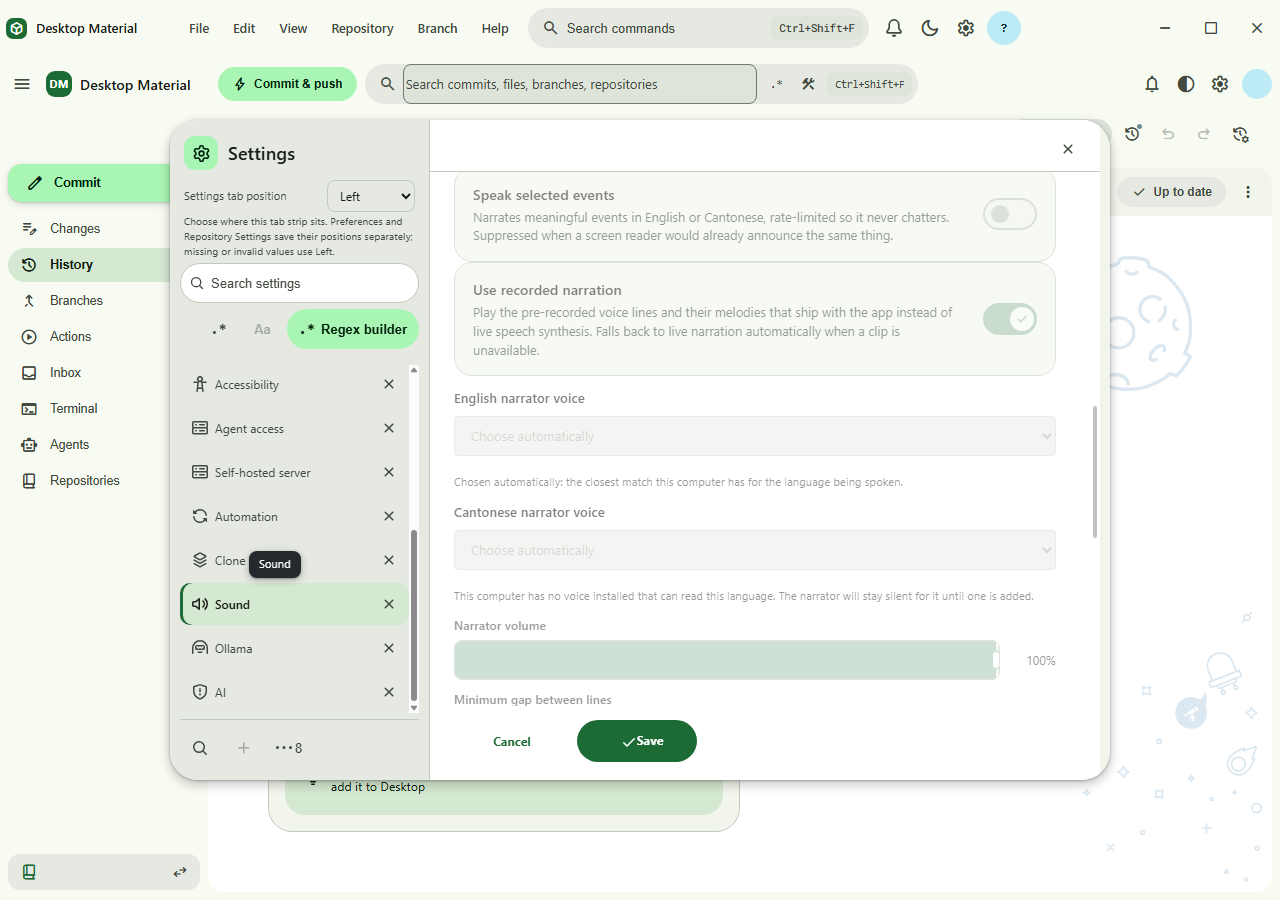
Captured from the built application through
script/capture-app.js at commit cce8632302.
The capture happens to show both states side by side: the machine it ran
on has English voices installed and no Cantonese one, so the honest
distinction between automatic and no voice available
is visible rather than merely asserted.
Which voices each side accepts
| Side | Language tags |
|---|---|
| English | en, en-* |
| Cantonese | zh, zh-*, yue,
yue-* |
Cantonese takes the whole zh family rather than only
yue because most Windows and macOS installs label their
Hong Kong voice zh-HK; a filter demanding yue
finds nothing on a machine that plainly has one.
Matching is on the whole subtag or a hyphen boundary, so
en does not swallow enm.
Offline voices sort first. A network voice that stops working on a train is a worse thing to land on by accident than a local one.
Failure modes
| Situation | Behavior |
|---|---|
| No speech synthesis at all | An empty list, and the picker is disabled with the reason stated. Not a throw — the settings screen still has to render |
getVoices() throws |
Same as above |
| Chosen voice uninstalled | Reported missing, choice kept, automatic fallback used |
| A stored value that matches nothing | Not reset; shown as missing |
| A stored value over 512 characters | Coerced to empty, i.e. automatic |
Verification
node script/test.mjs app/test/unit/narrator-voices-test.ts16 tests. Two guards verified by breaking them and watching them go
red: narrowing Cantonese to yue alone, and relaxing the
language match to a bare startsWith with no subtag
boundary.
Suggested articles
- Audio system — the narrator, sound effects and music this setting lives inside.
- Tone: per-language funny-level sliders — which styles the narrator's wording while the voice reads it.
- Personal vocabulary — the other per-language setting that changes what you hear and read.