Personal vocabulary
A local JSON file that renames the words this app shows you. Load it from Settings → Appearance → Personal vocabulary. Nothing ships with it, nothing is uploaded, and until you supply a valid file every surface renders its original wording unchanged.
一個本機 JSON 檔,可以換走呢個 app 顯示嘅字眼。 冇預設,唔會上載,未載入之前一個字都唔會變。
What it is, and what it deliberately is not
The app has opinions about what to call things. This lets you overrule them — per install, on your own machine, in a file only you have.
It is not a translation system. The three language modes already do that, and this runs after them: it renames words inside whichever language you are already reading. Nor is it a theming or scripting hook. It maps text to text, and that is the whole of its power.
No mappings ship with the app. No samples, no templates, no defaults. A built-in example would be exactly the private content this feature exists to keep out of the repository, and it would also misrepresent what the app is currently rendering.
The control
Always present, whether or not a file has ever been loaded. A control that only appears once it is in use is a control nobody finds, so there is always a file picker, always an honest statement of what is currently in effect, and — before any file exists — an explicit no vocabulary file is loaded, every surface is rendering its original wording.
The surface now uses the app's standard Material Design 3 text field and buttons. The field shows the selected file name or a cache note, the chooser opens the local file dialog, and clear returns the app to its original wording.
| State | What the control says |
|---|---|
| No file | No vocabulary file is loaded, and every surface is rendering its original wording |
| Loaded | A count of terms, and that they are held on this computer only |
| Refused | The exact reason, and that nothing has been changed |
| Unreadable | The underlying read error, and that nothing has been changed |
The status line reports a count, never the terms. The terms are the private part; the number is not.
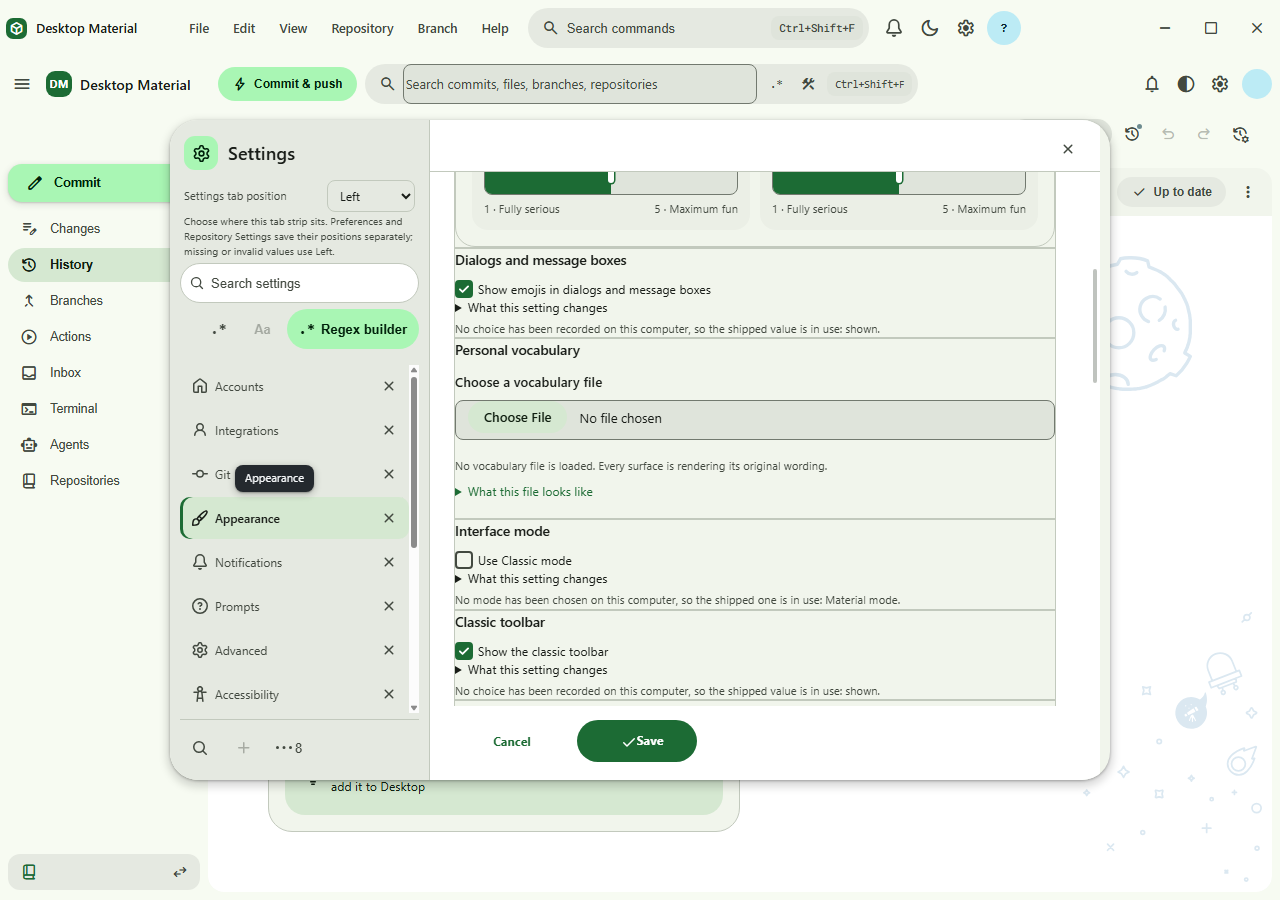
Captured from the built application through
script/capture-app.js. This is the state before any file
exists, which is the state the control has to be good at: present,
discoverable, and saying plainly that nothing has been changed.
The file
{
  "schemaVersion": 1,
  "terms": {
    "<source term>": "<replacement term>"
  }
}| Bound | Value |
|---|---|
| Schema version | Exactly 1; anything else is refused |
| File size | 1 MB |
| Entries | 2000 |
| Term length | 1–200 characters |
| Replacement length | 0–500 characters |
| Top-level fields | schemaVersion and terms, and nothing
else |
Older cached data that still uses version is tolerated
on read so existing installs keep their loaded vocabulary. New files use
schemaVersion, and that is the only accepted user-facing
file shape.
Validation
The complete byte payload is validated before anything is displayed or cached, and a refused file never applies partially. That is the rule the whole feature turns on: a half-applied vocabulary is worse than none, because you cannot tell which words on screen are yours and which are ours.
A refused file also never displaces a good one. Load something broken and the vocabulary you already had carries on working.
| Refused | Because |
|---|---|
| Empty file | Nothing to load |
| Over 1 MB | Checked against what was read from disk, before parsing |
| Not valid UTF-8 | Decoded with fatal: true, so a mangled byte is an error
rather than a silent U+FFFD substitution that parses as
something you never wrote |
| Not JSON, or not an object | A JSON array or string is not a vocabulary |
Wrong or missing schemaVersion |
Version is declared, not inferred |
No terms object |
— |
| A field this build does not recognise | An unexpected field is a rejection, not a warning: it usually means the file was written for something else |
A reserved object key (__proto__,
constructor, prototype) |
JSON.parse does not follow these, but
Object.keys still reports them, and a validator copying
blindly into a plain object is one assignment from a prototype
write |
| Any bound exceeded | Rejection, never truncation |
The refusal message never quotes a term or a replacement back. It is rendered on screen and could be read over a shoulder or land in a capture, so a message that helpfully echoes the offending term would defeat the feature.
How replacement works
Applied at translate in app/src/lib/i18n.ts
— the single boundary every piece of user-facing copy passes through.
One place, so the feature reaches every surface at once rather than
every surface having to remember it.
It runs after interpolation, so a term inside a substituted value — a branch name, a file path — is reachable too.
- Longest term first. Regex alternation takes the
first branch that matches, not the longest, so
force pushmust be tried beforepush. - Single pass. Replacing term by term would let one
replacement's output be rewritten by a later term:
{"a": "b", "b": "c"}applied toawould givec. A mapping is not a chain, and nobody wrote one. - Terms are literal. They go into a
RegExp, so they are escaped. An unescaped.would match any character, and a stray(would throw mid-render and take the surface down with it. - Compiled once per vocabulary, in a
WeakMap.translateruns for every string the app renders, and rebuilding a pattern from two thousand terms on each call is not an optimisation worth skipping.
Privacy
- Local only. No network request, at any point.
- The cache holds the validated terms; the source path is never stored.
- Nothing about the file reaches an export, a log, telemetry, a crash report, a screenshot, a local-history snapshot, or any repository.
- The cache is revalidated on every read, through the same validator as a freshly chosen file, because it outlives the release that wrote it. It fails closed to the original wording.
Legacy cache entries using version still load while they
exist, but the cache writer now stores schemaVersion so new
local data matches the current contract.
School mode
Suppressed entirely. The mode requires the vocabulary feature to
behave as though it were not installed, rather than merely disabled, so
personalize returns the text untouched and no replacement
occurs anywhere.
Failure modes
| Situation | Behavior |
|---|---|
| Storage unavailable | The vocabulary applies for this session and is not cached; the resize is never failed by a failure to persist |
| Cache corrupt or from a newer release | Revalidation refuses it and the app renders its original wording |
| A file refused | Nothing changes at all, and the previous vocabulary stays active |
| A term that is also a substring of another | The longest wins |
Verification
node script/test.mjs app/test/unit/personal-vocabulary-test.ts27 tests. Three guards were verified by breaking the thing they guard and watching them go red:
| Guard | Broken by | Result |
|---|---|---|
| Reserved keys are refused | Deleting the unsafeKeys check |
red |
| Terms are escaped before compiling | Dropping escapeForRegExp |
red |
| A pattern survives reuse | (see below) | could not be made to fail |
The third is worth recording rather than hiding. A
lastIndex reset was added to the cached pattern with a
confident comment about why it was necessary, and the test written to
prove it could not be made to fail —
String.replace with a global pattern manages
lastIndex itself. The line was removed and the comment now
says so, and the test was kept as a regression guard on reuse rather
than as proof of a reset that was never needed.
Suggested articles
- Show emojis in dialogs and message boxes — the other Appearance switch that changes presentation without changing facts.
- School mode — which suppresses this feature entirely.
- Tone: per-language funny-level sliders — what may and may not be styled in user-facing copy.