Renderer startup bundle safety
Desktop Material's Windows renderer must mount its React root before the main window is shown. A Node-oriented dependency that is concatenated into the browser bundle can fail during module evaluation, leaving the window blank before the app's normal error boundary exists.
Behavior
The Copilot SDK is loaded as a packaged external rather than
concatenated into renderer.js or
internal-browser.js. The application still loads the SDK
through Electron's existing Node-enabled renderer, while the build keeps
its Node child-process implementation out of the browser bundle. The
packaging step installs every entry in the Webpack external list into
the output dependency tree.
The build also checks both renderer bundles before packaging. A
missing bundle or the bare __webpack_module__ binding fails
the build with a direct path and does not produce an artifact that can
open to a blank window.
Configuration
app/webpack.common.tsowns the external package list. Keep the pinned@github/copilot-sdkpackage in that list when the renderer imports its runtime client.script/build.tsrunsassertRendererBundlesAreRunnableafter resources are copied and before packaging.app/test/unit/dependency-runtime-compatibility-test.tsprotects the externalization contract, whileapp/test/unit/build-copy-test.tsverifies both sides of the bundle guard.
Failure modes
ReferenceError: __webpack_module__ is not definedmeans a Node-only module wrapper escaped into a renderer bundle. Fix the dependency boundary and let the build guard fail until both bundles are clean.- A missing
resources/app/node_modules/@github/copilot-sdkmeans the package was externalized without being included bycopyDependencies. The artifact must not be shipped until the package and its declared transitive dependencies are present. - A clean static bundle check is not runtime proof. Launch the exact packaged executable, observe the real page, and check for renderer exceptions before calling startup verified.
Security considerations
The SDK remains pinned by app/package.json and is
installed from the repository's declared dependency graph.
Externalization changes where the existing Node client is loaded; it
does not grant the renderer a new provider, credential, or network path.
The existing Electron window security boundary is unchanged by this fix
and remains a separate hardening concern.
Verification
The focused contracts pass 14/14. A production
Windows build completed with GitHubDesktop.exe, both
renderer bundles, and the packaged SDK present. Both bundles contain
zero __webpack_module__ tokens. The exact executable was
launched on a hidden desktop; a CDP reload reached
readyState=complete with one populated
#desktop-app-container child and no captured runtime
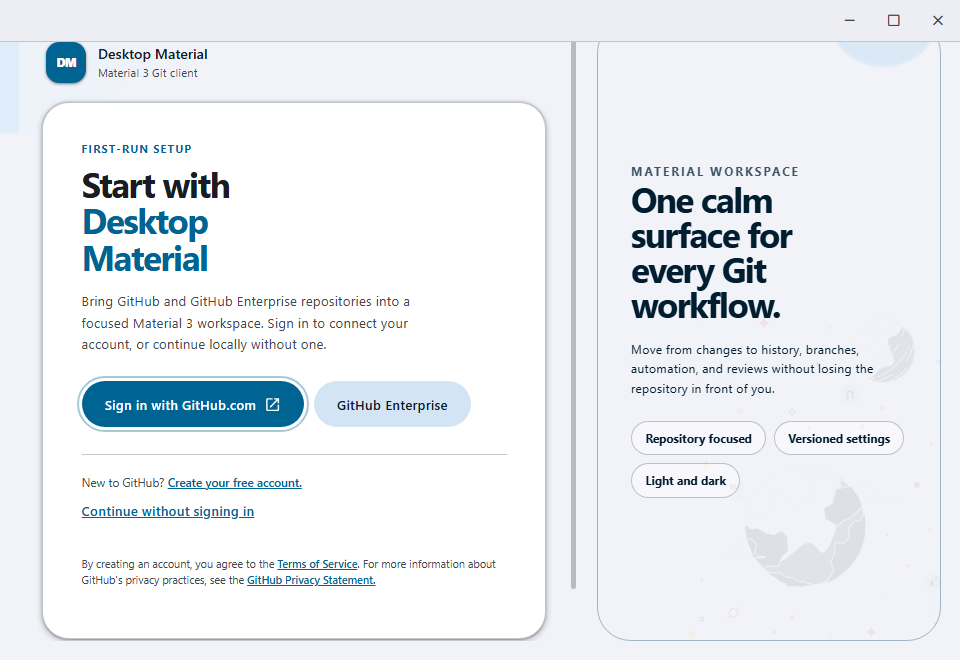
exceptions. A Lowlevel MCP capture at 960x660 shows the
first-run Desktop Material surface instead of a blank window. The
promoted evidence frame is material-blank-startup-fixed-20260806.png
with SHA-256
00D8BD6FCE0EFA10107523BF92BEA54E80DDA6ED66B8E3700B21297D6CBF2A82.
Suggested articles
- Progressive asynchronous loading — understand how startup work is staged after the shell can paint.
- Root renderer resource lifecycle — keep mounted renderer resources and subscriptions disposable.
- Supply-chain and CI hardening — preserve the dependency and release checks that protect packaged builds.