Automated update build status and release notes
Desktop Material distinguishes an available Windows update from a newer commit that GitHub Actions is still packaging. Automated GitHub Releases also explain which exact commits they contain instead of publishing only a generic build message.
Behavior
After Squirrel reports that no update is available, the renderer
derives the GitHub repository from the configured
releases/latest/download/ feed. It asks GitHub for bounded
provider data from both
ci-linux.yml/ci-windows.yml and
build-installers.yml, and shows New update coming
soon only when all of these checks pass:
- the feed is an HTTPS
github.com/<owner>/<repository>/releases/...URL; - the installed build exposes an exact 40-character
__SHA__; - either a push-triggered CI run or a
workflow_run/manual-dispatch installer run isin_progressonmainunder its exact expected workflow path; - bounded job data proves that run's exact
Windows x64build or packaging job is itselfin_progressfor the same run ID and head SHA; - the run exposes a different exact
head_sha; and - GitHub's compare endpoint reports that build SHA as
aheadof the installed SHA.
The status is in-memory remote state. It is not written to local storage. The ordinary last-successful-check timestamp remains persisted, so restart behavior stays compatible. English renders New update coming soon, playful Hong Kong Cantonese renders 新版本就快焗好出爐, and bilingual mode renders both in the shared compact format.
An updater transition generation guards every asynchronous no-update probe. If Squirrel reports a real available or downloaded release while the provider request is still running, the real updater event wins. A subsequent manual or four-hour periodic check uses the release feed normally and begins the existing download flow as soon as the release is published.
Both release lanes stamp Squirrel packages through
script/release-version.js as
<base>-z<9-letter-base-26-GitHub-run-ID>.
Execution attempts after the first append
-r<2-letter-base-26-attempt> so a rerun can publish a
fresh ordered tag without replacing the first attempt. One shared
namespace matters because the historical Super Express s…
namespace sorted above every normal b… build and could make
a newer release look like a downgrade. The z… migration
sorts above both legacy lanes, while the fixed-width alphabetic encoding
retains numeric run-ID and attempt order under lexical comparison and
cannot overflow Squirrel's legacy integer parser. Manual version
overrides are accepted only when they pass the same generated
z namespace validator.
Automated release notes
Build Installers / Express Release checks out the exact
RELEASE_TARGET_SHA with full history, then runs
script/generate-automated-release-notes.ts before the
single publish action. The generator:
- requires
HEADto equal the exact release SHA; - scans bounded published Release pages for the newest non-draft,
non-prerelease installer tag that contains
RELEASESand a full Squirrel package, ignoring Cheap LFS asset buckets, then resolves its tag to an exact commit; - requires that previous release commit to be an ancestor of the release target;
- reads at most the newest 50 commit IDs and subjects from the exact
previous..targetrange; - collapses control characters and whitespace, neutralizes Markdown, HTML, and mentions, and limits each subject to 180 characters;
- caps the complete notes at 24,000 characters and records any omitted count; and
- writes exact commit links and the visible exact range to a new
temporary file consumed by
gh release create --notes-file.
The first release has no previous tag, so it uses the exact target's reachable history with the same limits. A mismatched checkout, tag target, ancestry, provider response, Git object ID, or output bound stops publication.
Express installer release
The same workflow has two deliberately different entry paths:
- A push-triggered
CIrun on the currentmaincommit enters packaging directly. A successful CI may publish; a failed/cancelled CI may retain the installer artifact but can never publish a Release. - A
workflow_dispatchfrommainis the express recovery path. Linux lint, Windows x64 trampoline/unit/script tests, and the Windows x64 build/package job run in parallel; publication waits for all three.
The version is derived from the package version plus the workflow's
unique GitHub run ID, encoded as nine fixed-width base-26 letters in the
shared z… namespace. A rerun keeps the first-attempt tag
but uses an ordered attempt suffix from attempt two onward, so every
execution attempt has a distinct immutable tag and never replaces an
existing Release. Immediately before publication, the workflow proves
that the tag is still absent. One create-only
gh release create command publishes the installer, MSI,
Squirrel packages, RELEASES, portable ZIP, and generated
notes. It never edits or replaces an existing Release.
Automatic Express Releases are created non-latest so the shared
promotion helper can first prove the source is still current
main. Super Express publishers request Latest
after their verified assets are present. The helper then examines the
newest 100 published Windows-capable Releases — each must carry both
RELEASES and a full Squirrel package — and promotes the
greatest valid package version. A partial Linux/TUI-only Release can
still be published and documented, but it is never allowed to own the
Windows Latest feed. The helper rechecks both the same-SHA
maximum and main after promotion, reconciling an
overlapping higher release or demoting a newly stale candidate. Thus an
older job can finish independently without moving the update feed
backward or replacing it with a 404-producing partial release.
The packaging job uploads the verified installer directory as an uncompressed, three-day Actions artifact before release-note generation, then preserves the notes separately. A failed CI, notes error, tag race, or GitHub Release failure therefore leaves the exact installer payload downloadable from that workflow run for manual recovery whenever the Windows build/package itself succeeded.
Windows jobs restore an exact-content cache of the installed root and
app node_modules trees plus Playwright's external FFmpeg
payload. Its key includes operating system, runner and target
architecture, Node/Python versions, both lockfiles and package
manifests, install configuration, the post-install, environment-setup,
and tool-bootstrap actions, pinned Yarn, and local native-vendor
sources. A hit must contain reviewed generic, target-specific Copilot,
Electron-runtime, React JSX-runtime, react-confetti, and
Playwright sentinels. If a hit is incomplete, the setup action records
the missing paths and reruns the bounded dependency install
automatically rather than handing the broken cache to webpack. Legacy
installed-deps-v5 and installed-deps-v4 caches
can warm a self-hosted Windows miss, but neither is treated as exact and
the current lockfiles still drive installation. The cross-compilation
Copilot install restores app/package.json and
app/yarn.lock before the exact cache key is computed,
preventing a post-install manifest from making the saved cache
unreachable. Self-hosted keys include the runner identity and selected
Visual Studio/MSVC, ClangCL, and Windows SDK fingerprint; dependency
installs use yarn --frozen-lockfile. Python setup remains
unconditional for native builds. Build output, dist,
installers, Release assets, credentials, and runtime configuration are
never cached.
The hosted Windows packaged-E2E lane launches the Squirrel installer
without PowerShell's descendant-inclusive
Start-Process -Wait. It waits at most 300 seconds for
Setup.exe itself and terminates that process tree on
timeout. A scoped cleanup records the pre-existing
GitHubDesktop process IDs and the installer session, then
repeatedly stops only newly launched processes from that session while
Squirrel finishes writing the exact-version executable. This prevents
the launched application from holding the installer step open without
terminating an unrelated process that was already running.
Workflow concurrency
Automatic Linux/Windows CI uses GitHub-hosted runners. Ordinary
Windows CI keeps an explicit cloud or
self-hosted choice for a protected-main manual dispatch;
pushes, pull requests, and reusable calls cannot select the local pool.
The Windows test/package jobs in
Build Installers / Express Release use the fixed
project-labelled self-hosted pool, while the release workflow retains
its unique run-ID/run-attempt concurrency group with
cancel-in-progress: false. Every eligible completion
therefore keeps its own publication opportunity. Pages publication
retains the same non-cancelling run-and-attempt contract.
Only the self-hosted Super Express release family uses ref-scoped cancellation, so a newer emergency dispatch can release a scarce local runner from an obsolete release. Source-contract tests enforce the approved self-hosted job inventory and reject an unapproved local-runner declaration. Workflows without a concurrency group, including CodeQL, remain independently runnable.
Super Express release
.github/workflows/super-express-release.yml is a
separate, manual-only emergency dispatcher. Dispatching it from
main checks the exact commit and tag once, then runs two
inline packaging lanes in parallel. Every job in this dispatcher is
self-hosted-only: the coordinator and publisher use the registered Linux
x64 WSL runner, while the desktop package uses the registered Windows
x64 runner. If either runner is offline or busy, the run queues or
fails; it never moves to a GitHub-hosted machine.
.github/workflows/super-express-release-windows.ymlrestores the exact desktop dependency cache and builds the Windows x64 production package on[self-hosted, Windows, X64, desktop-material-windows-local], then publishes its verified artifact on that same exact Windows pool;.github/workflows/super-express-release-linux-tui.ymlbuilds the Linux TUI wheel, source distribution, locked runtime constraints, bootstrap, and installer on[self-hosted, Linux, X64].
The combined dispatcher and both packaging lanes have no cloud
fallback: static runner labels make their placement visible during
workflow planning and ensure the builds do not accidentally expose
source to a different machine. The direct Windows publisher stays on
[self-hosted, Windows, X64, desktop-material-windows-local]
for artifact download, line counting, signature-state verification, and
GitHub API operations. If that runner is offline or busy, the release
queues or fails rather than escaping to a hosted runner. It still uses
the RELEASE_TOKEN, ORG_TOKEN, then
GITHUB_TOKEN authorization chain; the token never chooses a
runner.
The combined dispatcher keeps its packaging jobs inline because GitHub had previously rejected the caller before creating any job when the runner labels were generated dynamically. The direct Linux reusable workflow remains packaging-only on its static self-hosted target. The Windows reusable call is also packaging-only; only its manual dispatch path enables the self-hosted publisher.
The Linux TUI action installs the pinned uv tool first
and runs uv python install 3.12; this avoids relying on
actions/setup-python's distribution manifest, which does
not list Python 3.12 for Debian 13 on the registered WSL runner. Version
discovery runs through uv run --python 3.12, so the wheel,
source distribution, and runtime constraints use the same managed
interpreter.
The Windows self-hosted actions run a PowerShell bootstrap before any
shell: bash step. Each PowerShell step uses an explicit,
per-process -NoProfile -ExecutionPolicy Bypass invocation;
the machine execution policy is not changed. The bootstrap reuses an
installed git.exe and matching Git Bash when they work. On
a cold host it downloads pinned PortableGit 2.53.0.3 from
the canonical Git for Windows release, verifies the committed SHA-256
value, and extracts it below RUNNER_TOOL_CACHE. It then
prepends the exact Git and Bash directories through
GITHUB_PATH, so the deprecated Windows WSL launcher cannot
be selected accidentally.
Self-hosted Windows setup also avoids the hosted toolcache installer
for the native-module Python dependency: pinned uv installs
Python 3.11 locally and the action exports the interpreter returned by
uv python find 3.11 as npm_config_python.
GitHub-hosted and non-Windows runners retain
actions/setup-python@v6.
Before actions/setup-node@v6 asks Yarn for its cache
directory, the same self-hosted Windows path runs bootstrap-pinned-yarn.ps1.
That script creates a runner-temporary yarn.cmd shim for
Windows actions and an executable yarn shim for Git Bash
steps; both call the repository-pinned
vendor/yarn-1.21.1.js through the runner's existing
Node.js. It adds both the Windows directory and its /c/...
Git Bash form through GITHUB_PATH, so
setup-node and later shell: bash commands
resolve the same runtime. Nothing is installed globally, committed, or
reused outside the job. This repairs a bare registered runner where Node
is present but Yarn is not, while keeping the lockfile's declared Yarn
runtime authoritative. If Node, Git Bash, or the vendored runtime is
missing, the preflight fails with the exact prerequisite instead of
letting a later step emit the less useful
yarn: command not found message.
The direct Windows publisher also bootstraps its release clients. It
reuses or installs checksum-verified GitHub CLI 2.97.0 and
jq 1.7.1 beneath versioned
RUNNER_TOOL_CACHE paths. PortableGit supplies
curl, sha256sum, and unzip for
those canonical downloads. A cache hit skips the download; a missing
published checksum, mismatch, extraction error, or missing executable
stops publication before a tag or Release is created.
Each packaging lane also exposes its own
workflow_dispatch action. A direct Windows dispatch accepts
an optional exact main SHA and Squirrel version; a direct
Linux TUI dispatch accepts an optional exact main SHA.
Blank inputs use the dispatched commit and derive the Windows version
from the run ID plus execution attempt. The Windows direct lane uploads
its verified artifact and publishes a standalone immutable Windows x64
Release marked Latest after its verified assets are
available. The Linux direct lane remains artifact-only. The reusable
workflow_call entry point for the Windows lane is also
artifact-only, so the combined dispatcher still has one publisher for
one complete cross-platform Release.
All Windows packages are permanently unsigned. Packaging disables
certificate auto-discovery, clears Windows signing and Azure identity
inputs, and verifies that both the setup executable and MSI report
NotSigned before upload and again after the direct
publisher downloads the artifact. Release notes warn that Windows may
show SmartScreen or an unknown-publisher prompt. A signature or signer
invocation fails the lane; there is no credential fallback.
The Windows lane runs the repository's complete script-contract suite after dependency setup and before it mutates the package version or starts the production build. A stale generated catalog, unsafe release contract, or other script failure therefore creates no release. The emergency lane still omits unit, TUI, lint, type, parity, smoke, trampoline, and packaged E2E tests, while the Linux TUI package lane remains packaging-only. Both lanes omit history-generated release notes. Ordinary CI and tested Express Release remain the comprehensive release gates.
The direct lanes still fail closed around their produced content.
They require the exact dispatched commit, use the same validated run-ID
package version as the automatic lane, reject an existing tag, and
require every Windows and TUI asset to be non-empty. The Windows direct
publisher downloads its lane artifact, writes a local note from the
exact checked-out commit subject/body, creates a uniquely tagged
non-Latest Windows-only Release, writes and verifies exact workflow
timing, and only then reconciles Latest. A same-job failure removes the
captured release ID and exact new tag before restoring the previous
Latest selection. The write-capable token is present only on
authenticated API steps. Both package and publication run on the exact
[self-hosted, Windows, X64, desktop-material-windows-local]
pool. The combined publisher downloads both lane artifacts, writes a
local note from the exact checked-out commit subject/body, and creates
one complete Release. Keeping the combined publisher as the only
cross-platform publisher preserves both the Squirrel update feed and the
TUI bootstrap URL; two independent cross-platform Releases would make
the shared latest redirect point at an incomplete payload.
Every lane artifact remains uncompressed for seven days. The combined
dispatch publish checkbox defaults on but can be cleared to
build recovery artifacts without creating its combined Release.
Published Super Express Releases use the same current-main and
highest-same-SHA promotion helper as automatic Releases.
The Super Express workflow family uses ref-scoped concurrency with
cancel-in-progress: true. A newer dispatch on the same ref
replaces an older self-hosted packaging run, while independent refs
retain separate groups. Tags and Releases are immutable: a same-tag race
has one winner, and later attempts fail without replacing it.
Downgrade guard
Squirrel installs whichever entry a RELEASES manifest
ranks highest. It never compares that entry to the version already
running, so a manifest that regresses reads to it as an ordinary update
and moves the whole install base backwards. Two independent guards close
that path.
The published manifest is bounded at its source. Both release lanes
pipe dist/RELEASES through
node script/release-version.js filter "$RELEASE_VERSION"
before anything is copied into the release payload, and the package-copy
loop reads the filtered manifest rather than the raw one. Only entries
naming the GitHubDesktop package at exactly the version
being built survive; a foreign package, a leftover lower lane, or an
unreadable line fails the release instead of publishing a feed nobody
vetted. Because the copy loop reconstructs any package file the manifest
names, filtering first also prevents a stale entry from conjuring a
mislabelled published asset.
The app checks before it hands the feed over.
app/src/lib/update-version-order.ts reproduces Squirrel's
legacy NuGet ordering — a four-part numeric core, then the prerelease
label compared case-insensitively as one whole string, with a missing
prerelease outranking a present one — and probeUpdateFeed
fetches the feed's RELEASES and judges its highest entry
against app.getVersion(). Only a downgrade
verdict is acted on: AppWindow.checkForUpdates then reports
the ordinary no-update state instead of calling
autoUpdater.checkForUpdates(). An unreachable feed, an
oversized or undecodable body, a response that is not a manifest for
this package, and an unreadable running version all return
indeterminate, so the guard never blocks an update check it
could not actually evaluate.
Only the update feed is guarded. The release promoter also refuses to
select a published release without the RELEASES manifest
and a full Squirrel package, because GitHub's
releases/latest/download/ path is an asset lookup rather
than a release-directory listing. This keeps a valid older Windows feed
active when a newer release contains only the Linux/TUI payload. A
Squirrel bootstrapper invoked as
Setup.exe --install . --checkInstall reads its own bundled
RELEASES from %LOCALAPPDATA%\SquirrelTemp,
logs First run, starting from scratch, and applies whatever
version it carries without consulting the installed
app-<version> folders at all. Re-running a stale
downloaded installer therefore still replaces a newer install with the
older build it contains. That is Squirrel's installer path, outside the
app and outside the feed; delete superseded
GitHubDesktopSetup-x64.exe downloads rather than relying on
the updater to undo them.
Configuration
DESKTOP_UPDATES_URLcan replace the complete update endpoint. Coming-soon detection intentionally disables itself for custom or non-GitHub hosts.DESKTOP_UPDATES_REPOselects the GitHubowner/repositoryused by the default release feed.- The runtime provider contract expects the active workflow files to
remain
.github/workflows/ci-windows.yml,.github/workflows/build-installers.yml, and the three Super Express workflow files. - The release-note step receives
GITHUB_TOKENthrough its environment. It is never accepted as a command-line value or written to the notes. This applies to the tested Express path; Super Express deliberately uses only local Git metadata from the checked-out commit. - Manual express release must be dispatched from
main. A failed CI conclusion permits package-only recovery but blocks publication. A wrong/stale CI trigger, stale dispatch SHA, existing tag, or changed default-branch tip stops before publication. - Super Express Release must also be dispatched from
main. Its Windows lane runsyarn test:scriptbefore build and publication, then deliberately omits unit, TUI, lint, type, parity, smoke, trampoline, packaged E2E, and history-note generation. Use it only when that bounded emergency path is the explicit operator choice. Clearing itspublishinput retains artifacts without creating a Release. - Release run IDs must be positive decimal values of at most 12
digits, and execution attempts must be positive decimal values
representable by the two-letter base-26 attempt suffix (at most 675).
The shared generator converts run IDs to a nine-letter base-26 payload,
rejects a stable base without a prerelease channel, malformed versions,
and a NuGet special-version label over 20 characters. Manual overrides
must also remain in the generated
znamespace for the checked-out base version.
Failure modes and security
Network, rate-limit, malformed-response, oversized-response, non-GitHub-feed, invalid-SHA, non-main, wrong-workflow/event, non-running, stale, behind, and diverged results all fail closed to the ordinary no-update state. The probe reads at most 256 KiB per provider response and times out after ten seconds. It never grants an update or downloads executable content; only Squirrel's existing feed can do that.
The historical normal b… and Super Express
s… version namespaces were not cross-lane monotonic. A
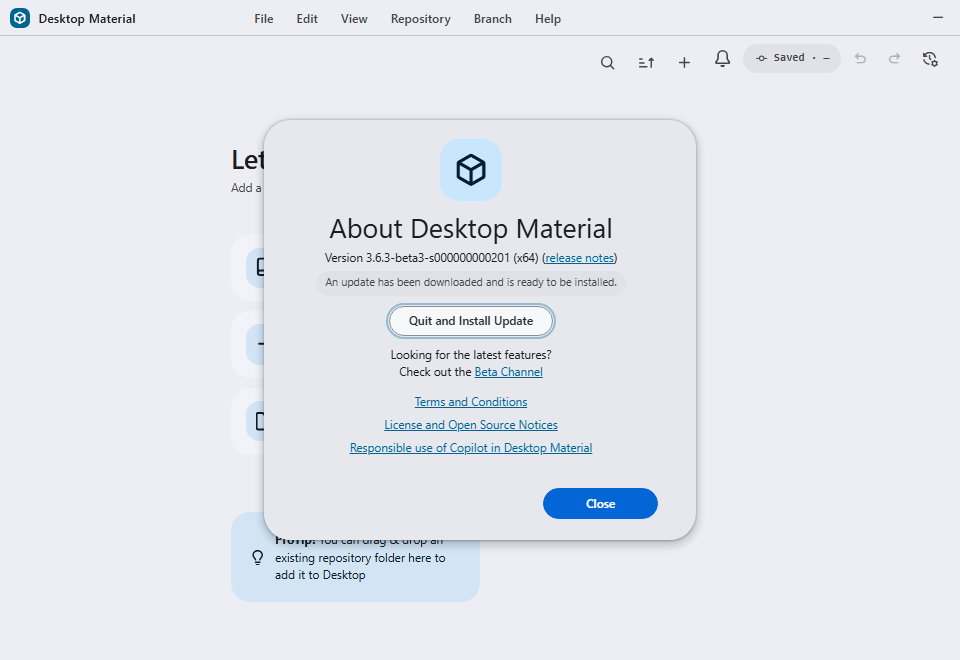
machine on 3.6.3-beta3-s000000000201, for example,
correctly treated later 3.6.3-beta3-b0000040887 as older
and displayed the ordinary no-update state. The shared z…
namespace is the migration floor for those installations. Package
generation fails rather than emitting a version that cannot be ordered
safely.
The run ID must not be embedded as one long decimal tail. The
Squirrel/NuGet comparer shipped with installed builds parses that tail
as a 32-bit integer; a current 11-digit GitHub run ID raises
OverflowException before an update can be selected. The
letter-only base-26 payload carries the same ordering without any
numeric prerelease token. Packaged updater E2E exercises this exact
path.
Commit subjects and release metadata are untrusted. The generator
invokes Git without a shell, validates tag refs and object IDs, bounds
subprocess output, neutralizes active Markdown/HTML/mention syntax, and
uses create-new output-file semantics. Release discovery reads at most
twenty five-release pages and caps each response at 8 MiB; the larger
per-page byte bound accommodates the asset metadata from full
1,000-object Cheap LFS buckets without retaining an unbounded response.
After notes generation, the workflow immediately revalidates
origin/main and immutable tag absence before publishing the
same RELEASE_TARGET_SHA as the release target.
Super Express does not call the history-aware generator. Its note
comes from git show against the already verified
RELEASE_TARGET_SHA, avoiding an API or token-dependent
metadata failure while retaining the dispatched commit subject and
body.
An invalid dependency cache fails instead of silently installing into a mixed tree. Cache misses perform the normal bounded install retries and save only after a successful job. Release creation is intentionally non-idempotent: a same-tag race has one winner and every later contender fails without changing the winner. Latest promotion is a separate, source-revalidated operation; it selects the greatest valid same-source version and never overwrites Release assets or tags.
Verification
The partial-Release regression guard landed in commit
a4ce485037138f24d7534452a861a1fb7749beeb. The focused
version-order, CI-workflow-safety, and automated-release-notes suites
pass 29/29. On 2026-08-05 the live Latest
alias was repaired to the existing Windows-capable Release
v3.6.3-beta3-zadwftypqg; the exact
releases/latest/download/RELEASES URL returned HTTP 200 and
served the Squirrel manifest. The required Cheap headless production
build ended before renderer output was emitted, so no About-dialog
screenshot is presented as runtime evidence for this regression.
Focused acceptance covers safe feed parsing, bounded Actions data,
exact CI/installer job/run/SHA binding, ahead-of comparison,
manual-dispatch and malformed/stale fail-closed behavior, transient
storage, the updater-event race, all three language modes,
non-cancelling independent CI/installer/Pages runs, the protected
Windows manual runner selector, pull-request CI, workflow wiring, exact
Git range collection, subject sanitization, output limits, and
first-release handling. The app and script TypeScript projects, targeted
formatting/lint, workflow YAML, express-path gates, create-only
publication, retained artifacts, and exact dependency-cache keys are
also checked locally. The Super Express source contract additionally
proves manual-only triggering, exact-SHA packaging,
unit/script-before-build ordering, omitted lint/E2E/history paths,
ref-scoped cancellation, retained artifacts, self-hosted packaging and
publication placement, the permanent NotSigned checks,
immutable tag checks, unique non-draft Latest publication, and exact
release targeting. The focused source contract enforces the exact
Windows project label on both direct jobs. Remote run
31126843395 verified the package and the older fallback
release v3.6.3-beta3-zadwtuvqil verified the six published
Windows assets, but both predate the Windows-hosted publisher placement
and permanent unsigned contract. A future direct run must verify the
complete self-hosted build-and-publish path itself. Downgrade-guard
tests use the real observed strings — 3.6.2,
3.6.3-beta3-b0000040888,
3.6.3-beta3-s000000000401,
3.6.3-beta3-zadtjbevjx,
3.6.3-beta3-zadtofsepy, 3.6.3-beta3-zadtorqoxa
— and the live manifest line the feed actually served. They prove the
app comparer agrees with script/release-version.js across
every lane, that a 3.6.3 prerelease outranks stable
3.6.2 in both that comparer and semver, that a
mixed manifest is judged by the entry Squirrel would install, that
manifest filtering drops foreign packages and lower lanes while keeping
the matching delta, and that the feed probe fails open on network, HTTP,
and non-manifest responses. Release-version tests cover the exact legacy
s… versus b… failure, fixed-width alphabetic
z… ordering, distinct ordered rerun attempts, manual
namespace validation, malformed/overflow rejection, and out-of-order
same-SHA selection.
Remote and installed acceptance is complete. Exact-source CI
29977738533 and installer
run 29978844761 published the six-asset exact-target
Release v3.6.3-beta3-zadtberjmv.
A live legacy s000000000201 installation automatically
selected, downloaded, applied, and subsequently reported that alphabetic
z version. Successful Super
Express run 29980281736 then published greater same-SHA
Release v3.6.3-beta3-zadtbhvdfc,
which the legacy UI visibly downloaded and exposed as ready to
install.
Current-source UI acceptance is also published as a separate frame.
Runtime source b069384ad7d8a65d1192ee06859a705fe484c9c8
reached the ready state through the real Electron/Squirrel event path
using a disclosed verifier-owned inert payload. Promotion
e3967f1b81ec039624500797dca40a1ab6d98598 records the
inspected 960×660, 47,086-byte PNG with SHA-256
0fc9caf5b13eb5b914121090f403c394545e02ea4303b11dd4598afcb3a2dfca.
This development proof does not claim that the inert payload was
published.
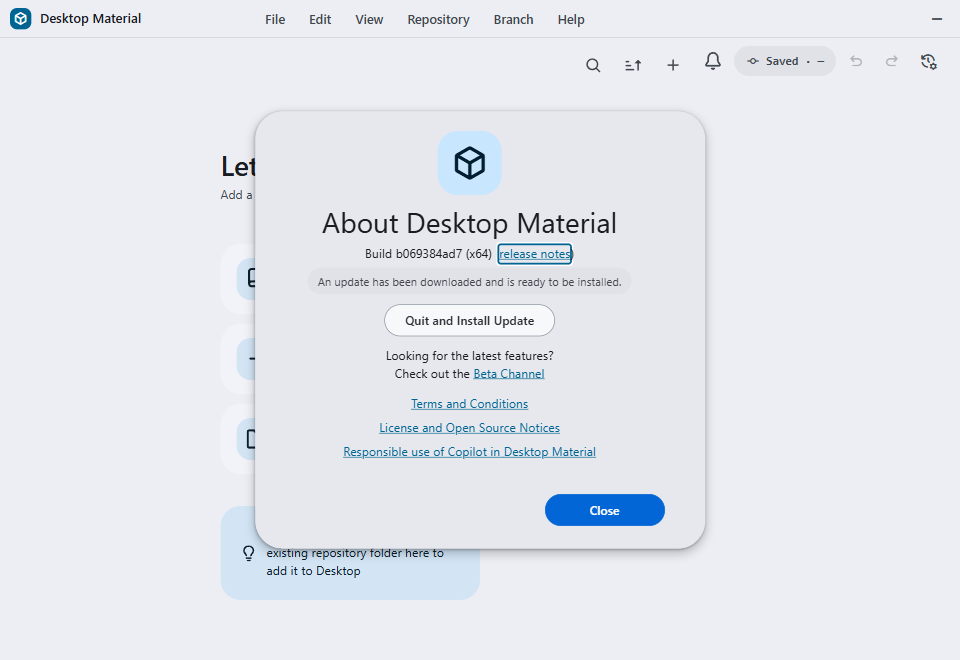
目前原始碼開發版畫面已驗收:驗證器自有、已披露嘅無害 payload 行過真 Electron/Squirrel 路徑;呢張圖唔代表嗰個 payload 已發佈。
The following immutable image remains the separate legacy Super Express migration record: